Sermon: “Following Jesus: I Will Hold the Christ Light for You” (Matthew 4:12-23) [1/22/17]

Last week, we launched our new worship theme of “Following Jesus.”  The theme comes from the book of Matthew, our focus Gospel this year.  Matthew is pretty much a how-to manual for following Jesus.  The guidebook within the guidebook is the Sermon on the Mount, Matthew 5 – 7.  We’ll start looking at that next week.  (You might like to start reading up, hint, hint. J)

Last week, we considered the first step of following Jesus—being called….responding to a deep yearning to do something in the world.  We talked about call in terms of using our original medicine to heal the world or, as Presbyterian minister and author Frederick Buechner identifies it:  We find our calling at the intersection of where “our deep gladness meets the world’s deep need.”  From what I hear, our youth worked with Buechner’s quote at the Winter Youth Retreat last weekend.  We look forward to hearing what you learned!

Calling is crucial to the life of faith.  Determining what brings us joy and figuring out how to do that joyful thing to meet the world’s deep need…That’s the critical first step in following Jesus.  What’s the second?

Last week, we heard John’s take on Jesus’ calling a couple of disciples.  Matthew’s take is a little different.

Matthew is sometimes called “The Jewish Gospel.”  It likely was written about 40 years after Jesus’ death to convince Jews that Jesus of Nazareth was the Messiah they’d been waiting for.  As we journey through Matthew this year, we’ll see lots of things that would appeal to people raised in the Jewish faith.  The book is divided into five sections, which some scholars say intentionally corresponds to the five books of Torah.  There’s a verse in Leviticus about the need for two witnesses to confirm any event or ritual.  At points, Matthew’s need for two witnesses gets pretty amusing.  Stay tuned for Holy Week for that one.  J  Also in the Gospel of Matthew, Jesus is portrayed as a Moses figure.  The Sermon on the Mount could well be a parallel to Moses going up Mt. Sinai to get the law…which makes the Sermon on the Mount the new law, right?  We’ll look more at that next week.  (Hint, hint.  J)

As the “Jewish Gospel,” Matthew quotes a lot from the Hebrew Scriptures.  That’s what happens in today’s passage.  It begins with Jesus leaving Nazareth and moving to Capernaum on the northwest coast of the Sea of Galilee.  Matthew calls the area, “the territory of Zebulun and Naphtali.”  What are Zebulun and Naphtali?  They’re how the prophet Isaiah referred to the location of Capernaum (several centuries before it was Capernaum), when he described the Messiah or savior.  What will this savior do in “the land of Zebulun and Naphtali, on the road by the sea, across the Jordan, Galilee of the gentiles?  The people who sat in darkness have seen a great light, and for those who sat in the shadow of death, light has dawned.”

So when Matthew quoted these familiar words of the prophet Isaiah–that the Messiah would bring light to people sitting in darkness in the land of Zebulun and Naphtali–Jews hearing them in reference to Jesus would have gotten the point:  Jesus of Nazareth is the Messiah and his main job is bringing light to places of darkness.

So maybe that’s our second step in following Jesus—Perhaps we are to follow him by also taking light to dark places…which sounds like a terrific thing to do.  But how do we do it?  How did Jesus bring light to those sitting in darkness?  Let’s see what happens next.

Matthew tells us that Jesus moves to Capernaum, then…goes for a walk by the lake.  While walking along the shore, he sees brothers Andrew and Simon fishing.  (See?  Two witnesses. J)  “Follow me and I will make you fish for people,” Jesus says.  They do.  Then he sees two more brothers—James and John; they’re on shore mending nets with their father.  (Two more witnesses.  So, now he’s got two sets of two witnesses…. just to be sure. J)  Jesus calls James and John and, like Andrew and Peter, they immediately drop everything and follow Jesus.

Follow him where?  Once he’s gathered his double set of double witnesses, Jesus goes “throughout Galilee, teaching in their synagogues and proclaiming the good news of the kindom and curing every disease and sickness among the people.”  “Bringing light to those sitting in darkness,” is an inspiring big-picture idea, but it doesn’t really tell us how to do it.  Hearing what Jesus did after collecting a few disciples makes things more concrete.  He teaches, he preaches, he heals…  It is in doing these things that he brings light to those sitting in darkness.

Timmy Williams was sitting in darkness—literally.  Struggling with AIDS and unable to work, his lights had been cut off.  Like many people who live on the margins and without support systems, Timmy also spent a lot of time at the ER.

In looking more closely at so-called “super utilizers” of ERs like Timmy, doctors and social workers discovered that many patients with complex medical issues “frequently turn to emergency rooms for problems better handled by primary care doctors and social workers.”

The news show I got this from noted that “super-utilizers make up just 5 percent of the U.S. population, but they account for 50 percent of health care spending.  As health care costs continue to rise, providers are trying to find these patients and get to the root of their problems.”

Timmy Williams was one of the people Houston social workers, Dayna Gurley and Bill Nice visited.  “Timmy was dying when they found him.  He was holed up at home and reeling from untreated HIV that had progressed to AIDS.  He couldn’t take care of his young son, and cycled through Houston’s hospitals.”  He was hard to engage, wasn’t taking any of his medicines, and had gotten very skinny.

“Gurley arranged for a home aide to care for Williams seven days a week, got his apartment cleaned, and the lights turned back on.  Now Williams’ HIV is undetectable and his health– and life– have been steadied.  He’s now healthy enough to make his way around the city on his own.  He says Gurley did more than rescue him from his darkest days.  At home now with his son, his illness no longer gets in the way of being the father he wants to be.”  The clip from the news show ends with Timmy and his young son sitting at the kitchen table while Timmy listens to his son read.  Because the social workers brought light to him in his time of darkness, he’s now able to share that light with his son.

The program has been extremely successful.  Patients in the first study reduced their visits to the ER by 70%.  Monthly costs to hospitals plummeted from $1.2 million/month to $500,000 per month….all because people—social workers, fire fighters, EMTs, doctors and nurses—took light to people who were sitting in darkness.  (PBS NewsHour, 1/17/17)

It’s the season of epiphany, the season of light.  We’ve heard about light in every worship service since Christmas Eve.  John’s Gospel begins with talk of the “light coming into the world.”  We heard that text both Christmas Eve and Christmas Day.  If you tuned into our snow day worship on January 8, you heard the sermon end with this line:  “What if you are someone’s epiphany?”  What if you are the one who reveals God to someone?  What if you are the one who can en-lighten another person’s world and circumstances?  “The people who sit in darkness have seen a great light.”  What if that light is you?

I’m not sure how many times I’ve read this quote in recent weeks…I promise to stop reading it soon…sometime after today.

The quote comes from L. R. Knost and is about the best quote for Epiphany I’ve found.  She writes:  “Do not be dismayed by the brokenness of the world.  All things break.  And all things can be mended.  Not with time, but with intention.  So go.  Love intentionally, extravagantly, unconditionally.  The broken world waits in darkness for the light that is you.”  The broken world waits in darkness for the light that is you.

(Sing)  “I will hold the Christ light for you in the nighttime of your fear.  I will hold my hand out to you, speak the peace you long to hear.”


In the name of our God, who creates us, redeems us, sustains us, and hopes for our wholeness.  Amen.

Kimberleigh Buchanan  ©2017


Posted in Uncategorized | Leave a comment

Sermon: 2017 Theme: Following Jesus (John 1:29-42) [January 15, 2017]


Our theme for 2017 is “Following Jesus.”  Sounds like something we Christians—literally, “little Christs”–should be doing, right?  You bet!  Just show us where to start!

Where do we start?  Today’s story from John suggests following Jesus begins with a call.

John was called to preach in the wilderness and prepare a way for the Messiah.  When Jesus (aka, Messiah) comes on the scene, he calls on John to baptize him.  The next day, when Jesus passes by, John exclaims to a couple of his (John’s) disciples:  “Look, here is the lamb of God!”…at which point, the disciples feel called to drop everything and follow Jesus.

Sensing his stalkers, Jesus turns and asks, “What are you looking for?”  They ask where he’s staying.  Jesus says, “Come and see.”  They follow Jesus to the house where he’s staying and hang with him a while.  Late in the afternoon one of the disciples–Andrew—feels called to go get his brother Simon and bring him to Jesus.

Calling.  John felt called preach and baptize.  Andrew and John’s other disciple felt called to drop everything and follow Jesus.  After spending time with Jesus, Andrew felt called to go share the good news with his brother, Simon.

Calling.  What is it, exactly, and what does it have to do with us?  I’ve heard many of you use the word “calling” to describe your life’s work–teaching, law enforcement, nursing, parenting, working with the differently-abled.  But what does it mean to feel called?  Based on what I’ve heard from you, it’s a feeling of fully inhabiting your own skin, a profound sense of “fit” between who you are and what you do.  Last week, we heard about what many indigenous cultures refer to as our “original medicine,” the individual gifts and talents that make us uniquely us.  When we use our original medicine to help heal the world, that’s a sign that we have found our true calling.

I suspect that’s what was going on with John the Baptist and Andrew—so seized were they by the certainty that they should follow Jesus, so taken were they with his teaching, his personality, his authenticity, they could choose no other path.  So, they followed.

Two millennia later, another person found himself so seized by a yearning to follow Jesus that he, too, could choose no other path.  In the 1930s when the Nazi regime began taking over the country and its churches, German theologian Dietrich Bonhoeffer spoke out.  He kept speaking out until his execution in 1944, in part, for his role in a plot to kill Adolph Hitler.

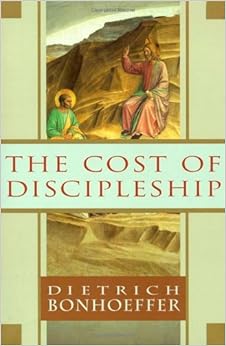
The best known of Bonhoeffer’s books is The Cost of Discipleship.  Even 80 years later, it’s still the quintessential work dealing with what it means to be a disciple of Jesus.  It also gives some insight into why Bonhoeffer took the stands he took and did the things he did during the war.  For that reason, Bonhoeffer will be one of our conversation partners this year as we focus on discipleship.  If anyone ever wrestled with what it means to follow Jesus, it was Dietrich Bonhoeffer.

Before delving into his writings, though, it will be helpful to hear about Bonhoeffer’s 9-month stay in this country, especially as we celebrate the life and work of Dr. Martin Luther King, Jr.  Bored with his classes at Union Seminary in New York and disappointed with the preaching at the white churches he’d attended in Manhattan, Bonhoeffer’s true education in our country began when fellow Union student, Frank Fisher—an African American from Alabama—invited Dietrich to attend a worship service at his church in Harlem, Abyssinian Baptist Church.  The experience transformed Dietrich.

In Abyssinian’s pastor, Adam Clayton Powell, Sr., Dietrich found a preacher who “combined the fire of a revivalist preacher with great intellect and social vision.”  (2222)  The faith Bonhoeffer observed and experienced at Abyssinian was passionate and tied directly to the social context of worshipers.  Dietrich remained at Abyssinian for the rest of his time in New York.  He worshiped there every Sunday, taught a Sunday school class of boys, participated in groups within the church, and spent time in members’ homes.

An accomplished musician, Bonhoeffer was especially moved by the music at Abyssinian.  So taken was he with African American spirituals, he scoured the record stores in Harlem for recordings.  He took the recordings back to Germany and shared them with his theology students.  “They remained some of his most treasured possessions.”

Thanksgiving break 1930 Bonhoeffer traveled to Washington, D.C., with Frank.  The trip gave Dietrich a glimpse of the racial situation in America that few whites had seen.  In a letter home, Bonhoeffer wrote (Note:  his language reflects the language of the times.):  “In Washington I lived completely among the Negroes and through the students [became] acquainted with all the leading figures of the negro movement.  I was in their homes, and had extraordinarily interesting discussions with them….The conditions are really rather unbelievable.  Not just separate railway cars, tramways, and buses south of Washington, but also for example, when I wanted to eat in a small restaurant with a Negro, I was refused service.”  (2248)

In a letter to his older brother, Karl-Friedrich, Bonhoeffer wrote:  “I was to have a look at church conditions in the South…and get to know the situation of the Negroes in a bit more detail.  I don’t quite know whether I have spent too much time on this question here, especially since we don’t really have an analogous situation in Germany…(Remember, this was 1930)  It does seem to me that there is a real movement forming, and I do believe that the negroes will still give the whites here considerably more than merely their folk-songs.”  (2248)

Karl-Friedrich, who earlier had spent some time in the U.S., wrote back:  “I had the impression when I was over there that [racism] is really THE problem.”  In fact, he told Dietrich, he had declined an offer to teach at Harvard out of fear that “living permanently in America could somehow taint him and his future children as part of ‘that legacy.’  Like his younger brother, Karl-Friedrich didn’t see an analogous situation in Germany at that time.  He even suggested that “our Jewish question is a joke by comparison; there won’t be many people who claim they are oppressed here [in Germany].’”  (2258)

From our perspective, the brothers’ lack of foresight seems laughably naïve.  Bonhoeffer’s biographer, Eric Metaxes, reminds us, though, that they had grown up “in a neighborhood of academic and cultural elites, a third of whom were Jewish.  They had never seen or heard of anything comparable to what they discovered in America, where blacks were treated like second-class citizens and had an existence wholly separated from their white contemporaries.

“What Bonhoeffer soon saw in the South was more grievous still.  The comparison was more difficult because in Germany, Jews had economic parity, while in America, blacks certainly did not.  In terms of influence, German Jews held top positions in every sphere of society, something far from the situation among blacks in America.  And in 1930 and 31, no one could imagine how the German situation would deteriorate within a few years.”  (2267)

In another letter to Karl-Friedrich, Dietrich wrote:  “The separation of whites from blacks in the southern states really does make a rather shameful impression… The way the southerners talk about the negroes is simply repugnant, and in this regard the pastors are no better than the others.  I still believe that the spiritual songs of the southern negroes represent some of the greatest artistic achievements in America.  It is a bit unnerving that in a country with so inordinately many slogans about brotherhood, peace, and so on, such things still continue completely uncorrected.”  (2328)

I decided last year to draw on The Cost of Discipleship for this year’s theme.  Matthew, discipleship, following Jesus…  As the primary book about Christian discipleship, it made perfect sense to spend time with it and with Bonhoeffer this year.

Image result for cost of discipleship picture

Introducing the theme of following Jesus today–Martin Luther King, Jr’s, birthday—led me to the material I’ve just shared.  I found it remarkable.  Sometimes outsiders can see circumstances so much more clearly than the folks who are immersed in them…which is demonstrated by the fact that the Bonhoeffers could clearly see what was happening with racism in America but could not see it in their own country, at least not yet.

It’s been over 85 years since Bonhoeffer’s first visit to our country.  A lot has changed in our country, thankfully, for the better.  But, as the president said in his farewell address this week, ours is not yet a “post-racial” society.  There still is work to do.

And not just with racism…there’s still work to do with economic disparity, with continuing gender inequity, with care of God’s creation.  There are so many ways in which God’s hopes for the world have not been realized, so many places still littered with the shards of broken dreams.  There is much work still to be done… much light still to be shed and shared.

So.  What will we do?  How will we do it?  How will we decide the best ways for us as a community and for each of us individually to act the world into wellbeing?  How will we figure out how to use the balm of our original medicine to help heal the world?  We’ll do it by responding to the call to follow Jesus…wherever that might lead.


In the name of our God, who creates us, redeems us, sustains us, and hopes for our wholeness.  Amen.

[Music for Reflection:  “The Summons”]

Kimberleigh Buchanan  © 2017

Posted in Uncategorized | Leave a comment

Bulletin for 1/8/17 Online Worship


bulletin-jan8-2017


Posted in Uncategorized | Leave a comment

Sermon: Christmas Day (2016)

6 There was a man sent from God, whose name was John. 7He came as a witness to testify to the light, so that all might believe through him. 8He himself was not the light, but he came to testify to the light. 9The true light, which enlightens everyone, was coming into the world.

Sometimes light is overrated.

Each year, our neighbor across the street hangs a very large, brightly lit star on a tree in his yard.  He keeps it on all night, every night through Christmas.  It shines directly into our bedroom.  All night.  Every night.  Through Christmas.

Sometimes light is annoying.  Really annoying.

Like the author of today’s Gospel lesson, we often associate light with good and darkness with bad.  That’s how our pagan ancestors saw things.  I know.  I’m not supposed to be talking about pagan stuff on Christmas, but we ended up with Christmas on December 25th because our ancestors in faith Christianized a pagan holiday…so maybe it’s okay.

As it turns out, December 25th has been a popular day of celebration from earliest times by people of many religions and cultures.  Why?  One theory is that, coming four days after the winter solstice –which is the longest night of the year, the largest presence of darkness in the world–by the 25th, it was clear that the days were growing longer again, that each day was beginning to harbor more light and less darkness.  For cultures that saw dark as bad and light as good, the darkest night of the year was forbidding.  The promise of light–which they had by four days after the longest night–was the optimal time to celebrate.

So, it makes sense to quote John’s line on December 25th that “The true light, which enlightens everyone, was coming into the world.”

But still.  Sometimes light is overrated.  And annoying. Because sometimes light reveals things you’d rather stayed in the dark….like your bedroom at night during the busiest season of a pastor’s year….

…or the numbers on the scale after holiday binging…or the overdraft notices arriving in your inbox…or the discarded liquor bottles accumulating in the recycle bin…or the widening gap between rich and poor in our country and around the globe…or the increasing violence against Muslims and other religious and ethnic minorities…or the acute irony of melting polar ice caps alongside sharp declines in potable water… or the realization that 62 million school age girls around the globe still are not able to receive education…

See what I mean?  The light coming into the world might not be the most comfortable thing ever to happen.  If these are the things the light reveals…maybe we’d do better if the light of the world hid himself under a bushel.

But…If the light of the world shines on all the broken places, mightn’t it also shine on all the sources of healing for those broken places?  Mightn’t it shine on places where people treat each other with kindness and generosity and good will?  Mightn’t it shine on places where justice is sought, where the earth is well-tended, where systems of poverty are transformed?  Mightn’t it shine on people who wake up to their privilege and use it to empower others, and on the marginalized who wake up to their worth and begin living it, and on the artists and writers who help us see our lives as they are and wake up to our own creative power to make the world a better place?

And might not the light of the world shine on us?  Might the light of the world be waking us up to our own creative power to transform the world?

It’s so easy for Christmas to stay sweet.  Christmas carols, Santa Claus, the baby Jesus, presents, hot cocoa….but the true story of Christmas, the true promise of Christmas comes from believing, truly believing in the power of God through the Christ– and through us— to transform a broken world into a place of peace and wholeness.

These words of L. R. Knost express it well:

“Do not be dismayed by the brokenness of the world.  All things break.  And all things can be mended.  Not with time, but with intention.  So go.  Love intentionally, extravagantly, unconditionally.  The broken world waits in darkness for the light that is you.”

It’s Christmas!  9The true light, which enlightens everyone, has come into the world.  Thanks be to God!

In the name of our God, who creates us, redeems us, sustains us, and hopes for our wholeness.  Amen.

Kimberleigh Buchanan  © 2016


Posted in Uncategorized | Leave a comment

Sermon: Christmas Eve (2016)

Italy takes its nativity scenes seriously…and has since St. Francis cobbled together the first one in 1223.  An article titled “On the Trail with Italy’s Manger Hoppers,” describes a few of the elaborate nativities Italians flock to see each year.

One dates from 1291 and includes the oldest known carvings of Joseph, Mary, and Jesus.  Another places the holy family on a cobblestone street under a flimsy overhang.

Another elaborate nativity dates from the 1700s.  In figurines of wood, terra-cotta and porcelain, it depicts not just the holy family, but a whole city alive and active.  In that one, the tableau predominates.  You have to look hard at the busy scene even to find the holy family.

Usually on Christmas Eve, we focus on the baby.  And that’s appropriate.  He was God, after all.  But all those Italian “manger-hoppers” don’t hop around just to look at a single baby, do they?  They go see the tableau—the context—in which the baby is placed…

…which reminds us that the Christmas story isn’t just about a baby being born and God showing up.  No, it’s about a baby being born and God showing up in a particular context.

Into what context was the baby Jesus born?  He was born to a young woman, pregnant before it was socially acceptable to be, to parents who had traveled far to be registered by a foreign government that often acted arbitrarily.  This arbitrary registration resulted in an influx of people the small town of Bethlehem wasn’t big enough to handle, which meant that even a nine-months pregnant woman couldn’t find lodging.  Two years later, the family would be forced to flee the government’s reign of terror.

A lot has happened in the last year.  The ongoing tragedy in Syria.  Terrorist attacks in Berlin, Brussels, Paris, Orlando.  A new level of divisiveness in our own country.

Reporting from the site of the Christmas market massacre in Berlin, a correspondent said, “It feels like Christmas has been killed.”  I’m sure for people closely associated with that horrific event that’s exactly how it feels.  Why go to a Christmas market if not to buy Christmas presents?  Those killed and injured must have been feeling the joy of the season.  But no more.

So.  Has Christmas been killed?  Is this all simply a rote ritual we dress up for each year to sing familiar songs, hear familiar stories, then stop by Waffle House on the way home?  Do we come to this service to escape from all the terrible things happening in the world?  Or is what we do here on Christmas Eve directly related to what’s happening in the world out there?

The story itself calls us to make the connection between the birth of Jesus and difficult events in the world….a pregnant teenager, being registered, seeking refuge…this is not a pretty story, or an easy one.  And yet, it is the one God chose to inhabit.  It is the story through which God chose to make God’s presence known in the world.  God is God, right?  God could have chosen to come to a world ruler in a grand city with an elegant palace…

But that’s not how God chose to come.  It’s as if God says:  The humble circumstances in which my son was born—these are my concern.  An unwed teenage mom?  She is my concern.  People whose lives are blown about by every whim of the arbitrary power of others?  These precious people are my concern.

If we only focus on the baby in the Christmas story, we’ve missed most of the story.  God didn’t just come to be with us in the form of a baby; God came to be with us in the messiness of life—in an unexpected pregnancy, in overcrowded cities, in oppressive political regimes.

God came to be with us in our sadness and grief and anxiety…God came to be with us in Aleppo, Orlando and Brussels…God came to be with us in the darkest places of our lives… because those are the places we most need to experience God’s presence, love, and light.

There is no place, no situation, no circumstance so dark, so crude, so hopeless that cannot be transformed by God’s love.  All that’s required—all that’s required—is for those present in the situation to open themselves to God’s presence.  When we open ourselves to God’s presence, even the most hopeless of situations can become the very places in which love is born.

Is it easy?  Absolutely not.  I’d love to know Mary’s first thought when Joseph guided her into that cave with the livestock.  (None of the things I can imagine her saying would be appropriate for a Christmas Eve service. J)  Yet, because Joseph and Mary were open to it, God transformed that crude stall into a place of hope and love and joy.

What might happen if we open ourselves to God’s presence, joy and love in the crude places of our world?  Might God-with-us transform those places as well?

If you’re ever manger-hopping in Rome, you’ll want to stop by the nativity being created in an abandoned garage.  In 1972, a street cleaner named Giuseppe Ianni began building the scene.  Since then, it’s grown to 275 figures and has been seen by thousands.  A street sweeper creating a work of art in an old garage is beautiful.  But here’s the really cool thing.  “Instead of the customary donation, Mr. Ianni asks visitors to give him a stone from their home countries to plaster to a wall in the scene.  They’re also “asked to pray for peace,” he said.”

Imagine that!  If we contributed a small piece of Stone Mountain to the scene, we would have a stake in it.  We would be a part of the context in which God-with-us comes.  Our contribution would help transform the context into a place where love could be born.

Here’s the good news for tonight—we don’t have to take a trip to Rome to begin transforming the context into which God-with-us is born.  Every time we serve the least of these, love is born.  Every time we de-escalate growing tensions, love is born.  Every time we seek the good even in the most dire of circumstances, love is born.  Every time we open ourselves to God with us, no matter the circumstances, no matter the circumstances, love will be born.  Thanks be to God!                                                                                Kimberleigh Buchanan  ©2016


http://www.nytimes.com/2016/12/21/world/what-in-the-world/nativity-scenes-rome.html?module=WatchingPortal&region=c-column-middle-span-region&pgType=Homepage&action=click&mediaId=thumb_square&state=standard&contentPlacement=3&version=internal&contentCollection=www.nytimes.com&contentId=http%3A%2F%2Fwww.nytimes.com%2F2016%2F12%2F21%2Fworld%2Fwhat-in-the-world%2Fnativity-scenes-rome.html&eventName=Watching-article-click


Posted in Uncategorized | Leave a comment

Sermon: “A Child Shall Lead Them” (Advent 4) [Matthew 1:18-25]

A couple of Sundays ago–the day of the Hanging of the Green–there were six babies in the house.  Six!  Michael at 8:30, and Devon, Maddie, and 3 first-time guests at 10:00.

Did you sense a different kind of energy that day?  I sure did.  Something is different when babies are present, isn’t there?  The world looks different when you’re holding a baby.  Church looks different when you’re holding a baby.

I know you think I don’t know about this, but some of you come to church JUST to see–and hold–the babies.  Mm hmm.  I’ve got a little notebook where I’m keeping a list.

Why keep a list of the Baby Brigade?  Because you baby-mongers get it.  You get what Advent and Christmas are all about.  You get what God was doing when dreaming up this outlandish story of bringing salvation to the world through a helpless, mewling little baby.

If God wanted to change the world, it’s the adults who were going to need to change.  What better way to change the adults, to challenge them to work hard to change the world into a more hopeful and just place, than to give them a child?  Does anything motivate us more or make us more hopeful than trying to make the world a better place for children?

The baby Jesus story from Mary’s perspective is certainly engaging.  We heard a little about that last week–Mary’s visit from Gabriel then her visit to her cousin Elizabeth, who also was pregnant.

Hearing the baby Jesus story from Joseph’s perspective…there’s something kind of earthy about it, the annoyance factor is more pronounced.  He’s the one who will bear the brunt of the social stigma.  Once she’s pregnant, Mary doesn’t really have a whole lot of choice in the matter.  Joseph does.  It would be so easy for him to fade out of the picture.  Instead, he chooses to stay in the narrative…

Our choice on this fourth Sunday of Advent is similar to Joseph’s.  We can admit to the lunacy of this story…it just doesn’t make sense.  It’s counter-cultural to believe in this narrative… and yet, what might happen if we choose to stay in the story, even if we don’t understand it all?

Today as we listen to the music selected by the choir, I invite you reflect on Joseph’s role in the Christmas narrative…and your own.


Posted in Uncategorized | Leave a comment

Sermon: “Filling the Hungry with Good Things” (12/11/16) [Luke 1:39-55]


Gabriel has been a busy angel.  First, he appears to Zechariah as Zechariah offers incense to God in the Temple.  Gabriel tells the surprised priest that his prayers have been answered–that, despite their advanced ages, Zechariah and his wife Elizabeth will conceive a son, who they will call John.  John will serve as a forerunner for God’s Messiah.  Despite Zechariah’s doubts–for which he is struck mute–Elizabeth does conceive.

Six months later, Gabriel makes another appearance, this time to a young woman in Nazareth called Mary.  She’s engaged to Joseph, but not yet living with him.  Gabriel’s message to Mary sounds a lot like the message to Zechariah.  ‘You have found favor with God.  You’ll conceive, bear a son, and call him Jesus.’  He will be the Messiah, the Holy One of God.’  Then Gabriel tells Mary about her kinswoman Elizabeth, who, in her old age, also has conceived.  The last thing the angel says before departing is:  “Nothing is impossible with God.”

An old woman conceives–with God, it’s possible.  A young woman conceives–with God, it’s possible.  Salvation coming through these two women–with God, it’s possible.

What’s the first thing Mary does after Gabriel’s visit?  She hurries to Elizabeth’s house.

As soon as Mary says Hi, the child in Elizabeth’s womb–who is 6 months along–leaps for joy and Elizabeth is filled with the Holy Spirit.  She blesses Mary.  Mary responds with  today’s Scripture lesson, a psalm often called The Magnificat.  Mary stays with Elizabeth for three months–perhaps to help with Elizabeth’s delivery?–then returns home to Nazareth.

Today’s focus Scripture is Mary’s song.  We’ll get to that in a minute.  Before we do, let’s spend some time with Mary and Elizabeth.

An old-ish woman.  A young woman, likely a teenager.  Both unexpectedly pregnant.  Both keenly aware of God’s presence with them in the midst of the promise and mystery.  That they would feel drawn together makes sense.

How much stronger we are when we share our lives together!  How much deeper our relationship with God grows when we nurture our friendships with others!  How much richer our understanding of God when we talk with and pray with and do things together with friends who have different experiences of God!

It was true for Mary and Elizabeth…and it’s true for us, too.  In the last year, there has been a surge in anti-Muslim rhetoric and even violence against our friends who practice Islam.  Recently, one of our members emailed and said, “We need to get together again with our friends from Ahmadiyya Community!”  …which reminded me that, though we had planned to do that after we met last February, planning another meeting had fallen off the radar screen.

A couple of days after I got the email, I attended the Cobb County Ecumenical Thanksgiving service at Temple Kol Emeth.  The first person to greet me was Nafis.  Isn’t that a beautiful statement?  My Muslim friend and I greeted each other in the lobby of a Jewish synagogue….It reminds me of that image in Isaiah, the one where people stream from all the far reaches of earth and climb the Mountain of God together…and as they near the top, all these people who worship God differently, come closer together.  As we get closer to each other, we get closer to God.  That’s what happened the night of the Thanksgiving service.

And it’s what happens with Elizabeth and Mary.  Each had different experiences of God…yet they also had much in common.  In the midst of and through their differences and their similarities, they had a profound experience of God together.  Elizabeth’s baby “leapt for joy” at Mary’s news and was filled with the Holy Spirit.  Mary’s joy leads her to sing praises to God.

Has your heart ever “leapt for joy” at good news that comes to a friend of another faith?  Has your heart ever wept with sadness experienced by a friend of another faith?

In October, over the course of two weeks, many women of Israeli and Arab descent marched together for peace from Israel’s border with Lebanon down to Jerusalem.  Many wore t-shirts emblazoned with the words “Women Wage Peace” in Hebrew, English, and Arabic.

Women Wage Peace is an organization “born out of Israel’s 2014 war with Hamas, which included daily missile attacks and killed 72 Israelis and more than 2,000 Gazans.

“Amal Abou Ramadan, a Muslim teacher and single mother from Jaffa, was one of those shaken by the bloodshed.  She recounts how Jewish and Arab neighbors stopped speaking to each other, but also how during a siren warning of incoming rockets she found herself comforting a Jewish woman, a complete stranger, on the street.

“‘She was crying and shouting, she needed someone to hold her, so I did,’ she said.  ‘I didn’t know her, but it didn’t matter.  We are all brothers and sisters.’

“After the war Amal felt deeply depressed, and when a friend invited her to a meeting of a new peace movement, her first impulse was to pass:  ‘I said, another movement?  What difference is it going to make?’  Today, she is a regional coordinator for Women Wage Peace.”  (Christian Century, Dec. 7. 2016)

“We are all brothers and sisters.”  When good things happen to our friends, we rejoice.  When sad things happen, we weep.  So, how do we learn what makes our friends happy or sad?  We get to know them.

I’m reminded of one author’s description of what’s involved in taking soup to a neighbor who’s sick.  First, you have to know them well enough to know they’re sick.  You have to know that they like soup.  You have to know what kind of soup they like.  You have to know if they have any dietary restrictions.  In short, taking soup to a sick neighbor only happens in the context of a well-established relationship.  Without that history of friendship, it’s really not possible to take soup to someone who’s sick.

I don’t know whether Mahmooda and her crew have brought soup today, but for 3 years now, they have been bringing food for our Family Promise guests.  As the smallest participating congregation in Cobb County, we sometimes need help getting all the meals covered.  The generous offerings of Ahmadiyya Community help us ensure that all our guests are well-fed for every meal.

At first, of course, we were simply grateful for the assistance.  After working together for 12 host weeks, though, we now look forward to hosting because, in part, it means we’ll see our Ahmadiyya friends again.  You are our friends.  We love you.  And working with you is a joy.

Today, we’ll have an additional opportunity for our communities to work together.  When I extended the invitation to Nafis and Mahmooda to come today, I did so because of our common work with Family Promise.  Of course, that means we won’t be able to have a wonderful time of sharing after the service like we had in February.  Immediately following today’s 10:00 service, several members of Ahmadiyya Community and their friends will join us in the process of setting up for our guests.  We are so blessed by—and grateful for—your presence and your willingness to help.

Mary’s response to Elizabeth’s blessing is to sing a psalm of praise to God.  “My soul proclaims your greatness, O God.  And my spirit rejoices in you, my Savior!”  In the midst of her praise, Mary describes God’s working in the world:  “You have shown strength with your arm; you have scattered the proud in their conceit; you have deposed the mighty from their thrones and raised the lowly to high places.”  Here’s the line that’s tailor-made for today:  “You have filled the hungry with good things and sent the rich away empty.”

“You have filled the hungry with good things…”  That’s what our communities working together today is all about– Filling the hungry with good things.  Providing families without homes with food and a place to lay their heads.  Reminding these beloved children of God, that there is help in this community, there is kindness in our world, and that they are loved.

I think it’s a little soon in our relationship to start bringing soup to each other when we’re sick, but members of Pilgrimage and Ahmadiyya Muslim Community?  If we keep meeting together and working together and learning from each other and laughing with each other and crying with each other and being joyful with each other….if our friendship continues to grow, there just might be some soup-sharing in our future.

In the name of our one God, who creates us, redeems us, sustains us, and hopes for our wholeness.  Amen.

Kimberleigh Buchanan  ©2016


Posted in Uncategorized | Leave a comment

Sermon: “When Presence Is Prophetic” (Nov. 27, 2016) [Isaiah 2:2-5]

       It looks like we’re going to have to find a bigger venue for the Cobb County Ecumenical Thanksgiving Service.  Since these interfaith gatherings began 12 years ago, Temple Kol Emeth, which seats between 800 and 900, has hosted them.  The place was packed Thursday before last.  When she couldn’t find parking, one of our members had to turn around and go back home.

Do you know how the Ecumenical Thanksgiving celebration began?  In 2000, the baccalaureate committee for Walton High School chose Rabbi Steve Lebow to give the main address.  The service was to be held at a local United Methodist church, which meant that Rabbi Lebow would be preaching.  The pastor objected to a non-Christian speaking from the church’s pulpit and told the planning committee if the rabbi remained the speaker, they would not be able to host the baccalaureate.  The event was moved to the Cobb Civic Center.

In response to the controversy, several interfaith partners planned an interfaith Thanksgiving service for the community.  The first was held in 2005, at Temple Kol Emeth, the synagogue Rabbi Lebow still serves.  With each passing year, the gathering has grown…. to the point that it looks like we’ll have to find a larger venue.

The thing I hear from those who attended the service is, “It was just so good to be in the same room together with people of other faiths.”  It’s true.  Women in hijabs.  Men wearing the turbans of Sikhism.  Yarmulkes.  A drumming circle.  Singing bowls from our friends at Unity.  The call to prayer from one of our Muslim friends.  And the Muslim children’s choir that stole everyone’s hearts!  In a time when divisive rhetoric is high—especially against our Muslim friends—there was something deeply moving about being together in the same room.  Reflecting on the event later, I realized that sometimes, the most radical thing you can do is simply to be in the same room with people who are different from you.  Sometimes presence is prophetic.

Have you seen the video that demonstrates what to do if you see someone being bullied?  The clip depicts a woman in a hijab sitting on a park bench being yelled at by a man leaning over her.  As the man yells, another person walks up, joins the woman on the bench, and begins a conversation with her, ignoring the bully.  That’s a great example of presence being prophetic.

The prophet Isaiah offers another image of the transformative power of presence.  “In days to come the mountain of God’s house shall be established as the highest of the mountains, and shall be raised above the hills; all the nations shall stream to it.  Many peoples shall come and say, ‘Come, let us go up to the mountain of God, to the house of the God of Jacob that God may teach us God’s ways and that we may walk in God’s paths.” 

We 21st century folk understand God to be present in all the world, not just on mountain tops or in sanctuaries.  But let’s go with this image for a minute.  First, we have a mountain, taller than all other mountains.  On top of this mountain is the house of God, a place to worship God, to learn from God.  And from as far as the eye can see, people are streaming to this mountain.  (Kind of sounds like the parking lot at Eastminster Presbyterian the night of the Thanksgiving service.  J)  From every direction, people of different races and ethnicities and nationalities and languages and sizes and shapes and colors and dress are streaming to the mountain of God.  They get to the bottom of the mountain and start climbing.  Why?  Because they want to get closer to God!  They want to learn from God.  And so, they climb.

And as all these different people climb the mountain to get closer to God, look at what else happens!  As the people get closer to God, they also get closer to each other…so that, by the time they get to the top of the mountain to commune with God, they’re sitting right next to each other!  And what do they do once they get there?  They learn from God’s ways so they can follow them.  Somehow it seems fitting that getting closer to God happens as we get closer to people who are different from us, including those who worship God differently.  Who knew the mountain of God was located at the corner of Sewell Mill and Old Canton Road!

The prophet doesn’t only offer an image of a better world, though.  He also offers an image of how to get there.  Listen:  ‘For out of Zion shall go forth instruction, and the word of God from Jerusalem.  God shall judge between the nations, and shall arbitrate for many peoples; they shall beat their swords into plowshares, and their spears into pruning hooks; nation shall not lift up sword against nation, neither shall they learn war any more.  O house of Jacob, come, let us walk in the light of God!

Swords into plowshares.  Spears into pruning hooks.  Take your weapons—implements of war—and transform them into implements of peace.

“The words of Isaiah 2:4 (‘They shall beat their swords into plowshares, and their spears into pruning hooks; nation shall not lift up sword against nation, neither shall they learn war any more’) are engraved in large letters on the wall opposite the United Nations headquarters in New York City.”

Image result for un isaiah wall

And in Washington, DC, ‘welded to a 16 by 19 foot steel plowshare are thousands of disabled handguns confiscated by the Washington Police Department.  The label for the sculpture reads, ‘Guns into Plowshares.’”

The words of Isaiah serve well as a mission statement of sorts of the UN.  And the creativity with which the Washington Police Department has contemporized the image is beautifully instructive.

But perhaps the most powerful use of this image is a nine-foot sculpture that stands in one of the gardens at the UN.  In that sculpture, a muscular blacksmith is beating a sword into a plowshare[2].  What the blacksmith has is neither sword nor plowshare.  It’s something in between.  The blacksmith is in the process of making peace.  He’s in the process of conversion.

Image result for un isaiah wall

As are we.  Oh, to live in a world where nations do not lift swords against each other!  Oh, that war-making could be removed from our collective curriculum as obsolete!  Unfortunately, for us—as for the prophet Isaiah—our conversion process is not yet complete.  We live in a world where nations do war, a place where senseless violence still occurs.  It’s hard—so hard—for us to imagine a world without war or violence, but that’s why God gave us prophets.  Prophets help us imagine.  And Isaiah helps us to imagine a new day, a day where people of different backgrounds and faiths and colors meet together on the mountain of God in peace.

When Isaiah wrote about the mountain of God, I’m pretty sure he wasn’t thinking about the corner of Sewell Mill and Old Canton Roads.  It was probably Mount Sinai or Mount Horeb, one of those tall mountains in Israel or Egypt.  But really, any place where people of diverse backgrounds come together to worship God, where implements of war are transformed into implements of peace….any place where that happens can become a dwelling place for God.

Even this place, our church, on this hill.

In light of the increase in anti-Muslim rhetoric, one of our members contacted me a couple of weeks ago and asked how we might support our Muslim friends in the Ahmadiyya Muslim Community.  Last December, several of us visited our friends at their mosque in Norcross.  Then, in February, several members from their community came to visit with us.  You’ll recall that we had a wonderful time of fellowship and learning.  We pledged at the time to do it again soon.

When I saw Nafis Rahman—Mahmooda’s husband—at the Thanksgiving celebration a couple of weeks ago, we talked about getting together again.  Now, it’s Advent and we don’t have a lot of extra time on our hands, but here’s an idea.  We first got to know our friends in the Ahmadiyya Community when we partnered together to work in Family Promise.  Because of their religious beliefs, housing people overnight in their facilities isn’t an option for Muslim communities.  Even so, Ahmadiyya wanted to participate.  Since Pilgrimage is the smallest participating congregation, Family Promise paired Ahmadiyya with us.  Mahmooda and her group take care of providing breakfast and lunch for our Family Promise guests.

So, here’s what I’m thinking.  Our next Family Promise host week begins two weeks from today, December 11.  We won’t have time for the kind of conversation we had when they were here in February, but we can invite our friends to worship.  I’m thinking—as an act of worship—we can receive the food offerings from Mahmooda and her crew.  Then we can share our prayers and hopes with our friends as a sign of our love and support.  (I’ve actually already extended the invitation.  Nafis is checking to see if it might work for them.  If they aren’t able to come on Dec. 11, we can hand write our prayers and hopes for them and send them to them.)

I invite you to share your prayers and hopes for our Muslim friends with me before December 11th…..that way, I can plan the service around them.  And perhaps on Dec. 11, we can set up a time to go back and visit Ahmadiyya Community at their place.

Our work of Advent is like the work of the blacksmith in the sculpture at the UN:  the call this Advent is to be about the process of making peace.  Perhaps extending hospitality, prayers, and good wishes to our Muslim friends is one way to create some peace, to turn a sword into a plowshare or a spear into a pruning hook.  And perhaps in doing so we will realize that God-with-us is with us…and has been all along.

In the name of our God, who creates us, redeems us, sustains us, and hopes for our wholeness.  Amen.

Posted in Uncategorized | Leave a comment

Sermon: “Come, Ye Thankful People, Come” (Nov. 20, 2016) [Dt. 26:1-11]


Have you ever gone through a difficult time and wondered how you were going to make it through?  What helped you get through it?

When times are hard and you feel hopeless, when the way has grown so dark all you want to do is curl up and binge-watch Netflix…sometimes it helps to remember difficult times in the past when you’ve made it through, when God has shown up in powerful ways… circumstances from which you have emerged stronger and more faithful.

That likely was the intent of whoever wrote Deuteronomy.  Deuteronomy was written in the 8th century BCE when once-sovereign nations Israel and Judah had become vassals of Assyria.  Israel soon would be conquered.  Judah would last another 150 years.  But even for them, in the 8th century the writing was on the wall—everything the people had hoped for and assumed (their presence and sovereignty in the land God had promised them) was being lost.

What might encourage people who felt like they were losing everything?  What would give them hope that, even in this changed landscape, they would survive?

The writers of Deuteronomy supposed they could do it by remembering where they’d been in the past, how far they’d come…and how God had been with them every step of the way.

The writers set the scene on the eastern bank of the Jordan River just as the people are about to enter into the promised land.  Moses is giving his final instructions before they cross over.  He tells them to do two things.  First, the people are to bring first fruits as an offering of thanksgiving to God….which is kind of beautiful, if you think about it.  What better symbol of one’s presence in the promised land than food grown in the soil of that land?

The second thing Moses instructs the people to do is, as they hand the basket of first fruits to the priest, to recite the story of their history with God.  “My ancestor was a wandering Aramean… we went to Egypt and became a great nation…God delivered us from oppression and brought us to this promised land.”

So, for people who believed that God had given them the promised land (a land they were in the process of losing), the writers of Deuteronomy sought to remind them of the time when they’d had no land and God still had been with them….and to be thankful for that fact.

The same can be true for us.  When we wake up in a strange land, far from all the things that once brought us comfort, far from the place where we knew who we were, we can find our way forward by remembering our past and how we’ve gotten through hard things before, how God has been with us every step of the way.  If God helped us then, won’t God help us now?  The future might look scary, even bleak.  But some things never change, among them, God’s deep and abiding love for us, God’s hope for our wholeness.  If we can tap back into our identity as God’s beloved people, we’ll figure out how to get to—how to create—a more hopeful future.

A few weeks ago, I was struggling.  In prayer I said to God, “The way has grown so dark.”  I sensed this response:  “Light the path with thank yous.”  My response to God’s response?  “What you talkin’ ‘bout, Holy One?”  At that point, I didn’t see even one thing about which to be thankful.

Then I read the story of Doochie Wilkinson, who lived in the 9th Ward of New Orleans when Hurricane Katrina hit.

That Sunday in late August 2005, Doochie decided to wait out the storm while his daughter took his elderly mother to the Superdome.  When Doochie awoke Monday morning, he stepped outside.  The sun was shining and all was calm.  The storm had done a lot of damage, but he was okay.  He offered a prayer of thanks to God for getting him through the storm, then asked God’s help for those who were recovering from it.

A few minutes after he stepped back inside the house, Doochie heard the sound of running water.  The 6 inches of water on the ground outside grew to a foot.  Water began rushing into his house.  In just 20 minutes, the water level rose from his feet to his chin.

Doochie’s account of the next two days is grueling.  He floated for a while in the water, bumping into cars and trees.  He was hit by a bench.  His leg got caught in a fence and was badly hurt.  Thanks to two tires that floated his way, he was able to make it to an elementary school, where others were seeking refuge.  While trying to put out a flag to let rescuers know he and the others were there, the heavy window fell on one hand, injuring his fingers.

Eventually, Doochie was rescued and taken to the Superdome.  As he describes it, it was a horrific experience—random gunfire, robbery, ill-equipped volunteers who left as soon as they saw the circumstances.  The adjacent sports arena—where those needing medical assistance could get help—was better organized.  Even so, Doochie wasn’t able to get the help he needed.  Eventually, he was taken by ambulance to the airport and flown to San Antonio with other people needing medical attention.

Doochie’s account of his experiences in the aftermath of Katrina is gut-wrenching.  After each devastating thing, another just-as-devastating thing happens.  It makes for exhausting reading… except for one thing.  Doochie’s account is laced with prayers.  As you might guess, he asks God’s help on a few occasions, but most of his prayers are prayers of gratitude for others—for people who share food or invite him into their rescue boat, for the little boy who told authorities Doochie was his uncle so he could join them on the plane.  Every time I read another of Doochie’s prayers, I thought, Really?  How can you possibly still be praying—especially prayers of gratitude—with everything that’s happening to you?

By the time Tuesday evening rolls around, you can tell from Doochie’s account that he’s wrung out.  He doesn’t know where his family is, he’s in tremendous pain, and is utterly exhausted.  The bed he’d been promised at the rescue center was given to someone else while he’d been assisting other people.

“I didn’t have a place to lay my head,” Doochie says.  “So I just walked to a back office and leaned against the wall.  I became very tearful, and my heart was very, very sad.”   It’s obvious from his account that Doochie is a person of deep faith and prayer.  But by Tuesday night, he didn’t have anything left.

That’s when a social worker showed up.  As it turns out, Doochie had stumbled into the social services area for people who were having mental problems.  Of the social worker, Doochie writes, “She saw I was full to the brim with grief, so she had compassion enough to tell me, ‘Look, you can sit here.  You can go in this cubicle…There should be a blanket in there.  Just rest yourself.’  Then she said, “God brought you this far, and you’ve been through what you’ve been through in the flood.  God will make a way for you.”

“God bless her,” Doochie said.  “She gave me a cubicle with a fold-up cot and blanket, and that helped me make it through the night.”  From that point, Doochie is taken to a hospital where his injuries and high blood pressure are tended to.  A day or two later he reconnects with his family who had evacuated to Dallas, Texas.

Today, if you’re struggling with despair, if you’re puzzling over a landscape that looks very different, if it feels like life is just one disastrous occurrence after another, remember the words of that social worker, words with which the writers of Deuteronomy would agree:  “God brought you this far.  God will make a way for you.”  And don’t forget to light the path with Thank yous.

In the name of our God, who creates us, redeems us, sustains us, and hopes for our wholeness.  Amen.

Kimberleigh Buchanan  © 2016

Posted in Uncategorized | Leave a comment

Sermon: “Where Do We Go from Here?”(November 13, 2016) [Micah 6:6-8]


So, some surprising things happened this week.  Have you heard?  J  After the most contentious presidential campaign in our history, the candidate no one thought would win, won.  The candidate everyone assumed would win, lost.  Even as the peaceful transition of power began, protests broke out around the country.

It’s like we’ve awakened from a long sleep to find ourselves on a strange new planet.

So, how do we inhabit this new terrain?  How do we continue living our Christian faith with integrity and relevance?  Where do we go from here?

Like everyone else in the country, I’ve gotten a lot of things wrong in recent weeks.  I thought the candidate favored by the polls would win.  I was wrong.  I thought some of the revelations about the other candidate and much of his rhetoric would prevent him from being elected.  I was wrong.  I thought we were on the brink of history, that the highest glass ceiling in our country, after 240 years, would be shattered.  I was wrong.

There is one thing, though, about which I haven’t been wrong, and which this election has reaffirmed:  As a nation, we have forgotten how to listen to each other.

In a sermon about the election this summer, I invited you to go to lunch with someone who holds different political views than yours and simply listen to each other.  No proselytizing, no analyzing.  Just listening.  Some of you did it and reported fruitful conversations.  Others honestly confessed:  “I can’t do that!”

Since this week’s election, our need to listen to each other has intensified.

The week before the election, I listened to an On Being interview with David Brooks and E.J. Dionne.  In that interview, E.J. Dionne said:  There used to be a time when people who disagreed went to the same congregations. They had an instinctive trust in each other. They could argue from respect, and didn’t assume bad faith. Is there any way in which religious institutions could try to play that role again?

He continued.  I came from a very argumentative extended family, and we always argued about politics, and we never doubted that we loved each other. You can’t do that much in our politics now outside the family, and I think our religious institutions might struggle to be venues for that.  I’m not talking about bringing people together artificially. The hardest thing to reach is authentic disagreement, but not disagreement among people who then leave and hate each other forever, but disagreement among people who respect each other and know they have to live with each other the next morning.  

http://www.onbeing.org/program/david-brooks-and-ej-dionne-sinfulness-hopefulness-and-the-possibility-of-politics/9001

So many faith communities in our area lack political diversity.  Most of their members tend to one side of the political spectrum or the other.  I suspect being in worship today is a bit more comforting—and comfortable—for them than it is for us here at Pilgrimage.  Chances are good this morning that you’re sitting next to someone who voted differently than you in this election.  That knowledge, no doubt, has some–maybe all–of us on edge.

And yet…it is our political diversity that better positions us to create something positive out of this election… because, like Mr. Dionne’s family, we know we have different views AND we don’t doubt that we love each other.  And while we might not always get it right, as a religious community, we have an intrinsic trust in each other, we strive to argue with respect, and we don’t assume bad faith in each other.

As much as we strive to be a community where we listen to and disagree respectfully with each other, this week it’s been challenging.  Out of our own fear and weariness, we’ve perhaps said things we might not have said in other circumstances.  It’s gotten hard to know what it’s safe to say, what’s better left unsaid, and what we might need to say, but just aren’t ready yet to utter.  In the last five days, simple conversations have become minefields.

So, I invite us today to take a deep breath, to remember the love and safety we’ve always experienced in this place, the love and safety we’ve always worked together to create in this space, to remember God’s deep love for all of us, to remember our deep love for each other….and listen.

Listen to those who are terrified today…for their families, for themselves, for those on the margins of society, for the least of these.  Hear the fear.  It is real.  Believe people when they say they are frightened.  And please, please, please, don’t tell them to just “get over it.”

Listen to those who feel judged for voting for the winning presidential candidate.  There are as many reasons for how people voted as there were voters.  No one wants to be labeled.  What might be learned from listening to someone’s reasons for voting for the president-elect?

Listen to the protesters.  No, the system isn’t rigged.  The electoral process worked as it was meant to…but something is stirring in these young people.  If we listen to them, we might learn something about who we are as a nation.  And who we want to become.

Listen to the people who’ve been forgotten by our government for a couple of generations now—those who have lost manufacturing jobs with few new vocational options, those whose incomes continue to decline, those who often feel condescension from their fellow citizens.  Large pockets of Americans feel left behind by the rest of the country.  What might be learned from listening to them?

Listen to the grief of women who had hoped they’d finally see a national leader who looked like them.  The election wasn’t only about gender, but the prospect of electing our first woman president gave hope to millions of women across the country.  Now they wonder if they’ll ever see a woman president.  Their grief is real.

Listen to the poor, the imprisoned, those who continue to be affected by racism…  Listen to immigrants and Muslims and the fearful voices of children who ask their parents, “Will we have to leave our country?”  Listen to the fear of parents who are having to comfort their children, who in the last week, have heard the N word directed at them for the first time in their lives or who have been grabbed, taunted, or worse.

Listen to something we heard very little about during the campaign—the earth.  Climate change hasn’t stopped just because we stopped talking about it.  Earth continues to cry out for healing, for an end to abuse, for a commitment from us to act it into wellbeing.  Listen to earth’s cries.  And respond.

And finally, listen to each other.  National politics have become so divisive.  How easy it is for that divisiveness to spill over into other areas of our lives…even church.  Now, more than ever, we need to listen to each other.

To help with that process, I invite you to join us for So What? Sunday School today.  The best way to figure out how to listen to each other… is to listen to each other.  We’ll do some listening in Sunday School.

It’s true that, in many ways, the world looks very different than it did last Sunday.  What hasn’t changed is our mission as a Christian congregation.  Regardless of what’s happened as a result of the election, our calling as followers of Jesus is the same—to continue feeding the hungry and giving drink to the thirsty, visiting the sick and imprisoned, and doing whatever we can to act the least of these into wellbeing.

I’ve been spending time with the Old Testament prophets the last several weeks.  Again and again the prophets attribute Israel’s down times to their neglect of the least of these.  “Buying the poor for silver and the needy for a pair of shoes…”

What gets Israel back on track?  The prophet Micah articulates it best.  “What does God require of you but to do justice, love kindness, and walk humbly with your God.”

Where do we go from here?  I’m not sure.  I am sure, though, that if we do justice—that is, if we do whatever we can to see that all people have the resources they need to live and freedom to become who God created them to be—  If we do justice, if we love kindness….Isn’t that interesting?  Micah didn’t say to “do kindness” or to “be kind.”  He said to LOVE kindness, to be kind because we want nothing better than to be people who act others into wellbeing.  If we do justice, if we love kindness, if we walk humbly with our God…which is to recognize our mutual partnership with God for acting the world into wellbeing…

Where do we go from here?  Just five days after a most surprising presidential election, I’m not sure.  Here’s what I am sure of….regardless of where we’re headed, the prophet gives us a good plan for getting there.  If we do justice, if we love kindness, if we walk humbly with our God, we’re going to end up exactly where we need to be.


In the name of our God, who creates us, redeems us, sustains us, and hopes for our wholeness.  Amen.

Kimberleigh Buchanan  ©2016


Posted in Uncategorized | Leave a comment