Prayers of the People  (11/6/16—All Saints; Sunday before the Election)


Holy One, the room has been full today with the memories of our faithful forebears, those people who have shown us by their lives how to live our lives intentionally and authentically.  We offer thanks for all our mentors in faith.  God in your mercy, Hear our prayer.


As we seek to live our own lives with faith and integrity, keep the eyes of our hearts and minds open to your wisdom and love…. especially as we come to the end of a tumultuous campaign season.  God in your mercy, Hear our prayer.


God of all love and all people, someone is going to be elected President this week.  Regardless of who wins, I think we can all agree that we won’t be electing a saint….unless we join Nelson Mandela in describing saints as “sinners who keep trying.”  We pray for our next President.  We pray they will “keep trying.”  We pray they will work to heal the deep divides in our country.  We pray always for his or her mind and heart to be open to your wisdom and love.  God in your mercy, Hear our prayer.


Last, we pray for ourselves.  During this election season, we have at some point, no doubt, thought less-than-saintly thoughts.  We have not always consulted our “better angels” before speaking or posting or debating.  Forgive our lapses, God.  Help us to keep trying.  And remind us again of just how much good and compassion and thoughtfulness and grace live inside us.  God in your mercy, Hear our prayer.


Posted in Uncategorized | Leave a comment

Sermon: “We Remember Because…” (All Saints, 11/6/16) [Eph. 1:15-19]


How many of you have heard of All Saints?  How many have heard of it but aren’t sure what it means?  How many of you didn’t realize there are churches that never celebrate All Saints?  That’s the tradition I grew up in.  All Saints sounded mighty Catholic to the fundamentalist congregations I was part of, so we steered clear.

Traditionally, All Saints is a time to remember the lives of people who have been canonized (that is, made saints) by the Catholic Church.  Increasingly, it’s become a day to recognize any forebear in faith who has lived his or her faith with integrity and courage.

Why do we do it?  Why remember the lives of faithful people from the past?

When I was 10–6 years after my grandmother died– Mom and I visited my grandmother’s two sisters, Aunts Henrietta and Inez.  As Mom, Aunt Inez, and I pulled out of the driveway after visiting Aunt Henrietta one afternoon, Aunt Inez said, “Did you see how Henrietta pushed her hair back from her forehead?  That’s just how Rosalyn (my grandmother) used to do it.  Henrietta didn’t start doing that until after Rosalyn died.”

Have you seen that happen?  A loved one dies, then someone adopts a characteristic of that person?  It’s a way of remembering them, a small way of keeping them alive….and, like so many things with family, it’s probably completely unconscious.

The gift of All Saints is the invitation to reflect on the lives of faithful people who’ve gone before us, then consciously take on the characteristics and behavior of those people.

For example, reflecting on the life of St. Francis might inspire us to care for animals and creation.  Reflecting on the life of Dorothy Day might inspire us to feed the urban poor and advocate for better living standards.  Reflecting on the life of Fannie Lou Hamer—who announced at the 1964 Democratic National Convention that she was “sick and tired of being sick and tired” about segregation and Jim Crow laws—might inspire us to work for racial justice.  Reflecting on the life of Dom Camara Helder—who said, “When I feed the poor, they call me a saint.  When I ask why they are poor, they call me a communist.”—might inspire us to work to transform social systems that oppress and marginalize the least of these.

Why do we remember saints and loved ones who’ve passed away?  We remember, not only to honor and express gratitude for their lives, but also to inspire us to live our lives with even greater faith and integrity.

On this All Saints Sunday, I’ve been thinking about two of our members who died this year—Neva Reitz and Betty Roth.  I miss those two so much.  I’ve begun thinking about what characteristics of Neva and Betty I might take on.  What aspects of their lives might help me live my life with greater integrity and faithfulness?

With Neva, it’s got to be a commitment to social justice.  Long before she and Harold moved to Georgia, Neva served on the staff of a Presbyterian church in Rochester, NY.  At that time—30 years ago?—she advocated strongly for inclusion of LGBT clergy.  It’s only been in the last couple of years that the Presbyterian Church USA has openly welcomed LGBT clergy.  Neva was a visionary.  Remembering her inspires me to look to the future and see possibilities.

Betty’s illness and death came so suddenly.  I wasn’t ready for Betty to die.  I miss her so much sometimes, it hurts.  The thing I miss most is Betty’s kindness.  We are a welcoming congregation.  First time visitors always comment on how warm the people in this congregation are.  That said, the day Betty died, we lost some kindness.  Do you remember Betty’s smile?  It just made you feel so special when Betty smiled at you.   Betty’s love for others was genuine.  And playful.  It is that gentle, playful spirit that I’m trying to keep alive.  I’m not going to lie; sometimes, I stink at it.  But when I find myself being less than kind, I think of Betty… and am reminded again of what kindness looks like.

That’s the real power of All Saints—remembering the lives of the faithful and finding in their lives inspiration for living our lives more faithfully.

I invite you to take a moment of silence to think about your own personal saints, loved ones who’ve passed away.  What characteristics or behaviors of theirs would you like to take on?  How might you help the gifts they gave the world to live on?  (Silence)

Not only can saints inspire us to live our faith lives more intentionally as individuals; they also can inspire communities to live with greater integrity and intentionality.

As we continue our decision-making process about what to build and how to use the new space we create, I’ve been thinking about who might inspire us.  What saint-like person might inspire us through this project to live our faith lives with greater integrity and intentionality?

My heart and mind keep coming back to Clarence Jordan.

After completing seminary and a doctorate in New Testament in the late 1930s, Clarence moved back home to southwest Georgia and, with a few like-minded folks, created what he called a “demonstration plot” for the Kingdom of God.  They named the place “Koinonia”–the New Testament Greek word for “community”– and worked together to create an intentional Christian farming community.  That was racially integrated.  Near Americus, Georgia.  In 1942.

Things went okay….until the Supreme Court’s 1954 ruling on Brown vs. Board of Education.  That’s when abuse of the Koinonia community ramped up, including extensive boycotts, frequent drive-by shootings, visits from the KKK, and excommunication from their church.  Many families left Koinonia; some sent their children to live in safer places.  Clarence stayed with the Koinonia community until his death in October 1969.  He died doing what he loved–studying the Bible, writing, and praying in his writing shack out in a field on the farm.

Image result for koinonia farm sign pictures

Why did Clarence start Koinonia?  Why did he stay with it, even when things got dangerous?   He could easily have pastored a big church or had a fruitful teaching career.  But God didn’t call Clarence to ministry or to academia.  God called Clarence to the work of racial reconciliation in a rigidly segregated south.  And Clarence followed that call.

He followed it because he believed in the Gospel.  He followed it because he believed in God’s love for all people.  He followed it in the certainty that a world of justice is exactly the world God dreams of, exactly the world the prophets, including Jesus, tried to help people imagine and live into.  He followed it because that’s what God put him together to do.

As I think about Pilgrimage, similar phrases come to mind—we, too, believe in the Gospel, the good news of God’s love for all people.  We too believe in and try to work toward a world where justice flows down like a mighty stream.  We too try to inspire others to create a world where the least of these are seen and cared for.  And we do all these things because that’s our understanding of what God has put us together to do.

So, in my own thinking about the potential building project before us, Clarence Jordan has become the “saint” I’ve been thinking of, and Koinonia is the community I’m looking to for inspiration…which has led me in my own mind to call the new building “Koinonia House.”

That’s not necessarily what I’m advocating we call the new space.  It’s just been a shorthand for me as I’ve thought about how whatever space we create might help us live into the next phase of our life together.  We’ve been looking at additional space for education—Clarence remained a dedicated scholar of Scripture, literally, until the day he died.  We’ve been looking at a larger space for fellowship.  Koinonia is the Greek word used for the fellowship created by the first Christians, recounted in Acts, the community where “they held everything in common.”

We’ve been talking about welcoming new groups to use our new space.  Koinonia Farm always welcomes anyone who stops by.  We experienced that last summer on the youth mission trip.  With the racial unrest of the past couple of years, many of you have expressed a desire to engage more actively in racial justice initiatives.  I’ve also heard from you that you’d like to continue the good work we’ve begun with our friends in the Ahmadiyya Muslim Community.  I’ve been wondering how we might use any new space we create to help us with those initiatives.

The possibilities are endless!  Not with construction.  Those possibilities definitely are finite.  J That’s why we’re taking such great care with the planning process.  The possibilities that are endless are possibilities for mission, for reaching out to others with God’s love in new and more vibrant ways.  How might our community continue to live with faithfulness and creativity?  How might new space help us fulfill our mission to act the world into wellbeing?

Are you wondering if I’m ever going to get to the Scripture text?  J  I’ve saved it for the end.  Whichever saints or saint-like people you’ve been thinking of this morning—some of the ones I’ve named or some you’ve been thinking about on your own—I invite you to receive the words Paul wrote to his friends at the church in Ephesus as if they are coming from them.

“From the time I first heard of your faith in Christ Jesus and your love for all of the holy ones, I have never stopped thanking God for you and remembering you in my prayers.  I pray that the God of our Savior Jesus Christ, the God of glory, will give you a spirit of wisdom and of revelation, to bring you to a rich knowledge of the Creator.  I pray that God will enlighten the eyes of your mind so that you can see the hope this call holds for you.”


May this be the prayer of and for us all, no matter what the future holds.


In the name of our God, who creates us, redeems us, sustains us, and hopes for our wholeness.  Amen.


Kimberleigh Buchanan  ©2016


Posted in Uncategorized | Leave a comment

Sermon: Humbling Prayer (Lk. 18:9-14) 10/23/16

When was the last time you prayed–not here at church, but by yourself?  I know.  It’s a nosy question…you don’t have to answer out loud. 🙂  When you last prayed, for what did you pray?  How did you pray?  What happened as the result of the prayer?

I doubt any of our prayers are as obnoxious as the Pharisees’ in the parable (at least I hope not J).  In truth, I doubt any 1st century Jews prayed that obnoxiously.  Hyperbole—exaggeration–is part and parcel of parables.  The over-the-top-ness brings home the point quickly and with humor.

So, what point do the exaggerations in this parable bring home?  What truth do they uncover?  There’s one person bragging to God about his righteousness, reminding God of just how much better than the other guy he is, while the other guy is over there beating his breast asking for mercy.  What truth was Jesus trying to communicate through this story?

It’s clear from the way Luke sets it up that Jesus directs this parable to the Pharisees.  So, tell you what let’s do.  Let’s imagine we are Pharisees, “trusting in our own righteousness and regarding others with contempt.”  I know that’s something we usually try NOT to do; it’ll take some imagination.  But stepping into a Pharisee’s shoes and receiving this parable might give us some insight into what Jesus was trying to communicate in this parable, so let’s try it.

Are you ready?  Feeling appropriately righteous and regarding others with contempt?

So, you’re a Pharisee, feeling righteous, regarding others with contempt, when you hear  this itinerant teacher tell a story about a Pharisee—who, it just so happens, feels righteous and regards others with contempt– and a tax collector (hated by just about everyone in that society), who bows his head and asks for mercy.

What’s it like for you as a Pharisee to hear this parable?  How do you respond to it?  Do you confront the teacher?  Do you storm off?  Do you lodge a complaint with the synagogue leaders?  Do you start discounting everything the teacher says, because—obviously—he doesn’t know what he’s talking about?

Or do you take the story in, ponder it, and allow yourself to think about it in the context of your own prayer life and, maybe, allow it to change you?

In the Gospel of Luke, Jesus is hard on the Pharisees.  I wonder, though, if what sounds like criticism is actually an invitation—an invitation to authenticity…because that’s the main difference in the prayers of the Pharisee and the tax collector in the parable, isn’t it?  The tax collector is as honest with God as he knows how to be.  The Pharisee instead hides his true self behind boasting and condescension.

How honest are you when you pray (you as you, not you as a Pharisee)?  When you pray, do you say things to God you think you’re supposed to say?  Do you hold back some of your true feelings–anger, depression, grief?  Do you not pray at all because you aren’t sure you believe in God, so what’s the point?  How much of your true self shows up when you pray?

If you don’t bring all of your true self to prayer, why don’t you?  Does prayer feel fake to you?  Have other prayers gone unanswered and you just can’t risk any more vulnerability with God?  Are you afraid if you get real with God, you might have to change something?

If you haven’t brought your true self–warts and all–to prayer, what might happen if you did?  If you held nothing back from God, not anger or outrage or depression or grief or impatience or pain or cynicism or unbelief?  What might happen if you brought your entire self to your conversations with God?  Theologian Marjorie Suchocki has written:  “If God knows me better than I know myself, what point is there in pretending I am other than I am before God?  Prayer is not the place for pretended piety; prayer is the place for getting down to brass tacks… God receives us as we are, and how we are is no surprise to God.  God, being continuously present to us, has no doubt noticed how we are before we take notice of it ourselves.  Thus we might as well acknowledge our true state when we pray.  We pray to God from where we are, not from where we consider we should be.”  (37-38)

Sr. Joan Chittister tells the story of her friend, Theresie, who prays to God from exactly where she is.  For years, Theresie taught first grade.  After she retired, former students continued to visit her long after they’d grown up, the impact she’d had on their lives was that great.

Theresie also suffered with bipolar disorder.  Medications helped keep the chemicals in her brain in balance, but maintaining that balance became increasingly difficult as she grew older.  When things got bad, Theresie would be hospitalized, taken off one medication, and slowly put back on a different one.  It was a grueling process.  Once balance had been restored, she’d be released and would be okay until the next episode.

In a particularly deep depressive episode, Sr. Joan found Theresie writhing on the floor in her bedroom.  “Her elbows were tight against her ribs” Sr. Joan writes, “her fists were clenched, she was rolling back and forth, from side to side, and moaning.”  Sr. Joan told Theresie it was time to go to the hospital again.

Theresie resisted.  “No!” she cried.  ‘Don’t make me do that.  I can’t do that.  I hate that.’  Sr. Joan held her and rocked her.  She told her the doctor was worried about her and wanted her in the hospital.  Theresie stiffened.  ‘I know he’s worried,’ she sobbed.  ‘He won’t believe me.  He thinks I want to commit suicide!  I’ve tried to explain to him but he won’t listen. Joan, tell him.  Tell him!  I would never do that.  I have too much faith in God to do that!’

When she said that, Sr. Joan knew she was telling the truth.  She really did have too much faith in God to take her own life.  Theresie “knew she was not being punished, not being abandoned, not being tested, not being scourged.  She knew she was sick and she knew that God was with her in the midst of the darkness of it.”  (Chittister, Scarred by Struggle, Transformed by Hope.)

Sometimes, the truest prayer we can offer is the one where we simply acknowledge in God’s presence who and how we are.  No requests.  No praise.  Just, “here I am.”  Part of the power of Theresie’s story is the fact that nothing was going to change.  There is no cure for bipolar disorder.  The possibility of depressive episodes would never leave her.  Theresie knew that.  Because she knew that, she didn’t ask God to cure her; neither did she try to hide who she was from God.  In her darkest moment, she simply came as honestly as she knew how and, even in the midst of excruciating pain, knew that God was with her.

Two more prayer stories.  Both come from one of the people I visit regularly, Gary Dorsey.  Gary and his wife, Jan Winburn, and their daughter Ella Dorsey (who is a meteorologist at Channel 46!) moved to Atlanta several years ago.  Both Gary and Jan had taken writing and editing jobs at the AJC.  Six weeks after moving down, Gary had a massive stroke in his brain stem.  Few people survive the kind of stroke Gary had, but Gary did.  Physically, he’s fine.  The stroke did, though, significantly affect his cognitive functioning.

As a religion writer, Gary won several awards for his work.  He also wrote a book called “Congregation,” that tells the story of what happened in a Congregational church in Connecticut over the course of a year and a half.

As he tells the story of the church, Gary also tells some of his story…part of which involves dealing with his and Jan’s infertility.  As his frustration over the infertility deepens, Gary finds his prayers changing.  “BLEEP you!  I would pray,” he writes.  “Over and over, the same message.  Could the all-powerful, all-loving God absorb that kind of anger?  Was there a language God could understand?  BLEEP! I’d pray.  “Stupid BLEEP!  Come here you lousy BLEEP!  Answer me now or leave me alone!”

Have you ever prayed that honestly?  Have you ever really told God how you feel?  Gary eventually discovered that God could absorb that kind of anger.  Toward the end of the book, he writes about adopting Ella.  After working in Baltimore for a while, the family moves to Atlanta and he has the stroke and loses a lot of his cognitive ability.

When I started visiting Gary, I asked Jan what I should do during our visits.  She suggested simply reading a verse of Scripture then sitting in silence.  She and Gary were Quakers and that was a practice Gary still appreciated.

Gary can talk and he seems to appreciate the visits.  He doesn’t initiate topics of conversation, but he does respond to questions I ask.  And he listens.  A few months ago, I took my guitar.  Singing some of the old hymns—He especially likes “I’ll Fly Away” and “Give Me that Old Time Religion”—Gary has come out of his shell a little more.  He sings and laughs and we have a good time.

And always, like this past week, we end our time by sitting in silence for 20 minutes or so.  We don’t pray for healing.  We don’t even pray for others.  We simply sit in God’s presence just as we are….which feels like the deepest kind of prayer.

We’ve spent a lot of time in recent months here at Pilgrimage focusing on what we can do out in the world.  Working with God in the world to act it into wellbeing is important work.  Equally important, though, is nurturing our own spirits through prayer.  If we come to God just as we are, with all of who we are, as honestly as we know how, we might find—through prayer—we are able to act ourselves into wellbeing, too.

In the name of our God, who creates us, redeems us, sustains us, and hopes for our wholeness.  Amen.

Kimberleigh Buchanan

Posted in Uncategorized | Leave a comment

Sermon: “Kissing the Leper Within” (ONA Sunday, 10/9/16) Luke 17:11-19

When sharing Pilgrimage’s mission with a new colleague, she told me about the time a friend came out to her.  “We were talking,” she said, “when Lisa told me she’d recently come out.”  My friend confessed that she was surprised by the comment and, quite truthfully, wasn’t sure how she felt about her friend’s coming out…so, she asked one of those good deflecting questions:  “What does that mean for you?”  Lisa responded, “It means I’m gay.”

When she heard that, my friend was greatly relieved.  “Oh!  You’re gay!  What a relief!  When you told me you’d come out, I thought that meant you were a debutante.”

This Tuesday is National Coming Out Day.  Coming out is the process of naming and claiming one’s sexual orientation or gender identity.  And as the quote in your bulletin reminds us, coming out isn’t just a one-time event; it’s something that happens again and again and again.  One person told me, “Last week, I came out 12 times.”  Another said:  I didn’t have a dramatic coming out experience…it’s staying out that’s been hard.  When I feel like so many people feel hatred for me, it’s hard to keep my chin up and think about the goodness and love I feel from God every day.

In many places, being gay, transgender, bisexual, or non-gender conforming is still dangerous.  In some places, it’s illegal.  Even in countries with few legal restrictions, prejudice remains and violence against LGBTQ folks still occurs with alarming regularity.  The person who named “staying out” as hard writes:  I still have a hard time introducing my wife as “my wife” for fear of retribution—even in my loving and supportive world.  She goes on to say that she has always felt safe here at Pilgrimage…  If only the rest of the country would treat me   the way this community of Christians does…and I pray that every GLBTQ person in the country could feel the love from their community like I do from mine.  I know we all have various political affiliations and different mindsets about social issues . . . but you treat me with kindness and love.  That is why I love this community because you truly live out the Good News of Jesus Christ!

In our world, naming and claiming one’s sexual orientation takes great courage.  We’re so welcoming of folks here at Pilgrimage, it’s easy to forget that, outside this place, our LGBTQ brothers and sisters don’t always experience the same kind of welcome.

That’s why it’s important we are here.  That’s why it’s important to live and celebrate our mission to welcome everyone in Christ.  That’s why it’s important to create a safe place for folks to be who they are created by God to be, to listen to each other’s stories, to support each other when the world beats us down, to remind each other just how precious each of us is to God.

I suspect that if we asked our LGBTQ friends, most would confess to having struggled at some point in their lives to feel precious in anyone’s eyes, especially God’s.  When basic rights are denied, when threats to one’s personal safety are constant, when people try to change you or call you names, it takes a lot of energy and imagination to believe in your worth.

The same was true for those suffering from leprosy in first century Palestine.  According to Jewish law, here’s a day in the life of a leper:

The person who has leprous disease shall wear torn clothes and let the hair of his head be disheveled; he shall cover his upper lip and cry out, “Unclean, unclean.”  He shall remain unclean as long as he has the disease…He shall live alone; his dwelling shall be outside the camp.

This business about being unclean was taken seriously in biblical times.  If you were clean, you were in the community; if you were unclean, you were out.  The rationale was that illness resulted from sin.  If you’re living right, you’re healthy.  If you’re unhealthy, then you must be sinning.  And if you’re sinning, you don’t deserve to be in relation to God.  If you’re sinning, the rest of us don’t want to be in relation with you…because then we might “catch” your uncleanness.  Then we’ll be cut off from the community and God, too.

Some of us know what it’s like to be excluded from communities.  We’ve been asked to leave churches.  We’ve been thrown out of our families.  We’ve been “disfellowshipped” from our denominations.  Some of us have been told we’re not welcome… and not just gay and lesbian folks.  Also disabled folks, divorced folks, unmarried parents…lots of folks.  Others of us, while not explicitly excluded from communities, have been treated in ways that we had no choice but to leave; at some point, the actions of people in the community made it impossible for us to stay.

Exclusion–overt and subtle–is devastating.  It makes us feel small, powerless, unloved, unworthy.  If you’ve ever experienced exclusion, you know just how devastating it can be.

But, as devastating as overt and subtle exclusion are, there is another even more insidious form of exclusion: self-exclusion.  Sometimes we convince ourselves that we don’t deserve to be part of the community…so we exclude ourselves from the full benefits of community membership.  We get involved, but not too involved.  We get to know people, but not too well.  We let ourselves become known, but only superficially.  It’s as if we have an internal leper, something inside that convinces us of our uncleanness, that tells us we are wrong or less-than or unworthy, something that convinces us we don’t deserve the nurture of a faith community.

Archbishop Desmond Tutu talks about flying on a small plane once that hit turbulence.  As the ride grew rougher, the Archbishop found himself hoping the pilot was white.  The thought shocked him.  He, who had worked so hard to end Apartheid in South Africa, he, who was himself black, he had internalized racism to the point that, in that frightening moment, he assumed a white pilot would be more skilled than a black pilot simply because of the color of his skin.  Internalized racism– even in this enlightened individual–continued to diminish him, continued to convince him of his unworthiness.  Internalized racism was, for the Archbishop, something like an internal leper.

Have you ever done that?  Taken a part of yourself that’s just a part of who you are and, because of how other people demonize that part of you, turned yourself into a leper?  Do you have an internal leper, some bit of unhealed suffering deep inside you?

What do we do with our internal lepers?  How do we help them heal?  How do we allow ourselves back into the nurturing embrace of God’s love?  Perhaps we can begin by kissing the leper within.

St. Francis was born to a wealthy family in Assisi, Italy.  As a young man, he lived a profligate life, mostly partying and blowing through his father’s hard-earned money.

Then one day Francis met a leper in the road.  Something compelled him to go to the suffering man.  When he reached the man, he kissed him.

That kiss changed Francis.  Places inside him that once harbored selfishness and gluttony suddenly were filled with compassion.  Where he’d once focused only on hedonistic pursuits, from the moment of the kiss, compassion for others, especially the poor, became his sole pursuit.

Not having gone through a coming out process, I’m only guessing, but I wonder if coming out might be a little like kissing the leper within…a process of embracing a part of you that has been labeled and dehumanized by others, a sweet, tender part longing to be loved simply for who she or he is.

Because I haven’t experienced the process of coming out (except maybe as a former Baptist), I asked a few of our members about their coming out processes.

One person said the coming out process always begins with oneself.  She writes:

There’s a phrase, “process of your own becoming,” that resonates with me about my coming out; coming out is deeply and internally intimate.  Whether I come out as a lesbian, gender non-conforming woman, feminist, or Christian, I deal with it first within; whether or how or to whom I come out publicly is always secondary to that.

 Another person wrote:

Coming out is a repeated process by which I can measure the progress of society; in the 90s, we would use coded language to come out to each other; now it’s direct and frank.

When brain scientist Oliver Sacks came out to his mother at the age of 18, she did not respond well.  She told her son:  “You are an abomination.  I wish you had never been born.”  It’s little wonder that, as soon as he could, Oliver moved to the States from his native England.  It wasn’t until he was 80 and writing his memoir that Sacks was able, as he wrote just before his death last year, “to make a full and frank declaration of my sexuality, facing the world openly, with no more guilty secrets locked up inside me.”   (Gratitude)

Happily, not everyone’s coming out story is so traumatic.  One of our members writes:

My parents’ initial reaction was opposite of what I expected it to be.  They said, “You will always be our son and we will always love you.”   I can’t imagine what my life would be like if their reaction had been different, but I can say with utmost certainty that their reaction did give me confidence and hope in my future.  I am reminded of their words every Sunday when we hear the “Good news that brings us new life.”

My hope today is that all who come out, especially those who come out at a young age, experience that same unconditional love from their parents.  I also hope that parents realize the impact of their words and actions, especially in moments like that, so they can help act their children into wellbeing.

 Another member described coming out as

stepping out into the sun and really feeling light on your face for the first time.  Being birthed into existence in the middle of your life.  Finally exhaling.

One last quote:

 Coming out was better than the best Christmas I have ever experienced.  I feel authentic, living my truth for the first time in my entire life.   It took some time but it has also brought me closer to God. 

Several years ago, someone who was thinking about joining Pilgrimage—a straight person—said this:  “At first, I wondered why we talk so much about ‘the gay thing,’ but now I get it.  I get that it’s really important to give voice to their experiences.”

Indeed.  There are so few places in our area where faithful Christians who are LGBTQ can proclaim both their faith and their identity with freedom.  It’s true that our ONA identity as a community is only part of who we are…but it is an important part.  And so, on this day, we celebrate all who have come out, all who just want a place to live out their faith authentically, all whom God loves, just as they are.

In the name of our God, who creates us, redeems us, sustains us, and hopes for our wholeness.  Amen.

Kimberleigh Buchanan  © 2016

Posted in Uncategorized | Leave a comment

Confessing My Sin of Silence

As a Christian pastor, I take the separation of Church and State seriously.  I do not believe it appropriate for pastors–in their roles as pastors–to support one candidate over another.  While I do believe it’s vital that people of faith live their faith in the public sphere, I understand–and respect the fact–that the ways people live their faith commitments will be wildly diverse.  That diversity is good and energizing, both for faith and for democracy.


Here’s the thing that’s frustrated me about the current presidential campaign.  Demeaning and derogatory comments are being made with alarming regularity.  Because those comments are being made by a presidential candidate, I haven’t felt it appropriate to speak directly to the comments out of fear that talking about those comments might be construed as supporting one candidate over another.


The latest comments making the rounds–comments glamorizing the mistreatment and assault of women–have convinced me that, as a Christian pastor, I can no longer remain silent.  


To objectify women, or to advocate for and confess to harming women is not acceptable, in a presidential candidate or anyone else.  And it’s certainly not something any person of faith can advocate for….or stand idly by saying nothing while these terrible things are being said.  Theologian Rebecca Chopp has described the church’s two-fold mission as “denouncing sin and announcing grace.”  She describes sin as whatever militates against human flourishing.  Advocating violence against women can only be understood as sin.


In her book, The Power to Speak, Chopp also talks about how rhetoric isn’t just words.  Words are not birthed in a vacuum.  Words grow out of reality.  Words create reality.  And (this is me again) words that advocate–and valorize–violence, help create the reality to which they point.  Because of derogatory comments being made right now, our country is a little less safe for women.  And Muslims.  And people of color.  And LGBTQ people.  And soldiers suffering from PTSD.  


If words create reality, I choose to use my words–as a Christian pastor–to denounce the sins being committed in our public life in this country right now–both the sin of speaking words that militate against the flourishing of so many AND the sin of silence from public figures who could be speaking out, but aren’t.


I confess the sin of my own silence up to now.  I offer these words as a first step in my penance.


Posted in Uncategorized | 1 Comment

Sermon: “Welcome to the Table!” (10/2/16) Luke 14:1-24

           Week before last, I was asked to co-lead a group to Ireland in the Spring.  If it works out, I’ll let you know…there will be seats on the trip for Pilgrimage folks.  Pilgrimage on pilgrimage!

The process of dreaming opportunities for the trip has put my mind and heart in a completely different place.  I’ve been thinking about Ireland’s culture, music, history, and spirit…and about how all of that is nurtured in pubs.  I’m thinking of the terrain of the country and how Ireland’s landscapes have nurtured Celtic spirituality, a faith deeply rooted in the natural world.  I’ve been thinking about the Great Famine of the mid 19th century and The Troubles of the 20th.  I’ve been remembering how seeing the United States through the eyes of another country’s citizens has made me a more thoughtful American.

The gift of World Communion Sunday is its invitation to visit in our minds and hearts other places and people around the globe.  Without that reminder, it’s easy to focus on what we do here on our hill and assume our experiences are normative for all Christians.  World Communion reminds us–in tasty ways!–that diversity isn’t a nice add-on to our faith, but is integral to it.  As we learn about how others live their faith, it deepens our own.

Integral to living our Christian faith here at Pilgrimage, is loving our neighbor—acting them into wellbeing.  Have you learned some things from this summer’s theme?  I sure have!  The most intense experience for me was beginning the summer thinking about acting the differently-abled into wellbeing…then having foot-surgery.  Walking a mile in another person’s shoes—especially when they can’t walk, or walk with difficulty—that experience has helped me grow in ways I didn’t know I needed to grow.  Perhaps you’ve had a similar experience.

So, we’ve spent some time this summer thinking about acting the world into wellbeing.  Maybe it’s time now to get down off our hill and do something—or something more, or something different– about it.

What new ways might we act the world into wellbeing?  In what ways might we deepen the actions we’re already taking to contribute to the wellbeing of others?  Might that deepening process lead us to Ireland?  (Or Canada?)  Or to the Shepherd Center?   Or to becoming more politically involved or participating in social justice protests?  Or to scouring dark streets for children in crisis?  Or to spending time with folks who are imprisoned?  Or to holding lonely hands in nursing homes?   Or to serving lunch to folks at MUST Ministries?

This place is called Pilgrimage for a reason, right?  What we do here on our hill is so important!  Nurturing our own faith is a prerequisite to sharing it with others.  If we don’t tend to our own wellbeing, how can we see to the wellbeing of others?

But keeping all that wellbeing, love, and nurture up on this hill is only half the story.  At some point we have to leave the hill and actively share the good news of God’s love with others.  I encourage us to begin thinking together in more focused ways about how we might strengthen our work of acting the world out there into wellbeing…   But first—we gotta eat!

The procession of breads today reminds us to bring with us to the table the different groups of folks we’ve been thinking about this summer.  The variety of breads reminds us to bring our friends in Christ from around the globe.  The Gospel reminds us that God doesn’t have a list of requirements for coming to the table; God just wants the house full and all the seats taken.  God just wants all of us to be fed.  And nourished.  God wants us to know we are loved.

A landowner was giving a large dinner and sent out many invitations.  At dinner time, he instructed an aide to say to those invited, ‘Come to the feast, everything is ready.’  But they began to excuse themselves, each and every one…  The aide reported this to the landowner, who became angry and said, ‘Go into town, into the streets and alleys, and bring in those who are poor or crippled, and those who are blind or lame.’  After doing so, the aide reported, ‘There’s still room.’  The landowner then said to the aide, ‘Go out and scour the side roads and the back roads and make them come in.  I want my house full!”


If you respond to these words, then for you, they have become the word of the living God.  Thanks be to God!

Posted in Uncategorized | Leave a comment

Sermon: “How Might We Act the World into Wellbeing through Our Facility?” (9/25/16)


The past few years, wmosaiccross.eastere’ve been talking, dreaming, and praying about our gathering places.  Eight years ago, we envisioned Divine Redesign as one step in a longer process of updating our facility.  That’s why we chose to rent a used modular unit for educational space.  We thought it would work for us while we discerned what our next steps might be.

The deterioration of the Next Generation House has added urgency to the need to figure things out.  Hence, all the talking, dreaming, praying, and discerning.

The sermons this month have invited us to observe how our facility facilitates and/or hinders our mission of acting the world into wellbeing.  Three weeks ago, as we hosted Family Promise, we considered service.  Two weeks ago, as the new Sunday School year got underway, we considered learning.  Last Sunday, in the midst of our hot dog social, we considered how our space facilitates and/or hinders our gatherings for fellowship.

As we conclude the series today, I invite us to look at how this room shapes our experiences of worship.  The invitation isn’t so much to imagine something new, as to reflect on what the Divine Redesign renovation has meant for us in the 7 years since its completion.

So…What’s your favorite part of this room?  (Responses)

Here’s my favorite part of this room:  the stories.  They’re everywhere!  They’re attached to every thing.  They’re in the tree cross.  They’re in the configuration of the room.  They’re in the communion table top.  They’re in the mosaic cross.  They’re in the windows.  They’re in the baptismal wall art.  They’re in the candle holders on the table.  They’re in the piano.  They’re in the baptismal font.  They’re in the new arrangement of choir and handbell tables.  They’re in the ramp.

First-time guests to Pilgrimage generally comment on two things–the natural beauty of our setting and the welcome of the worship space.  If the colors are out, they comment on that.

There is something about design that welcomes people.  I’m glad we’ve made design decisions in the past that, in and of themselves, embody welcome.

But if the guests a while…if they come every week, they’ll start hearing the stories held by so many objects in this room.  And if they stay a long while, they will–like the rest of us–become midwives to the birthing of new stories as we continue living into this space together.

Christian religious educator Thomas Groome describes the whole church thing– worship, education, service, all of it–as a process of creating conversation between our individual stories (small “s”) with the larger Christian Story (large “S”).  The same is true for the stories we create together as a community.  As we write the story of our life together here at Pilgrimage, that story is in constant conversation with the larger Story of our Christian faith.

As we birth this latest story about deciding what to do next with our space, one story from the Old Testament will be a particularly good conversation partner.

The story thus far….The Israelites escape from slavery in Egypt.  (Think Moses, Pharaoh, and the plagues.)  They wander around in the wilderness for 40 years.  (Think wandering around in the wilderness for 40 years.  If they’d had GPS, the little lady in their phone would have been stuck in “Redirecting” mode.)  Finally, Moses dies, Joshua takes over, the people spy out the land, and now are on the east side of the Jordan River ready to enter the promised land…all they have to do is cross the river…which—in good dramatic biblical fashion, is at flood stage.

Reliving a story from their ancestors in faith–when Moses parted the sea and the people escaped Pharaoh’s army—just like that, the swollen waters of the Jordan also part.  The people cross over on dry ground.

It had been a long journey.  All those years of slavery.  All those years in the wilderness.  All that talk–from the time of Abraham–of “a land God would show them,” “a land flowing with milk and honey.”  It had taken so long, and yet, here they stood.  Finally.  In the promised land.

It was a moment.  A deep, holy moment.  They needed something to mark that moment.

God had an idea.  God told Joshua to select twelve people–one from each of the twelve tribes of Israel–to go to the middle of the river (while the waters were still parted), pick up a stone from the river bed, bring it to the other side of the river (the promise side), and set the twelve stones together into a monument.  We often see something similar these days–stacks of stones marking a holy place…similar to what you see on the bulletin cover.

Here’s the coolest part of the story from Joshua.  Verse 6:  “In the future, when your children ask you, ‘What do these stones mean to you?’ tell them that the flow of the Jordan was cut off before the ark of the covenant of the Lord.  When it crossed the Jordan, the waters of the Jordan were cut off.  These stones are to be a memorial to the people of Israel forever.”  The words are repeated a few verses later:  “In the future when your descendants ask their parents, ‘What do these stones mean?’ tell them, ‘Israel crossed the Jordan on dry ground.’”

As we continue prayerfully to discern the next steps to take with our facility, we’ll do well to imagine how we will answer our children in the future when they ask, “What does this building, what do these bricks and this mortar mean to you?”  If you happened on those 12 stones mentioned in the Joshua story, set up there by the Jordan River…. If you didn’t know the story of why they were there, it would just be a pile of stones.  But if someone told you the story of those stones?  Then they would mean something.  And slowly, you would begin to add your own meaning to the stones.  And the meaning would deepen every time you shared the story of the stones with others.

That’s what’s been happening in this room.  We’ve been creating stories from Day 1.  And with the telling of each story, our faith deepens, as does our commitment to this community and to our mission of acting the world into wellbeing in Jesus’ name.

So, what story are we writing now?  How will we answer our children in the future when they ask “What does this building mean to you?”  How will we continue to act the world into wellbeing through our facility?


In the name of our God, who creates us, redeems us, sustains us, and hopes for our wholeness.  Amen.

Kimberleigh Buchanan  © 2016

Posted in Uncategorized | Leave a comment

Sermon: “Acting the World into Wellbeing through Our Facility: FELLOWSHIP” (9/18/16)

water2wine

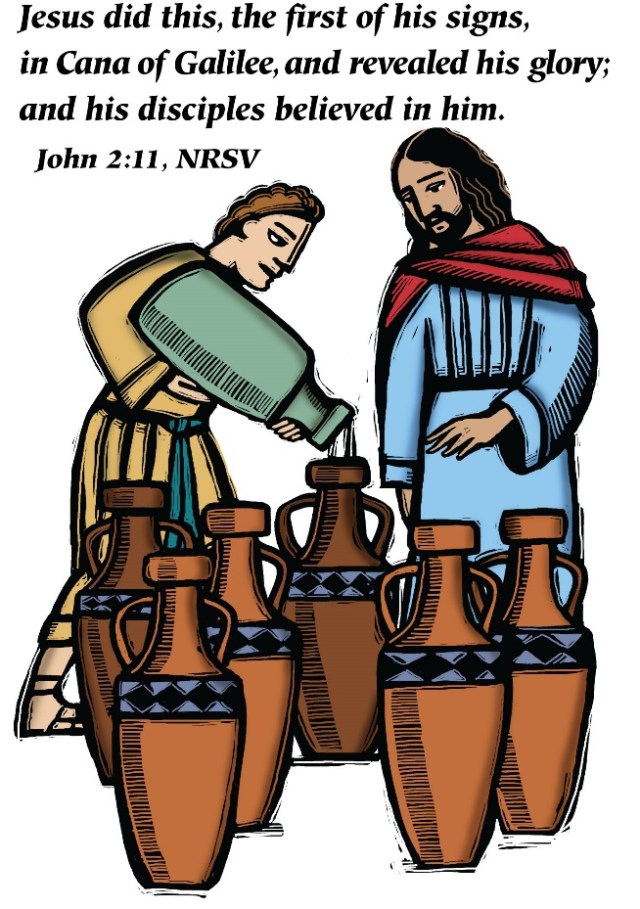
The third day after Jesus started collecting stray disciples, there was a wedding…and somehow, they all end up going.  Don’t you find that odd?  Here they were, going to save the world and all and before they’ve even gotten started, they stop by a wedding?

The Gospel writer doesn’t tell us why they stopped by a wedding.  What John does say is that “Jesus’ mother was there.”  Which explains so much.

When the wine runs out, Mary runs to Jesus and says, “They’ve run out of wine!”  Implied in the statement is the directive:  “Do something about it!”  Jesus’ response sounds snippy, but is more about self-differentiation than sassiness.  “What is that to you or me?  My time hasn’t yet come.”  Quit trying to hurry God, Jesus seems to say.  Things will happen in their own time.  Mary must perceive that God’s time is NOW.  She tells the stewards to “Do whatever he tells you.”

Wouldn’t you love to be a fly on the wall of a family therapy session between Jesus and his mother?  As intriguing as that might be, the real point of the story is what happens next.

After what I imagine to be a very deep sigh, Jesus tells the steward to fill six empty stone jars with water.  When the steward tastes the contents, he’s astonished, not only that water has been turned into wine, but that water has been turned into good wine.

Isn’t this a great story?  And good fodder for some of the better jokes on Facebook.  “Jesus goes into a bar, orders 12 waters…then winks at his disciples.”  J  But what does it mean, especially as we’re contemplating how we use our space to grow in fellowship?

The Gospel of John is organized around seven “signs.”  Each sign reveals something about God.  What might this first sign of turning water into wine at a wedding reveal about God?

(1)  First, it tells us that in Jesus, God wasn’t starting from scratch.  God didn’t plan to toss out the old faith and replace it with something completely new—Note that Jesus doesn’t tell the steward to go out and buy new jars.  Rather, he tells him to use the stone jars already there, jars used to hold water for Jewish purification rites.  Turning water into wine was a completely new thing, but that completely new thing happened within the structure of the old faith.

I’ve seen that same dynamic at work here at Pilgrimage as we prepare to celebrate the 20th anniversary of our vote to become Open and Affirming.  That vote happened in 1997, when Dick Mehlan was President of the Congregation.  Our current president….Dick Mehlan… J

It’s kind of beautiful that the person who was president when our ONA journey began will be president when we celebrate the 20th anniversary.  Everything we’ve done in the last 20 years to live into our ONA identity has happened because of the vision of folks who were part of this community back then.  And when they came up with the then-new idea of becoming ONA, they were building on the legacy left by the people before them—a legacy of deep Christian faith, strong commitment to living that faith in the wider Cobb County community, and centuries of social justice work done by our denominational forebears.

The same will be true as we decide what to do to replace the Next Generation House.  We’ll make the decision in the context of all the other decisions made by this community in the past—the decision to buy this property and build this building in the 80s, the vote to become ONA in the 90s, and Divine Redesign 8 years ago.  This congregation has a history of honoring its history.  We owe a great debt to those who have been members of this congregation for a long time and to those who came before them.  Those folks have left us a solid legacy of healthy decisions rooted in prayer and the commitments of our Christian faith.

Old jars, new wine—new things are best birthed in the context of all that’s come before.

A second thing this first sign reveals:  (2)  God is a God of abundance.  One commentator urges preachers NOT to downplay the extravagance of what Jesus does in this story.  Don’t water it down!  Each stone jar would have held 20 – 30 gallons of water.  For a home to have 6 of those jars—even for a wedding—would have been overkill.  The number of jars, the amount of water turned into wine, even the quality of the wine—all of it signals extravagance, abundance.  The new thing Jesus is ushering in, this new understanding of God—it’s all about abundance.  God is so much more, provides so much more than we can imagine!

It’s easy when new things present themselves to get scared, to look around and see only what’s not there, to focus only on what we lack.  Anxiety sends us straight to a scarcity mindset.  That’s where Mary is when she tells Jesus, “They’ve run out of wine!”  She’s focused on what’s lacking.  The same scarcity mindset plagues the disciples before Jesus feeds the 5,000.  “We have these loaves and fish, but what are they among so many?”

Both these signs—turning water into wine and feeding 5,000+ people with five loaves and two fish—both are invitations to move from a scarcity mindset (where we see only the things we don’t have) to a mindset of abundance (where we see the potential that lies in the things we do have.)  It’s true, the wine had run out.  But they still had water, and they had those big stone jars.  Jesus looked around him, saw what was there, imagined something different, and it happened.  He imagined something different with those loaves and fish… and it happened.

That’s probably the biggest difference between a mindset of scarcity and a mindset of abundance:  imagination.  When we focus only on what we don’t have, it short circuits our imaginations.  When we focus on what we do have, we might not end up with 120 – 180 gallons of good wine, or 12 baskets of leftovers from the 1st century equivalent of a Lunch-able, but we’ll certainly be able to do more than if we hadn’t imagined in the first place.

A case in point.  When the cots arrived for Family Promise a couple of weeks ago, the previous host forgot to send the sheets…either that, or as Deb Loche told me, “I forgot to ask for them.”  Even if someone had run over to the other congregation to get the sheets, they still would have needed washing.  No time for that.  Deb told me that, as they stood around trying to figure out what to do about the lack of bed linens, one person said, “I can go buy a few sets of sheets.”  That led to another person, and another, and another offering to buy additional sets.

Everybody could have stood around wringing their hands, beating themselves up about not having taken care of that one detail.  Instead, one person started imagining and– because imagination is infectious– other people began imagining, too.  Now we have a set of sheets that will remain here at Pilgrimage and which we’ll use each time we host Family Promise.  As she finished the story, Deb said, “I’m thinking now about what I need to forget next!”

Doing new things in the context of what’s gone before.  Living in a mindset of abundance… two things this story reveals about God.  The third thing?  (3)  New life in God is all about joy.

Listen to all the joy in the intro to the wedding service in the UCC Book of Worship.  “We are gathered here as people of God to witness the marriage of, oh let’s say, Wayne and Steve.  We come to share in their joy and to ask God to bless them.  Marriage is a gift of God, sealed by a sacred covenant.  God gives human love.  Through that love, spouses come to know each other with mutual care and companionship.  God gives joy.  Through that joy, spouses may share their new life with others as Jesus shared new wine at the wedding in Cana.”

New life is birthed in joy—whether it’s the new life of marriage, the new life of a human being, new life in God, or the new life of something we’re imagining together as a community.  We do a lot of joyful things here at Pilgrimage—worshiping, serving… holding babies.  Perhaps the most joyful thing we do is spend time together, get to know each other better, eat together, play together.  Perhaps even to play Corn Hole together.  (We’ll see. J)

In talking with a friend once about the end of her marriage, she attributed the marriage’s failure to an “inability to play together.  We just took everything so seriously,” she said.  The same can be true in communities.  When we stay focused on work, work, work, without taking time to visit and fellowship and play, community life becomes a drudge, doesn’t it?

Maybe that’s why in the Gospel of John, Jesus begins his ministry at a wedding, a party, a party where the booze runs out.  This new thing God was doing?  It was going to take some playfulness, some imagination, and it was going to—already was—ushering in great joy.

Assignment time.  Thus far this month, we’ve been thinking about how our facility facilitates or hinders service and learning.  This week, the invitation is to think about how our facility facilitates or hinders fellowship.  Your assignment, should you choose to accept it, is a two-parter.  First, as we fellowship together with food, conversation, and, if we must, Corn Hole, take note of all the ways you meet God.  How is God revealed in joy, play, conversation, and a shared meal?  Second, as we fellowship together this afternoon, observe (with specifics) how our facility facilitates and/or hinders our fellowship with one another.

Oh, man.  Would you look at what I’ve just done?  I’ve invited everyone to take this really fun day and turn it into work.  Have I not been listening to this sermon?  (It happens.)  Tell you what, forget the assignment….and, like Jesus and the D’s on their third day of ministry together—allow yourselves to experience the joyful, playful, extravagant abundance of God!


In the name of our God, who creates us, redeems us, sustains us and hopes for our wholeness, Amen.

Kimberleigh Buchanan  ©  2016

Posted in Uncategorized | Leave a comment

Sermon: “Acting the World into Wellbeing through our Facility: LEARNING” (9/11/16)

We’ve got a great crop of new babies in the house… Michael, Madison, and, making his debut at the ripe old age of one week:  Devon Hill-Kalasky.  A couple of you have brand new grandbabies–those silly grins are giving you away, Karen, Neil, and Jeanette.

Something happens when babies enter the picture, doesn’t it?  It’s like everything fades into the background except this beautiful, brand new human being.  Your whole perspective of the world shifts when you look at it through the lens of your relationship with this tiny miracle.

I confess that as your pastor, I get nervous when we go a year or two without any new babies.  A key part of keeping a faith community alive and vital is living in the present with an eye to the future.  Without new human beings, a community has to work much harder at envisioning the future.  With new human beings around?  That kind of thinking comes naturally.  Making the world a better place for children, in general, isn’t nearly so compelling as making the world a better place for Michael and Madison and Devon and Logan and Audre and Evelyn…

I realize, of course, that I’ve now lost half the congregation.  The new parents and grandparents will be able to think of nothing but baby for the next few…hours.

For those still with me, I invite you to join me in looking at Psalm 127.  Psalm 127 is part of a collection of 15 psalms called “Songs of Ascents.”   It’s not clear exactly what “ascends” in Psalms 120-134.  The consensus is that the psalms were sung either as pilgrims as they made their way “up” to Jerusalem for high holy days, or as they ascended the 15 steps to the altar in the Temple.  Fifteen psalms for 15 steps.  Makes sense.

So, let’s imagine we’re pilgrims.  After a couple days’ journey, we’ve made it to the Temple in Jerusalem.  We pass through some outer courts and reach the stairs that lead up to the altar where we’ll make our offering.  We begin our ascent, chanting a psalm per step.

Step 1, Psalm 120—a song of complaint.  “I am for peace; but when I speak, they are for war.”  Sometimes you just have to get that kind of thing off your chest before you’re ready to worship, don’t you?  Step 2, Psalm 121—the pilgrim remembers what they’re there for:  “I lift up my eyes to the hills–from where will my help come?  My help comes from God, who made heaven and earth.”  The next song begins, “I was glad when they said to me, ‘Let us go to the house of the Lord!’”  An appropriate song for step #3.

In Psalms 123-125, the psalmist again lifts eyes to God, remembers the times God “has been on their side,” and reflects on what it means to trust God.  In Psalm 126, the pilgrim rejoices in all God has done for them:  “When God restored the fortunes of Zion, we were like those who dream.  Then our mouth was filled with laughter, and our tongue with shouts of joy!”

If we go with this one-psalm-per-step interpretation, Psalm 127 would have been sung on step 8, just over halfway to the altar.  We’ve complained, lifted our eyes to the altar, reminded ourselves of all God has done for us in the past and of what it means to be faithful.  Now, on step 8 we sing:  “Unless God builds the house, those who build it labor in vain.”

To what “house” does the psalmist refer?  Is it a reference to God’s house, the Temple?  Could be.  After climbing 7 steps heading up to the altar, I’m sure the grandeur of the Temple would have begun to sink in.  Early Israelites understood the Temple to be the literal dwelling place of God.  It was a holy place.  House as Temple?   Makes sense.

But then you read about the vanity of overwork and sleeplessness…which leads to a discussion of children and the happiness of those who have many.

Reading those last bits make you wonder if, instead of the Temple, the psalmist is talking about actual houses.  Early rising and going to bed late happens in homes… that’s also where one eats the “bread of anxious toil” and thinks about the gift of children.

So, if all these psalms were to be sung as prelude to making an offering to God in the high holy days, why this psalm about home, and sleep patterns, and children?

Here’s a theory—and it’s just a theory.  But what if children weren’t allowed on the steps to the altar, which is likely.  That being the case, maybe step 8 of the parents’ ascent was the point at which pilgrims started missing their kiddos.  Maybe as they stood there singing Psalm 127, they pulled out their smartphones, scrolled through pictures of their little ones, and sighed.  Maybe step 8 is where it all came together for them:  Now I get it!  Our faith doesn’t mean much if we aren’t sharing it with, teaching it to, and living it with our children.

That’s why I get nervous when we go a couple years without babies in the church.  I get nervous when we go a year or two without Confirmation for the same reason…because unless we’re sharing our faith with the next generations, it becomes stale and loses its future focus.  Let me put it bluntly:  faith communities without children and youth die.

…which is why I have so much confidence in the viability and longevity of the ministries here at Pilgrimage.  This community loves children—nurturing them, inviting them to participate in all areas of the church’s life, asking them what they think about important issues… We love and value children and teenagers here.

Which is all well and good, but what does any of this have to do with our building?  When I began writing this sermon, I thought it had everything to do with our building.  Children need space to learn!  Teenagers need space to learn!  Adults need space to learn!  When I selected Psalm 127 for today’s sermon, I wasn’t thinking past the first verse—“Unless God builds the house, those who build it labor in vain.”

But as I studied the whole Psalm, I realized it has a lot more to do with building the faith of our children, of raising them to know God, and to know they are loved by God, than it has to do with actual bricks and mortar.  We are, of course, thinking a lot about bricks and mortar right now.  The Growth Task Force has been working hard, looking at options for meeting our space needs.  With the Next Generation House nearing the end of its life, we need to be thinking about bricks and mortar.

Psalm 127, though, reminds us why we’re thinking about bricks and mortar.  We’re doing it, in part, to ensure that the children who are part of our community have space to learn about our Christian faith, about God, and about just how much God loves them… because our investment in them is an investment in the future of this community and in the Christian faith.  I suspect that if we stay focused on that part of our mission—nurturing faith in our children and teenagers—the decision about what to do about bricks and mortar will take care of itself.

After graduating college, I taught school in Lawton, Oklahoma.  The sanctuary at First Baptist Church, where I attended, was big, beautiful, and new.  It resembled a grand, old New England Congregational church.  White interior, large clear windows letting in tons of light.  Soaring columns in a Greek revival style.  Outside, a large steeple topped off with a cross.

When I asked the Children’s minister what led to building the new sanctuary, Doris told me this story.  For decades, the congregation had worshiped in a sanctuary across the street from its present location.  We still used the old education building for children’s Sunday School.

Doris told me the staff got a call one night that the sanctuary was in flames.  The arsonist, who was soon caught, told police voices in his head had told him to burn the church down.

As you can imagine, the experience was deeply traumatizing for the congregation.  After a time of healing, they began planning for a new sanctuary and additional educational space on the adjacent lot.

During construction, Doris served as Director of First Baptist’s large, thriving Preschool.  We talked a little about how construction had affected work at the preschool.  Then she told me about the arrival of the new steeple.

When Doris saw the steeple resting in the church’s parking lot, she got an idea.  The next day, she took some children from the preschool to the steeple and let them touch it.  The day after that, a crane lifted the steeple to its final location atop the new church building.

Hearing that story changed my understanding of First Baptist, and of church, in general.  That one gesture spoke volumes.  It reminded the children that they were a vital part of the church.  It reminded the adults present of the same thing.

Hearing the story also helped me get clear in my own mind about how vital children are to any faith community’s life.  Seeing that steeple?  Imagining all those tiny handprints and the glee those children must have felt when they saw—and continued to see—that steeple, high up in the air, reaching to God?  Every time I saw that steeple, I remembered those children…and the point of everything we do as a church — to nurture children into faith.

Are you ready for this week’s homework assignment?  It’s another two-parter.  First, I invite you to reflect on our community’s ministry with children.  How are we nurturing, how are we building up the faith of the children in our midst?  Second—and only second—observe how our facility facilitates (or gets in the way of) our work in helping children learn Christian faith.  The most sound research on that front likely will involve a tour of the Next Generation House.  Oh!  I know!  Invite a child you know to show you the Next Generation House!  Listen to what they say.  Let them teach you about what best helps them to learn about God.

Then pray about it.  Because “unless God builds the house, those who build it labor in vain.”

In the name of our God, who creates us, redeems us, sustains us, and hopes for our wholeness.  Amen.

Kimberleigh Buchanan  ©2016


Posted in Uncategorized | 1 Comment

Sermon: Acting the World into Wellbeing through Our Facility: SERVICE (9/4/16)

For my devotional practice this year, I’m reading through the Bible.  Having done this when I was a teenager, I remembered there being large portions that were deadly dull—like, genealogies and allll those chapters offering detailed descriptions of building projects.  When I started this venture in January, I generously gave myself permission to skim those parts.

I’m still skimming the genealogies.  All those begats!  A funny thing happened, though, with the passages about building projects… Maybe it was because I was reading about building the ark, Tabernacle, and Temple at the same time we were addressing our space needs, but it wasn’t long before my skimming slowed down to actual reading.

Then it hit me:  All these words about construction, furniture, and building use…They’re part of Scripture…Which means our ancestors in faith saw all of it–down to the last wooden peg and silver shekel–as holy.  It’s not just the sanctuary that’s holy, but the whole process of imagining, making preparations for, making decisions about, and building that are holy.

Reflecting on the sacredness of the discernment process we’re currently in, I ended this month’s newsletter article with these words:  “As we continue discerning the best way to address our space needs, I encourage us, too, to see every step as holy.  I pray every decision, every conversation, every disagreement, every dream be imbued with prayer.  I pray every meticulous detail might teach us something about who God is to us, who we are to each other, and how we will share God’s love with the world.”

When I re-read that part a couple weeks ago, I realized we haven’t created much space in worship for holy-seeking or prayer-imbuing.  Hence, this September sermon series:   “Acting the World into Wellbeing through Our Facility.”

So, how do we act the world into wellbeing through our facility?  To answer the question, I invite us to recall the words that guide everything we do here:  our mission statement.  Say it with me again.  “We seek to grow in worship, learning, and service, as a faithful people of God, bringing hope, comfort, and friendship to all, welcoming everyone in Christ.”

Most of our reflecting during Divine Redesign focused on “growing in worship.”  The character of our worship changed when we reoriented the sanctuary.  Now that we can see each other, the space–even though it seats more people–feels more intimate.  The colors from the stained glass windows also have helped to deepen our worship experiences.  One person recently told me they’d like to die in this room when it’s bathed in color.  Then they thought about it and said, “But I guess that would be a little awkward for everyone else, wouldn’t it?”  Um, yeah.  But I get what they meant.  Since the installation of our windows, many of us do meet God in color.

If Divine Redesign helped us reflect on growing in worship, the current process invites us to reflect on how we use our space to grow in learning and service.  This week, we’ll look at service.  Next week, learning.  The week after that, we’ll look at fellowship.  Fellowship isn’t mentioned in our mission statement, but it is a big part of our community’s life.

So….how do we act the world into wellbeing through our facility in terms of service?

If I were to sum up our mission statement in a single word, it would be hospitality.  Everything leads up to that last phrase:  “welcoming everyone in Christ.”  If I’m not mistaken, that phrase was added around the time the congregation voted to become Open and Affirming.  Though I wasn’t here at the time, I think this community got clear about its primary mission during the ONA process:  We are here to welcome everyone in Christ.

Because hospitality is so fundamental to semitic cultures, it’s a focal theme throughout Scripture.  Today’s story from Genesis might be its best illustration.

The story begins with Sarah and Abraham at their tent somewhere in the wilderness.  A few chapters before, God tells them to leave home and follow God “to a land I will show you.”  Just for fun, I plugged “a land I will show you” into my GPS.  “No results found.”  This journey to “no results found,” as you can imagine, was a tad stressful.  Several times along the way, God reassures Abraham that God will always be with him.  God also promises Abraham and Sarah myriad descendants.  Did I mention the couple already were well into their 90s?  When God tells him he’s going to be a dad, old Abe falls on the ground laughing.

So, Abe and Sare are chillin’ at their tent when three guests show up.  Abraham immediately kicks into high-gear hospitality mode.  He sees the guests, runs to meet them, honors, invites, refreshes, prepares, serves, bows to, gives the best he has (a calf!), makes and serves food, is attentive to their welfare, and when they depart, he accompanies them on their way.  It is clear that Abraham understands himself to be the servant of his guests.

IMG_0792

(Family Promise van and trailer, ready to be unloaded.  Photo credit:  Carson!)

Just for fun, I sent Abraham’s hospitality protocol list to our folks who work with Family Promise hosting and asked how the list jibes with what happens during a host week.  I was deeply moved by their responses.  Among those who work with Family Promise hosting there is a profound concern for the humanity of our guests.  The Benedictines—whose main focus is hospitality—suggest that we are to welcome every person as Christ.  It’s clear that’s what happens when we host Family Promise.

Here’s what one person wrote:  These people are stressed.  They are most likely humiliated by having to live at the mercy of others.  Making them feel as valued by us as they are by God is our top priority.  Another wrote:  It’s hard on these folks.  I feel for them and I will do all I can to make them feel at home while they are with us.

Another more directly compared what happens during a Family Promise host week to Abraham’s hospitality protocol.  Seeing – We recognize our guests not as “homeless people” but as members of our kindom, the image of God sent to us, as to Abraham.  Running to meet – being available according to their schedules, showing our pleasure to see them.  Honoring – respecting individual needs, privacy, letting them know they are every bit as important as we are, if not moreso, while we serve them.  Inviting – sharing the meal and conversation, welcoming them to attend our service but not pushingRefreshing – providing a respite from their stressful days where they can relax and feel that their needs are taken care of.    

Preparing – with the intent of pleasing them, for their wellbeing, not just our own.  That their rooms and meals are prepared with love.  Serving – there is a Hassidic saying: “Another person’s physical needs are my spiritual duties.”  We aren’t doing our guests a favor by hosting them.  We don’t do it to be good people.  Jesus wants us to put others above ourselves, to “bow” to them in our own humility, to sacrifice our precious time and money, our “best,” however humble that may be.  Like, we’re not going to do this every day, but at least we can manage 4 weeks in a year.”  

Hosting Family Promise is one of the primary ways we live our mission to grow in service as we welcome others in Christ.  Our facility plays a large role in hosting weeks.  So, here’s your homework for this week.  It’s a two-parter.

Part, the first.  As we get things ready to host—that’s right after the worship service—and throughout the week, reflect on how our facility facilitates serving others, bringing them hope, comfort, and friendship, welcoming them in Christ.  In what ways does our facility help us fulfill our mission?  In what ways does it get in the way of fulfilling our mission?  How does our facility help us act our Family Promise guests into wellbeing?  There won’t be a test next week, but I’m sure the Growth Task Force and Council would love to hear your responses.  Me, too.

For the second part of the assignment, I invite us to look briefly at the second half of today’s story from Genesis.  As the guests are enjoying the meal Abraham has prepared, one of them says:  “I will return to you in due season, and your wife Sarah shall have a son.”  It’s understandable that Sarah, who is well beyond child-bearing years, laughs at the news.  Hearing her laughter, the guest says to Abraham:  “Why did Sarah laugh, and say, ‘Shall I indeed bear a child, now that I am old?’  Is anything too wonderful for God?”

The guest’s words are an invitation to imagine.  Based on the facts, the prospect of Sarah conceiving and bearing a child was laughable.  And yet, just a couple chapters later, that’s exactly what happens.  Appropriately, she names her little boy “Isaac,” which means “laughter.”

So, the second part of your assignment is to imagine.  As we discern how to address our space needs, does anything seem laughable to you?   If it does, imagine—just imagine—that it might be possible.  If adding square footage seems impossible to you, imagine it happening.  If NOT adding square footage seems impossible to you, imagine that happening.  It’s too soon to know precisely where this discernment process will lead.  We’re on our way to a “land God is showing us.”  That’s why we’re taking such great care with it.

Here’s what I do know—figuring out the best solution to our space needs will require us—all of us—to engage our imaginations.  The good news is that imagining costs nothing.  There will be time to deal with costs later on.  For now, let us give ourselves the gift of imagining, of dreaming.  If we do, who knows what wonderful thing God might reveal to us?


In the name of our God, who creates us, redeems us, sustains us, and hopes for our wholeness.  Amen.

Kimberleigh Buchanan  © 2016


Posted in Uncategorized | Leave a comment