Singing the World into Wellbeing (8/28/16)

This summer, we’ve been exploring what it means to act the world into wellbeing.  As I contemplated how to engage that theme on this last Sunday in August—which has become a singing service—I thought about Pete Seeger.  Pete believed—really believed—that the world would change if we could just sing together.  At Pete’s concerts, more of the singing was done by attendees than by him.
Desmond Tutu At Columbia University

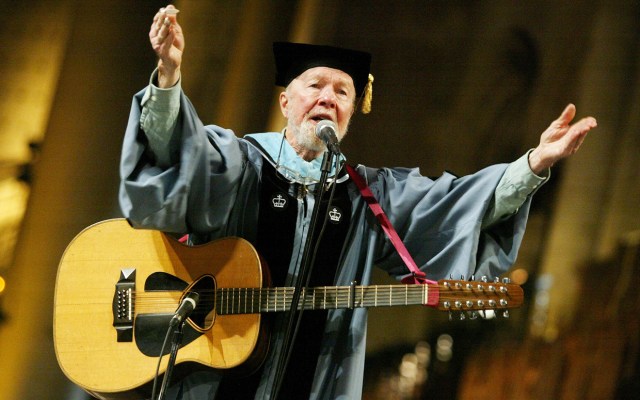
NEW YORK, NY – MAY 20: Legendary folk singer Pete Seeger encourages the crowd to sing at Teachers College, Columbia University commencement convocation May 20, 2003 at St. John’s the Divine church in New York. Singer and two other men were given awards and honorary degrees during the ceremony. (Photo by Chris Hondros/Getty Images)


Something happens when we sing together, doesn’t it?  In a seminar I took at Emory with Don Saliers, Emily’s dad, the worship and theology professor, bemoaned the fact that concert-goers’ responses to Indigo Girls concerts were much more impassioned than the responses of worshipers to liturgy he created.  For those of you who are into the Indigo Girls, singing “The Power of Two” with a couple thousand other people—it kind of is a holy experience, isn’t it?


                                         indigo.girls


As I thought about singing the world into wellbeing, I began to wonder:  How does music inspire us to live God’s love in the world?  What songs inspire us to act the world into wellbeing?  I heard back from a few of you.  Today’s service includes at least one suggestion from everyone who made submissions.


A few thoughts about how to get the most from today’s service.


So often when we think of music, we think, either:  I like that, or, I don’t like that.  With today’s music, we know that every one of these songs was chosen because it’s vitally important to a member of this community.  Each of the songs we’ll sing or hear today inspires someone to live God’s love in the world, to act others into wellbeing.  (Below, you’ll find the stories of why folks chose the songs they did.)


So….If you know and like a song, sing along!  If you don’t know–or don’t like–a song, do a little research.  Listen to the song generously.  Hear it as the offering it is from one of our fellow community members.  See what it might teach you about your own practices of acting the world into wellbeing.


And if in the midst of our singing together this morning you find yourself thinking, “Man.  I wish I’d contributed a song or two,” room is provided on the insert for you to begin creating your own playlist.


In fact, you might like to create an actual playlist…on Youtube, or Spotify, or your iPod, or your Hi Fi, or your Victrola…Create a playlist that will inspire you to act the world into wellbeing.


With that, let us now sing the world into wellbeing.

******************

Stories about why each song was chosen:


GOSPEL MUSIC;  NEGRO SPIRITUALS.   I love this music! The tempo, the words, the rhythm. I feel like the Holy Spirit is running through me! My heart pounds , I wanna move, get down and get jiggly with praising the Lord ! Act the world into loving Jesus?  Amen . This music can do it!  (June)


HUMBLE AND KIND  (Tim)

Simple lyrics that we all need to hear again and again.  In this crazy busy, violent and harsh world, we need to listen to this song.  Really listen.  Great thoughts for this world and for individuals to remember that even a small gesture of kindness can make a huge impact on someone.  And then that someone can pass it on.  Words to live by, be humble, be kind, go to church, visit your grandpa, say please and thank you. All simple things, but much needed in these times.  (June)


IMAGINE  (The Beatles)  I loved them all and all their music! As a teenager, I had posters all over my bedroom walls and all their records, yes records!  Later, in College, I was a hippie, a flower child with jeans, gauze tops, sandals and flowers in my hair protesting the war.  “Make love not war” was the bumper sticker on my VW.  I was all about love, harmony and peace.  This song just got into my head and into my soul.  It moved me then and I cry when I hear it today.   (June)


MAN IN THE MIRROR (Michael Jackson)

I’ll start by saying this song gives me chills and the end makes me cry (no surprise there).  This is one of those songs that has a singable tune, relatable lyrics and a personal message for each of us. This song says it all.  Like putting your oxygen mask on in the plane before you ever try to help someone else.

It all starts with each individual person and their own internal search for what moves them in the world.  Your passion may not be the same as my passion, but that’s great!  That’s how all causes get attention, from people who care about them. We should never belittle someone’s belief in a charity, a cause or a political stance, because we haven’t walked in their shoes to be able to understand their point of view, which is as valid for them as our own are for us. “That’s why I’m starting with me!” is a line from the song, and the place where we should all start.  Explore yourself, implore God for guidance, and you will know when you are doing the right things for yourself and the world!  (Carol)


ORDINARY LOVE  (U2)  My songs are about peace and hope. “Ordinary Love” by U2, tells me how simple it is to love one another.  (Noel)


ONE DAY  (Matisyahu) tells me that most of us want peace and hope that one day, that will be possible. Sadly, reality and history tell us that will never really happen, but if people keep writing songs of hope, living a life of love and giving to mankind, the example will be set for future generations. Our actions speak loudly against hate. I do my little part when and where I can, be it hosting charity events, giving to Missions, helping a friend or neighbor in need, it’s something we all can, and should do.  (Noel)


PATRIOTIC MUSIC    I am so grateful to the Almighty God that I was born in this country instead of a third world or Middle East country that is ravaged with war, poverty, disease and hopelessness. Hearing a patriotic song makes me feel safe and warm. My Dad WWll veteran and my Gramps WWl veteran flew their flags 365 days a year. They were proud, they were brave and they loved this country. Hearing a patriotic song makes me think of what men and women have given for us to be free.  (June)


RING THEM BELLS  (Bob Dylan)  Several years ago, my son gave me a four disc collection of Dylan songs, performed by various artists, with an Amnesty International label on it. This song is meaningful to me because, shortly after the Orlando tragedy in June, my son, who also inspires me, put up a Facebook post with the song, “Ring Them Bells”. I just happened to be listening to that CD in my car during that same time frame.

The recording artist on this particular CD is Natasha Bedingfield. The song suggests ringing bells “for the child who cries” and “when the innocents die”.  It also states to ring the bells “from the sanctuaries, from the valleys and streams”.  Several more references include ringing bells “for the poor man’s son, “for the blind and the deaf” and “for all of those who are led”. All of these references speak to acting the world into wellbeing.  (Diane)


SKIN (Sixx A.M.)  When my daughter was having a very hard time with anxiety, serious mental health side effects from ADHD medication, and problems with kids at school, this song really spoke to her.  She made me play it every day for quite a while and we would sing it together.  When you listen to the lyrics of the song, the message it gets across is that you are more than what people see, you are more than just your skin, you are more than just your scars.  Show your heart and people will see…You are wonderful and beautiful.

If you are unfamiliar with the band, it is composed of three musicians, James Michael, DJ Ashba, and Nikki Sixx. Nikki Sixx (as some of you probably already know), is also the bassist for Motley Crue. He was a terrible heroin addict (he seriously overdosed twice and technically died from one of the overdoses for a few minutes and they got his heart beating again). He has been clean and sober for 15 years, and is a very vocal proponent of the sober life and very supportive of folks fighting addition and mental illness battles. So, this song would have ties to acting both mentally ill folks and folks suffering addiction into wellbeing.   (Trudy and Emily)

WAITING ON THE WORLD TO CHANGE  (John Mayer)  The lyrics of this song say that the younger generation is waiting on the world to change, and it’s hard to make a difference, about their feelings that the older generation doesn’t think their ideas are worth much.  To me it’s more of a wake-up call to get out there and do something. He covers a lot of topics like war deaths, the powerless feeling of the young to fight the establishment (sort of the opposite of how the younger people felt in the 60’s and early 70’s), the spin the news outlets make on current events, etc. To me it says, listen to what the young people are saying – they have ideas that ARE worth hearing! (Carol)


WHAT A WONDERFUL WORLD (Bob Thiele and George David Weiss)

I had only been a pastor 3 months when September 11th happened.  New to ministry, I called a couple of colleagues to ask what they would do in worship the following Sunday.  Neither of the folks I asked was currently in a pastorate.  Both said:  “I’m glad I’m not preaching this Sunday.”  I knew I was on my own.       The Monday following that Sunday (9/17), I saw in the paper that at Sabbath services that week somewhere in New York, a rabbi led his congregation in singing “What a Wonderful World.”  My first thought was, What was he thinking?!  After what has just happened, how can he possibly sing “What a Wonderful World?”  Then I got it.  It is a wonderful world.  Terrible, traumatic things happen sometimes, but if the world is to be a place worth living, we have to believe in its goodness.

Even to ask the question of how we might act the world into wellbeing is to assume that it isn’t yet well, it isn’t yet whole.  As we continue to seek ways to act the world into wellbeing, we might do well to remember what that rabbi remembered:  that the world—as it is—already is wonderful.  (Kim)


WHAT THE WORLD NEEDS NOW IS LOVE (Burt Bacharach & Hal David)

This song came to mind because we truly do need more love in the world. If we show others kindness and reach out to others, one would think it would bring good to the world and act the world into wellbeing.

When I was in high school, I remember leaders from various schools playing a recording of this song for a “Human Relations” group.    (Reese)

Posted in Uncategorized | Leave a comment

Sermon: Acting the World into Wellbeing through Politics (8/21/16)


donkey-elephant.jpeg__800x600_q85_crop

Rhetorical question:  Who are you going to vote for in November?  How do you feel about folks who’ll be voting for the other person?

At the beginning of the summer, neither today nor last Sunday had a theme.  I invited you to offer suggestions.  Christian Ed reminded me that one of the days needed to be Rally Sunday.  We did that last week and focused on “Acting Children into Wellbeing.”

I got a lot of other suggestions for today.  Interestingly, a couple of those focused on growing older–either acting the elderly into wellbeing or acting ourselves into wellbeing as we age.  Having recently relocated to Over-the-Hill Town, I fully plan to come back to that theme.

No one suggested today’s topic.  I’ve gone rogue.  I did it because of the increased rancor of the current presidential campaign.  Don’t get me wrong.  Past political campaigns often have been rancorous, but the current election cycle….  Does anyone else find the things being said distressing?  Do you ever find yourself longing for a candidate with no dark clouds of questionable ethics hovering over them?  Are you giving serious thought to not voting at all?

Had I asked that first question–For whom will you vote?–non-rhetorically, I suspect we’d have seen hands raised for both candidates.  If I mentioned either candidate’s name, an equal number of eyes likely would have rolled.  Some of you might not have raised your hand at all.  Did you know that, that there are Republicans and Democrats in our congregation?  For the longest time, I’ve avoided acknowledging our political diversity, thinking that to do so would only invite the rancor out there into the safe space of our sanctuary.

Recently, though, I’ve come to realize that I haven’t given any of us enough credit.  On every other issue we’ve discussed together as a community, we’ve done so with respect and grace, even when we disagree.  What’s so scary about acknowledging our political diversity?

In many faith communities, a majority of congregants identify with a single political party.  That’s fine, but it doesn’t really encourage discussion, does it?  If we only talk with people who agree with us, we don’t have to engage in critical thinking.  Nothing invites critical reflection like disagreement.

So…I have an idea.  It might be crazy, maybe even scary.  But here goes.

If you know someone here today who plans to vote for a different candidate than you’re planning to vote for, why not invite them out to lunch for some conversation?  Note that I said “conversation,” not “conversion.”  Ask your dining partner their reasons for voting for that candidate.  Then listen generously to their response.  By listening generously, I mean listening simply to hear the other person’s story, to hear things from their perspective.  Don’t listen to analyze, criticize, demonize, or proselytize.  Simply listen.  And receive.  Then say, “Thank you for sharing your thoughts with me.”  And since your table-mate also is hearing this sermon, perhaps they will listen generously to your reasons for voting the way you do.

Can you imagine having that kind of conversation?  I wonder what might come of it?  What might each of you learn?  How might each of your own commitments deepen as a result of listening to each other?  Maybe the best way to live our faith with integrity this election season is to refrain from vilifying candidates or their supporters and really listen to each other.  If you do spend some time talking together about politics and you want to report back, we’d love to hear.

It’s true that we are all over the map when it comes to political commitments.  There is one thing, though, that all followers of Jesus share.  Those of us working to establish God’s kin-dom here on earth as it is in heaven, those of us who believe in Jesus’ call to stand in solidarity with the least of these, those of us who seek to act the world into wellbeing…

As people of Christian faith, all of us—no matter who we’re voting for—are called to engage public and political systems.  Our faith isn’t something we tend to only in church on Sundays, or during times of personal trial.  Taking our faith seriously requires complete submersion.  The life of faith calls us to view every aspect of our lives through the lens of our Christian faith… even our political life.  Perhaps especially our political life.  How can we hope to act the world into wellbeing if we don’t engage political and public systems?

Today’s Scripture lesson recounts the call of the prophet Jeremiah.  The writings of most prophets in the Old Testament begin with the story of the prophet’s call.  That’s to let folks know that it’s not the prophet’s fault he or she has to say all these difficult things.  “I don’t want to say it!  God’s making me!”

The job of prophets is to poke the beehive, upset the status quo, speak truth to power,  proclaim that the emperor has no clothes.  If the social systems currently in place allow for the oppression of some, then the system must be changed.  Jeremiah describes the prophetic task this way:  “to pluck up and to pull down, to destroy and to overthrow, to build and to plant.”

The image—which would have resonated well in an agrarian society—is of what happens at the end of the growing season:  plow it all under so we can start again.  If current systems aren’t doing what they’re supposed to do, if the current crop isn’t nourishing the people it’s meant to feed, it’s time for an overhaul.

We’ve seen the positive results of people of faith engaging political systems in our country– the 14th Amendment, ensuring that no person can be discriminated against because of their race; the 19th Amendment, ensuring women the right to vote; the Civil Rights Act of 1964; the Voting Rights Act of 1965; the Americans with Disabilities Act; Marriage Equality.

The UCC often has been at the forefront of acting the world into wellbeing through public and political processes.  The work of Everett C. Parker, head of the UCC’s Office of Communications in the 1960s is a great example.  In 1962, when WLBT in Mississippi refused to air the confirmation of Supreme Court Justice Thurgood Marshall, Everett filed a complaint with the FCC.  The FCC refused to hear the complaint.  Parker appealed the decision.  In 1966, the Supreme Court determined that WLBT had violated its public trust by depriving large sectors of citizens—particularly African Americans—of news coverage that affected them.  That decision was key in creating fairness in journalism in our country.

Another example of people of faith actively working in the public/political arena is the work that was done here two weeks ago.  Through the auspices of Faith in Public Life, some of our folks participated in a phone bank.  The purpose of the event was to educate voters in Cobb County about so-called Religious Freedom legislation, in particular, what it could mean for LGBT folks.

We might be voting for different candidates this election season, but as people of faith, we all are called to live our faith with integrity in the public sphere.  We all are called to take our faith with us into the voting booth.  We all are called to vote in ways we believe will act the world into wellbeing.

As you contemplate how your vote might act the world into wellbeing, I invite you to think about one group, in particular; it’s a group neither of the major political party’s candidates is talking about.  It’s a group on which both Old Testament prophets and Jesus focus:  the poor.  Some call this concern for those living in poverty “God’s preference for the poor.”  If God is so concerned about the poor, mightn’t those of us who worship God and follow Jesus do well to share the concern?

Matthew Desmond, a Harvard professor of sociology acknowledges that from neither presidential candidate do we “have a full-voiced condemnation of the level or extent of poverty in America today.  We aren’t having a … serious conversation about the fact that we are the richest democracy in the world, with the most poverty.”

The article that quotes Dr. Desmond goes on.  “The silence [about poverty] is particularly striking because the problem is growing.  There is not a single state where a full-time worker earning the minimum wage can rent a market-rate one-bedroom apartment for 30 percent or less of their income, according to the National Low Income Housing Coalition.  And more than 11 million households spend more than half of their income on rent.”  http://www.nytimes.com/2016/08/12/us/politics/trump-clinton-poverty.html?_r=0

We heard from Christy Stanley last week about the large number of students in her school who, were it not for free and reduced breakfasts and lunches, would not eat those meals.

Can one vote erase poverty?  Of course not.  But what might happen if, when we cast our one vote, we bring the poor with us into the voting booth?  I’m not a big fan of what would Jesus do, but I think that’s what Jesus would do in November.  The root of the word “politics” is power.  As you cast your vote in November, I invite you to look at things through the lens of power.  Who wields power in our country?  Who benefits from the status quo?  Who gets lost in the shuffle?  Who gets forgotten?

Here’s one more invitation.  At lunch today—after you’ve listened generously to each other about your political views—I invite you and your table-mate to talk together about those for whom the prophets and Jesus were so concerned:  the poor.  How might each of you use your vote to advocate for those with little power?  How might the two of you together work within the public and political arenas to advocate for the least of these?  How might you—how might we all—engage public and political systems to act the world into wellbeing?

In the name of our God, who creates us, redeems us, sustains us, and hopes for our wholeness.  Amen.

Kimberleigh Buchanan  © 2016


Posted in Uncategorized | Leave a comment

Sermon: Acting Children into Wellbeing (8/14/2016)

feed5000           The day after VBS ended, I got an email from Miss Janet:  “Let’s have a mini-VBS on Rally Sunday!”  Still in recovery mode from volunteering during VBS, I groggily typed, “What’s the theme?”  “The little child’s contribution of fish and loaves to feeding the 5,000!”  “Uh huh,” I replied…then went back to my annual post-VBS coma.
When I awoke and determined that I hadn’t dreamed that message from Miss Janet, I looked in the Bible for the story of Jesus feeding the 5,000.  It’s one of the few stories that appears in all four Gospels.  Which to choose?

I went first to Luke–that’s the focus Gospel for the current liturgical year.  I read it.  No child.  Then I went to Matthew, the focus Gospel for next year.  No child.  Then I went to Mark, thinking surely the child was hiding there!  Nope.  In Matthew, Mark, and Luke’s versions of the story, the loaves and fish just appear; we aren’t told how or by whom they appear.

That led me to John’s Gospel, where–as we heard–when Jesus asks where they’re going to buy bread for all those people, Andrew says, “There is a child here who has five barley loaves and two fish.”  Ding!  Ding!  Ding!  Found him!

Now that we’ve found him, what do we do with him?  Do we celebrate the little boy’s sacrificial giving?  Do we put him on a pedestal and honor him for being wiser than the adults?  We could do that…but if we did, we would be reading our own perceptions into the story, because the Gospel writer doesn’t say anything about the spirit in which the child surrenders his lunch.  Did he offer it willingly?  Or did he feel like he had no choice because an adult had asked him for it?  In the text, the child says nothing.  So any guesses about his intentions are just that–guesses.

What we can do is look at what is in the story as it’s told in John’s Gospel.  A great crowd has followed Jesus across the Sea of Galilee.  Jesus takes his disciples up the mountain… whether trying to get away from the crowd or seeking a higher perch from which to address them, John doesn’t tell us.  From that vantage point, Jesus looks out over the sea of people and asks Philip:  “Where are we to buy bread for these people to eat?”  Philip answers:  ‘Six months’ wages wouldn’t buy enough bread for each of them to get a little.’  Basically, the needs are too great.  It’s simply not possible for us to meet them.

Do you ever feel like that?  Overwhelmed by the world’s needs?  A couple weeks into our summer theme of acting the world into wellbeing, someone playfully re-named it (at least I think it was playful):  “Who aren’t we doing enough for this week?”  For those of us who want to make a real difference in people’s lives, the weighty needs of the world can overwhelm, even paralyze us.  What’s the antidote to that paralysis?

One approach might be to follow Andrew’s lead.  While Jesus and Philip are looking up at the crowd, focused on the big picture, Andrew is looking down, seeing what resources are at hand.  What does he see?  A little boy with some bread and fish.

A lot of people looking for resources at hand to help act the world into wellbeing would not have seen a child as a potential resource.  None of the other Gospel writers sees them, right?  And even though he does see the child, Andrew’s not convinced the boy’s offering will do any good.  “What are the loaves and fish among so many?” he asks.  But Andrew does see the child.  He does entertain the possibility that this child might be able to help in these seemingly insurmountable circumstances.  The little boy has gifts to give, but in order to give them, first he has to be seen.   Andrew sees him.

How many children have contributions to make in acting the world into wellbeing but don’t get to make them because no one sees them?  One way of acting children into wellbeing is to help them give their gifts to the world.  We saw that demonstrated beautifully just a little earlier with our youth’s report on their “Random Acts of Kindness.”

When I heard about Christy Stanley’s decision to go back to a high poverty school after teaching in a school in a more affluent area, I was curious.  After talking with Christy, I realized that she and the disciple Andrew have a lot in common:  Each of them sees children.  I’ve invited Christy to tell us a little bit about why she’s chosen to go back to a high-poverty school.   [Christy]

Because this teacher sees children that many others do not see, they too will be empowered to offer their gifts to the world.

When I came to the UCC, the one thing I really had to think about was infant baptism.   Like UCC churches, Baptist churches also are radically congregational.  Adherents of both denominations believe in freedom of conscience, the priesthood of all believers, and the ability of every believer to interpret Scripture for himself or herself.  The major point of difference between Baptists and the UCC is baptism.  Baptists practice believer’s baptism, which means you’re baptized only after you make a confession of your faith.  If that’s the way you understand baptism, then infant baptism doesn’t make sense.  How can an infant make a confession of faith?

So before I became a minister in the UCC I had to give the whole idea of infant baptism some thought.  It didn’t take long.  When I read the liturgy for baptism in our UCC Book of Worship, especially the part where the congregation “promises their love, support, and care to the one being baptized, as he or she lives and grows in Christ,” it made so much sense.  In infant baptism, the community claims the child, nurtures him or her until—at the time of Confirmation—the child is able to confess his or her own faith.

One of my favorite memories of Betty Roth was the time she came up to me and said, “Baptism means we’re supposed to take care of all the children!”  It was like the lightbulb had just come on; she’d really gotten that baptism was about nurturing the children in our midst, seeing them, then creating space where they can claim their gifts and give them to the world.  That declaration from Betty echoes in my mind every time we baptize a child here at Pilgrimage.

As we seek to act the world and its children into wellbeing, we’ll do well to follow the example of Andrew, Christy, Wayne with our youth, and Betty Roth:  See the children in our midst, nurture them in ways they are able to recognize their gifts, then get out of the way and let them give those gifts to the world.


In the name of our God, who creates us, redeems us, sustains us, and hopes for our wholeness.  Amen.

Kimberleigh Buchanan  ©2016


Posted in Uncategorized | Leave a comment

Celebrating the life of Betty Roth

Today’s homily from Betty Roth’s funeral service at Pilgrimage.mosaiccross

Two months ago, none of us could have imagined this is where we’d be today.  Just a couple weeks before she went into the hospital, Betty–as she did every year–volunteered at VBS.  I remember thinking on the way out of church that last day, “Betty has way more energy than I do.  And she’s still smiling.”  How can one who was so vibrant so recently now be gone?  It doesn’t seem possible.  In our most vulnerable moments, it seems cruel.  We want to trust in God’s love and presence….but right now, trusting is very hard work.

How do we make our peace with Betty’s passing?  How do we absorb the loss of her sweet spirit…of her fierce love for her family…of her loyal, playful friendship with the rest of us…of her profound compassion for and tireless work in behalf of people in need?  How are we going to move forward knowing we won’t see that bright smile and the twinkle in those baby blue eyes ever again?

I’m not going to lie.  Making our peace with Betty’s passing is going to be hard.  It’s going to be the hardest thing you, John, Clay and Chase, have ever had to do.  We saw Betty on Sundays and every other time she helped out with activities here at the church, which was every chance she got.  We definitely will miss Betty.  Our hearts are breaking.  But your whole worlds are changing.  Thursday night dinners will never be the same.  Holiday and birthday celebrations will be hard, perhaps especially for you, Gavin, who share a birthday with your grandma.  Day to day living…it’s going to be difficult.  Grieving is going to take time…a lot of time.

As I’ve reflected on Betty’s life, on all she has meant to us, I’ve begun to wonder if the best way to make our peace with Betty’s passing might be to make sure that the best of Betty lives on.  Betty’s body has ended its struggle.  She is now in a place of love and light, resting in the arms of God.  But Betty’s spirit…Betty’s spirit is still here.

Just look at this room!  Your presence here today is a beautiful and fitting tribute to Betty’s life…and to just how much Betty’s sweet spirit has impacted our lives.  How might we ensure that Betty’s spirit lives on?  We can do it by living in the ways Betty lived…

Whenever we smile or laugh or let our eyes twinkle with mischief, Betty’s spirit will live on.

When we support our church community and do everything we can to act the least of these into wellbeing, Betty’s spirit will live on.

When we seek to learn more about the Bible and choose in whatever ways we can to draw closer to God, Betty’s spirit will live on.

When we watch or play tennis, Betty’s spirit will live on.

When we fight with extra vigor for the naughtiest ornament at the Annual Christmas Ornament Exchange (two words—“Naked Santa”), Betty’s spirit will live on.

When we honor and nurture relationships with our friends, Betty’s spirit will live on.

When we take time to be with our families, when we offer them our constant love and support, when we do everything we can to act our families into wellbeing, Betty’s spirit will live on.

When we love our spouse so much that our hearts seem to beat as one, Betty’s spirit will live on.

Still, it’s not going to be easy.  Betty’s passing leaves a gaping hole in this church community and the large community of friends she and John have created.  Grieving her loss is going to be hard, especially for you, John.  As you, as we all try to navigate the difficult journey of grieving Betty’s passing, here are a couple things that might help.

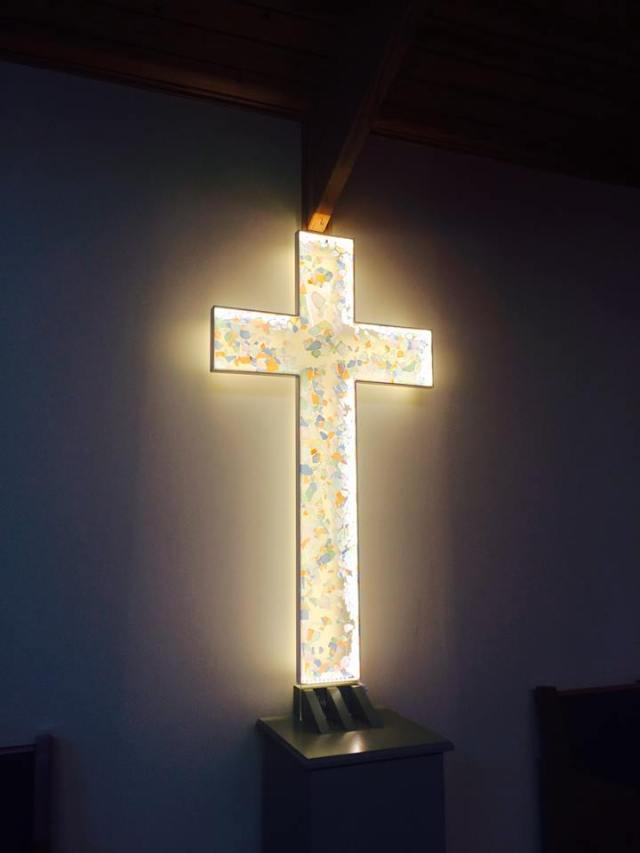
The first is this cross.  Our church community created this mosaic cross during Lent this year.  Each Sunday in worship during Lent, we brought our brokenness to the cross, represented by pieces of sea glass.  A few people named their brokenness; those words are engraved on some of the glass.  One shard bears Joshua Derby’s name.  Josh died a week and a half after Easter.

Creating the mosaic cross together was a deeply moving experience for our community.  The Sunday after Easter, Betty came up to me and said, “Just look what you did, Lady!  You created that beautiful cross.”  I reminded her that it wasn’t me, but the community that had created it.  Then Betty told me, “One Sunday, my whole family went up and we glued all our pieces of glass in the same area.  It was so meaningful.”  I jokingly said, “That cross has some Roth real estate on it!”

I never learned the address of that real estate, but what a powerful symbol, perhaps especially today.  Even in brokenness, the Roth family is together.  Even in brokenness, your family clings to its faith and its savior and the God who has loved us, loves us now, and will always love us.  Even in brokenness, John, Clay, Chase and Melanie, Gavin and Olivia, even in brokenness, you are surrounded by the love and care of this community of faith and your large community of friends.

One piece of glass on the cross contains these words:  “Even broken, it is well with my soul.”  That is the prayer of every person here today for you:  That even in the midst of the brokenness caused by Betty’s death, it will be well with your souls, especially yours, John.  We pray God’s presence, comfort, and peace.  We pray for your wholeness.

One last quote as we begin the difficult journey of grief.  It comes from Andy Raine of the Northumbria Community:

“Do not hurry as you walk with grief; it does not help the journey.  Walk slowly, pausing often: do not hurry as you walk with grief.  Be not disturbed by memories that come unbidden.  Swiftly forgive; and let Christ speak for you unspoken words.  Unfinished conversation will be resolved in him.  Be not disturbed.  Be gentle with the one who walks with grief.  If it is you, be gentle with yourself. Swiftly forgive; walk slowly, pausing often.  Take time, be gentle as you walk with grief.”

And John, Clay, Chase, Melanie, Olivia, Gavin, know that as you walk with grief, God walks beside you.  As do we.

In the name of our God, who creates us, redeems us, sustains us, and hopes for our wholeness.  Amen.


Posted in Uncategorized | Leave a comment

Singing the World into Wellbeing

Among my folk music friends, I often hear the lament:  “Where has all the movement music gone?”  Many social movements throughout history have been spurred on by music.  The labor movement in the 19th and 20th centuries and the Civil Rights movement in the mid-20th century are two examples.  Cyndi Lauper’s “True Colors” also has done a lot to bring folks together around LGBTQ rights.

With our iPods, Pandora, Youtube, and Spotify, though, we are rapidly losing a common musical vocabulary.  Folk singer Pete Seeger believed–really believed–that if people could sing together, they could accomplish anything.  Pete wasn’t looking at things from a faith perspective, but I think he was on to something.  We experience it every Sunday at Pilgrimage when we sing “Let There Be Peace on Earth and Let It Begin with Me.”  How often has simply singing that song, holding your neighbors’ hands, inspired you to live your faith more mindfully in the world?  Here’s a bit from NPR about five Pete Seeger songs you might have heard–or sung–before:  http://www.npr.org/2014/01/28/267584749/5-pete-seeger-songs-to-sing-together

On August 28th at Pilgrimage, we’re going to celebrate the music that inspires us to “act the world into wellbeing.”  In order to do that, though, we need to hear from you!  (We’ve got a few contributions already.  Thank you!)  I don’t know that we’ll be able to sing all the songs together in worship, but we can compile a list to share with the rest of the community.  In this way, we’ll begin to create our own Pilgrimage UCC Playlist for Acting the World into Wellbeing.

So that the musicians will have time to work up accompaniments, we’ll need your submissions by Sunday, 8/14.

Let the singing begin!

Kim

Posted in Uncategorized | 1 Comment

Sermon: Acting the World into Wellbeing? (7/10/16)

Acting the world into wellbeing… It’s a catchy phrase.  It resonates well with our mission here at Pilgrimage.  It sounds like exactly what we followers of Jesus should be doing.

But in light of what’s been happening in the world since we began our summer theme… it’s getting harder and harder to believe in anybody’s power to act anybody into wellbeing.  Orlando.  Baghdad.  Dakha.  Medina.  Istanbul.  Alton Sterling.  Philando Castile.  Dallas.  Why all this killing?  Why this inability to see each other as human beings?  What will it take to stem the tide of hatred and violence?  I suspect most of us are feeling overwhelmed right now.

I had planned to preach something else today, but the events of the last week cry out for some word.  But what can be said?  What’s the point?  Nothing seems to change.  In fact, things keep getting worse.

And yet…If our faith doesn’t speak to events like those occurring this week, what good is it?  Why believe at all if God doesn’t care about the brutal murders of so many people?  Any word that attempts to speak to what’s been happening will be inadequate.  But as people of faith, we are compelled to try.  As a preacher of the Gospel, I must try.

A word about this summer theme.  The description of love as “the power to act each other into wellbeing” has become one of our watchwords.  Before I ran across that description, love always felt like a touchy-feely ephemeral kind of thing.  But “acting each other into wellbeing”… that puts some feet to love.  Love is best demonstrated when one takes action to help the beloved become who they are created to be.

Extending the description of love outward to the world, makes sense.  If we are to “love our neighbor,” that love will be demonstrated by acting our neighbors–no matter where they live–into wellbeing.  Thus far, we’ve considered the differently-abled, those who struggle with mental illness, women, and the imprisoned.  Still on the schedule are the poor, refugees, those affected by racism, children, and the earth.

It was a helpful, well-thought-out plan.  But here’s my frustration.  The issues facing each group we consider are so complex–and big–that all we’ve been able to do is skate along the surface of the issues facing each group.  Sure, we can listen generously to the lives of all these different populations of people, but how in the world will we be able to act anyone into wellbeing?  The needs simply are too great.

In mulling over and praying about recent events, a thought occurred to me.  Maybe the reason I feel so hopeless when these tragedies occur is because I’m trying to come up with a response equal to the violence that’s occurred.

Here’s what I mean.  Events like Orlando, Istanbul, and Dallas happen so quickly.  They’re big, immediate explosions of hatred and evil.  I think I keep trying to come up with loving acts that are equally big and immediate.

But that’s not how love works, is it?  Occasionally, there are huge events where we all come together, but on the whole, we don’t act the world into wellbeing with grand gestures.  We do it step by step, system by system, encounter by encounter, person by person.

Which, in the moment, is frustrating.  When these huge tragic events occur, we want to fix things right away.  But these aren’t fixes that can happen right away.  The circumstances that have led to each violent act have been building step by step for months, years, decades.  Transforming the world into a safer, more loving place also will have to be done step by step for months, years, and decades.  As much as I want to fix things right now, when I stop to think about it, I realize that taking things step by step actually is more empowering.  Today, I have no grand gestures….but I can take a baby step.

Thursday of this week, I attended a gathering of clergy and law enforcement officers at the Carter Center.  The meeting launched a program called One Congregation One Precinct.  OneCOP is a step by step movement that seeks to “create a culture of consciousness, concern, and cooperation” by building bridges between law enforcement and faith communities.  The issues facing our country, especially in light of increasing violence, can’t be solved by law enforcement alone.  As the folks at OneCOP say:  “Law enforcement officials, civil rights advocates, civic activists, and faith leaders must work cooperatively around common public safety goals.”

How does OneCOP work?  The intention is to put a structure in place that will support the building of personal relationships between congregations and precinct law enforcement officers, the officers on the street…doing whatever we can, as one person said at Thursday’s meeting, “to see the humanity in each other.”  Congregations are encouraged to invite officers to attend services, to meet with congregants, including teenagers.  Each congregation will appoint a liaison to work with the precinct’s representatives.  We’ll be learning more in coming weeks about exactly what is involved in being a participating congregation.  I’ll keep you posted.

Today’s Scripture was read by a rabbi, who led Thursday’s gathering in an opening prayer.  How very good and pleasant it is when kindred live together in unity! What might that look like, kindred living together in unity, and how do we get there?  I think it entails doing exactly what was suggested on Thursday:  “Seeing the humanity in each other.”  Every evil act begins by denying or diminishing the humanity of the other.  If we commit ourselves to seeking out and celebrating the humanity in every single person, we’ll begin to see the way forward to living together in unity with our kindred.  If we don’t seek and celebrate the humanity of every single person, unity will continue to elude us….and the violence will continue unabated.

After the 10:00 service today, we’ll brainstorm together some things we might do to act into wellbeing this new world we’ve entered.  Whatever we choose to do—as individuals or as a community–it will involve seeing the humanity in each other….like two people at a convenience store did yesterday morning.  Some of you will have seen this shared on Facebook a million times, but it’s a story that bears repeating.

Natasha Howell, a young African American woman, posted this on social media.  “This morning I went into a convenience store to get a protein bar.  As I walked through the door, I noticed two white police officers (one about my age, the other several years older) talking to the clerk behind the counter (an older white woman) about the shootings that have gone on in the past few days.  They all looked at me and fell silent.  I went about my business to get what I was looking for.

“As I turned back up the aisle to go pay, the oldest officer was standing at the top of the aisle watching me.  As I got closer, he asked me how I was doing.  I replied, “Okay.  And you?”  He looked at me with a strange look and asked me, “How are you really doing?”  I looked at him and said, ‘I’m tired.”  He replied, “Me, too.”  Then he said, “I guess it’s not easy being either of us right now, is it?”  I said, “No, it’s not.”  Then he hugged me and I cried.

“I had never seen that man before in my life.  I have no idea why he was moved to talk to me.  What I do know is that he and I shared a moment this morning that was absolutely beautiful.  No judgments.  No justifications.  Just two people sharing a moment.”

“Just two people sharing a moment.”  How good and pleasant it is when kindred live together in unity.  How vital it is to see the humanity in each other.  Whatever we choose to do in response to events of the last week, we’ll do well to begin there…and to take things Step by Step.

Step by Step

Step by step the longest march
Can be won can be won
Many stones can form an arch
Singly none singly none
And by union what we will
Can be accomplished still
Drops of water turn a mill
Singly none singly none

In the name of our God, who creates us, redeems us, sustains us and hopes for our wholeness.  Amen.

Kimberleigh Buchanan  © 2016

Posted in Uncategorized | Leave a comment

Sermon: Acting Women into Wellbeing (6/26/16)

Have you heard?  Pope Francis has elevated Mary Magdalene’s saint day (July 22) to a Feast Day.  Among Catholics, the move puts Mary on equal footing with the Apostles.  The decree states that this woman, “recognized as one who loved Christ and who was very dear to him,” can be considered by the faithful as “a paradigm of the ministry of women in the Church.”

In a letter released along with the announcement, the Secretary of the Congregation, Archbishop Arthur Roche, argued that the decision speaks to the current moment facing the Church, which, in part, calls for “a deeper reflection on the dignity of women.” 

Isn’t that just great?

And yet, life is still precarious–and dangerous–for women worldwide.  30% of women worldwide have experienced physical or sexual violence.  The figure in the US is closer to 33%.  Half of those who abuse women are intimate partners or family members.  An alarming number of women across the globe have inadequate access to healthcare.  The vast majority of the world’s poor are women and children.  Rape is a terrifyingly common practice.

The issues are widespread and run deep in most cultures.  Where does one begin the process of acting women into wellbeing?

It’s a crucial question for people of faith in the 21st century.  Based on today’s Gospel story, I suspect few people were asking it in the 1st century.

Simon, a religious leader invites Jesus to dinner.  As they eat, a woman—who is known in town as a “sinner”—enters the house carrying an alabaster jar of ointment.  Imagine the scene with me.  “She stands behind Jesus, at his feet, weeping.  She begins to bathe his feet with her tears and to dry them with her hair.  She continually kisses his feet and anoints them with the ointment.”

What do you imagine those present are feeling?  Here’s the word that’s coming to my mind:  AWKWARD!  Yikes!  Even in our more progressive 21st century culture, if this happened at a gathering we were attending, I suspect it would make most of us uncomfortable.  Like, really uncomfortable.  But in that culture?  A culture that did not honor the whole personhood of women?  Or of so called “sinners?”  This was a social disaster—especially for Simon.  A sinful woman acting this way, doing these things to the great religious teacher?  It was scandalous!

Even more scandalous, is Jesus’ response.  Instead of scolding the woman and quoting Scripture at her, as any good religious teacher would have done, he tells Simon a story, a sure sign the Pharisee is about to be taken to school.

“A certain creditor had two debtors; one owed five hundred denarii, and the other fifty.  When they could not pay, he canceled the debts for both of them.  Now which of them will love him more?”   Simon answers, “I suppose the one for whom he canceled the greater debt.” Jesus says to him, “You have judged rightly.”   Oh no!  Not the “You have judged rightly” response!  Fasten your seatbelt, Simon, because your ride is about to get very bumpy.

“You have judged rightly,” Jesus tells Simon.  “Then turning toward the woman, Jesus says to Simon….”  Wow.  With one simple gesture, Jesus upends every social expectation, every modicum of propriety.  He looks at the woman….while he addresses Simon.

…which begs the question:  With whom is Jesus trying to communicate?  Are his words for Simon or are they for the woman?  While looking at the woman, Jesus says to Simon:

“Do you see this woman?  I entered your house; you gave me no water for my feet (a common sign of hospitality), but she has bathed my feet with her tears and dried them with her hair. 45You gave me no kiss, but from the time I came in she has not stopped kissing my feet. 46You did not anoint my head with oil, but she has anointed my feet with ointment. 47Therefore, I tell you, her sins, which were many, have been forgiven; hence she has shown great love.  But the one to whom little is forgiven (that’s you, Simon), loves little.”

If you’re Simon, the words are a scathing indictment.  If you’re the woman, they’re a deep affirmation of your personhood and generosity.  So, with his words, Jesus indicts Simon and praises the woman.  But what does his gaze communicate?  His gaze shows us that Jesus saw the woman.  The one Simon would have dismissed without a second thought, to Jesus is a human being, a beloved child of God…and more generous in spirit than the religious leader.

In the Gospel of Luke, Jesus spends a lot of time seeing women in their full personhood.  After the scene at Simon’s house, Luke tells us that Jesus “went on through cities and villages, proclaiming and bringing good news of the kingdom of God. The twelve were with him, as well as some women…Mary Magdalene, Joanna, and Susanna, and many others, who provided for them out of their resources.”  Perhaps those women followed Jesus and helped with his ministry because he had seen them and welcomed them as equal partners in the work he was doing.

Which is great…but how might this story help us figure out how to act women into wellbeing today?  How do we act women into wellbeing?  We do what Jesus did:  we see them.  We see women as beloved children of God.  (And for the women in the room, that means we see ourselves as beloved children of God.)  We see women as whole human beings.  We see them as deserving of a life free from fear of violence, as deserving of equal pay for equal work, as deserving of having a say in what happens to their bodies, as deserving of respect and dignity and freedom from being objectified simply because of their gender.

Remember all the hubbub when Caitlyn Jenner came out?  Jon Stewart nailed it when he said:  “It’s really heartening to see that everyone is willing to not only accept Caitlyn Jenner as a woman, but to waste no time in treating her like a woman.  You see, Caitlyn, when you were a man, we could talk about your athleticism, your business acumen, but now you’re a woman, and your looks are really the only thing we care about.

“Pundits are asking each other important questions about the societal impact of Caitlyn’s transition, such as “Do you think Caitlyn is hotter than Kris?” and “Does she have a better body than Kim Kardashian?” and, saving the best for last: “She looks good!  Especially for her age.”

“There you go! That’s the caveat we were missing: Remind her she has an expiration date now! You came out at 65, you’ve got another two years before you become invisible to society.”

Trying to make the world a safer, more life-giving place for women is a daunting task.  If you want to work for women’s health and wellness, I encourage you to check out the Half the Sky Movement website at halftheskymovement.org   http://www.halftheskymovement.org/pages/movement   In the meantime, here’s a place all of us can begin—with the women in our lives, the girls and women we know.

Last week was Father’s Day.  In all the excitement of VBS Sunday, I totally forgot to mention it.  As a way to make up for the omission last week and connect it to worship this week, I invited some of our fathers who have daughters to name their hopes for their daughters.  They’ve given me permission to share some of their responses.

One father hopes his older daughter gets through her husband’s retirement from the military and that his younger daughter successfully completes college.


Another dad hopes his daughter will live a long, healthy life, where she feels empowered and fulfilled with what she does with her life, and of course, be happy.


One dad said this.  I’ve always said to my daughter – if you want something and you work hard, you will attain it. No matter what it is you want to do or accomplish you will always be competing against others so do your best every time; relax and breathe and you will be successful.  At this time in her life she has actually listened and done what I instilled in her and she is successful and knows what it takes to accomplish anything that she wants.   I am glad and very proud and I know she will keep going with that.


My hope for our daughters is that through the influence of family, church and school, our daughters will make decisions which will help fulfill each one’s goals and ambitions and allow them to grow into the person they want to be.


What do I hope or wish for my daughter?  My sincerest wish is that she finds happiness and contentment in life. That she continues to chase rainbows. That she never loses faith in God or in herself. That she remains the independent and determined soul that she is and I hope always will be. That she finds the love of her life.   And, that she knows my love for her is eternal.


I pray that my daughters will always have love in their hearts, and be lights in the darkest of places.  I pray they will find what they love to do and not let any struggle keep them from doing it.  I pray they will dance with such great joy they will bring the same peace and happiness to all those watching that I experience.  I pray they will never go a day without hearing the words, “I love you.” I pray they will know how wonderful and beautiful they are but also understand the same wonder and beauty exist in all of their friends.  And I pray that if the road of life does get too hard for them, I, or someone else, will always be there ready to give them a hug.   Finally, I pray for all the daughters of the world that their voices will continue to remain strong and that one day all of our daughters will grow up in world without violence so they can realize what sweet gifts they are.


Want to act women into wellbeing?  Follow the examples of these dads and the example of Jesus—see the women in your life, listen to them, and do everything in your power to help them become all God has created them to be.

In the name of our God, who creates us, redeems us, sustains us, and hopes for our wholeness.  Amen.

Kimberleigh Buchanan © 2016


Posted in Uncategorized | Leave a comment

Sermon: What Are You Doing Here? (V BS Sunday, 6/19/16)

It’s been an intense week, she understated.  It began last Sunday as reports of the mass shooting at the Pulse nightclub in Orlando began pouring in.  VBS began the next  day.  Wednesday, many of us gathered here at Pilgrimage for a prayer vigil for those affected by the shooting in Orlando.  Friday marked the first anniversary of the mass shooting at Emanuel AME Church in Charleston.  Today, we hear from the children–both in their words for worship and in their actual voices–about their experiences during VBS.

It’s been an intense week.  I confess it would have been easier for my work as your pastor if I could have chosen to focus on just one thing, either the shooting or VBS.  But that’s not where the Spirit led.  The Spirit led me to be as present as I could to both places–to the place of outrage and grief over the Orlando massacre and to the place of imagination, hope, creativity, and joy of VBS.

I’m not going to lie.  I need a nap…as do, I suspect, most of the adults who helped with VBS this week.  For today, though, I invite us all to be as fully present as we can to all that has happened this week…because, though it might seem like mass shootings and VBS have nothing to do with each other, I suspect that finding the connections between them might just show us the way forward as we seek to act a hurting world into wellbeing.

A good place to begin is with one of the VBS Bible stories, the one about Elijah.  Elijah was a prophet of God…and a thorn in the flesh of the King Ahab and Queen Jezebel.  The conflict culminated in a contest between Elijah and Ahab and Jezebel’s prophets of Baal to see whose God was the true God.  Elijah won…which enraged the king and queen.  They were so enraged, in fact, they went after Elijah intending to kill him.

The besieged prophet ran and ran and ran into the wilderness.  Finally, he collapsed under a broom tree and asked to die.  “It is enough; now, O Lord, take away my life, for I am no better than my ancestors.”  (Just so you know, we didn’t include this part of the story in VBS. J)  As soon as he speaks the words, Elijah promptly falls asleep.

Hopelessness is exhausting, isn’t it?  When you do your best to make the world a better place, when you share God’s love with others in compassionate, merciful, justice-seeking ways, when you parent your children as thoughtfully as you know how…when you do everything right and the world still falls apart…  Hopelessness is tempting.  And disempowering.  Sometimes the easiest thing to do is simply go to sleep and forget it all.

That’s what Elijah does.  He falls asleep.  When he wakens, an angel is there with food and water.  “Get up and eat,” the angel says.  Elijah does, then goes back to sleep.  When he wakes up the second time, the angel is there again with food and water.  “Get up and eat,” the angel says again, “otherwise the journey will be too much for you.”

It’s easy in the midst of tragedy and terror to neglect the things that nourish us.  We forget to eat.  We neglect sitting down at the table with our family every day.  We stop praying.  We avoid the faith community that nurtures us.

The angel reminds Elijah that even in the midst of tragedy and terror, it is vital that we continue doing those things that feed us—physically and spiritually.  If we don’t…if we don’t get the rest we need, if we don’t eat good food at regular intervals, if we neglect nurturing our spiritual selves, then the journey to a better, more hopeful place will be too much for us.

After a couple of good long naps and some nourishing food and drink, Elijah sets out.  “He goes in the strength of that food for 40 days and 40 nights to the mount of God.”  Then what does he do?  He finds a cave and spends the night.  Yes.  He sleeps again.

When he wakes up, the word of God comes to Elijah and asks:  “What are you doing here, Elijah?”  Elijah responds:  “I have been very zealous for God; the Israelites have forsaken your covenant, thrown down your altars, and killed your prophets.  I alone am left and they want to kill me, too.”  Even after fleeing from those who wanted to kill him, getting some rest and nourishment, and journeying to the mount of God, Elijah still feels hopeless.  At least he wants to live now; that’s progress, I guess.  But he’s still sounding pretty whiny.

What are you doing here today?  When Miss Janet saw today’s sermon title, she said, “Because Miss Janet told me to be here.”  That, of course, goes without saying.  J

Why else are you here?  Are you here because your child is participating in worship?  Are you here because you’re trying to make sense of what happened in Orlando?  Are you here because this is where you always come when life goes off the rails?  Are you here because you want the wider community to know that the Christians getting most of the media coverage right now do NOT speak for all Christians?  Are you here because this is one place where you can just be yourself without fear of ridicule…or worse?  Are you here because you want folks who identify as LGBTQ to know they are loved?

Are you here because, like Elijah, you’re just hanging on by a thread and desperately NEED to experience some glimmer of hope?

So, Elijah is asked what he’s doing at the mount of God, he does his whiny, hopeless thing, then the Spirit tells him to wait for God, who’s about to pass by.

“There was a great wind, so strong that it was splitting mountains and breaking rocks in pieces before the Lord, but the Lord was not in the wind; and after the wind an earthquake, but the Lord was not in the earthquake; 12and after the earthquake a fire, but the Lord was not in the fire; and after the fire a sound of sheer silence.13When Elijah heard it, he wrapped his face in his mantle and went out and stood at the entrance of the cave.”

Then–you’re going to love this part–then God’s Spirit asks again, ‘What are you doing here, Elijah?’  I hope you won’t think less of Elijah when you hear that his response–even after the earth, wind, and fire…I mean, wind, earthquake, fire, and sheer silence–in response to the identical question of God’s Spirit, Elijah responds identically:  “I alone am left of the Prophets of God…and they’re trying to kill me.”

Will our response also be the same?  After Newtown, after Charleston, after San Bernardino….every time we say, This has to stop!  But it’s not stopping.  Gun violence–and other forms of violence–are escalating exponentially.  What will our response be this time?

What are we doing here, church?????  How will we respond this time to unspeakable violence?  Will we continue to wring our hands and allow ourselves to remain mired in helplessness and hopelessness?  Or.  Will.  We.  DO SOMETHING?

Despite his hopelessness, Elijah takes action.  He allows God’s Spirit to lead him.  He slowly acts himself back into doing the work God has for him to do.

The same can be true for us.  We’ve had the wind knocked out of our sails this week.  It doesn’t take a lot of imagination to understand where Elijah was coming from.  Sometimes you work and work and work to act the world into wellbeing and it’s like you’ve done nothing at all.  It’s easy to feel hopeless…and when we get hopeless, we get idle.  Nothing seems to work, so why try?  And when we get idle, the world really does become more broken.

So…What are we doing here, Church?  What will we do?  Will we, despite our hopelessness, listen to the still small voice and go where God’s Spirit leads?  The Missions Team is creating space for us to begin dreaming together about what we might do in response to the mass shooting in Orlando.  Our responses, no doubt, will be varied.  Will you ramp up your support for the LGBTQ community?  Will you seek to educate people about mental illness?  Will you work for sensible gun legislation?  Will you seek to strengthen ties between law enforcement and the community so that we can work more closely together to end violence?  Will you seek to work with those who’ve been traumatized by violence?

Wednesday at VBS, we heard the story of Jesus’ baptism.  I don’t know what the recreation activity was that day, but I’m pretty sure it involved large amounts of water.  Just before one of the groups came into music that day, Miss Janet warned us that the children might be drenched.  They were.  Head to toe.  And they were full of energy…laughing, loud, joyful.  On that day, for those children, baptism had become… a contact sport.

If you think about it, it kind of is, isn’t it?  After John baptizes Jesus, a dove descends and Jesus hears these words:  “You are my beloved child, with you I am well pleased.”   That moment—his baptism and the reminder of God’s deep love for him—THAT is what gave Jesus the energy he needed to do his work of acting the world into wellbeing.

Baptism isn’t some quaint ritual we Instagram and tweet then forget.  No, baptism is a contact sport!  It’s loud and playful and joyful!  And necessary.  Baptism—this knowledge that we (every person) is a beloved child of God, that God’s spirit is with us and leads us, that God is pleased with us, even when our efforts seem so tiny and ineffective—our baptism is what gives us the energy we need to continue Jesus’ vital work of acting the world into wellbeing.

Are you feeling hopeless and helpless today?  If so, remember your baptism…then get to work.  And if it still seems too hard, find a child to go with you—because children get it.  Like the child on the viral video who, instead of whacking the piñata Spiderman, drops the stick, walks over to the papier mache figure, and embraces it.  Children get it.  Children get it.

In the name of our God, who creates us, redeems us, sustains us, and hopes for our wholeness.  Amen.

Kimberleigh Buchanan  ©2016


Posted in Uncategorized | Leave a comment

Sermon: Acting Those Who Struggle with Mental Illness into Wellbeing (6/12/16)

It’s an old story.  A person struggling with mental illness is excluded from the community, called demonic—that is, not of God.  When the person gets some relief for his illness, the community still wants nothing to do with him.  Yes, it’s an old story.

Or is it?  Even after all the progress that’s been made in psychology in recent years, on the whole we’re still trying to figure out how to respond to people who struggle with mental illness.  Too often, the church has been silent, or worse yet, has continued to act as though mental illness is, if not demonic, at least not of God.

I am heartened by the space this congregation creates for people to talk about their struggles with mental illness.  It all started many years ago when Jamie Durkee shared with us how she had found God in depression.  That testimony helped us to see that it’s okay to talk about mental illness.

Today, we’re going a little deeper to reflect on how we might act those who struggle with mental illness into wellbeing.  Last week, I suggested that our main task this summer isn’t so much to get to work acting all the groups we’ll be talking about into wellbeing.  If we try to do that, we’ll be burned out by August.  No, our number 1 job this summer is listening generously.  According to Dr. Rachel Naomi Remen, the goal of generous listening is simply to learn what is true for the other person, then to receive it and respect it.

Today, we’ll hear from some of our members about their experiences with mental illness.  Our task is to listen generously…to learn what is true for each person, to receive it, and to respect it.

Trudy’s story. 

Mental illness runs deep in my family.  What we affectionately call “the Grenon Crazy Gene” that actually comes from my paternal grandmother’s side of the family. Of her 8 children, 4 have diagnosed mental illnesses, and her oldest son, a 76-year-old Air Force veteran, retired professor of history, was recently killed by police during a standoff resulting from a severe mental crisis as a result of under-treated paranoid schizophrenia.  Mental illness is my family.

Kim sent me today’s bible reading.  I had a lot of feelings about this reading that all just came out. And I’d like to share them with you…

Fear. People fear mental illness and people with mental illness. People were afraid of the man with his demons and then they were afraid of Jesus after he healed the man of his demons. They did not understand it and they were afraid of all of it, the affliction and the process to healing.

That fear leads to a dehumanized view of people with mental illness (please notice my deliberate use of “people with mental illness” and not “mentally ill people” or “the mentally ill”. My choice of terminology allows the people I am talking about to retain their dignity first and foremost as a person, a person that happens to have a mental illness and it does not define their entire self by their illness). When we have a dehumanized view of people with mental illness, it is easier to write them off, “oh, she’s just an addict” or “that guy is a psycho” or “look at that crazy bum”. These people, like every one of us, are someone’s child…someone’s brother/sister, many times someone’s parent, uncle, cousin, etc. THEY ARE A CHILD OF GOD. And they are hurting. And our society denies that pain and suffering, allowing addicts to wallow in their self-medicating addiction, allowing folks with mental illness and little financial means to become homeless, allowing folks in mental illness crisis to escalate to the point of them facing eviction, cowering in their bathtub, clutching a kitchen knife tightly, fearing everything, and then getting killed by police when they try to run out and protect themselves from the danger that their illness is telling them they are facing.

All because we are afraid.

We need to stop being afraid and start looking with love at people with mental illness. When we hear of someone getting diagnosed with cancer or heart disease or diabetes, we don’t shun them. We don’t call them names. We shower them with love and cook them tasty casseroles and put them on our prayer lists. When someone gets a mental illness diagnosis, we [our society, not necessarily the members of our church] pull away. We give them the side eye when they act up in public. We get angry when they turn to illicit drugs to feel better and can’t understand “how anyone can choose to put a needle in their body.” We hurry by and look away when we see them sitting on the street, with all their belongings in a ratty backpack, their faces and hands dirty and worn from not bathing for weeks/months. We need to be more like Jesus and go toward them with love, not away from them with fear.  Just like us, they are children of God, and as their siblings in God, we need to act them in to well being, too.

Julia’s story. 

Good morning.  Pastor Kim asked me to tell you a little of my story, my families story, as we look at Acting the Mentally Ill Into Wellbeing.

Some mental illness is passed on directly in the genes, the DNA.  Some of it is passed from generation to generation through trauma left unhealed.  I met two of my great grandmothers.  I don’t know much about their stories, but their lives weren’t easy, and they left their marks on my two grandmothers.  Both grandmothers had traumatic childhoods and one also developed manic depression, what we now call bipolar disorder.  Both grandmothers spent their lives as active members of their church but I never heard of either one sharing their struggle with their church community.  None of their children had a diagnosed mental illness, but there was plenty of damage, unhealed in one generation, then passed on to the next.

The family legacy of mental illness mostly passed my mom and dad.  So they didn’t have a clue what to do with me.  I was aware of being depressed as young as 7, but I’m not sure when it started.  But my parents needed me to be a happy, healthy little girl.  Besides, little girls in the South in the 60’s didn’t get depressed.  It was only when I got old enough to act out that anyone tried to help me.  We were very active in church but it wasn’t somewhere I could share the darker parts of my life.

I met Chris, got married, had two little boys, and was finally ready to deal with my depression. Therapy helped, but it became obvious that more was needed. We had become active in a large Methodist church out here in the suburbs.    I was terrified that taking medications would ruin the relationship I had with God.  And I sure wasn’t going to tell anyone that I was taking anti-depressants. It took quite a while to convince a doctor that I needed help.  I had become very good at being a happy little girl.

But it was only when I finally got the help I needed that I was able to come into full relationship with God.  I was able to open up, to let myself be led by God.  I became a Stephens Minister, then a Stephens Leader.  I became active in the prison ministry, Kairos, along with my mother. I was active in early AIDS ministries.  I experienced such joy in reaching out to others, listening to their stories.  It fulfilled a great need within me.

When Chris and I first had children, I was determined not to let my boys grow up the way I had.  I didn’t know my mom loved me because I was so depressed.  So when first one son, then the other, starting experiencing trouble, I was lost.  I was in a world of pain.  But I wasn’t in denial.  Both boys were in counseling by the time they were in elementary school.  One son was depressed and suicidal but responded well to medications.  The other continued to have problems, until the day came when he had his first manic episode.  I immediately recognized it for what it was, and he was diagnosed and began treatment that same week.

The hard part was the next Sunday, sitting in church with a heavily medicated child draped across me, and I stood up in prayer time and let everyone, our whole church family, know what we were facing, and that we needed their support.  We all left church that day crying, and so many people came up to tell me about their own stories, their parents, spouses, children, all suffering from mental illness.  It was then that I became passionate about making mental illness and mental health something that was talked about in church.

We came here a few years later.  It took me awhile to become active here because leaving the last church had been so painful.  But Pastor Kim gave me the time and the space to heal, to renew my relationship with God.  And so it is my great passion in life to make this place, this family of God, a safe place to share all the troubles that come in life.  Some of our physical illness comes from mental illness – Granny with memory loss and dementia from early treatment, me with prediabetes due to the food addiction that started in my need to self-medicate, to my son who has kidney damage from the very drugs used to treat his mental illness.   I still get people taking me aside and telling me stories about their families struggles.  We are getting better about sharing all our troubles.  Here we can take ALL of our pain to God and to our church community and know that we are heard.

Donna’s story. 

I want to thank Pastor Kim and the congregation for giving me this opportunity to speak about mental illness.  When Pastor Kim told me how long I was allowed to speak, my first thought was, “Oh mercy, how will I ever be able to say much about mental illness in that amount of time?” After all, when I was in seminary in the 1970’s, I learned not to say anything in five words that I could say in twenty- five. Also, regarding the scripture reading this morning, I am uncomfortable with the words demon or demonic and hope, at least related to mental health, so hopefully, we can understand these two words as metaphors.


This shirt is one I picked up from a conference I went to last year sponsored by NAMI (National Alliance on Mental Illness) which was held Richmond, VA in May. The shirt says, “1 in Five” because that is how many children have a mental illness. Mental illness has many forms and sometimes it is difficult to diagnose. Some of the following illnesses may be familiar to you, however this is not an exhaustive list: ADD, ADHD, Oppositional Defiant Disorder, Obsessive Compulsive Disorder, Sensory Integration Disorder, Bi-polar Illness, Autism (Spectrum), Depression, Schizo-Affective Disorder, Schizophrenia, and the list goes on. I believe that sometimes it is difficult to understand these illnesses because there is no outward physical sign. These are all difficult issues for families – there is usually a certain degree of grief once a family becomes aware that someone in their family has a mental illness. It is important for family members to have an opportunity to grieve what is lost to them upon diagnosis. There are many questions and concerns that get raised one of the biggest being, “will my child ever be able to live independently?”  Another – “What will be required of us to raise this child to live out her/his potential?” There is usually an expectation that children will be launched into a full adult life which is less dependent, and more interdependent, with the adults who are raising that child. This can change the plans and social needs of the adults who are raising a child whose future is so uncertain.


Mental illness knows no social, cultural, economic, educational, or religious bounds. It can strike anywhere to anyone, even families without prior history.


Somethings that are important to remember – it is important to say, “my child HAS a mental illness” rather than “my child is bipolar or depressed, or schizophrenic.” A person who has a mental illness, like all of us, is made up of a lot more than one individual characteristic. There are many complex parts to every human being.


My son, Palmer (show picture) – isn’t he beautiful? He is 13 years old and going into the 8th grade at Simpson Middle School. As an adoptive parent of two children, I can say that I was lucky enough to be at his birth. He was born healthy and beautiful; however, he had a great chance of developing bipolar illness given that one of his biological parents has bipolar disorder. He also inherited ADHD, dyslexia, and some sensory integration struggles. He has, although not inherited, ODD. He was a very easy baby and a wonderful, not terrible, two- year -old. However, about the time he was three years old, it was clear that we had gone from easy sailing to some rough waters. It was a bit surprising and also painful. This was a child who was talking in full sentences at 18-months old and showed every sign of advanced academic and physical development. And in fact, he is still able to read at the 99% despite having dyslexia and is very athletic. And when he is on the good side of his bipolar illness, he is an incredibly delightful, funny, kind, thoughtful, articulate boy who is nicely moving on to young adulthood.


Palmer has given me permission to share this story. When he was about 3 ½, he had gone into a terrible tantrum and was throwing things around his room and was in an intense rage. That evening when I was putting him to bed I asked him, “Where does my nice boy go sometimes, I really miss him.” He looked at me and said, “Well, I have a good brain and a bad brain and sometimes the bad brain tells the good brain what to do.” So I asked, “Do you think that you could recognize when that is going to happen and help the good brain tell the bad brain what to do?” “No, Mommy, I can’t because the bad brain is too powerful.” This was astonishing coming from a three- year- old and it caused me great grief and concern. He was officially diagnosed at about 8 years old. We have had some wonderful doctors and therapists to help us along the way and I was in a NAMI support group until a few months before we moved to GA.


Of course, Palmer has an IEP so that he can have the best help possible in school. He has a wonderful teacher in wonderful school, yet there is still a long way to go before teachers and other educators understand the best processes and protocols for helping students like Palmer succeed without excessive punishment.


What does a family who is struggling with a mental illness need? Support, care, patience, and a lack of judgment when someone acts out in public. Have you ever looked at a situation and wondered, “why can’t that parent get that child under control?” What that parent may need is understanding and some respite. Parents who have a child with a mental illness, must learn many new, and perhaps untried, ways of parenting which may not be understood by family and friends whose comments can be hurtful and show a lack of understanding.


There are many good books for learning about mental illness and two that I can recommend. One is called The Bipolar Teen by Miklowitz and George and the other one is I Am Not Sick and I Don’t Need Help by Xavier Amador.


There are gifts that come with mental illness – heightened perception, sensitivity and in some, even genius. Some famous people who have struggled with mental illness and have obviously been highly successful – Abraham Lincoln, Jane Pauley, Catherine Zeta-Jones, Rosemary Clooney, Patrick Kennedy, Winston Churchill, Ludwig Von Beethoven, and many more.


Here is a piece of my son’s genius. When he was three years old he made up this song, “God made people, but people really do not understand God.” He is a very deep thinker and seems to know things that he has not necessarily been taught.


A number of us attended the book club meeting on Tuesday night in which we discussed the book Just Mercy. The book is well worth reading, although also difficult emotionally as it deals with people who are socially disadvantaged and may be struggling with a mental illness who are incarcerated. I want to leave you with 2 ½ short paragraphs from this book which I think address how we can love and care for those who struggle.


“Our shared vulnerability and imperfection nurtures and sustains our capacity for compassion.”


“We have a choice. We can embrace our humanness, which means embracing our broken natures and the compassion that remains our best hope for healing. Or we can deny our brokenness, forswear compassion, and, as a result, deny our own humanity.”


“…simply punishing the broken – walking away from them or hiding them from sight- only ensures that they remain broken and we do, too. There is no wholeness outside of our reciprocal humanity.”


Thank you.


Let us pray.  Holy One, we thank you for our sisters who have shared today.  We know it can’t have been easy.  Struggling with mental illness ourselves or with the effects of the illnesses of loved ones…There just aren’t that many places in our lives where we can talk honestly about these kinds of things.  We are grateful for this place, which is as safe as we know how to make it.  Thank you that here at Pilgrimage it is okay to talk about depression, bi-polar disorder, schizophrenia, and other diseases of the brain.  As we listen generously to each other and share together in our struggles with mental illness, as we seek to act each other into wellbeing, give us wisdom and insight into how we might act those who struggle with mental illness outside this community into wellbeing as well.  In the name of your son, who had profound compassion for all who suffer, we offer this prayer.  Amen.

Posted in Uncategorized | Leave a comment

Sermon: Acting the World into Wellbeing–The Differently-Abled (6/5/16)

Kim:    “Jesus Heals a Crippled Woman…”             Holly/Dan:    Not respectful….


Kim:     But that’s the title given by the editors of the NRSV, “Jesus Heals a Crippled Woman.”


Holly/Dan:   It’s not respectful.


Kim:    Okay.  Jesus Heals a Handicapped woman.       Holly/Dan:  Not respectful.


Kim:   Jesus Heals a Disabled Woman.    Holly shakes her head.


Kim:    Come on!  It’s called the Americans with Disabilities Act!  Surely “disabled” will work!


Holly shakes her head.


Kim:   Then what do I say?  I don’t want to be disrespectful, but I also don’t know what to say.


Holly/Dan:  Explains the term “differently-abled.”


Kim:    Huh.  That makes a lot of sense.  Okay.  Jesus Heals a Differently-abled Woman.  (Looks at Holly, who nods.)  10 Now he was teaching in one of the synagogues on the Sabbath. 11And just then there appeared a woman with a spirit that had crippled her for eighteen years.  Oh, that is so true.  Disabilities–differing abilities–often are sent by God to teach us lessons, right?


Holly/Dan:  Response.  (“Things just happen…  God is there waiting…”)


Kim:    So, now you’re questioning my theology?  Talk about no respect!  (To Holly)  May I continue?  (Holly nods)  She was bent over and was quite unable to stand up straight. Oh, that poor woman.  Can you imagine only ever seeing the floor?  How did she reach anything high up?  And I’ll bet everybody stared at her.  And I’ll bet she couldn’t work.  I bet she didn’t have any family.  I’ll bet she had no social life.  I feel so sorry for her.


Holly/Dan on not pitying…the differently-abled work, date, get married, have families, play sports…


Kim —  12When Jesus saw her, he called her over and said, ‘Woman, you are set free from your ailment.’ 13When he laid his hands on her, immediately she stood up straight and began praising God. That woman must have had a lot of faith.  Faith can heal you, right?  If people just had enough faith, they wouldn’t have to deal with disabilities (differing abilities).  Holly —  Response


Our theme this summer is “Acting the World into Wellbeing.”  Each Sunday, we’ll look at a specific population and consider what it might take to act those folks into wellbeing.  If you’ve looked at the worship schedule, you’ll see two unlabeled days.  That’s so we can imagine together what other groups or issues we might like to consider.  Let me know if you have ideas.

Acting the world into wellbeing…Sounds like something we Pilgrimage folks would be all over, doesn’t it?  Act the world into wellbeing?  You betcha!  Sign us up!

But sign us up to do what, exactly?  What might acting others into wellbeing look like?

It depends on the person, right?  What will act one person into wellbeing might not have any effect—or maybe even a negative effect—on someone else.  The first step, then, in acting someone into wellbeing is learning what it will take to act them into wellbeing.

So, how do we learn what it will take to act someone else into wellbeing?  We can do research, watch videos, read books.  We can talk with people who’ve worked with those populations.  That’s what we did with the book drive.  The Missions Committee invited us to collect books for children at Argyle Elementary School because Christy Stanley used to—and will again–teach there and understands the struggles of those students.  All those are great ways to learn what it takes to act others into wellbeing.

There is another way that’s even more effective.  How might we learn what will act someone into wellbeing?  We ask the expert—the person him or herself.

Sounds simple, doesn’t it?  Just ask someone what they need then do your best to meet the need.  How often, though, have we– other churches, well-meaning nonprofits–assumed we already knew a group’s needs and sought to meet those needs without ever stopping to ask if it’s something the people actually want or need?

I’ve just returned from songwriting camp at the Highlander Center for Research and Education.  Highlander was started by Myles Horton in 1932 at a donated homestead near Monteagle Gap in Tennessee.  In the 70s, it moved to its current location just east of Knoxville.

Growing up in the hills of Tennessee, Myles had seen coal miners struggle with unfair practices by the mining companies.  Those hard-working people had little say in their lives and little to show for their labor.  Myles established Highlander as a place for the miners and their families to come, talk together about the issues confronting them, and devise their own solutions to those problems.  That’s why the main meeting room at Highlander is designed like a yurt— it’s a circle—of rocking chairs—with a ceiling designed to amplify all voices around the circle.  In the 1930s and 40s, most of the miners and their families were so beaten down by their difficult lives they didn’t know they had the power to solve their own problems.  They assumed some experts somewhere had the solutions to their problems.  The methods they learned at Highlander empowered them to name their own issues then ask the Highlander staff to put them in touch with people and agencies that had the means to help them solve those problems.  Which makes sense.  Who knows better what wellbeing looks like than the person him or herself?

That’s why I’m inviting you all to help plan the worship services this summer.  I know Holly has worked for several years with folks who are differently-abled and has had to deal with some medical issues of her own.  She knows more than I what it takes to act the differently-abled into wellbeing.  She’s worked with and talked with and listened to lots of folks who navigate an able-bodied world as a differently-abled person.  Our little shtick a minute ago illustrated (or was meant to J) the importance of listening to those we seek to act into wellbeing.

Really, that’s our theme for the entire summer—listening.  On the whole, how would you rate people’s listening skills these days?  I’m going to go out on a limb here and say that, as a species, I don’t think we’ve quite lived up to our listening potential.

Early in her work as a physician, Dr. Rachel Naomi Remen realized that “every illness has a story attached.  A person is given a diagnosis of cancer or diabetes or heart disease, but the details of a person’s life make every cancer or diabetes or heart disease different and every course of healing unique.”  (Krista Tippett, Becoming Wise, 24)  The first step toward determining an effective course of healing is to listen.  Generously.

Here’s how Dr. Remen describes “generous listening” to her colleagues.  Generous listening isn’t about listening to analyze or figure out how to fix a problem; it’s not assessing whether or not you agree with what’s being said or whether or not you like the person who’s speaking.  The goal of generous listening is simply to learn what is true for the other person.  “In generous listening, you don’t even listen to understand why the other person feels the way they do.  It doesn’t matter why.  What matters is what’s true for this person.  And you simply receive it and respect it.”   https://www.youtube.com/watch?v=UdhP6sR5uvk

On the day in question in today’s Gospel lesson, the leader of the synagogue didn’t listen very generously to the life of the bent-over woman Jesus healed on the Sabbath.  All he heard when the woman shouted her thanksgiving was evidence that a Sabbath rule had been broken.

Jesus reminds the man that even the most faithful Jew will untie an ox or donkey from the manger and lead it to water on the Sabbath—another breach of Sabbath law.  If you’ll break the Sabbath law for your livestock, Jesus asks, why not do the same for this woman who has suffered so long?  Jesus is inviting the synagogue leader to listen more generously, to hear more deeply the experience of the woman who hadn’t stood straight in 18 years.  He invites the man to hear that woman’s life and simply receive it and respect it.

At this year’s songwriting camp, John McCutcheon invited us to hear someone else’s life and simply receive it and respect it.  He asked us to pair up and spend ten minutes each listening to our partner tell a personal story.  Then we were to take the story and create a song.  The last night of camp, we shared our songs with the group.

I can’t vouch for the quality of the songs, but the quality of the learning?  Tremendous.

You listen differently—more generously, more deeply—when thinking about how to give voice to another person’s experience.  John encouraged us to check in with our partners as we wrote to make sure what we were writing was accurate.  When I checked in with my partner, Joan, I realized I’d made a lot of assumptions, some of them wrong.  Thankfully, she was gracious when she corrected me.  J

I’m still unpacking the experience, it was so rich and deep.  I was deeply honored the last morning of camp when Joan camp up to me and said, “You said things in the song I never would have said, because I’m a jokester.  I make a joke out of everything.  But you got below the surface.  You said things I was feeling.  Thank you.”  For my part, I was amazed at what Joan was able to do with the story I told her.  Hearing her take on my story helped me hear it in a new way.

That assignment was deeper than anything we’ve ever done at camp.  I suspect that’s because it drew us out of ourselves and into someone else’s experience.  We weren’t so concerned about rhyme or rhythm or form.  We were more concerned about honoring the person whose story we were telling.  That concern led us to listen intently.

We’ll be listening to lots of lives this summer—those who struggle with mental illness, women of the world, the imprisoned, the poor, those affected by racism…  The goal of our listening will be simply to receive and respect what we hear, to honor the dignity of every person.  And if, in the midst of our generous listening we discover ways we might act others into wellbeing, I say, let’s go for it.  Who knows?  It might even lead to some songwriting.  J


In the name of our God, who creates us redeems us, sustains us, and hopes for the wholeness of the world.

Kimberleigh Buchanan  © 2016


Posted in Uncategorized | Leave a comment