Sermon: Longing for Certainty (4/3/16)

(https://www.youtube.com/watch?v=Tj2UkQ9kLIE) That’s Susan Werner’s “Probably Not.”  She calls it the “Agnostic’s Anthem.”  About time someone wrote one of those, isn’t it?

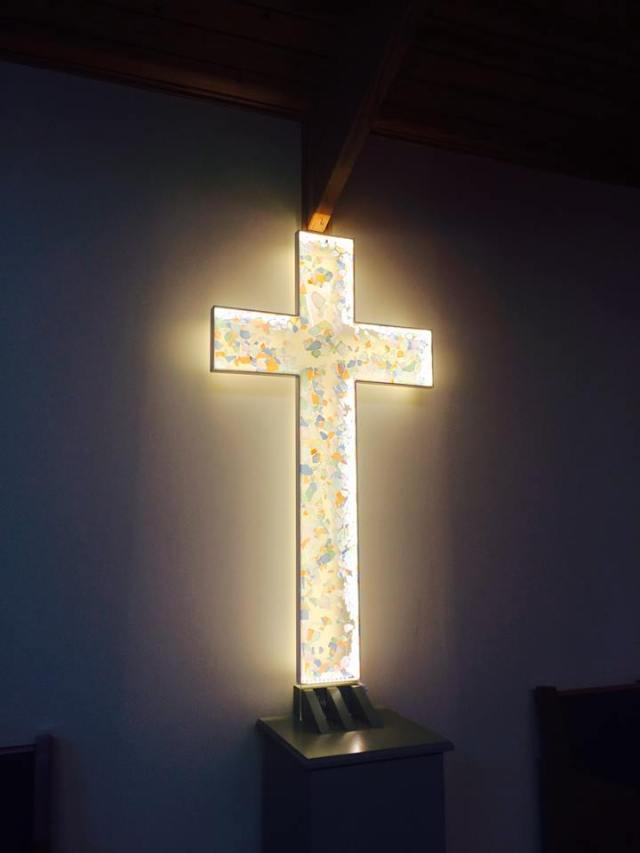
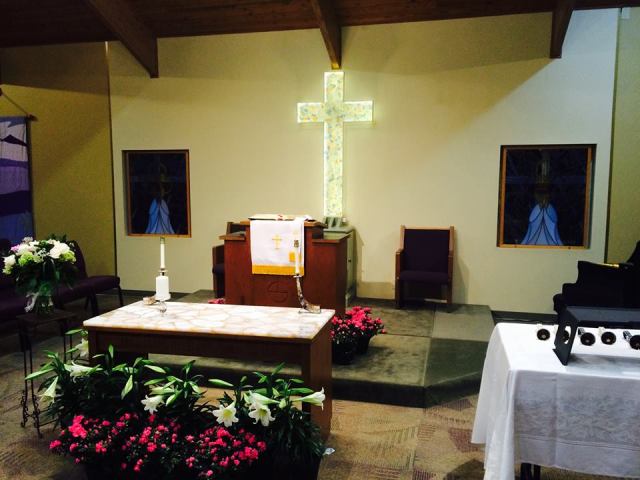
Last Sunday was great!  We got Jesus raised from the dead, reintroduced Alleluias back into our vocabulary, and celebrated the installation of our broken cross.  And, thanks to what I’m sure was a healthy collection of “Chreasters,” at 10:00 the place was packed!

When asked why many people attend church only at Christmas and Easter, one wise pastor said, “Because those are the only parts of the story they know.”  That might be true.  And I’m glad folks come on those two Sundays.  Who knows?  At some point, hearing the familiar parts of the story might intrigue them enough that they’ll want to learn some of the other stories.

But today’s story isn’t for the Chreasters.  Today’s story is for the doubters.  So, let’s check in on the “grooviest apostle of all,” our good friend Thomas.

It’s the same day the women discover the empty tomb.  The disciples are gathered behind a locked door because they’re afraid of what the religious authorities might do to followers of Jesus.  They crucified him, right?  If I were a follower of Jesus, I’d be terrified, too.

The door is locked, but Jesus shows up.  He says “Peace be with you”…like it would do any good.  They’re afraid of the authorities, their friend’s been killed, and suddenly, said dead friend shows up alive, despite the fact that the door is bolted shut.  I’m not sure if in that moment even Jesus-peace would have calmed me down.

So the resurrected Jesus appears, shows the disciples his wounds…at which point the disciples rejoice, because now they believe.  Jesus again grants them his peace.  This time, it probably has a better chance of sticking.  Then Jesus commissions the disciples–“As God sent me, so I’m sending you”– and gives them the gift of the Holy Spirit.

What a great scene!  The resurrected Jesus reunites with his closest followers…he gives them the gift of the Holy Spirit…A great story….

…for everyone but Thomas.  John introduces a plot twist when he reveals that someone was missing from that happy scene.  We don’t know why Thomas wasn’t with the others when Jesus first appeared.  All we know is that he wasn’t going to take their news at face value.  ‘Unless I see the mark of the nails in his hands, and put my finger in the mark of the nails and my hand in his side, I will not believe.’

Before we go beating up on Thomas for not believing, it’s important to note that, except for the touching-Jesus’-wounds part, all he was asking for was the same thing the other 10 disciples had needed to believe—to see Jesus’ wounds.  Just like the other disciples, Thomas longed for certainty that this thing was real.  He– all of them– just wanted to be 100% sure—or as sure as they could be– that Jesus really was resurrected.

Wouldn’t that be great?  To know without a doubt this whole Jesus thing is certifiably real?  Wouldn’t it be great to have incontrovertible proof of the resurrection…then take that proof and show it to all your spiritual-but-not-religious friends, or your agnostic and atheist friends?  Wouldn’t it be great to know, really know, that Jesus is risen and living among us?

Thomas gets his proof.  A week after Jesus appears to the ten, he appears to them again.  This time, Thomas is there.  Jesus shows Thomas his wounds, invites him to touch them.  Thomas declares, “My lord and my God!”  Then Jesus says:  ‘Have you believed because you have seen me?  Blessed are those who have not seen and yet have come to believe.’

That last sentence is about us.  We haven’t seen the risen Jesus.  We haven’t seen his wounds or touched them.  From the vantage point of unbelief—or agnosticism—what Jesus says sounds right:  the people who don’t see and still believe do seem blessed.

So, what’s a doubter to do?  Coming here today is a great first step toward belief—you’ve gathered with the community.  Had Thomas been there with the others the first time Jesus appeared, he’d probably have come to believe like the rest of them.  But he wasn’t there.  Later, though, his companions found him and told him what they’d seen.  Maybe it was their taking the time to seek him out and stay connected to him that got Thomas back with the community so that he was there the second time Jesus appeared.  For Thomas, it was his community that created space for him to encounter Jesus.

Clarence Jordan, founder of the intentional Christian community, Koinonia, understood community to be crucial to experiencing resurrection.  He said this:  “The proof that God raised Jesus from the dead is not the empty tomb, but the full hearts of his transformed disciples.  The crowning evidence that he lives is not a vacant grave, but a spirit-filled fellowship.  Not a rolled-away stone, but a carried-away church.

We might not have the resurrected Jesus standing here in our midst, we might not ever get to see or touch his wounds, but as long as we stay connected to a community of believers, we will get glimpses of the risen Jesus.

We’ve gotten lots of those glimpses during our broken cross project this Lent and Easter.  Just to know that we all feel broken, that we all long to be whole, that we all believe that—somehow—something in the Christian story will save us…It’s so much easier to believe when we’re around other people who believe…or people who also struggle to believe.

If you were here during Lent and glued a glass shard or two onto the cross, how does it feel to look at that cross and know that a piece of you is up there…alongside everybody else’s?  Someone stopped by this week who’d missed last Sunday and, I thought, all of Lent.  So I started describing the whole cross project, at which point, he interrupted me and said: “Hey!  I’ve got a piece of glass on that cross!”  Even though he missed most of Lent, he still felt a part of the project, a part of the community.

brokencrossbulletin

Did you notice the bulletin cover?  Last week, I invited everyone to write down a word or two that describes their experience of the broken cross project.  I copied the responses onto a depiction of stained glass.  I did it that way so you can take it home and color it.  J  (There also are blank copies of the stained glass design on the narthex table.  Feel free to take one home and color, or use it for a devotional practice…whatever you like.)  I invite you to take your bulletins home today.  Read through all the responses.  Let those responses remind you that all of us together are the body of Christ…and whenever you’re feeling depleted in the belief department, find in the full hearts of the transformed disciples in this community proof that God–through Jesus–is alive and living among us.

Okay.  I know.  Sounds good, doesn’t it?  Downright preacherly.  But I’m guessing that if you’re struggling to believe, if you came here today burdened by doubt, if your soul has been longing for certainty about the whole God thing…if those things are true, I doubt this sermon has helped much.

Perhaps this song by Cynthia Clawson will.  “A Doubter’s Prayer.”

Play, “A Doubter’s Prayer” https://www.youtube.com/watch?v=fqbkZc8oVig


In the name of our God, who creates us, redeems us, sustains us, and hopes for our wholeness.  Amen.

Kimberleigh Buchanan  © 2016


Posted in Uncategorized | Leave a comment

Sermon: “Stained Glass Love” (Easter, 3/27/16)

This year’s journey to the cross has taken some unexpected turns.  I’m not a crafty person, but I had been thinking about a mosaic cross for a while.  With no idea how to make it happen, I tossed the idea aside and forgot about it…Until I remembered Jaime Fulsang.

Jaime told me about plexiglass, stained glass, and E6000 craft glue.  We debated the best size for the cross.  Then Jaime asked if I knew someone with a circular saw. 

As it happens, I know someone with two circular saws. 

Bill Dischinger and I talked about it.  He visited a plastics place and purchased a sheet of acrylic.  A few cuts with one of the aforementioned circular saws and—Ta da!  We had a cross!

I’m not a crafty person, but I do think theologically about things.  As Bill worked on crafting the cross, I began working out the theology.  Bringing broken glass to the acrylic cross could symbolize bringing the shards of our individual brokenness to the cross and creating something beautiful out of that brokenness.  That’s how I’ve come to understand the meaning of the cross in the life of faith—as a symbol of our collective brokenness redeemed by love.

What I wasn’t prepared for in the cross project was just how meaningful it would become, just how deeply it would touch us.  Each week during Lent, we came to the cross, chose a piece of glass, and glued it down.  We negotiated for space around the table, shared glue, touched the shoulder of a friend who teared up.  When Bill told me that he and Ric Reitz had found a way to backlight and display the cross once we’d finished, I thought, Cool.  After only a couple of weeks, I already had a vision of the end product.  Easter was going to be great!

Then I got an email from Chris Shiver.  “I have an engraver,” he wrote.  “Perhaps we can write names or words on some of the glass.”  Another unexpected turn, but one that deepened the experience even more.  Loneliness.  Anxiety.   Addiction.  Estrangement.  The names of loved ones gone or still alive, but struggling.  “Even broken, it is well with my soul” one person wrote.

mosaiccross.evenbroken

Seeing our own brokenness and that of our friends spelled out, literally clinging to the cross…was deeply moving.  After revising my picture of the end product to include engraved words and names, I once again looked forward to the project’s completion.

Then last week happened.  As in previous weeks, I invited everyone to bring their brokenness to the cross.  Because there still were empty spaces, I encouraged you to fill them up.

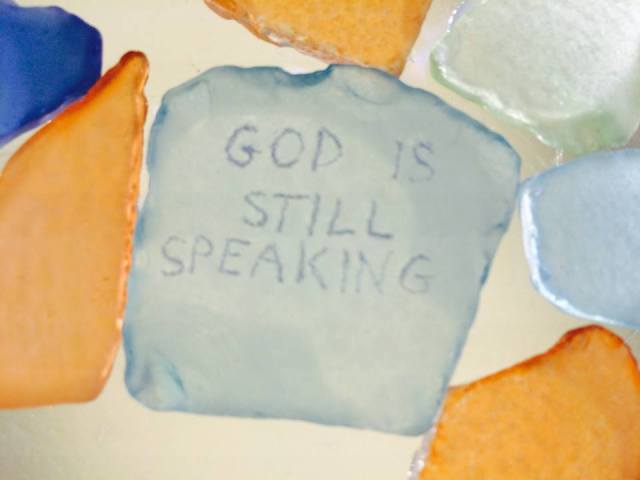
Then, before we could get started, Ric Reitz raised his hand.  Now, you need to understand.  Unless it’s Joys and Concerns, nothing instills fear in a preacher in a worship service like a raised hand.  Unless it’s Children’s Time.  J  “Do we really want to fill up the spaces?”  Ric asked.  “Won’t an unfinished cross better represent who we are as a community?  Aren’t we all still in process?  Isn’t God still speaking?”

mosaiccross.godisstillspeaking

I confess — Ric’s suggestion threw me.  After six weeks of being open to the Spirit’s leading on this thing, taking lots of people’s ideas and weaving them together to create this beautiful cross, I was done with openness.  I was ready to tie this thing up with a bow and announce, “It is finished!”  I was ready to fill those spaces and get on with our next project.

Then the guy who plays a minister on TV (“Turn,” April 25th, AMC, 9:00 p.m.)… Rev TV derails all my plans by inviting us to remain open, to keep the artwork open by NOT filling the spaces.  Those of you who were here last week saw me struggle with the idea, think it through, look around helplessly…like I often do during Children’s Time.

After wrestling a bit, I realized that Rev TV was right.  We are people of the still speaking God.  We are not complete.  There still is brokenness in the world longing to be redeemed by love.  Brussels and several state legislatures are sad cases in point.

And so, here’s our cross.  A visible reminder that our brokenness can be redeemed by love, especially when we share it with each other.  A reminder, too, that there still is much brokenness in our lives and in the world that longs for redemption, for resurrection.  We still need each other.  The world still needs us to reach out.  God’s spirit still hovers over us, calling us to new ways of being, calling us to wholeness.

mosaiccross

All through Lent, Allen and I kept noting how the cross project had taken on a life of its own.  We were puzzled and amazed–kind of like Peter at the end of today’s Gospel lesson.

My puzzlement lessened when I read the resurrection story.  Joseph of Arimathea takes Jesus’ body and lays it in a tomb.  Luke tells us that some women had followed Joseph to see where Jesus’ body was laid.  That was so they’d know where to come two days later to prepare the body for burial.  Leaving the tomb Good Friday evening, they returned to the place they were staying, and prepared the death spices and ointments.

Dawn of the morning after the Sabbath—the earliest time they could arrive—the women came to the tomb bearing the spices they’d prepared, intending to finish the burial process.  In their grief, they were doing the expected thing, the honorable thing—completing the burial process for their friend.  They were there—respectfully–to tie the bow on Jesus’ life.

Except there was no body.  There was no body, but there were two men, who asked the women:  “Why do you look for the living among the dead?  Jesus is not here; he is risen.”

In all four Gospels, the first people to discover Jesus’ resurrection are women, which makes sense when you recognize that it was women who tended to the bodies of the sick, the dying, the dead.  It was women who removed the garments from the deceased, applied the burial spices and ointments, and wrapped the burial shroud around the body for the last time.  Just as bodies entered life through and in the company of women, so did bodies leave life through and in the company of women.

At first stunned by the absence of Jesus’ body and the appearance of the messengers, when reminded of Jesus’ words about being raised, things clicked for the women.  Luke doesn’t tell us whether they believed, but they must have sensed something significant had happened, because immediately they go and tell the disciples what they’ve seen.

How do the disciples respond?  To them, the women’s account sounds like idle tales.  They don’t believe.  They don’t remember.  They still are looking for the living among the dead.

I wonder if the disciples’ dismissal of the women’s story of the resurrection comes from the fact that they had not been to the tomb.  They hadn’t seen the empty space.  They hadn’t stood there with jars of spices and jugs of ointment looking for Jesus’ body.  For them, the resurrection was still an abstract idea.  It’s easy to dismiss things— ideas, news, people—if you distance yourself from their flesh-and-bone, dirt-and-water, living-and-breathing reality.

The only one of the 11 who doesn’t dismiss the women’s story is Peter, who, Luke tells us, ran to the tomb and saw the linen cloth lying in a corner.  We don’t know if Peter believed in the resurrection yet, but after his visit to the tomb, he did wonder about it.  Engaging the material reality of the resurrection—seeing the empty tomb and the abandoned death shroud—helped Peter move closer to believing.

When I reflect on my ministry in retirement, I suspect I’ll recall this season as “The Year Lent Got Hijacked.”  I had such plans!  And you all—because you opened yourselves to the deep meaning of the season—kept interjecting plans of your own.  I’m being playful when I use the word “hijacked.”  Of course, what’s happened this Lent is exactly how living faith in community is supposed to go.  No one of us has the best ideas for how to connect with God …not even me.  The point of everything we do here is to listen to each other, to engage our imaginations, and together create space where people might meet God.  We’ve definitely done that this Lent.

And it hasn’t just been you all.  Each week, I’ve posted pictures of the cross on FB.  A couple of weeks ago, a songwriting friend who lives in Nashville told me about a song written by her friend, Marcus Hummon.  “It would be perfect for your Easter service!”  Really?  Another detour on our way to the cross?  I was resistant.  I felt like I’d stayed open to this project well beyond the point most pastors would have.  I’d done my part….and now I was done doing it.

Then I listened to the song.  It’s called “Stained Glass Love.”  Here are some of the words:  “It’s a picture made of broken things, Falling feathers from an angels wings The shattered pieces of my past, Are held together like stained glass.”  Great, right?

Then I heard the second verse.  “Hold the pieces in your hand, and think of how glass is made from sand.  Sand together becomes clay.  And clay is flesh when God breathes our way.”

When I heard that verse, this whole Lenten adventure with the cross—especially the way it went so deep for most of us—made sense.  This glass doesn’t just represent our brokenness…  We and the glass are made of the same stuff!  Which means that all those bits of broken glass are pieces of us, of our real flesh-and-blood lives.

I think some of the power of this project has come from the fact that we got out of the abstract—out of our heads–and into the real world.  As we see in today’s resurrection story, the people who kept things in the abstract—the disciples—struggled to believe.  It was the people who actually came to the tomb—the women and Peter—who took one step closer to belief.

Often on Easter we get bogged down asking, Did Jesus really come back to life?  That’s a conundrum…which means it’s a question without an answer.  It’s academic.  It’s abstract.

If we are to understand resurrection, if we are to have some hope of believing in resurrection, it’ll be a whole lot easier if we get out of our heads and into the real world…the world filled with people and food and trees and grass and homes and public restrooms and metro stations and hospital beds …  and acrylic…and E6000 glue…and tiny bits of broken glass.

So…Would you like to hear the song?  As the song plays, you’re invited to write down a word or two describing what this Lenten experience of the cross has meant for you.  When you come forward for communion in a minute, you can bring your response and put it in the basket.  I’ll compile them this week and share them next week.

Hear now Marcus Hummons’ song “Stained Glass Love.”


mosaiccross.easter


In the name of our God, who creates us, redeems us, sustains us, and hopes for our wholeness.  Amen.

Kimberleigh Buchanan  ©2016


Posted in Uncategorized | Leave a comment

Two Good Friday Poems

Good Friday

1

This story is so sad.
There’s so much love and evil.
And fear.

Maybe that’s what evil is—
fear gone bad.  Or mad.
Fear.

I really think that’s
mostly what this story is about—
FEAR.

Pilate was afraid.
The Pharisees and other religious leaders were afraid.
Everyone was afraid.

Jesus.
Was Jesus afraid?
Was Jesus afraid?

Mostly, I bet he was sad—
Sad because he didn’t have time to
help his disciples interpret what was happening.
Sad because he still had so much to teach them.
Sad because they hadn’t yet learned
the things he’d already taught them.
Sad because he loved them.
Sad because they were afraid.
Sad because he was lonely.

So.

Very.

Lonely.

2

It’s the halo I don’t get—
in every picture…
colored yellow, always yellow—

WHAT DOES IT MEAN, JESUS?
WHAT DOES YOUR HALO MEAN?

Does it mean that you’re God,
wholly divine and all that?
If so…that annoys me…
…and disheartens me…

If you’re not God,
then the pain you feel from the beatings,
the deprivations,
the unjust decisions and proclamations….

If you’re not God,
then the pain you feel
is very close to the pain I feel.

If you’re not God,
then this day is a day I can understand,
it’s a day that you can understand,
a day you can understand me.

And I need to be understood by you.
I don’t know why, but I do.
I do need to be understood by you.

Maybe for the artist,
the halo does mean you’re God…

But I choose to see it otherwise.

I don’t think you were God,
not that day—

If you were God on that day,
then what was the point?
I ask:  What was the point?

No.
I don’t think you were God that day…

But still.
The halo.

WHAT DOES IT MEAN, JESUS?
WHAT DOES IT MEAN?

I think it means God—
not you as God,
but God as God,

God, who tags along with those who suffer
because there is no other place in the universe
she’d rather be.

I think the halo-yellow-halo in every picture
isn’t a reminder of just how God you were,
but of just how close God stayed with you that day
until you died.
Even after you died.

If that is true,
Then we should all be wearing halos.

(4/6/2007)

Posted in Uncategorized | Leave a comment

Sermon: Longing for Reconciliation (3/6/16)

It’s a familiar story–whether you’ve heard the one in the Bible or not.  A young person leaves home, full of confidence and looking for a good time.  The behavior seems rebellious, but mostly it’s just an attempt to establish some independence.

Once the young person gets out on their own, the realities of responsible living set in–the rent comes due every month.  Food and gas cost, like, money.  Alcohol costs money.  Electricity and water and cable cost money.  And if you get sick, going to the doctor takes lots of money.  And speaking of money, who is this FICA person who keeps taking away your good, hard-earned cash every paycheck?

And then what happens when you attend one too many parties, miss a few too many days of work recovering from said parties, and lose your job?  Then you have to find another job, any job, probably one without benefits or opportunities for advancement.  You no longer have money to pay rent, so you crash with friends…who eventually kick you out.  There’s no money for parties any more…not even money for food.

So, you end up on some farm outside of town feeding hogs.  One day you find yourself envying the pigs their slop.  The moment you do, the full weight of every bad decision you’ve made hits you like a semi. You look at the hogs…you look at the slop…you smell the stench…you feel the clothes hanging off your rapidly dwindling body…

…and you remember–Luke tells us that the prodigal “came to himself;” came to his senses maybe.  You come to your senses.  You remember home.  Your family.  Your father.  You wince when you recall the bravado with which you left home, dragging the bag heavy with your inheritance.  Now, there’s nothing, no one.  Only you.  And the hogs.

You think about your father’s house.  You think about his wealth.  You don’t dare think about coming home as a beloved son.  But you do think about coming home as a servant, because even the servants in your father’s house have it better than you.  So, you head home.

What do you think it took for that young man to go home?  If you’ve ever been on the outs with anyone, you know how hard it can be to make up.  A rift happens for whatever reason.  And if you don’t deal with it immediately, it festers.  The anger deepens, the righteous indignation intensifies, and before you know it, you can’t possibly imagine any kind of reconciliation.

After a while, though, when the anger has subsided, you begin to miss the person.  You remember more of the good times than the bad; you begin to recognize your own role in the rift and you want to make up; you want to reconcile…but so much time has passed.  You just can’t imagine having that one conversation that needs to be had, the one conversation that can break through the wall between you, the one conversation that can begin building the bridge of reconciliation with the person for whom your soul aches.

It’s hard, isn’t it?  It’s hard to reconcile.  I don’t know why.  Maybe it’s because we’re afraid the other person is still angry.  Maybe it’s because we’re afraid they’ll reject our attempt to reconcile.  Maybe it’s because we’re embarrassed about our own role in the rift.  For whatever reason, taking the first step toward reconciliation is hard.  Building bridges out of the rubble of broken relationships….that may be one of the most courageous things human beings ever do.

Wandering around St. Patrick’s Cathedral in Dublin year before last, Allen and I happened on an old wooden door displayed among other artifacts.  The door had had a big hole cut out in the middle.  Curious, I pulled out my glasses and read the sign beside the door.

Door of Reconciliation

“The Door of Reconciliation,” the title read.  Here’s the story.  “In 1492, two Irish families, the Butlers and the FitzGeralds, were involved in a bitter feud.  This disagreement centered around the position of Lord Deputy.  Both families wanted one of their own to hold the position.  In 1492, this tension broke into outright warfare and a small skirmish occurred between the two families just outside the city walls.

“The Butlers, realizing the fighting was getting out of control, took refuge in the Chapter House of St. Patrick’s Cathedral.”  The warring families argued through the door for hours.

Finally, Gerald FitzGerald realized the escalation of hostilities was getting them nowhere.  Perhaps he, too, like the prodigal son, “came to himself.”  When he did, he spoke to the Butlers through the church door, suggesting they end hostilities and make peace.  The Butlers were like, Uh uh.  No way.  This could be a trap.  We’re staying right here behind this door.

So, here’s what Gerald FitzGerald did.  He ordered someone to cut a hole in the door.  Then he “thrust his arm through the door and offered his hand in peace to those on the other side.  When they saw that FitzGerald was willing to risk his arm by putting it through the door, the Butlers reasoned that he meant what he said.  They shook hands through the door, the Butlers emerged from the Chapter House, and the two families made peace.

“Today this door is known as the “Door of Reconciliation.”  “This story lives on,” the Cathedral’s website notes, “in a well-known expression in Ireland ‘To chance your arm.’”

“To chance your arm.”  Isn’t that a great phrase?  To make yourself vulnerable, to offer your hand in friendship when it might not be taken, to risk rejection–or worse, to take the first hard step toward coming back into relationship.

It isn’t easy to take the first step toward reconciliation…And I’m not going to lie.  Sometimes it doesn’t work.  Sometimes our first tentative steps toward mending fences are rejected and hostilities continue.  But sometimes…sometimes…all it takes is that first step–just one tiny gesture–to begin the process of reconciliation.

If you look at the larger context in which the parable of the prodigal is placed, it’s clear that Jesus isn’t really talking about relationships between human beings.  He’s using the story to illustrate the radical welcome of God to any who long for a close connection with the divine.  No matter who we are, no matter where we are on life’s journey, no matter what we’ve done, always we are welcomed home by the one who has loved us, loves us now, and will always love us.

And with God–just like with the father in the parable–all we have to do is come home and we will be embraced and feted.

Here’s the question I’ll leave you with today:  What is the connection between your relationships with other people and your relationship with God?  Is relating to God, is feeling God’s love for you easier when your relationships with others are good?  Are relating to God and feeling God’s love harder when you’re on the outs with someone?

As we come to the cross today, I invite you to think about the connection between your human relationships and your relationship with God.  Might “chancing your arm” with a sister or brother help you better receive and feel God’s love for you?

Today, we’re adding another opportunity to our experience of bringing our brokenness to the cross.  If you’d like to name the brokenness you bring–the name of a person you’re grieving, a person from whom you’re estranged, an illness with which you’re struggling, unemployment, addiction–  If you’d like to name your brokenness and write it (in one word) on a piece of paper, Chris Shiver will engrave your words to pieces of glass already attached to the cross.

And now, bring your brokenness to the cross.   (Glue shards onto cross.)

In the name of our God, who creates us, redeems us, sustains us, and hopes for our wholeness.  Amen.

Kimberleigh Buchanan  © 2016
http://www.stpatrickscathedral.ie/chancing-your-arm.aspx


Posted in Uncategorized | Leave a comment

Sermon: Longing for God (2/28/16)

“O God, I seek you.  My soul thirsts for you; my flesh faints for you, as in a dry and weary land where there is no water.”  Is your soul thirsty today?  Does it feel like you’re wandering around an arid terrain, parched, fainting, with no hope of finding water?  Does it ever feel like you might just die if can’t get some sign that God is alive and present with you?

George Caywood worked for many years at a rescue mission on Skid Row in Los Angeles.  After some time, George became deeply depressed — his work was hard, his marriage was dying, they hadn’t found the right combination of meds yet for his depression.  George was a person of faith, but he hadn’t felt God’s presence in a long time.

In an interview for the Storycorps Project, George spoke of that dark time.

“I was in my office.  I wasn’t fully out of my depression; my wife and I were well on our way to divorce.  Working like crazy, exhausted, probably 8:00 at night.  I was so lonely.  I used to get a haircut once a week just to have someone touch me.  And I’m sitting in my office and I said, ‘God, I need you to touch my arm.  I need you to physically touch my arm.’  And I just sat there praying, hoping something would happen–but of course nothing did.”  (143)

Have you ever longed for God like that?  Have you ever ached to feel God’s touch?  If you have, then the reading from Isaiah probably annoyed you.  “Everyone who thirsts, come to the waters; Why do you spend your money for that which is not bread, and labor for that which does not satisfy?  Seek me while I may be found,” God says.  “Call upon me while I am near.”

Yeah, right.  Whatever.  God is present; all we have to do is wake up and say, “Hi, Holy One!”  Been there, done that, have the abandonment issues to prove it.  Sometimes, no matter how hard we try, no matter how wide we open ourselves, we still can’t feel God’s presence.  We seek God…and find nothing.  We search for God, and end up feeling even lonelier than we started.  Desperate for God, we reach out, but our hearts return to us empty every time.

So…it makes sense when we experience God’s absence to “spend our money for that which is not bread, and labor for that which does not satisfy.”  We just want something to fill up the emptiness–and those non-bread, non-satisfying things do satisfy for the moment.  All we’re trying to do is to find a little happiness, right?

But once the moment passes?  Yeah.  That’s the hardest.  That’s when we feel truly alone, when God feels farthest away.  So what do we do?  How can we slake our thirst for God when all the wells have dried up?

Reading the Psalms, you discover that the ones that begin with the negative almost always end by praising God.  That’s what happens in Psalm 63.  It begins with “My soul thirsts for you, God.  My flesh faints…” then ends with, “Because your steadfast love is better than life, I will bless you as long as I live; I will lift up my hands and call on your name.”

How does the psalmist move so quickly from a sense of God’s absence to all this praise?  Well…they don’t.  Words of praise at the end of Psalms of lament are basically stated wishes.  It’s kind of like something we did on the Council retreat.  At the retreat, we imagined what Pilgrimage would look like in five years.  Instead of speaking from the present and saying, “I hope we’re doing this in 2021,” we spoke in present tense, as if what we hoped already were a reality.  “It’s 2021, and look what Pilgrimage is doing now!”

That’s what words of praise at the end of lament psalms are–It’s standing in the future and speaking as if the thing for which we hope already has happened.  Sometimes we have to act ourselves into the reality we want to inhabit…even the reality of God’s presence.

So what does the psalmist suggest we do when we long to reconnect to God?  After confessing how thirsty for God he or she is, the psalmist says:  “So I have looked upon you in the sanctuary, beholding your power and glory.”

I have looked upon you—where?– in the sanctuary.  One of the good gifts of being part of a faith community like this one is that we never have to go searching for God on our own.  We have all these people to help us.  During those times when we struggle to feel God’s presence, we’re surrounded by people who do feel it.  With their presence, they remind us that God is near.

There’s also something about being in the sanctuary and doing what you do in a sanctuary–worshiping God together with other people—there’s something about worshiping together that actually helps us to experience God.

Poet Kathleen Norris happened on a community of monks during a period of intense doubt.  She writes, “I was surprised to find the monks so unconcerned with my weighty doubts.  What interested them more was my desire to come to their worship… I had thought my doubts spectacular obstacles to faith and was confused when an old monk blithely stated that doubt is merely a sign that faith is alive and ready to grow.  I am grateful now for his wisdom and grateful to the community for teaching me about the power of liturgy.  They seemed to believe that if I just kept coming back to worship, things eventually would fall into place.”  (Amazing Grace, 63)  And, eventually, they did.

The thing I think the “spiritual but not religious” folks are missing is just how healing liturgy can be.  Except for cheering at sporting events, where else in our lives do we say or sing the same things at the same time with other people?  Okay.  Sporting events and Indigo Girls concerts.  J  Where else in our lives do we confess our faith together?  Where else in our lives do we share with each other our struggles, hopes, fears, brokenness?  Except for 12-step groups, I can think of no other place where this sort of thing happens on a regular basis.

How easy it is to neglect the gift of community, perhaps especially when we’re feeling hurt, abandoned by God, broken.  And yet, community—this worshiping community—can be the source of our healing.  This community of friends can help us reconnect with ourselves and with other people.  These people, the very people in this room, can help us find God again.

Today is our third Sunday of bringing our brokenness to the cross.  I am not a crafty person.  I’ve had this idea for a mosaic cross for a while, but didn’t have a clue how to make it happen.  Then I talked to my friends Jaime and Bill.  And look!  It’s happening.

One thing that happens with craft projects—we learned this last summer with our Growing Deeper into Community banner—as we work together on the project, the layers of meaning build and deepen.  That’s been happening with this project, too.  Last Sunday, one person noted how the glass on the cross is starting to mirror the glass in the baptismal wall art.  Then I posted a picture of the cross on FB this week with the caption, “Bringing our brokenness to the cross.”  I was struck that the two people who “loved” the picture have within the last couple of months, lost loved ones to tragic accidents.

Another thing I’ve noticed is that—while a few folks are placing their broken glass pieces in open areas — most are fitting their glass right up against other pieces of glass.  It’s like we’re trying to figure out how we can come together in our brokenness.

I certainly could have commissioned Jaime and Bill to create this cross and we could have presented the finished product to you with great fanfare on Easter Sunday saying “This cross represents the brokenness of all humanity.”  But if we did that, we’d miss the experience of bringing our own brokenness to the cross…and to do so alongside our friends who are doing the same thing.  There’s something about coming to the sanctuary, coming to worship with these friends, that helps to heal our brokenness, to renew our hope, and to reconnect to God.

The invitation today, as you come to glue a piece of glass onto the cross—symbol of your brokenness, of your soul’s thirst for God—is to be aware of your neighbors.  Take in the reality that you are not coming to the cross alone, but with these friends.  As you share glue and negotiate for space around the table, be aware of those who come with you.

After his desperate prayer for God to physically touch his arm, George Caywood says, “I walked down this huge flight of stairs and out the front door.  I’d spent a lot of time walking in the streets, just talking to people, including women who were prostitutes.  I never hugged the women because they had been so abused by men they didn’t want to be touched.

“So here I am, my heart broken.  And I look up the street, maybe 25 yards away, there’s this woman I knew to be a prostitute.  She took one look at me and started running towards me and threw her arms open, hugged me, kissed me on the cheek, then just went on.  I was so shocked.”  That was the person through whom “God chose to physically touch me.”  (pp.143-4)

Sometimes the only thing that can reconnect us to God is another person.  And so, as you come to the cross today, be aware of the people around you.  Look at the cross and see how all the broken pieces are fitting together.  See how beautiful all that brokenness becomes when it’s shared.  As you come, be aware of those who come with you.  It could be that today, your longing for God will be met by one of them.   (Bringing pieces of glass to the cross.)

FullSizeRender

In the name of our God, who creates us, redeems us, sustains us, and hopes for our wholeness.  Amen.

Kimberleigh Buchanan  © 2016
Posted in Uncategorized | Leave a comment

Sermon: Longing for Safety (2/21/16)

A few chapters before today’s Gospel lesson, Luke tells us that Jesus “set his face to go to Jerusalem.”  It’s a literary device that sets the context for how to read everything that happens between that statement and what happens in Jerusalem–foreshadowing is the technical term.  And we all know what’s going to happen in Jerusalem, right?  Jesus will be crucified.

So Luke intends us to interpret everything that happens after Jesus “sets his face to go to Jerusalem” in the shadow of the cross, including sending out missionaries, teaching through parables, visiting his friends Mary and Martha, teaching the disciples how to pray, taking the religious leaders to task for using their office to oppress the faithful, healing a disabled woman on the Sabbath, which was against religious law.  All of these activities take on new meaning when you see them in the context of the crucifixion.

The next thing that happens connects with Jesus’ crucifixion more literally:  the Pharisees pull Jesus aside and warn him that Herod wants to kill him.

Jesus’ response?  “Go tell that fox, ‘I will keep on driving out demons and healing people today and tomorrow, and on the third day I will reach my goal.’  I must press on today and tomorrow and the next day–for surely no prophet can die outside Jerusalem!”  Which sounds like a perfect reason to plug another location into the GPS…anywhere but Jerusalem.

I don’t know about you, but I’d be shaking in my boots if someone told me that someone else wanted to kill me.  Why is Jesus so defiant?  Why isn’t he more afraid?  Personally, I’d find Jesus a bit easier to relate to if he was just a tiny bit more terrified.  But “telling that fox where he can go”… that’s harder for me to relate to.  It must be a Messiah thing, right?  He knows how everything’s going to turn out, so he doesn’t need to worry.  He can say whatever he wants.

Except that there are lots of stories throughout human history where people were so committed to doing what they knew was right, that even the threat of death couldn’t shake them.

“A story from the Far East recounts that a vicious general plundered the countryside and terrorized the villagers.  He was particularly cruel to the monks of the place, whom he despised.

“One day, at the end of his most recent assault, he was informed by one of his officers that, fearing him, all the people had fled the town…with the exception of one monk who had remained in the monastery going about the order of the day.

“The general was infuriated by the audacity of the monk and sent the soldiers to drag him to his tent.  ‘Do you not know who I am?’ he roared at the monk.  ‘I am he who can run you through with a sword and never bat an eyelash.’

“But the monk replied quietly, ‘And do you not know who I am?  I am he who can let you run me through with a sword and never bat an eyelash.’”  (Chittister, Rule of Benedict, 60)

From where does that kind of fearlessness come?  How can one live, seemingly, without a sense of safety?

Maybe it’s not so much about living without safety.  Maybe it’s about re-defining what safety is.  Is safety about having enough money, or a place to live, or food to eat, or clean water to drink, or living without the threat of physical violence?  Yes.  Those things are important, especially for our physical well-being, and to a certain extent, for our emotional and spiritual well-being.  But here’s my question:  Is physical safety enough to make us spiritually whole?

I don’t mean to diminish the need for physical safety.  Violence is dehumanizing.  I am beginning to work with the Cobb Interfaith group on a prayer vigil and workshop on preventing gun violence in our community.  National security is important.  Personal security is important.  Being a safe church is important.  But are these kinds of security enough to save us?

Here’s the problem with linking our spiritual safety to physical well-being.  If we only see God’s love for us in terms of physical well-being, then when our physical well-being is compromised, our faith can’t help but waver.  If you pray for someone to be healed of cancer and they die, what happens to your faith?  And what if someone you love dies a tragic death?  If your belief in God is directly connected to physical well-being, that belief is going to falter when tragic things happen.

9/11 taught us a lot about security, didn’t it?  Because lax security made it possible for the planes to be hijacked, our national response was to throw everything we had into security.  We’ve heard that same sort of fear driving a lot of the conversation about Syrian refugees of late.  “If we let them in, there’s no telling what they’ll do.”  People seem to forget that Dylan Roof wasn’t a refugee, nor was Timothy McVeigh or Eric Rudolph or David Koresh.

Hear me well.  I’m not suggesting that physical security isn’t important.  It is.  Before people can grow spiritually, emotionally, mentally, they have to feel physically safe.  If you’re constantly in survival mode, you’re not going to be able to grow spiritually or any other way.

But these stories–the ones about Jesus and the monk–suggest that there is something more to feeling spiritually safe than physical security alone.

Shortly after 9/11, a couple of us attended a Cobb County Zoning Board meeting.  We needed to get a variance to build our sign out by the road.  At that meeting, a Presbyterian minister was asked to offer a word.  She chose to read Psalm 27.  Just weeks after 9/11, she read:

1God is my light and my salvation; whom shall I fear? God is the stronghold of my life; of whom shall I be afraid?  2When evildoers assail me to devour my flesh— my adversaries and foes— they shall stumble and fall.  3Though an army encamp against me, my heart shall not fear; though war rise up against me, yet I will be confident.


4One thing I asked of God, that will I seek after: to live in the house of the Lord all the days of my life, to behold the beauty of the Lord, and to inquire in the temple.  5For God will shelter me in the day of trouble; God will conceal me under the cover of God’s tent; and will set me high on a rock.


6Now my head is lifted up above my enemies all around me, and I will offer in God’s tent sacrifices with shouts of joy; I will sing and make melody to God.


13I believe that I shall see the goodness of God in the land of the living.

14Wait for God; be strong, and let your heart take courage; wait for God!


In those first tender days after 9/11, these were the first words that brought me comfort.  I suspect it’s because the psalmist speaks so honestly–and so confidently–about their faith in God, even in the midst of catastrophic circumstances.  The descriptions of enemies, war, and armies rising up resonated loudly with what our country just had experienced.  And yet, even in the midst of dire circumstances, the psalmist still was able confidently to confess faith in God.  Sitting in that meeting room, hearing those words, at that time, I began to imagine that I too could confidently confess my faith in God even after that terrible event.

The longing to feel safe is deeply human.  The scientists among us can explain that longing in evolutionary terms:  In order for the species to survive, there has to be some assurance that it can survive.  The longing to be spiritually safe also is deeply human.  We all want to know that we are accepted and welcome and loved, perhaps especially by the creator of the universe.

So how do we get access to that kind of safety?  I suspect the precise answer will be different for every person.  The things that make me feel safe will be different from what makes you feel safe.

I do think, though, that a lot of what we already do here in this community helps—meeting together regularly for worship, learning, and service to others…hearing the same Assurance of Grace every week (“One fact remains that does not change:  God has loved us, loves us now, and will always love us.”)…sharing our joys and concerns with each other…having friends to support us when our faith falters…  On its best days, this community is a spiritual safety net for us.

The rest of the job of finding out what contributes to our spiritual safety is a solitary, internal process.  Figuring it out takes prayer, reflection, prayer.  And sometimes, we just have to practice our way into it.  We have to tell ourselves over and over again:  “God is my light and my salvation; whom shall I fear?  God is the stronghold of my life; of whom shall I be afraid?”

Since our trip to Ireland, Allen and I have been reading up on Celtic spirituality.  There’s a tradition in Celtic prayer of invoking the presence of Christ before me, behind me, above me, to my right, to my left.  That kind of encircling prayer…it’s almost like a cocoon, a shield.

In fact, perhaps the best known of this kind of prayer is called “St Patrick’s Breastplate.”  As a musical setting of the prayer plays, you’re invited to come forward to place a piece of broken glass on the cross.  Every Sunday in Lent, we’ll be adding more pieces of broken glass.  The completed cross will be revealed on Easter Sunday.

Because we’ve got several more weeks to go, the invitation is to take just one piece of glass.  If we end up with lots of empty space on Palm Sunday, we can add more pieces to fill up the spaces.  For now, just take one, put a dab of glue on it, and place it anywhere on the cross above the blue tape.

As you come, the invitation is to practice feeling safe with God.  Remind yourself that no matter what’s going on in your life, no matter how vexing, or perplexing, or trying, or awful, or joyful your life’s circumstances, still, always, Christ is before you, Christ is behind you, Christ is above you, Christ is to your left, Christ is to your right, Christ is in you.

Come.  Bring your broken pieces to the cross.  And feel yourself surrounded by, protected by God’s loving embrace.  https://www.youtube.com/watch?v=8bAKFyGaWvk

In the name of our God, who stands before us, who stands behind us, who hovers above us, who is to our right, who is to our left, and who lives in our hearts—Amen.


Kimberleigh Buchanan  © 2016

Posted in Uncategorized | Leave a comment

Sermon: “Spiritual Longing” (2/14/16)

Lent is here.  Already.  The look on Fran Howard’s face last week when I announced the Ash Wednesday service said it all.  (Make face.)  

Those who were able to attend the Ash Wednesday service got a good start on the reflective work of Lent.  If you missed it, not to worry.  The theme we introduced Wednesday will take us all the way to summer.  There’ll be plenty of time to catch up.

What is the theme, you ask?  What could we possibly spend the next 14 weeks reflecting on?  Our theme for Lent and Pentecost this year is spiritual longing.  The idea for the theme came from reading the Scripture stories for the next few months.  Each passage illustrates a deep human need, a yearning in our inmost beings, an ache we seek to fill.

It’s the filling process I’m inviting us to reflect on.  Because sometimes, the things we use to try to satisfy our spiritual longings don’t fill them and in fact intensify them …things like alcohol, food, drugs, excessive spending, excessive scheduling, excessive Facebooking…

Wednesday night, we confessed the things that get in the way of having our spiritual longings met.  Today, I invite us to take a closer look at what we mean by spiritual longing.

There’s no better place to begin our reflections than with Jesus in the wilderness.  Right after his baptism, Jesus heads into the wilderness, where he fasts and prays for 40 days.  Luke tells us that during those 40 days “the Devil” tempts Jesus.  Luke doesn’t say what those temptations were; he just says they happened.

It’s the last three temptations Luke describes in detail… the ones that come when Jesus hasn’t eaten in 40 days, when he’s weak and vulnerable.  “Make this stone a loaf of bread.”  “Let me make you the king of the world.”  “Do a header off the Temple and let God’s angels swoop in and save you.”  Jesus counters each temptation with Scripture and doesn’t let himself get pulled in.  Then, Luke tells us, the Tempter “departed from him until an opportune time.”

An “opportune time.”   I wonder what makes a time “opportune” for temptation.  And if the Tempter is waiting for an opportune time to tempt Jesus, then the moment of which Luke writes must be an in-opportune time.  So what makes the end of this scene an in-opportune time for tempting Jesus?

Here’s the thing about temptation–it reveals to us so much about ourselves.  That year I gave up French fries for Lent?  I’m still trying to get over that.  I learned that year just how much I love French fries….just how dependent on them I am—I mean–was.

As I continue to process that Lent so long ago, I continue to ask myself–why French fries?  What does ordering and eating French fries tell me about my deeper needs?  Why does it feel like those deeper needs will be met by eating French fries?  (This is where I need to say that Lenten reflections are for the reflector alone.  You can’t do someone’s reflecting for them. J)

So maybe after 40 days of being tempted, Jesus had learned a few things about himself… enough that he’d gained some clarity about who he was.  Maybe those temptations helped Jesus get honest about his deepest needs so that he knew precisely what would meet them…. which made him less susceptible to trying to fill them with things that could not satisfy.  Maybe the Tempter departed because he knew that through his wilderness experience, Jesus had become so strong that he was able to resist any temptation the Tempter could throw at him.

Knowing our deepest needs empowers us.  If we don’t know our deepest needs, all we feel is an undefined ache.  The ache hurts, so we try to fill it up.  If we don’t have a name for the ache, we’ll throw anything at it to try to quell it.  That’s when we can get ourselves in trouble.

I want to take a minute to talk about something hard.  The last several weeks during Joys and Concerns, we’ve heard about the deaths of 3 young people.  In November, we learned of the murder of an Allatoona High School student by her friend.  Two weeks ago, Jim Kennedy told us about the 27 year old daughter of a friend who died of a drug overdose.  Just last week we learned that a 17 year old boy in the Heilhecker’s close-knit neighborhood took his own life.

It’s hard to talk about the violent deaths of young people.  We don’t want to believe the world we live in can allow such things to happen, especially not to people we know and love.  And yet, as we have learned, terrible things do happen.

It would be easier not to say anything about these tragic deaths….we want church to be a happy place, right?  But if we don’t talk about these hard things here at church among our friends of faith, where will we talk about it?  If we can’t bring these terrible events to God, who also knows the pain of losing a beloved child to a violent death, then to whom can we bring them?

I wish I could tell you why these kinds of things happen.  I can’t.  I don’t know why bad things happen to good people.  I don’t know how people can destroy themselves or each other.  I have no explanations.

I do think, though, that the best way to honor these young people who have died is to learn everything we can from their deaths so that we can do what we say we as followers of Jesus want to do:  act others into well-being.

And that, I suspect, comes from looking at and being honest about spiritual longing.  What is it deep down that we human beings want and need?  I suspect it’s pretty much the same for all people:  we’re all looking for acceptance, inclusion, a feeling of worth, love.  We all want to know, need to know that we are precious.

Hear me well.  I’m not suggesting that the three young people I’ve mentioned didn’t know these things.  I never met any of them; it wouldn’t be appropriate for me to speculate on what led to their tragic deaths.

What I am suggesting is that we take time in our own lives to ask ourselves for what we long.  What truly will make us happy?  We also need to create spaces for other people–especially the young people in our lives–to reflect on, name, and share what their deepest longings are.  Henry David Thoreau said that most people “lead lives of quiet desperation and go to the grave with the song still in them.”  I suspect that’s true.  One of the gifts of Christian community is that it gives us a place to name the things we’re desperate about.  There’s something about sharing our fears, our hopes, our desires in community that makes us feel less desperate, more loved, more whole.  Community helps us sing our songs before we die.

Of course, it’s not only the tragic things that reveal our spiritual longings.  Last Sunday’s experience with our friends from the Ahmadiyya Muslim community also revealed a longing—the longing to connect with folks who find God by a different path.

The responses have been strong to last week’s worship service, presentation, and fellowship time.  Some of you described it as one of the best Sundays you can remember.  Others expressed the desire for our friends to return soon to continue the conversation.  I’ve been pleased by the responses…and also a little surprised by the passion behind them.

But after thinking about it, that passion makes sense.  I suspect that when we hear anti-Muslim rhetoric these days, it doesn’t feel right; it doesn’t feel true; and it sure doesn’t feel loving.  And yet, we work hard to live just, authentic, loving lives.

I suspect that we’ve all been hungering for a long time to find an appropriate way to act our Muslim friends into well-being.  Posting anti-anti-Muslim statements on Facebook is one way to do it, or rolling our eyes when we hear another Islamophobic diatribe, but that doesn’t meet the deeper spiritual longing of connecting with people who find God by a different path from us.  The only thing that can meet that longing is actually to connect with people of other faiths.  I think that’s why last week felt so good.  We didn’t throw some temporary stop-gap measure at the need; we went to the heart of it and tried to meet it.  We spent time with and connected with friends with whom, we discovered, we have a lot more in common than not.

For this first leg of our journey into exploring spiritual longing, we’re going to work on an art project together.  We’re going to create a cross out of broken glass.  The bits are sea glass, which means they’ve rolled around the ocean floor long enough that the sharp edges have been worn off, so no need to worry about injuries.

The invitation with the bits of glass is to glue them to the plexi-glass cross.  Each Sunday in Lent, you’ll have the opportunity to come forward and glue on a piece of glass.  The invitation is to reflect on your own spiritual longings, on the places where you might feel broken.  Or you might choose to reflect on a place of brokenness in the world.  In fact, that could be your Lenten practice this year—to think about and pray about the longings of a particular group of people… or maybe even the longings of creation.

Now to logistics….  The cross is as big as it is because we’re going to be gluing glass on it all six weeks during Lent.  So, you’re limited to one piece of glass per week.  If we get to Palm Sunday with lots of empty spaces, we can fill them up then.  Until then, one piece of glass per person.

Today, you’re invited to come as Soohyun plays.  Bring all your brokenness, bring all your longing, and leave them at the cross.

FullSizeRender (29)

In the name of our God, who creates us, redeems us, sustains us, and hopes for our wholeness.  Amen.

Kimberleigh Buchanan   ©2016


Posted in Uncategorized | Leave a comment

Ash Wednesday Meditation (2/10/16)

For what does your spirit long tonight?  What inside you feels incomplete, fragile, unworthy, lonely?  Do you ever try to satisfy that longing?  Chances are, you do try to fill it.  Because the ache of the emptiness, our wholeness is very painful…

So often, though, the things with which we try to fill the emptiness, to quell the loneliness—alcohol, food, drugs, excessive spending, excessive scheduling—only satisfy for a moment.  After we have consumed whatever it is we think will make us whole, we find that the emptiness hasn’t been filled as we had hoped, but rather has grown larger.  Which means filling that now, filling the emptiness will take even more—more alcohol, more food, more drugs, more spending, more scheduling…It becomes a vicious cycle.

Lent is the church’s way of helping us to identify the cycle, slow it down for six weeks, long enough to consider whether all these things we’re consuming, all the things we’re doing, truly are satisfying our deepest longings.

And Ash Wednesday helps us clear out the clutter so we can do that reflection.

Psalm 51 is attributed to David after committing adultery with Bathsheba.  On the roof of his house, watching Bathsheba bathe, David thought possessing Bathsheba would fill his emptiness, quell his loneliness.  But it didn’t.

In fact, once the deed was done, he plotted to have Bathsheba’s husband, Uriah, killed.  What in the moment seemed like it would satisfy all his desires—possessing Bathsheba—in the end only led to greater emptiness.  And greater sins.

When David’s sins were pointed out to him by the prophet Nathan, David finally realized what he had done.  Filled with remorse, the story goes, he wrote this psalm asking God’s forgiveness, pleading for a clean heart, confessing his deepest desire:  truth in his inmost being.

Because that deep-down-to-the-core-of-who-he-was honesty—THAT is what would save him.  THAT is what his soul really longed for.  THAT is what would make him whole.

For what does your soul long tonight?  For what does your spirit ache?  What are you doing to try to meet those needs?  Is it working?

The invitation tonight is to reflect on what your soul is longing for… and all the things you’ve done to try to satisfy that longing.  As you come to receive the imposition of ashes, I invite you to see it not so much as a guilt thing or a depressing thing…I invite you to see it as a new beginning, starting over, hitting the reset button.  I also invite you to take a piece of broken glass.  Take it home and let it remind you of your brokenness, your longing to be made whole.  Each Sunday during Lent, we’ll be working with broken glass in some way.  Feel free to keep your shard at home or to bring it back here to church.  Or do both.

I wrote the words we’re singing tonight last year.  The tune, of course, is WONDROUS LOVE.  The hymn we traditionally sing to the tune is “What Wondrous Love Is This.”  I selected this tune to remind us that no matter what we’ve done, no matter how far we have wandered away from our truest selves, always, always, we are surrounded by and held in God’s wondrous love.

As the piano plays, I invite you into a time of quiet, honest reflection.  And as you receive the ashes with their reminder of the frailty—the brokenness–of all human living, know that God has loved you, loves you now, will always love you and more than anything else, hopes for your wholeness.


Posted in Uncategorized | Leave a comment

Prayer for Our Muslim Friends (2/7/16)

Prayer for Our Muslim Friends   

President Obama made an historic visit to a mosque in Baltimore this week.  In the face of so much anti-Muslim rhetoric these days—especially among presidential candidates—he reminded all of us that ours is a country built on a strong commitment to religious freedom.  Sounding every bit the UCCer he used to be, Mr. Obama said:  “If we’re serious about freedom of religion — and I’m speaking now to my fellow Christians who remain the majority in this country — we have to understand an attack on one faith is an attack on all our faiths.”

Yes!  When our Muslim brothers and sisters are threatened, discriminated against, attacked, we too are threatened, discriminated against, and attacked.  We have in our respective traditions found different paths to God…but we all are seeking God.  We all are seeking the common good.  We all are trying to the best of our ability to act the world into well-being.

And so today, it seems important—as people of Christian faith—to pray for our Muslim friends.  They have experienced much discrimination, they have been the victims of hate crimes, they have been ridiculed—especially the women wearing hijabs—for their dress.  And all they’re trying to do is practice their faith.

Certain that the one God loves us all fiercely and hopes for the wholeness of ALL God’s children, let us join our hearts together in prayer:

Holy One, we call you Holy One, because it’s a phrase that all of us can speak to you.  By whatever name we call you in our private devotion, for each of us, You are the One who is holy, the One who makes us whole, the One who makes us one.  We thank you that you receive us into your love and care no matter the path we take.  As Christians, we come to you most easily through the person and life of Jesus.  Our Muslim friends come to you through their prophet Mohammad and their caliphs.  We all come to you in the context of our religious traditions, our cultural settings, our desire to help you create the world as you hope it to be.  Thank you for making us one.

As Christians, we pray today for our Muslim friends.  Many of us in this room have experienced exclusion, humiliation because of our appearance, even threats to our lives.  That kind of hatred is dehumanizing, Holy One.  That kind of hatred is not from you.  And so today, we pray for our friends who are experiencing frightening things at the hands—and voices—of their fellow country people.  We pray that they might know just how precious they are in your sight…and in ours.

We pray for ourselves, too, Holy One.  We haven’t always had open minds when it comes to adherents of other faiths.  We’ve believed some of the hurtful things that have been said about Muslims.  Forgive us, Holy One.  Give us wisdom and courage to keep our minds and our hearts open to these, your beloved children.

And give us the creativity and the strength we need to be active allies with our Muslim friends.  May we never be “bystanders to bigotry.”  Help us know best how to support our friends publicly, and in conversations with friends and with family.  Our prayer is that these Muslim friends will know without a shadow of a doubt that at least one group of Christians in Cobb County, Georgia, have their back.

Holy One, we are so grateful for your love, which sustains us through every hardship and challenges us to live our best lives so that the world can become the place you always have imagined it could be.  Help us at all times, in all places, in all ways to reflect your love to others.

In the name of Jesus–and all names—we offer this prayer, Amen.


Posted in Uncategorized | Leave a comment

Sermon: “The Mountain of God” (2/7/16)

Jesus and his disciples have been traveling throughout Galilee.  After a hectic schedule of teaching and healing and hosting 5,000 people for dinner on the ground, Jesus takes Peter, James, and John with him up a mountain to pray.

As Jesus prays, “the appearance of his face changes and his clothes become dazzling white.”  Then Moses and Elijah appear and start talking with him.

Can you imagine being Peter, James, and John and witnessing this event?  I wonder how they responded.   Let’s see… Luke tells us that “Peter and his companions were very sleepy.” They must have thought they were in church.  🙂

But then they wake up.  And when they’re fully awake “they see his glory and the two men standing with him.”  And then, as he is wont to do, Peter gets over-eager and proposes that they build three shelters on the mountaintop to capture the moment.  Luke tells us that, as was often the case, Peter “didn’t know what he was saying.”  🙂

While Peter is speaking, a cloud descends over the disciples and envelopes them…. which terrifies them.  Then they hear a voice:  “This is my Son, whom I have chosen; listen to him.”  Sound familiar?  It’s very similar to the words spoken at Jesus’ baptism.

After these fantastic occurrences, Luke tells us that “the disciples kept it to themselves and did not tell anyone at that time what they had seen.”  Do you blame them?

This story is one of those it’s hard to wrap our 21st century minds around.  Glowing clothes, transmogrifying faces, ghosts…Sounds like a sci fi blockbuster at the movies.  But as a story of our faith?  What are we to do with it?

When Nafis proposed today for his and Mahmooda’s visit, I immediately looked to see what today’s Scripture text was…then promptly started looking for another.  Until I thought about it.  And prayed with it.  After spending time with it, I realized that the story of the Transfiguration is a perfect Scripture story for today.

For one thing, the scene takes place on a mountaintop.  Mountaintops play an important role in many of the world’s religions, often because they are seen as closer to heaven, and thus as sites of encountering the divine.  Noah’s ark landed on Mt. Ararat.  Moses received the 10 commandments on Mount Sinai.  Jesus’ best-known sermon?  The Sermon on the Mount.  Jesus’ crucifixion occurred at the Place of the Skull, a hill just outside Jerusalem.

In doing some research, I discovered that Islam also highlights mountaintop experiences.  On the narthex table, there are copies of a blog post that names and tells the stories of 8 of those mountains.  http://www.iqraonline.net/8-famous-mountains-caves-referenced-in-islamic-history/

You’ll see that #7 is Mount Sinai, which reminds us that the three Abrahamic faiths–Judaism, Christianity, and Islam–hold many of those sacred sites in common.

I visited another of those common holy sites on my trip to Jerusalem in 1992.  On that trip, we were able to visit the Temple Mount in the Old City of Jerusalem.  (When I returned to Jerusalem in 2006, tourists weren’t allowed in that area.)  We entered the Temple Mount area at the Western Wall.  Perhaps you’ve seen pictures of it.  It’s the wall where the Jewish faithful go to pray; they write their prayers and slip the small pieces of paper into the cracks of the wall.  hasidic-jew-praying-500

That wall is the western foundation of the twice-destroyed Jewish Temple.  The last time it was destroyed was in 70 A.D.—so those stones have been there a very long time.

In 1992, after slipping our own written prayers between the stones of the Western Wall, we climbed lots of stairs and arrived at the Temple Mount, which sits atop the Wall.   On the Temple Mount are two important structures.  One is Al Aqsa Mosque, a place of prayer for Muslims.  The other structure is the one that stands out in all pictures of the Old City of Jerusalem, the gold-plated Dome of the Rock.  If you’ve ever seen a picture of Jerusalem, you’ve seen the Dome of the Rock.  🙂

dome-of-rock-city

The Dome of the Rock was built in the 7th century by Muslim faithful as a place of pilgrimage.

dome_of_the_rock_500

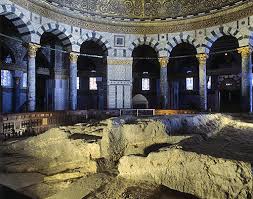
The structure covers a large stone outcropping identified as Mount Moriah.  Mount Moriah is the setting of several stories from the Judeo-Christian tradition.  It’s thought to be the place where Abraham nearly sacrificed his son, Isaac.  Later, Isaac’s son Jacob takes one of the stones from the altar Abraham built and uses it for a pillow.  During the night, Jacob has a dream—the one where angels descend and ascend a very long ladder.  “Upon waking from the dream, Jacob anointed the stone pillow, which sank deep into the earth, to become the foundation stone of the great temple that would later be built by Solomon.

dome-of-rock-rock

“Mount Moriah also is the site of an important event in Islam.  A passage in the Qu’ran–the 17th Sura, entitled ‘The Night Journey’,–relates that Muhammad was carried by night ‘from the sacred temple to the temple that is most remote, whose precinct we have blessed, that we might show him our signs…’ Muslim belief identifies the two temples mentioned in this verse as being in Mecca and Jerusalem.  According to tradition, Muhammad’s mystic night journey was in the company of the Archangel Gabriel, and they rode on a winged steed called El Burak…

“Stopping briefly at Mt. Sinai and Bethlehem, they finally alighted at Temple Mount in Jerusalem, and there encountered”—Listen up.  This is good!—“Abraham, Moses, Jesus and other prophets, whom Muhammad led in prayers.  Gabriel then escorted Muhammad to the pinnacle of the rock… where a ladder of golden light materialized.  (Sound familiar?)  On this glittering shaft, Muhammad ascended through the seven heavens into the presence of Allah, from whom he received instructions for himself and his followers.  Following his divine meeting, Muhammad was flown back to Mecca by Gabriel and the winged horse, arriving there before dawn.”    http://sacredsites.com/middle_east/israel/dome_of_the_rock.html

I remember on my visit to the Dome of Rock—in line with Muslim, Jewish, and Christian pilgrims—being overcome with just how much the Abrahamic faiths have in common.  As I descended the stairs from the Temple Mount to rejoin my group, I wondered why people of faith spend so much time fighting about our differences when we could instead be celebrating our connections.

It’s something I still wonder.  Some of the most faithful people I know are Muslims.  As part of their faith, Muslims pray five times a day.  Mahmooda and her crew help us with Family Promise because of the strong commitment in Islam to compassionate service to others.  After the shootings in San Bernardino, Muslims gave large sums of money to assist the families affected by those shootings.  Our Muslim brothers and sisters can teach us so much about living faith with passion and integrity!  There is so much that we can learn from each other.

Perhaps a good place to start these conversations is with our common stories, our common holy sites…our common ancestors.  Can we not begin with these things as a foundation for learning about each others’ faith and in our collaboration act the world into well-being?  Can we not follow our president who reminded us this week that “Mere tolerance of different religions is not enough.  Our faiths summon us to embrace our common humanity.”?

I’ve gone rogue today and have pulled in a reading not prescribed by the lectionary.  But if the lectionary folks had known Nafis and Mahmooda were coming today, they would have included it I’m sure.  We heard it read earlier.  Let’s hear Isaiah 2:2-3 again.

“In the last days, the mountain of God’s holy [dwelling] will be established as the most important mountain and raised above all other hills—all nations will stream toward it.  Many people will come and say:  ‘Come, let us climb God’s mountain to the holy place of God…that we may be instructed in God’s ways and walk in God’s paths.’”

This is one of the best images ever….because—Think about it.  What happens when people stream from all directions and climb a mountain together?  The closer they get to the top, the closer they get to God, the closer they get to holiness, the closer they get each other.  Or maybe it’s that, the closer we get to each other, the closer we get to holiness.  Perhaps the best way to meet God is to spend time with and learn from each other.  Perhaps we love God best when we love each other well.  Perhaps we act God into well-being when we act each other into well-being.

And perhaps having climbed our small mountain of God today, we too will be transfigured, transformed.  Perhaps today on our mountaintop with our Christian brothers and sisters, with our Muslim friends…perhaps in our sharing, in our speaking, in our listening… perhaps we too will be empowered and strengthened for the journey that lies before us.  Perhaps we too will come closer to each other in understanding.  Perhaps we too will become more holy.

And perhaps in our transformation, the world will become a better place, a kinder place, a safer place, a more loving place.

God willing, this will happen.  Perhaps our presence here today means that it already is happening.


In the name of our God, who creates us, redeems us, sustains us, and hopes for our wholeness.  Amen.

Kimberleigh Buchanan  © 2016
(Luke 9:28-36;  Isaiah 2:2-3)


Posted in Uncategorized | Leave a comment