“We’re So Proud of You and Your Ministry!”

When I learned of Betty’s death, I felt compelled to drive out for her memorial service.  I didn’t know why exactly, but the pull was strong.

I’d lost touch with Betty the last couple of years.  (My fault, not hers.)  I hadn’t been back to the state in 20 years.  There were only a few folks I’d kept up with at all, and that was all on Facebook.  I’ve been a UCC pastor for almost 15 years.  What need did I have to return to Oklahoma, a place that was very much part of my past?

Then I saw Tom and Nancy Willoughby.  Tom served First Baptist, Shawnee, as Minister of Music when I first came to OBU.  After a year or two, he was called to FBC, Lawton.  After graduating, I got a job teaching school in Lawton.  Tom, Nancy, and I renewed our acquaintance.  They are two of the few people I’ve kept up with over the years.  Delightful people.  And always supportive.  And terrific musicians!

When talking with Nancy, I reminded her of a comment she made at a goodbye luncheon a church member had thrown for me as I left Lawton for Southern Seminary.  Over lunch, we’d been talking about how the fundamentalists were taking over Southeastern Seminary in North Carolina.  (This was 1988.)  Nancy spoke up, her voice laced with alarm:  “I think Southern is next on their list.”  I remember wondering if she was right, then—because the idea terrified me—I shoved the thought aside.

When I reminded Nancy of her statement at Mrs. W’s memorial service, she said:  “I didn’t want you to go!  We love you and we didn’t want you to be hurt!”

When I heard Nancy speak those words, I knew I had driven to Oklahoma, in part, to hear her speak them.  “We didn’t want you to go.”  Someone had cared about what happened to me even before the fundamentalists took over Southern.  I had felt so alone, so cut off from anyone in Baptist life during the dark days of seminary, but someone had cared about what happened.  They loved me and didn’t want me to be hurt.

As her words seeped in and I scrambled to reframe my narrative of seminary, Nancy looked at me and said, “We are so proud of you and your ministry!”  It was like she was speaking another language.  Proud?  These people from way back in my Baptist history—proud of me?   Later, both Nancy and Tom assured me that they were very proud that I am a pastor and that the church I serve practices an inclusive faith.  “Really?” I asked in disbelief.  “Oh, yes.”

I’ve always liked Tom and Nancy and have always felt welcome in their presence, but I didn’t know they believed in me.  I didn’t know they were proud.  Hearing their words, receiving their hugs, hearing about their own journeys away from Baptist life—that was what I needed to hear.  It’s what I’ve needed to finally close this chapter in my life—the one of struggling to hear and follow my call to pastor.  The thing I have sought for the past 30 years is a blessing for my calling.  Certainly, many people and communities have done just that.

But I guess I’ve needed to receive that blessing from someone who was there at the beginning.  I’ve needed to hear someone say they’re proud of me for being a pastor and of the congregation I serve for being Open and Affirming.  I had no idea that blessing is what I’ve craved, what I’ve been hungry for.  Now that the blessing has been offered and received?  Now the fight to claim my call is over.  Now I can say with the ease I first heard from a monk at St. Gregory’s Abbey 30 years ago:  “This is my calling.”

(Far left–Tom.  Far right–Nancy.)

Posted in Uncategorized | Leave a comment

Sermon: Imagining a New Heaven and a New Earth (9/27/15)

At last summer’s Annual meeting of the Southeast Conference of the UCC, a man named John Stewart (not THAT Jon Stewart!  This John has an “h.”) led a workshop called:  When Democracy Worked:  Reflections on the Passage of the Civil Rights Act of 1964.  As an aide to Senator Hubert Humphrey, John did lots of the leg work that led to the passage of the Act.

After decades of severe discrimination against African Americans, the need for the Civil Rights Act was clear, but the political will wasn’t there.  “It won’t pass in my district,” some in Congress said.  “It’s too soon,” others said.  “We need to move more slowly.”  Many Southern representatives were adamantly opposed to the legislation.  Representatives from other parts of the country wondered if things were really bad enough to warrant new legislation.

To break the impasse, here’s what Sen. Humphrey’s staff did.  Some senators would vote for the Act no matter what.  Others would not vote for the Act no matter what.  They didn’t bother those folks.

But for those who were on the fence, or who might be swayed to support the legislation, Sen. Humphrey’s aides talked to as many religious leaders as they could in those senators’ states.  If they knew a Senator was flying home, they’d make sure a clergy person the senator knew would just “happen” to be at the airport and “casually” bring up the Civil Rights Act and offer their support.  In one case, the aides colluded with a senator’s wife.  Every day just after the senator left for the office, a staffer would call the house and speak with the Mrs.  They’d plot their next step in changing the mind of the senator, which usually involved selecting the topic of conversation for supper that night.

John Stewart told us that without the strategy of involving religious leaders in the process of swaying public opinion–or at least the opinions of a few key US senators–the Civil Rights Act would not have passed.  Stewart’s assessment was this.  Before the clergy became involved, the issue of what amounted to American Apartheid was a matter of opinion.  When the clergy became involved, the mistreatment of African Americans became a moral issue.  When it became a moral issue, the tide of public opinion shifted…because the American public now could see that not passing the Act was no longer an option.  If we were going to be a just and humane nation, we had to pass the Act.

So, why am I telling you this story?  Because I think something similar is happening with Pope Francis’ encyclical “On Care for Our Common Home.”  Scientists have worked for decades advocating for policy changes that will slow–if not reverse—the devastating effects of climate change.  To this point, though, much of the debate–especially in our country–has been opinion-based.  With the Pope’s encyclical, caring for the earth has become a moral issue:  If we are going to be just and humane, we have to take decisive action in caring for the earth.

Has anyone been binge-watching Pope-sightings this week?  At the White House, riding down Pennsylvania Avenue in the Pope-mobile, at the World Trade Center Memorial, celebrating Mass at Madison Square Garden, celebrating Mass at St. Patrick’s Cathedral, eschewing lunch with politicians to serve a meal to homeless folks and spend time with them?

Most of my friends are not Catholic.  Many are former Catholics.  A lot are adherents of other faiths or no faith.  Most, of course, are Protestants.  I can’t tell you how many times I’ve heard from friends the past couple years, “I’m not Catholic, but he’s my pope.”  The Pope is still Catholic, of course.  There are many policies he staunchly supports with which many of us would not agree.  But overall, Pope Francis’ commitment to the poor, to simplicity, to erring on the side of love…he’s radically changing the face of the papacy.  And the world is taking note.

I’ve wondered many times since Francis became Pope why he’s doing this.  If he loves simplicity, if he stands with the poor, if he’d rather serve lunch to the homeless than eat lunch with the powerful, why in the world did he become Pope, arguably the most powerful position on the planet?  I’m not up on all the rules about these things.  It could be that if you’re elected Pope, you don’t have a choice….so maybe poor Francis is just stuck.

Stuck or not, here’s the thing I find most impressive about this Pope—he’s using his position to create positive change in the world.  He’s using his position to draw the world’s attention to the plight of the poor—and to how decisions of those in the developed world create hardships for those in under-developed parts of the world.  For a man who, after being elected Pope, rode the bus back to his hotel, you’ve got to think that all the trappings of the papacy must annoy Francis…even so, he is using his office to raise the moral consciousness of everyone on the planet.  And you know, I think it might just be working.

Today’s passage from the prophet Isaiah comes as the people are preparing to go home from what has been a decades-long exile.  They lost their sovereignty, they lost their land, and they wondered for a long time if God was even there anymore.

As they begin packing up their belongings to head back to their homeland—though not with the sovereignty they once enjoyed—the prophet invites them to imagine a more hope-filled future…one where heaven and earth are like new, where cries of distress no longer are heard;  a future where babies don’t die and old people live out an entire lifetime;  a future where the people who build houses and plant vineyards actually get to live in those houses and eat the fruit produced by those vines;  a future where the wolf and the lamb shall feed together.

I once heard environmental poet Wendell Berry say, “If I can imagine it, I can do it.”  (At the time he hadn’t yet been able to imagine how to live without his pick-up truck.  He was working on it.)   That’s exactly what the prophet is offering the people as they head home.  For a people whose future looked bleak, the prophet was inviting them to look again and imagine a more hopeful future

It sounds nutty, I know.  Wolves and lambs sitting down to the same table without the wolves eating the lambs?  Impossible!  But the first step toward making something impossible happen is to imagine it happening…so the prophet gives the people a picture, something to work toward.  Before we see an actual wolf and an actual lamb sit down together at the picnic tables outside, we’ll have to imagine it.  Before we see our planet whole and flourishing, we’ll have  to imagine it.  Before we inhabit an actual world where cries of distress are no longer heard and where babies don’t die, we’ll have to imagine it.

When we see just how devastated our planet and its inhabits are after centuries of poor environmental practices, finding a new heaven and earth like the prophet suggests sometimes seems like our only option.  Maybe life on Mars is the answer.  But as we move into the future, the prophet reminds us that God is already there, working for our welfare, hoping for our wholeness.  We needn’t fear what’s to come, because God is already there waiting for us so that we can work together to create a new heaven and earth in the here and now.

A good way make our way to the future God is hoping for us is to answer the Pope’s call to work together with people of all faiths across the globe to heal our common home.  I don’t know that anyone or anything has done as much as Pope Francis to engage the imaginations of people around the world.  A pope tooling around Rome in a little Fiat?  Who would’ve imagined?  A pope who prefers to live in simplicity in community rather than in the papal apartment?  Who would’ve imagined?  A pope who chooses to wash the feet of the poor on Maundy Thursday instead of the feet of the cardinals?  Who would’ve imagined?

Watching Pope Francis re-make the papacy, I’ve about decided he’s the most imaginative person alive right now.  He is using the power of his position to seek the healing of the planet, to make better the lives of the poor.  And he’s not preaching at us or guilting us into being good… he’s showing us how to be good; he’s calling forth the good that’s already inside each and every one of us; he’s showing us how to use the power for good each of us has to act the earth and its inhabitants into well-being.

So, let’s do a little imagining.  Imagine an environmental issue, something that really has you worried, something specific—maybe it’s lack of safe drinking water for all earth’s inhabitants;  maybe it’s the drought in California;  maybe it’s rapidly melting polar ice caps….or perhaps what most worries you is the devastating effects on the world’s poor of unrestrained consumption in the developed world…or the equally devastating effects of deforestation on creatures who once lived in those forests….

My goal isn’t to depress you more than you already are about these issues.  The invitation is to focus on one issue related to earth-care—it could even be some small thing around your house…  Think of one problem that seems insurmountable—and imagine that problem solved.  You don’t have to come up with the plan for getting it solved.  Just imagine that whatever that problem is has been solved.  What does that new world look like?  Take a minute and imagine …  [One minute of silence.]

Let us pray.  Holy One, keep our imaginations alive and active, especially when it comes to acting creation and its inhabitants into well-being.  Help us to trust in your promise of a hope-filled future by working to create it.  Amen.

In the name of our God, who creates us, redeems us, sustains us, and hopes for our wholeness.  Amen.

Kimberleigh Buchanan ©2015

Posted in Uncategorized | Leave a comment

Singing Betty Home

Text to Allen:  I’m in the sanctuary at FBC.  My heart is racing!

Allen:  I’m praying.  All will be well.

Me:  Thanks.  Ron Lewis just started playing organ.  Settling down.

Allen:  Good.  Still praying for you.

Me:  There are several brass players headed for the balcony.  Gotta go get a bulletin.

Allen:  Okay.

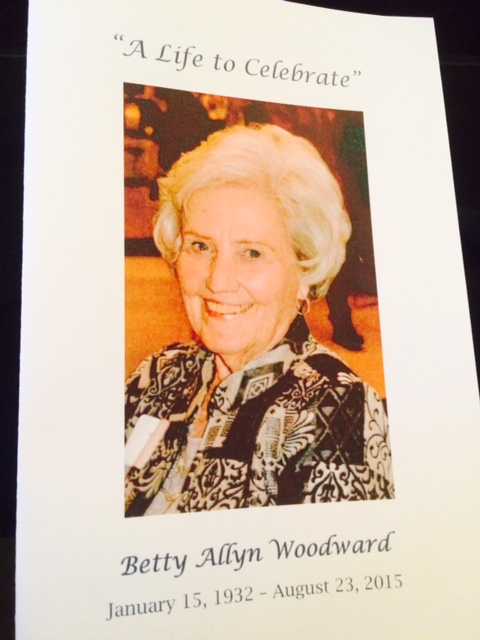
 FullSizeRender

*************

Betty’s service was lovely.  Lots of music.  Lots of hymn-singing.  A beautiful tribute to her life…as was the large number of people who gathered to tell her goodbye.

I was so glad to be one of them.

Posted in Uncategorized | Leave a comment

Loving Baptists

Driving out to Oklahoma for Betty Woodward’s memorial service, I had the sense that part of the reason for the trip was to forgive myself…which felt odd.  Forgive myself for what?  Now, I wonder if the thing for which I feel I need forgiveness is being Baptist.  Maybe it is.  And maybe that assumption grows out of internalizing the thoughts of people who disparage Baptists.

The truth is, though, that there was much about Baptist life that nourished me.  The Baptists, in their evangelical fervor, found me, for one thing.  They took me under their wings.  They nurtured me the best they knew how.  They weren’t able to imagine some things for me, like a call to pastor, but….they did the best they could with what they had.

They did the best they could.

So maybe now I can love, really love, these Baptist folks.  Many of the Baptists I knew—some of whom I’ll see on Saturday—were very good people, people who loved me.  If they don’t remember me or remember me, but not with fondness—so what?  They loved me then.  And nurtured me.  And helped me get to the place where I, eventually, was able to do the healing work I needed to do.

And that is something for which I can be very grateful.

Posted in Uncategorized | Leave a comment

“Nexus Point”

In an email exchange with a friend, she described this moment as a “nexus point,” a time to take stock of things and identify what to keep and what to leave in Oklahoma.  Since arriving, driving around the campus, I’ve felt very little connection with OBU.  I realize now that that’s a gift.  OBU was an important place for me 30 years ago, but I’m a different person now.  OBU is a different place.  And that is just fine.  I can be grateful for what I received and move on.

Even so, I am apprehensive about how I will be received by my OBU friends…will they remember me?  I suspect they will remember me, but will they remember me with fondness?

Posted in Uncategorized | Leave a comment

Moving Beyond Southern Seminary

(The insight about “moving past OBU to a Benedictine monastery” reminded me about this piece I wrote on a trip to Our Lady of Grace Monastery in Beech Grove, Indiana—two hours north of Louisville and Southern Seminary.  The piece was written in June 2009.)

About the trip up here (to Our Lady of Grace) yesterday…

I really do believe I made my peace with the whole seminary thing, all the trauma of it, most of my anger at the Baptist stuff, three years ago.  But yesterday was the first time I’ve driven north of Nashville on I-65 since that peace-making.  Once I hit the KY state line, I started feeling…a lot.  It felt like I was driving back to seminary.  The closer to Louisville I got, the sadder I got, the more like crying I felt.  I felt some anger, yes.  But mostly sadness.  And love–for the city, for the good parts of my time at Southern.

When I passed the exit for I-64 East (toward the seminary) and started crossing the bridge over the Ohio River into Indiana, the weepy-ness evaporated.  It felt like I was leaving seminary behind.  I was–literally–moving beyond seminary…

…and I was heading to Our Lady of Grace (which is located–no lie!–on Southern Avenue!).  I stayed up much of the night thinking about this place being “beyond seminary,” both geographically and metaphorically.  Part of what makes me sad about Southern is that the school I attended no longer exists.  I can’t go back and visit professors; I can’t hope one day to teach there, like I’d often dreamed about.  Based on articles about women I’ve read in the alumni quarterly, I’m pretty sure there’s no one left at my seminary who would be proud of a woman graduate who has gone on to successfully pastor a church.

One of the great losses since the fundamentalist take-over is the loss of a network.  Things were so traumatic for everyone in the 90’s that we all scattered–we headed for new institutions, new denominations where we wouldn’t have to talk about the Baptist stuff anymore.

So, I’m thinking all these thoughts as I’m driving up I-65…then I arrive at the monastery.  Sr. Luke greets me.  Lots of sisters greet me.  They’re glad I’m here.  They’ve fixed my room, they help me unload the car, invite me to dinner, give me a key to the place.  Invite me to prayer.

Then last night while I’m journaling, it hits me–what I had hoped for as an alum of Southern, I have (and more!) here…Because of their vow of stability, the sisters always will be here.  They’ll always be glad to see me.  They’ll always want to know how things are going.  They will know me.  And I will know them.

I know.  A monastery is an institution…an institution that’s part of the largest institution on the planet.  In truth, my experience with the Baptists has left me leery of all institutions.  But still…everything I had hoped from Southern, I have here.  And much more.

By saying all of this, I don’t mean to disparage my experiences at Southern and with other Baptists.  Were those experiences traumatic?  Absolutely.  Even so, those experiences shaped me…they’ve made me a deeper person, a more compassionate pastor.  AND….those experiences led me to claim my call to pastor…and if I hadn’t become a pastor, I never would have come into relationship with this monastery.

Before yesterday’s road trip, I had intended to come to the monastery simply to pray and rest.  After yesterday’s powerful and surprising insights from the drive up, though, I think I need to add them to mix and see what emerges.

Posted in Uncategorized | Leave a comment

Sermon: Precious in God’s Sight (9/20/15)

In the chorus of Bernice Johnson Reagon’s song “Greed” she sings:  I been thinking about how to talk about greed//I been thinking about how to talk about greed//I been wondering if I could sing about greed//Trying to find a way to talk about greed.

Her point, of course, is that talking about greed isn’t easy.  But she feels compelled to say something, because saying nothing won’t accomplish anything.  So she begins with a confession:  “I been trying to find a way to talk about greed.”

Since returning from sabbatical a year ago—just a month after Ferguson, Missouri, erupted into violent protest after the shooting death of Michael Brown—“I been trying to find a way to talk about race.”  I think I’ve been waiting for the right book, or the right workshop, or the right TV program, or divine inspiration…something that will help create space for us to have honest and holy conversations about race here at Pilgrimage.  I think I’ve been looking for a way for us to talk about race that will be neat and tidy—kind of like our focus last summer, when  we immersed ourselves in the idea of community.  At summer’s end, we tied it up with a bow and moved on.

It struck me the other day, though– there really is no tidy way to talk about race or racism.  There’s no way not to ruffle feathers.  There’s no way to stay comfortable when we talk about race, not if we want our conversations to be authentic.  If I wait for the perfect words, if we as a community wait for the perfect method to appear to talk about race—much less to do something about racism—we’ll never start.  I’m beginning to see Bernice’s wisdom—sometimes you just have to start….even if it’s only to confess just how hard it is to start.

So, where do we start the conversation about race?  In my thinking about how to talk about race I’m thinking we’ll do well to begin with Genesis 1:27.  There we are told that “humankind was created as God’s reflection:  In the divine image God created them.”  Every human being is created in the image of God.  If we begin with that basic assumption, and hold it fast, the way forward will become clear.  Or at least clearer.

Looking at every person as if they are a beloved child of God will help us to see them as God sees them; we’ll see them whole.  We’ll want to learn about their experiences, discover their gifts, hear their stories, learn about their dreams.  I’m convinced the way forward on any subject that involves other human beings becomes clearer when we see them as God sees them, when we see God in them.

Looking at others with our God-glasses on—that’s really good.  Any time you try to see something from someone else’s perspective as a way to understand them better, as a way to connect with them, it’s a good thing.

But I’m thinking now as I’m trying to figure out how to talk about race, that perhaps there’s a prior step.  Perhaps before we try to see others as God sees them, we might turn that holy, grace-filled gaze on ourselves.  Perhaps the best way to prepare ourselves for authentic conversation about race is to see ourselves as whole human beings, created in the image of God, and deeply loved by God.

Conversations on race are not easy, perhaps especially for white people.  White privilege is a real thing.  But before we can confront that or any racism we might harbor, it’s vital to remember that we, too, are beloved children of God.  If we know we are loved—deep down know we are loved—then doing the hard work of talking about race becomes, not easy, but more doable.  If we know that we are loved, then authentic conversation becomes possible.

So, what might it mean to engage in conversations about race as if we are beloved children of God?

I think it begins by acknowledging that we aren’t perfect.  We’re not going to say everything right all the time.  In fact, we’re probably going to get things painfully wrong some times.  We’re going to mess up.  At some point, we’re going to say something deeply offensive to someone.  Our words are going to hurt somebody—when we never had any intention of hurting anyone.  Because of the way race has played out in American culture, people of color long have had to think about race…every moment of their lives they have been aware that they are not part of the dominant culture, of the predominant race.

Those of us who are white, because we are part of the predominant culture, we haven’t had to think about race every moment of every day of our lives.  That means that this kind of thinking, this kind of conversing is going to be new for us.  It’s going to be hard at first.  It will take practice.  We’ll have a lot to learn about what words, images, and traditions mean for people who are from a different racial background.  We’ll have to listen.  A lot.  We’ll have to open ourselves up to anger—both our own and that of others who have been judged, mistreated, and discriminated against by white people because of their color.  That part’s hard.  It’s really hard.  But it will be part of any authentic conversation about race.

What happens when you’re learning something new and it gets hard?  If you’re like me, you start beating yourself up.  Self-laceration can become a gut response to not doing things perfectly.  Others of us might lash out at someone else.  Mis-direction, the psychologists call it.  We’re angry at ourselves and, because dealing with that anger is too difficult, we direct it toward someone else.

If in those times when the lessons get hard we remember that we are whole human beings, created in the image of God, deeply loved by God…If in the midst of authentic conversation about race we start feeling inadequate or defensive or beaten up, if we can remember in those hard times that we are deeply loved by God, then we’ll have another option besides mis-direction or self-laceration.  If we know we’re loved, then when we mess up, we can take a step back and learn from the mistake.  We can grow from it.  We can, the Genesis writer says, do an even better job of reflecting God’s love to others.

Each of us has our own history.  And each of us has our own history with race.  Each of us at some point likely has experienced some sort of discrimination.  And each of us, no doubt, has without intending to, hurt others with our words or stereotypes or thoughts or exclusions.

One account of someone waking up to their own racism comes from a beautiful song written by Kate Campbell.  It’s a story she made up after seeing a photograph of a half-burned plantation home.  The circumstances likely won’t resonate too much, but the feelings might.  Here’s Kate Campbell singing, “Look Away.” https://www.youtube.com/watch?v=8pTMN10Nois

Now.  I understand that we’re all at different points in our desire to engage in conversations about race.  Some of us are eager to learn all we can, to talk together, to work to transform social systems, to work to heal our own racism.  Others of us don’t see the need for the conversation or we see the need, but we just don’t have energy for it.  Wherever you are on that journey is fine.

If you are interested in engaging in issues of race, on the other side of the sheet with Kate’s song you will see several opportunities for doing so.  One thing I’d draw your attention to is the Ala-Tenn Association meeting in Montgomery Oct 2-3.  One of the great things about being part of the Southeast Conference of the UCC is the amount of racial diversity among our member churches.  We have a unique opportunity in the Southeast Conference to really talk with each other, learn from each other about issues of race.  The meeting in Montgomery is one of those opportunities.

You’ll see that the main speaker is Rev. Traci Blackmon, pastor of a UCC church in Fourissant, Missoruri.  Traci has been a key voice in the conversations that have been happening in Ferguson.  If you might be interested in joining me for that overnight trip, let me know.

My first year here someone said of my sermons:  “There are lots of levels to them.  You can get something from the surface, or if you want to go deeper, you can do that, too.”  This is definitely a multi-layered sermon.  If you want to take Genesis 1:27, this idea that human beings are God’s reflection, and focus just on it, go for it.  If you feel drawn to receiving and learning to believe in God’s love for you, do that.  If you want to enter the process of reflecting more deeply on race and racism, do that.  And if any of the things on the sheet interest you, let me know.

Let’s end the sermon together by singing “Jesus Loves the Little Children,” remembering that we, too, are one of the children Jesus loves.

In the name of our God, who creates us, redeems us, sustains us, and hopes for our wholeness.  Amen.

Kimberleigh Buchanan  © 2015

Posted in Uncategorized | Leave a comment

How One Baptist Introduced another Baptist to Benedictine Prayer

I graduated college in 1986.  After graduation, I taught school in Lawton, OK, for two years.  I went back to Oklahoma a couple of times during seminary, but hadn’t seen any of those folks since I’d taken my then-boyfriend Allen to meet them all just before we got married in 1995.

Twenty years is a long time.  Not knowing when I’d ever make it back to Oklahoma, my first thought when planning the trip for Mrs. Woodward’s memorial service was to see as many people as I could—former church members in Stillwater, good friends in Lawton, several friends in Shawnee.  When a couple of possibilities for staying with friends didn’t pan out, I shifted to Plan B.  Instead of driving all over the state for hurried visits with old friends, why not make retreat at St. Gregory’s?

St. Gregory’s is a Benedictine monastery a mile past OBU.  As a Baptist student, I was wary of Catholics.  We students—wisely, we thought—steered clear of St. Greg’s.

…Until my Hymnology class with Mrs. Woodward.  For one of our class sessions, she hauled us down to Vespers at St. Gregory’s Chapel.  It was my first experience of prayer in a monastic community.  I didn’t understand much at all, except that it was beautiful.  I do remember, though, being struck by the fact that immediately following prayer, the brothers who I’d seen depart through a door behind the altar, were heading to a dining hall to eat supper cafeteria- style—just like I did (and hated) at the college.  I remember wondering how anyone could choose to eat in a cafeteria the rest of their lives.

Part of the reason we went to St. Greg’s was because Mrs. W had an in—she’d taught Br. Damian, the community’s musician, Freshman Music Theory.  Br. Damian came and talked to us after Vespers.  After he’d explained a little about the history of liturgy and praying the hours, Br. Damian asked if we had any questions.  I raised my hand.  “Why do you do this?”

Mrs. W later told me she was mortified by the question.  But Br. Damian took it in stride.  He said simply, “This is my calling.”

In my 2 days of retreat before Mrs. W’s memorial service, as I remembered, reflected, and prayed, I marveled that I had “moved past” (literally) OBU to make retreat at a Benedictine monastery, a place whose rhythms of prayer have become so central to my life.

The first evening in the chapel, as I closed my prayerbook and prepared to follow the line of monks through the door behind the altar to join them for a cafeteria-style supper, I giggled a little.  After all these years, here I was making retreat at a Benedictine monastery, and who was it who introduced me to Benedictine prayer?  My Baptist professor and friend, Betty Woodward.

One more thing for which to be grateful to Mrs. W.

Posted in Uncategorized | Leave a comment

The Drive to Say Goodbye to Betty Woodward

When I saw the news on FB that my college mentor and friend, Betty Woodward, had died, it surprised me.  Betty wasn’t the sort of person one ever imagined dying.  She was a force of nature, full of energy.  Betty loved life and people and music and hummingbirds.  And she had survived a couple of nasty bouts with cancer and the tragic death of her husband Jim in a 1991 plane crash.  Die?  Mrs. Woodward?  It didn’t compute.

I messaged a couple of friends to ask if it was true.  Each quickly responded that, sadly, it was.  When the information about the memorial service was posted a couple days later, I made plans to attend.

After two years of study at the University of Florida, in 1983 I transferred to Oklahoma Baptist University, in Shawnee, Oklahoma.  Betty was my Elementary Music Methods prof.  When it came time to student teach, I was assigned to three schools in Moore, OK—40 miles away… which was fine, except for the fact that I didn’t know how to drive.

Mrs. Woodward:  “You can ride to Moore with another student who also will be doing his teaching there, but you will have to drive his car between schools.”  Then she drilled me with those piercing blue eyes.  “Do you just not WANT to learn to drive?” she asked.  I assured her that I did want to learn to drive; I’d just never had anyone to teach me.  Mrs. Woodward: “What are you doing at 3:00 this afternoon?”  Me:  “Going for my first driving lesson?”

That I learned to drive at all is a testament to just how gifted a teacher Mrs. W was.  We went out nearly every afternoon in her car—a gargantuan (or so it seemed) gold Cadillac.  I was terrified.  But we kept going out and somehow—through the grace of God and the patience of Mrs. W—I got my license.

After a short trip home to Florida for the summer, I returned to school walking a little taller.  I could drive!  When I saw Mrs. Woodward, I presented my license—and beamed.  (She’d been out of town when I took my driving test and hadn’t seen it yet.)  She smiled, too, then asked, “What are you doing at 3:00 this afternoon?”  Huh?  “If you’re not doing anything, I thought we could go out for a driving lesson.”  I RE-presented my newly-minted driver’s license with an even bigger smile.  “Oh, your lessons aren’t over yet.  Now it’s time to learn stick-shift!”

All my terror came flooding back.  Stick-shift?

That afternoon at 3:00, she took me out for my next driving lesson in their standard transmission car—a brown Subaru with the driver’s side door smashed in.  I didn’t mind so much climbing through the passenger’s side to get to the driver’s seat.  This car was much more my style.

I thought I’d done pretty well learning stick-shift…until a few months later when I took Mrs. W. for a ride in the used car I’d just bought—a 1983 Nissan Sentra, stick-shift.  She got in, looked at the shifter, then looked up at me—“Stick-shift?”  The surprise in her voice suggested that perhaps I hadn’t been the quickest learner of stick-shift driving.  But the drive went well…and Mrs. W seemed a little calmer when she got out of the car than when she got in.  I think that’s a good thing, right?

When I learned the date of the memorial service for Mrs. W, I debated driving or flying.  Shawnee is a 12-hour drive from my home in Georgia.  Perhaps I should fly.  But while scouring travel sites for a cheap plane ticket, I remembered those afternoon lessons with Mrs. W and knew—I had to drive.

And so I did.

Posted in Uncategorized | Leave a comment

Oklahoma Journal: Poem

At the Hotel Waiting to Attend a Friend’s Memorial Service


La Quinta Inn

Shawnee, Oklahoma

Room 306

Mid-September…

I peer through

wispy strands

of an abandoned

web

splayed against the window

as the sun

rises over

a stagnant pond—

All around the pond–

green—

“We’ve gotten lots of rain this year,”

the monk at the abbey told me.

Oklahoma.

Green.

At the end of summer.

********

There is more life

than we know

in places we’ve

long thought dead.

************

Two small lumps

in the water

glisten white

where sunlight kisses

the damp–

Turtles?

Trash?

Tires?

I measure my curiosity—

Shall I walk down to

water’s edge

and inspect the lumps

more closely?

Or will I simply let them be—

A mystery that

holds my imagination,

douses me with wonder

for one small part of a morning

on the hazy edge

of death?

Or life?

**************

A subtle shift

lures my gaze

right—

a short plank

with four dark lumps–

moving!

Turtles–

shifting

sidling

inching

testing

searching for balance

as a group

to rest.

I watch unblinking

for a moment of sheer

awe

as the board floats

with four

still

tiny

shining

lumps.

************

I close my eyes,

offer a prayer of thanks,

gratitude for friends.

And silence.

And water.

And sun.

And life.

************

The next moment I look down–

a single turtle

paces the plank

searching for her

companions,

now gone.

Finally,

she stops on one corner

and sits—

whether grieving

or content

or resigned

I cannot tell.

************

I observe the lone turtle

Sympathize with her.

Empathize with her.

Identify with her.

Then I think of

her companions

somewhere below the murky

surface

swimming

drinking

eating

maybe even cavorting,

Who knows?

Then I look up,

take in the whole pond

and finally see–

It’s only half-stagnant.

Half-alive.

kjb

9/12-14/2015

Posted in Uncategorized | Leave a comment