Sermon: “Dancing with the Trinity” (5/30/20210)

John 3:1-9;  Genesis 18:1-15

Poor Nicodemus.  A leader in his faith community, Nicodemus comes at night to speak with Jesus.  Jesus has just arrived in Jerusalem for the Passover.  His first act in the holy city is to visit the Temple … and throw a hissy fit.  He overturns the tables of the moneychangers and yells:  “Take these things out of here!  Stop making my Father’s house a marketplace!”

It’s not long after this scene that Nicodemus comes to visit Jesus.  It’s no mystery why he comes at night.  After the scene in the Temple, it wouldn’t be wise for a religious leader to be seen fraternizing with the angry-crazy guy.  

If Jesus’ behavior in the Temple was confusing, the things he says to Nicodemus are downright opaque.  Be born again?  Of water and Spirit?  How can this be?  Indeed.  The lectionary folks probably chose this story for Trinity Sunday because Jesus, God, and the Spirit all show up.  All three “persons” of the Trinity are accounted for…or, as my theology prof said, “All three hypostatic forms of being…”  But maybe the strongest connection between the story of Nicodemus and the doctrine of the Trinity is his question:  How can this be?   

Have you ever asked that question when contemplating the Trinity?  How can this be?  How is your relationship with the Trinity these days?  Do you understand it?  No?  Good news!  All is about to be revealed!   (Trinity Video!) 

Ann had just had eye surgery.  The recovery process required her to lie face down for two weeks.  Ann’s husband fashioned a bed for her, with a hole cut out for her face.  The bed was surprisingly comfortable…but staring at the floor for hours on end was excruciatingly boring.

So, Ann had her husband place her Rublev Holy Trinity icon on the floor so she’d have something to look at….which might sound just as boring as staring at the carpet.  But spending time with an icon is different than simply looking at a poster.  Coming from the Orthodox tradition, icons are invitations to prayer.  Every step of their creation is itself an act of prayer— from the preparation of the wood on which they’re written to the materials, objects, and colors used.  Icons aren’t meant to be glimpsed and quickly understood.  They’re meant to be sat with, entered into, and taken into the pray-er’s deepest self. 

On this Trinity Sunday, the invitation is to enter into the Rublev icon.  It was created by a monk named Andrei Rublev in the early 1400s to honor St. Sergei, one-time abbot of Holy Trinity Monastery near Moscow.  Like many iconographers before him, Rublev set his depiction of the Trinity in the context of the story of Abraham and Sarah hosting three visitors.  It seems odd that Christian iconographers would use an Old Testament story to illustrate the Trinity.  Let’s listen to Genesis 18 and see if we can figure out why they did. 

Yhwh appeared to Abraham by the oak grove of Mamre, while Abraham sat at the entrance to his tent in the heat of the day.  Looking up, Abraham saw three travelers standing nearby.  When he saw them, Abraham ran from the entrance of the tent to greet them; and bowing to the ground, said, “If I have found favor in your eyes, please do not pass by our tent.  Let some water be brought, that you may bathe your feet, and then rest yourselves beneath this tree.  As you have come to your faithful one, let me bring you a little food, that you may refresh yourselves.  Afterward, you may go on your way.” “Very well,” they replied, “do as you have said.”  

Abraham hurried into the tent to Sarah and said, “Quick— take a bushel of fine flour and knead it into loaves of bread.”  Abraham then ran to the herd, selected a choice and tender calf, and sent a worker hurrying to prepare it. Then Abraham took cheese and milk and the calf which had been prepared, and placed it before the travelers; and he waited on them under the tree while they ate.

After the visitors have eaten and rested, they promise the elderly couple that, in a year’s time, Sarah will bear Abraham a son.

In the icon, we see a couple of references to the Genesis story.  There are three visitors, who first are identified as “YHWH.”  We see the tree, which could be a reference to the oaks of Mamre where Abraham was camped.  There’s the building, which could be Abraham’s house, though in the story he and Sarah live in a tent.  The three sit at a table which recalls the hospitality Abraham extends to the visitors.  In the original, that blob in the middle of the chalice is the head of the calf mentioned in the story.

Generally, rooting around in the Old Testament looking for Jesus isn’t the most responsible form of biblical exegesis.  Even so, I’m intrigued by our faithful forebears connecting this story to the Trinity, not so much for the three-in-one God thing, but because  Genesis 18 fundamentally is a story of hospitality.  When the three visitors appear, Abraham bows to them, he washes their feet and offers them food and a place to rest.  He whips up some milk and curds then has the fatted calf killed and served to the visitors.  It’s only after all the rituals of hospitality have been completed that God gets down to business promising a son for the elderly couple…which suggests just how important these rituals—and hospitality—are.

Look again at the icon.  The guests are seated at a table.  There is a cup; there is food.  In the way the 3 figures lean toward one another, the connection among them is clear.  All these pieces of the icon—along with the allusions to the Abraham story—clearly portray hospitality. 

There is one more thing about it that fairly shouts hospitality.  Can you discern what it is?  (Responses)  The gap.  That gap invites us to pull up a chair and join the three figures at the table.  Rublev’s icon isn’t just a picture of the Trinity; it’s an invitation to participate in the Trinity.  Despite all those great pictures we saw earlier, none of them invited us to participate with, to live in the Trinity…except maybe the one of the 3 men in the pub.  Almost to a one, those diagrams and depictions invite us only to look at the Trinity from the outside, to observe it, to analyze it, to come up with a mathematical equation for it.  Except for the men in the pub, none of the depictions invited us into the Trinity.  Rublev’s 15th century icon does exactly that.

So…How can these things be?  Let’s say we accept the Trinity’s invitation to pull up a chair—Then what?  How does one go about participating in, with, and out of the Trinity?  Ann Persson, the woman who prayed the Rublev icon as she recovered from eye surgery, calls Rublev’s depiction of the Trinity a “circle of love.”  The icon invites us to join that circle of love….not just for our own edification, but so that we can work with God in the world.  Persson writes:  “Just as Rublev’s icon leaves a space for us to enter the circle, so the Trinity makes space for us to join in.  The dance is in full swing but a hand is extended, as it were, so that we, the people of God can join in and live life out of relationship with the Trinity.  This life is to be expressed in the world in which we live, in our attitudes and actions, our thoughts and words.  God is at work and calls us to join in that work.”  (K848) 

So, what might it be like to join the Trinity’s dance?  What does it mean for us—as individuals and as a community—to live in and with the Trinity?  Another quote from Ann Persson:  If we lived in, with, and out of the Trinity, “we would see a genuine honoring of each other, the people of God in whom the same Spirit dwells.  We would serve one another without feeling threatened.  This attitude would release us to be the people God created us to be, both individually and as a community of believers.  We would recognize the differing gifts that lie in one another and find contexts in which they could be expressed.  Instead of hierarchy, we would create a fellowship built on relationships emanating from God’s own love” (K963).

We’ve only scratched the surface of praying this icon.  In truth, we haven’t prayed it at all.  I’ve just been talking about it.  So….we’re going to take a couple of minutes of silence.  In the silence, I invite you to pray this icon.  Allow yourself to experience the hospitality that’s being extended.  Allow yourself to accept God’s invitation into God’s own heart.  Let us pray.   

Trinity (Andrei Rublev) - Wikipedia

In the name of our God, who creates us, redeems us, sustains us, and hopes for our wholeness.  Amen.

Kimberleigh Buchanan  © 2015

Posted in Uncategorized | Leave a comment

Sermon: “When We Breathe Together” (5/23/2021) Pentecost

Acts 2:1-21

Last Tuesday, our country marked the 125th anniversary of the US Supreme Court’s verdict in Plessy v. Ferguson.  This coming Tuesday marks the first anniversary of George Floyd’s murder.  The two events are not unrelated.

Some background.  During the period of Reconstruction after the Civil War, Congress created laws to make real the promises of the Emancipation Proclamation.  For a season, the country flourished.  Numerous people of color–especially from the South– were elected to positions in local, state, and federal government.

Uncomfortable with how quickly things were changing, Southern legislators resisted Reconstruction.  In 1877, a compromise “led to the withdrawal of federal troops from the South.”  At that point, “Democrats consolidated control of state legislatures throughout the region, effectively ending Reconstruction.”  The first set of Jim Crow laws passed by Southern states required “railroads to provide separate cars for “Negro” or “colored” passengers.”

“At the heart of Plessy v. Ferguson was a law passed in Louisiana in 1890 [quote] “providing for separate railway carriages for the white and colored races.”  It stipulated that all passenger railways had to provide these separate cars, which should be equal in facilities.”

Many of you will identify with Homer Adolph Plessy.  Of mixed race, Mr. Plessy “agreed to be the plaintiff in the case aimed at testing the law’s constitutionality.”  Many of you made trips to the courthouse to challenge laws prohibiting gay marriage.  Mr. Plessy tried to make a trip on a train going from New Orleans to Covington, Louisiana.

“He took a seat in a whites-only car.  After refusing to leave the car at the conductor’s insistence, he was arrested and jailed.  Convicted by a New Orleans court of violating the 1890 law, Plessy filed a petition against the presiding judge, Hon. John H. Ferguson, claiming that the law violated the Equal Protection Clause of the 14th Amendment.”

The Supreme Court delivered its verdict on May 18, 1896.  “In declaring separate-but- equal facilities constitutional on intrastate railroads, the Court ruled that the protections of the 14th Amendment applied only to political and civil rights (like voting and jury service), and not to “social rights” (sitting in the railroad car of your choice).  In its ruling, the Court denied that segregated railroad cars for Black people were necessarily inferior.  Justice Henry Brown wrote for the majority: “We consider the underlying fallacy of [Plessy’s] argument to consist in the assumption that the enforced separation of the two races stamps the colored race with a badge of inferiority. If this be so, it is not by reason of anything found in the act, but solely because the colored race chooses to put that construction upon it.”

Thus was the inferiority of people who are Black re-codified into federal law 31 years after slavery ended.

The first Sunday of the “Say Their Names” art exhibit, I spent some time with Kai Lendzion in the gallery.  I shared what I saw in his photographs.  He pointed out things I wasn’t seeing.  I commented on his use of a sepia tone on some of the photos he took in Selma in 2015.  At first glance, those photos look like they’re from the 50s or 60s.  Then you see the cellphones and realize the scenes are contemporary.

When I asked Kai why he used the sepia, he said he wanted it to look like pictures from the 50s and 60s.  That’s when the deeper meaning Kai’s artwork was communicating:  It seems like we’ve come a long way regarding racial equity.  Certainly, strides have been made.  But the sepia tone on Kai’s photographs from Selma begs the question:  How far have we really come?

Heather’s painting of George Floyd’s death begs the same question.  How far have we really come?  Jim Crow laws, mostly, are off the books now.  Most of our country’s laws support racial equity.  As a country we have made progress toward racial equity…but how far have we really come?  In our country, in our laws, in our justice system, in our social structures, do Black lives matter?  Do Black lives really matter?

Today we celebrate Pentecost, the birthday of the church, it’s called.  In the Scripture story, it happens 50 days (hence the PENTE part) after Jesus’ resurrection and 10 days after his ascension when he left the scene for good.  Last week, just before his departure, we heard Jesus tell his disciples to go back to Jerusalem and wait for the gift of the Holy Spirit.  Once the Spirit came, Jesus said, the people would be empowered to be his witnesses in Jerusalem, in Judea and all Samaria and even to the ends of the Earth.

Today is the day!  The people are gathered in Jerusalem when God’s spirit whooses in!  Wind!  Tongues of flame on everyone’s head!  People who’d never before understood each other suddenly understanding each other!  Peter preaching, reminding the community that the young people will see visions and the old people will dream dreams!  

Pentecost is pivotal.  Jesus’ followers become something new that day.  They become a community.  They become church.

Wind or breath is the key symbol of Pentecost.  On more than one Pentecost over the years, I’ve had fans turned on during worship.  One year we attached red streamers to the fan to represent fire.  The reality didn’t quite meet our vision.

Breath.  This has been a year of breath.  Covid’s theft of breath.  George Floyd’s cry as breath left his body, “I can’t breathe.”  Even the breath-wind that brought sands from Africa to blanket our country last summer.  It has been a year of breath, mostly, a fear of losing it.

Those of you who attended the opening for the “Say Their Names” art gallery will remember:  It was a windy day!  The most brilliant invention of the day were the garbage cans Beaver Wyatt created out of tomato cages and plastic bags.  Genius!  Trash cans would have blown away.  Beaver’s trash cages?  We didn’t lose a one!

As we set up then waited for people to arrive–and as I made my peace with what the wind was doing to my hair–I looked up into the trees and watched the leaves dance.  After a brief rain in the morning, by afternoon the sun poured through the newly-birthed leaves.

Sometimes, I have to search hard for sermon illustrations.  And sometimes they blow in, wreak havoc with my hair and shout, “Use me!  Use me!”  The wind blowing around on the front patio at the gallery opening?  Yeah.  It was Pentecost.  And not just because of the wind.  

There we were.  All together, gathered as love had called us to do…There we were, making preparations, standing around, engaging in awkward chit-chat, when… Whoosh!  Spirit blew in!  Virtuous sang our hearts and minds into focus… Spirit kept blowing… We shared our stories… Spirit kept blowing… People whose stories we haven’t understood before started making sense… Spirit kept blowing… Gazing at the artwork in the gallery, we saw the visions of the young people! … Spirit kept blowing… Gazing at the artwork, we older folks began to dream dreams…  Spirit kept blowing… 

And as Spirit kept blowing, and blowing, and blowing…something shifted, something opened, something lightened…and suddenly, at last, we understood:  God’s spirit gives us power!  Power to listen… power to heal… power to change–our minds, our church, our city, our country, the world…  God’s Spirit gives us power to create the world of which God dreams! …If we will only open our hearts…if we will only open our minds….if we will only learn to breathe together…     [Video, with Wayne playing “Spirit of Gentleness”]

This sermon was inspired by this Pentecost Day Blessing by Jan Richardson.

When We Breathe Together
A Blessing for Pentecost Day

This is the blessing
we cannot speak
by ourselves.

This is the blessing
we cannot summon
by our own devices,
cannot shape
to our purpose,
cannot bend
to our will.

This is the blessing
that comes
when we leave behind
our aloneness
when we gather
together
when we turn
toward one another.

This is the blessing
that blazes among us
when we speak
the words
strange to our ears

when we finally listen
into the chaos

when we breathe together
at last.

Posted in Uncategorized | Leave a comment

Sermon: “Hold the Hope” (5/16/2021) Mental Health Sunday

May 16, 2021   (Mental Health Sunday) “Hold the Hope”

Acts 1:1-11

When Nightlife appeared at Tol Proudfoot’s chicken coop that morning, he seemed off, not quite himself.  The people around Katy’s Branch had grown accustomed to the spells that overtook Nightlife from time to time, spells that left him sad, angry, confused, and maybe dangerous.  During his spells, no one could help Nightlife.  Sometimes, he had to go to the hospital until the spell broke and he was able to crawl back into his own skin again.

The night before he appeared at Tol’s chicken coop, Nightlife had presented himself to the preacher and visiting preacher at the revival down at the church.  Nightlife told the two that he, Nightlife, would be preaching the sermon that night.  Tol and everybody learned later that Nightlife’s plan had been to tell what it was like to be himself.  The preachers said no.

That no–the church not wanting to hear what it was like to be him–sent Nightlife into this current spell, which sent him to Tol’s chicken coop that morning.  Before Tol knew what had happened, Nightlife had picked up Tol’s rifle, “Old Fetcher.”  Tol’s heart sank when Nightlife said, “Why, a fellow just as well shoot hisself, I reckon.”

Tol’s nephew Sam had dropped by, so Tol sent Sam to go tell Tol’s wife, Miss Minnie, what was going on, and then to go get some of the neighbors to come help.  Then Tol set out after Nightlife.  He wasn’t sure what he could do, but Tol was certain Nightlife needed following.  

All told, 9 of Nightlife’s neighbors follow him that day and into the next.  Wendell Berry’s story, Watch with Me, recounts the tale of Tol, Sam, and their neighbors following Nightlife.  They follow him up the hill.  They follow him to Uncle Othy and Aunt Cordie Dagget’s house and gasp when he walks in the door with the gun.  (They later learn all he wanted to do was to pray over their lunch.)  The neighbors follow him along Katy’s Branch.  

When Nightlife goes into the woods that night and they lose him, the 9 of them fall asleep.  At sunrise, they wake up to Nightlife standing over them, crying in disbelief, “Could you not stay awake?  Could you not stay awake?”  Then he wanders off again.  They pick up Nightlife’s trail a little later and follow him…until a rainstorm comes.  They head for Tol’s barn.  

In today’s reading from Acts, we hear the story of Jesus’ Ascension.  It always comes the Sunday before Pentecost.  The story of Pentecost usually gets more press…which makes sense.  I mean, God’s Spirit blowing in, tongues of flame appearing on everyone’s heads, people speaking in tongues and everyone understanding each other.  Such drama!

The story of the Ascension isn’t as dramatic, but without it, there would have been no Pentecost at all.  

The book of Acts begins with the resurrected Jesus’ last minutes on Earth.  Forty days after his resurrection, Jesus gathers his disciples on a hill outside Jerusalem and promises them the gift of the Spirit.  “You will receive power when the Holy Spirit has come upon you.  And you will be my witnesses in Jerusalem, in all Judea and Samaria, and to the ends of the earth.”  And then–WHOOSH! Jesus flies off into the sky and a cloud takes him out of their sight. 

No doubt, jaws were scraping the ground.  “What just happened?  Jesus left again?  Again?  Now what are we going to do?  Jesus!  Don’t leave us again!”

Jesus flying up into the ether, yeah.  I guess that’s pretty dramatic…but that’s not the most important thing that happens in this scene.  The most important part of this story, the thing that makes the birth of the church possible, happens next.  

“While he was going and they were gazing up towards heaven, suddenly two people in white robes stood by them and said, ‘Why are you looking towards heaven?”

It’s a good question.  Jesus told them to go back to Jerusalem, but they’re still staring at the sky.  Jesus told them to wait for the gift of the Spirit, but they’re still staring at the sky. Jesus  told them to be witnesses in Jerusalem, Judea, Samaria and to the ends of the earth, but they’re still staring at the sky.  “Why are you looking towards heaven?” They’re asked. 

Imagine we’re those disciples.  We’ve followed Jesus and learned from him.  We lived through his violent death, then rejoiced in his resurrection.  What joy it’s been to spend these last 40 days with him.  Then we follow Jesus out to the hill, ready for another teaching.  He says something about the Spirit, whatever that is, then Whoosh!  He flies up into heaven.

So, we’re all staring at the sky with our jaws dropped wondering what in the world has just happened, when into the stunned silence, someone speaks.  What are we going to do?  We’re staring into the ether, flabbergasted, and someone on the ground speaks.  What will we do?  We’re going to lower our heads and look for who’s speaking, right?  We’re going to shift our gaze from the sky to the ground, from heaven to Earth, from what was to what is becoming.

And that is what makes Pentecost and the birth of the church possible–the shifted gaze from the Jesus they knew // to the world he was sending them to love; the shifted focus from the ephemeral things of heaven to the hard realities of life on Earth; the shift from looking only to Jesus to now looking to each other.

The story of Nightlife’s sinking spell is an Ascension story.  Tol and his friends could have prayed to God about Nightlife, they could have looked to a far-away Jesus to save Nightlife, like those revival preachers were doing.  But Nightlife didn’t need another empty prayer.  Nightlife needed people to look after him while he wasn’t himself.  He needed people to keep him safe.  Tol and all the neighbors tracking Nightlife for a day and a half–being present to Nightlife in his darkness–that was the best prayer they could have prayed for him.  Nightlife needed people who were focused on the real world and not some faraway heaven.

On this Mental Health Sunday, the story of Tol and his friends caring for Nightlife in the best way they could, offers a picture of how we might be church to folks who struggle with mental health issues–we look to each other and band together to offer our support, even if we don’t quite know what to do.  And we stay present until the spell is broken…or until the meds kick in…or until the light begins to seep in through the cracks.

As Tol and company talk in the barn, rain pelting the roof, Nightlife walks in, still holding Old Fetcher.  “Brethren,” he says, “Let us stand and sing.” They sing “Unclouded Day.”  

After the hymn, Nightlife preaches the sermon he’d been wanting to preach about his life.  He tells the story of the lost sheep.  “Oh, it’s a dark place, my brethren.  It’s a dark place where the lost sheep tries to find his way, and can’t.  The slopes is steep and the footing hard.  The ground is rough and stumbly and dark, and overgrown with bushes and briars, a hilly and a hollery place.  And the shepherd comes a-looking and a-calling to his lost sheep, and the sheep knows the shepherd’s voice and he wants to go to it, but he can’t find the path, and he can’t make it.”  “The others knew that Nightlife knew what he was talking about.  They knew he was telling what it was to be him.”

While Nightlife preached, Miss Minnie’s old setting hen came in.  She was none too happy to find Nightlife preaching right in front of her nest.  “She began to walk back and forth at Nightlife’s feet…Now and again, she squatted and opened her wings as if to fly up to her nest, and then changed her mind.  At last, she crouched almost directly in front of Nightlife, and with a leap, a desperate, panic-stricken, determined outcry, and a great flapping of wings, she launched herself upward…she hung there in front of Nightlife’s face, flapping and squawking…until Nightlife slapped her away.”

By the time the hen hit the ground, Nightlife’s spell was broken.  He was back in his own skin and handed Old Fetcher back to Tol.  About that time, they heard the dinner bell ring and headed back to Tol’s house to partake of the feast Miss Minnie had prepared.

Years later, Miss Minnie summed up the story of what happened that day and a half this way.  “Poor Thacker Hample,” (that was Nightlife’s given name).  “They kept him alive that time, anyhow.  They and the Good Lord.”

“And that old hen,” Sam Hanks said.

“Yes, that old hen,” Miss Minnie said.  She mused a while, rocking in her chair.  Finally she said, “And don’t you know that old hen survived it all.  She hatched fourteen chicks and raised them, every one!”

They kept him alive that time, anyhow.  They and the Good Lord.  Yes.  That is our calling as a compassionate community–do what we can to keep each other alive and whole, us and the Good Lord.  As a beloved and loving community, we are called to hold the hope for each other.  (Video)

Posted in Uncategorized | Leave a comment

“Who Can Withhold the Waters for Baptism?” Acts 10:44-48

While Peter is preaching to a group of Gentiles, the Spirit falls on everyone present.  They begin speaking in tongues, just like Jesus’ Jewish followers had done a short time before at Pentecost.  For Jesus’ Jewish followers, this was an unexpected turn of events.  Gentiles–people not like us–receiving the gifts of the Spirit?  How could that be?

The story the lectionary delivers up for us today couldn’t be more timely.  Some of us are participating in anti-racism workshops.  In the Oak Street Gallery we’ve begun hosting the “Say Their Names” art exhibit.  Hearing a story about one group questioning the worthiness of another group to join them–Yeah.  This is a story about racism…Which means it’s the perfect time for us to hear this story.  

A couple of weeks ago, I confessed my on-going struggle to root out racism still roaming around inside me.  It was–and is–hard to recognize that I’m not quite as far along in my journey of becoming anti-racist as I thought I was.  At times–it’s painful to admit this–but sometimes the questions of Jesus’ Jewish followers in this story rise up in my own thinking.  Even these people can do …fill in the blank?  

I once heard Archbishop Desmond Tutu talk about his own internalized racism.  It came to a head for him on a plane trip.  When the plane hit some turbulence, the archbishop’s first thought was:  “I hope the pilot is white.”  For the Archbishop, it was a hard realization.

It’d be easy to beat up on the circumcised believers in this story for seeing the Gentiles as less-than.  If we’re honest, though, I suspect we all struggle with a similar dynamic.  All of us have a long way to go in becoming truly anti-racist.

It can be depressing to realize we’re not as far along as we thought we were in our anti-racism work.  If that thought makes you sad, let me tell you about Peter.

At the end of today’s story, Peter says: “Can anyone withhold the water for baptizing these people who have received the Holy Spirit just as we have?”  Peter really seems to get it.  It doesn’t matter whether the people there had grown up in the Jewish faith…their race didn’t matter at all.  What mattered was that they had received the gift of the Spirit.  And people who received the gift of the Spirit were baptized.  End of story.  

At the end of the story, Peter shines.  At the beginning?  No so much.  It took Peter a while to get to this place of radical openness.

Acts 10 begins in Caesarea.  A Gentile believer named Cornelius receives a visitation.  He’s told to send a contingent to Joppa and find Simon Peter.  As the contingent begins their journey to Joppa, Peter goes to the roof of his host’s house to pray.

As he prays, Peter has a vision.  He’s hungry, so the vision that comes is about food.  Peter sees a large sheet descend from heaven.  On the sheet are “all kinds of four-footed creatures and reptiles and birds of the air.  Then he hears a voice saying, “Get up, Peter; kill and eat.”  But Peter says, ‘By no means; for I have never eaten anything that is profane or unclean.”   In the vision, Peter is invited to eat foods that had been prohibited his whole life.  As a good Jew, he daren’t eat the things pictured on the sheet.  The vision happens two more times.

Cornelius’ cohort arrives just as Peter is waking up from his vision.  They extend Cornelius’ invitation and Peter goes with them.  When he arrives, he says, “You know it is unlawful for a Jew to associate with or to visit a Gentile (this was according to Jewish law at the time); but God has shown me that I should not call anyone profane or unclean.”  After that, Cornelius and Peter talk; they share their stories.  And in the conversation, Peter wakes up.

Then, as he is wont to do, Peter preaches.  “I truly understand that God shows no partiality,” he says, “but in every nation anyone who fears God and does what is right is acceptable to God.”  It’s while Peter is preaching that the Spirit descends, the Gentiles believe, and Peter invites them to be baptized.

Peter’s conversion story bears hope for those of us who are still trying to wrap our heads around this idea that “God shows NO partiality.”  It’s not a toggle switch we can flip–I once was a racist, now I’m not.  Becoming anti-racist takes a long time.  It’s a process.  Sometimes we, like Peter, have to see the vision over and over and over again before it transforms us.

Another striking thing about Peter’s conversion is that it happens in the context of relationship.  Peter got a vision of welcoming Gentiles into the community, but it didn’t become real until he started talking with and getting to know Cornelius, who was a Gentile.  Peter’s conversion wouldn’t have happened without the conversation.

Last Sunday, I spent a few minutes in the gallery talking with Kai Lendzion, one of the artists whose work is displayed in the gallery.  I told Kai that walking through the gallery felt like hearing a sermon.  In the months we’ve been planning this exhibit, my focus has been on trying to be a good host for these artists who are Black to display their work.  Once the exhibit was up, I realized our task as a mostly white congregation is not only to be good hosts, but to open our ears and hearts to hear what this artwork is saying to us.    

We need to see this artwork.  I need to see this artwork.  We need to spend time taking in the photographs and paintings.  We need to open our eyes and see.  We need to open the ears of our hearts and hear.  And we need to talk with Kai and Heather.  We need to talk with each other.  We need to listen to each other.  We need our hearts to open to the fact, the stone-cold fact that God shows NO partiality.

When I told Kai walking through the gallery felt like hearing a sermon, I got an idea–maybe the artwork could be the sermon this week.  Then I received a video Kai made of him and Heather talking about their artwork.  I could tell you what they said, but why not hear from the artists themselves?  [Video]

FINAL_VID.mp4 – Google Drive

Posted in Uncategorized | Leave a comment

Sermon: “Home Again?” (5/2/2021)

Ezra 3:10-13

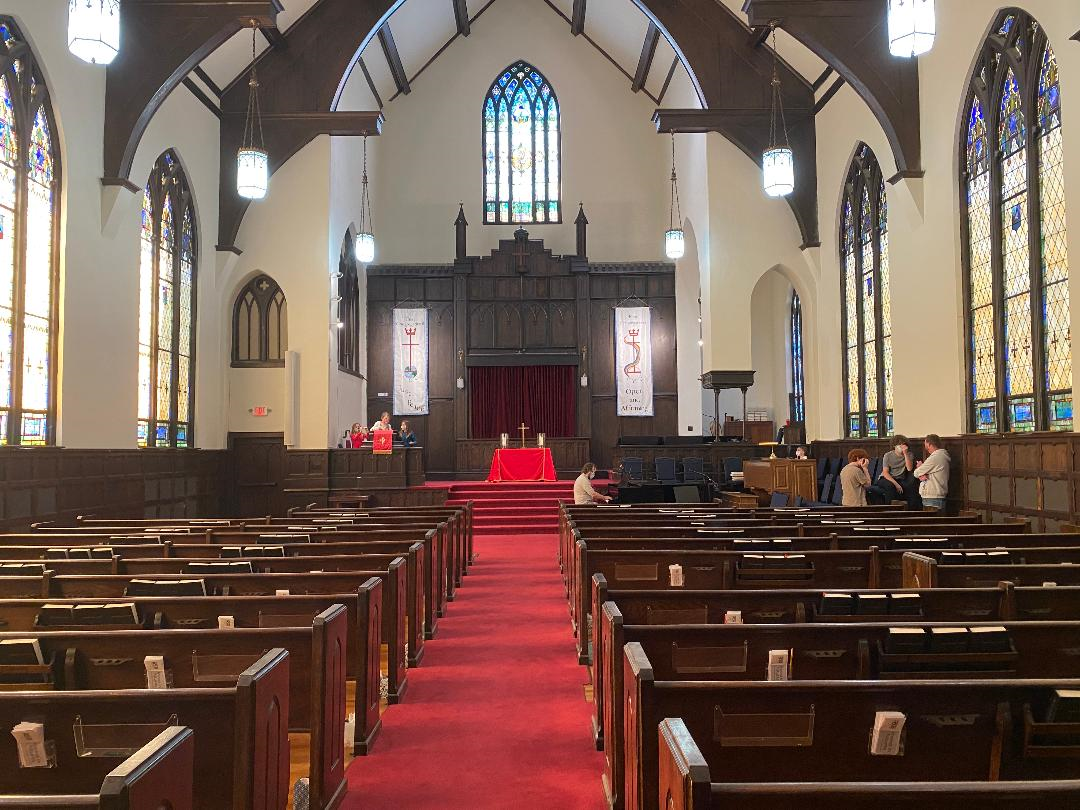
Here we are!  Back home in our sanctuary.  Some of us can see each other in person.  We have our communion packets and will be able to share the holy meal together.  We can hear the music live.  And–now that we aren’t editing–we can watch Kim mess things up in real time!  Here we are!  Home again.

Right?  I mean, this is what we’ve been waiting for!  To be gathered in our sanctuary for worship!  To see each other, to be together in this beloved space, which is deep with meaning for so many of us.  This is the space where our children were baptized and confirmed, or where we were married.  This is the space where we have said goodbye to loved ones who have died.  This is the space where we heard for the very first time in our lives that God loves us just as we are.   This space is central to who we are as a church.  It is another member of our community.  

So, I was surprised when the slots for our first in-person worship service didn’t fill up quickly.  I’ve been wondering why.  I’ve heard such eagerness to return to in-person worship… not from everyone, of course, but from many.  Some aren’t ready to be here in person…which is why I’m grateful we’re live streaming.  (Hi, online First Congregational community!)  Why aren’t more people here today?

Maybe it’s that we’ve gotten out of the habit of going anywhere, including to church.  Or maybe we haven’t been fully vaccinated.  Or maybe, after so many months of isolation, togetherness is something we’re having to ease into.  Maybe we LIKE participating in worship at home in our jammies.

Or maybe it’s the long list of things we can’t do yet because the pandemic isn’t over.  In the US, we’ve made a lot of progress, but we’re still only one third fully-vaccinated.  And as long as other countries don’t have the resources to vaccinate their people, the pandemic will not be over.  We do want to remember people in India and South America.

Because the pandemic isn’t over yet, though we do feel comfortable having folks in the sanctuary for worship, we still have to wear masks, we still have to social distance, we still can’t hug, we still can’t sing.  We won’t be taking up the offering by passing the plates.  We won’t come forward to have communion.  We won’t be able to share Joys and Concerns in the usual way.  We won’t have Friendship Time after the service.

So, we’re coming home…sort of.  Maybe we don’t have more people today because people recognize that, yes, we’re back in the sanctuary for worship, but it’s not the same.  Because of the need to follow Covid protocols to keep everyone safe, it’s just not the same.

When the Reopen Team started talking about returning to in-person worship a couple of months ago, I knew which Scripture story would help us navigate this new reality. 

Several hundred years before today’s story, King Solomon had built a magnificent temple for God and for the people.  The people believed that God lived in the innermost part of the Temple complex called the Holy of Holies.  For the people, coming to the Temple meant, literally, coming to meet God.

So, when the Babylonians came and leveled the Temple, the people were devastated.  They’d lost their temple, they’d lost the Holy of Holies, they’d lost their sovereignty as a country, they’d lost their land, they’d lost their God…and now, they lived in exile in Babylon.

I know.  It’s not the same.  Our building hasn’t been razed.  In fact, our sanctuary got a facelift while we were away!  But it still feels like we’ve been exiled, doesn’t it?  Our sanctuary has been taken away from us.  In our heads, we know God doesn’t only dwell in our church building, but our hearts?  Our hearts have ached to be back in this place.  And here we are!

Today’s story comes after the people have returned from exile.  (The Persians had defeated the Babylonians.  Cyrus, the Persian leader, gave the Judahites permission to return to Jerusalem.  He even provided for building projects.)

The people’s first task upon returning from exile was to build a wall around Jerusalem.  Completely different context than for us today.  2400 years ago, walls were needed for security for towns and cities.  The book of Nehemiah tells the story of the rebuilding of the wall.

The book of Ezra recounts the story of the rebuilding of the temple.  Today’s passage relates what happened when the foundation was laid for the new Temple.

The day begins with a celebration.  The priests in their vestments praised God with trumpets.  The Levites did the same with cymbals.  They sang responsively:  “God is good!  God’s steadfast love endures forever!”  All the people responded with a great shout when they praised God, because the foundation of the house of God was laid.

Yay!  Big celebration.  We’re home!  Thanks be to God!  But everyone that day wasn’t celebrating.  Many of the priests and Levites and heads of families, old people who had seen the first house on its foundations, wept with a loud voice when they saw this house.  Yes.  They were home.  They were laying the foundation for the new Temple.  But looking at the footprint of the new Temple, the elders knew–this Temple was going to be a mere shadow of the first one.

And so, they weep.  They cry out.  They pour out their grief.  In fact, though many shouted aloud for joy, the sounds of the joyful shouts couldn’t be distinguished from the sound of the people’s weeping, for the people shouted so loudly that the sound was heard far away.

Take a minute to imagine the scene.  The exiles have returned.  Finally!  They’re back home.  They’ve built the wall.  Now it’s time to rebuild the Temple.  Plans are drawn up, the foundation is laid.  People born in exile in Babylon who’d never seen the first Temple erupt into joyful praise.  While off to the side, the elders sit, quietly weeping.  Visions of how things used to be, of the time when they had their own country, when they met regularly in the Temple Solomon had built, visions of how things used to be dance across their minds…and their hearts.  Then the flood gates open.  Quiet tears become heaving sobs.

Imagine now you live in a village outside Jerusalem.  You notice a loud crowd sound.  You ask your spouse, “Do you think those people are happy or sad?”  The two of you debate it for a minute.  Then your young child says, “Maybe they’re both.”

Maybe we’re both happy and sad today, too.  Some of us are over the moon to be here today.  Others of us are missing the way things used to be.  People joining us online might be thinking, What’s the big deal?  We’re loving online church!  If we could be together all in one place, I suspect the shouts of joy, sounds of sobbing, and chorus of “meh” also would mingle together into an indistinguishable roar.

One message of this story for us is the recognition that, as a community, we’re in a lot of different places today.  And, guess what?  Every single place, every single feeling, all of it is exactly right.  It makes sense that we’re all over the place right now.  It’s important that–as a community–we create space for all the places, all the feelings.  It’s important that we give each other space to do what we need to do.  That’s how community works.  

This story also reminds us of the critical importance of grieving.  While it’s great to be back in the sanctuary for in-person worship.  But it’s not the same; it’s so not the same.

Here’s the thing about active–even loud–grieving.  Sometimes, loud grieving is the only way we have of accepting our new reality.  I suspect on the far side of their lamenting what they’d lost in the exile, the elders felt differently.  Perhaps after their tears dried, they were able to accept the new reality, despite the fact that it was so inferior to the reality they remembered.  

The documentary Fierce Grace tells the story of Ram Dass after suffering a stroke.  As his assistant helps him into the passenger seat of a car, Ram is asked, “Does it frustrate you that can no longer drive?”  Ram says, “If I enter the car as a driver, yes.  I am frustrated that I can no longer drive.  But if I enter the car as a passenger, I enjoy the ride and am peaceful.”  Ram had done his grief work.  He had accepted his new–diminished–reality.  And he was at peace.

I think we all know that, to quote Thomas Wolfe, we can’t go home again…not after all that’s happened in the last 13 months.  If we come back to this place expecting things to be like they were before the pandemic, we are going to be frustrated.  If, however, we come back to this place fully accepting our new reality, our frustration will ease and we will be at peace.

It could be that on the far side of grieving all we’ve lost, on the far side of accepting our new reality, …it could be that when we settle in and fully accept where we are, we’ll discover that this new reality we’re inhabiting isn’t diminished at all.  We might even see it as good, exciting.  Perhaps, when we have grieved the way things were, we’ll see all kinds of possibilities for the way things might be.  When the pandemic has ended, perhaps we will, as T. S. Eliot wrote, “Arrive where we started and know the place for the first time.”  

In the name of our God, who creates us, redeems us, sustains us, and hopes for our wholeness.  Amen.

Kimberleigh Buchanan  © 2021

Posted in Uncategorized | Leave a comment

Sermon: “Creating Beloved Community” (4/25/2021) Acts 2:42-47

When asked what one thing people can do to make a difference in the world, author Paul Born tells them, “That’s simple.  Bring chicken soup to your neighbor.”  “Really? [That’s it?]” is the typical response.  Born says yes, then adds:  “‘The answer is simple.  But the act of bringing soup?  That takes work.’

“How so?  It requires that you know your neighbor.  It requires that you know they are not vegetarian and like soup.  It requires that you know them well enough and communicate regularly enough to know they are sick.  Once you know they are sick, you must feel compelled to want to help and to make this a priority among the many calls on your time and energy.  Your neighbor must know you well enough to feel comfortable in receiving your help.  And you must have enough of a relationship to know what they prefer when they are sick, whether it is chicken soup, pho, chana masala, or even ice cream.

“So, you see, the work takes place long before you perform the act of bringing soup.” (Deepening Community, Paul Born)

Creating beloved community…sounds simple, doesn’t it?  All three words leave your insides feeling warm and fuzzy–creating…beloved…community.  Yes!  Creating beloved community is exactly the thing churches should be doing!  Let’s do it!  Let’s create beloved community!  Here in our First Congregational community and in the wider community.  Creating beloved community is what it’s all about!  Let’s get to it!

The answer to healing the world?  It’s simple:  create beloved community.  The act of creating beloved community?  Yeah.  That takes work.

My gut reaction to a short video capturing a woman’s reaction to the guilty verdicts in the Derek Chauvin murder trial reminded me of just how hard it is to create beloved community.  In 1995, I waited in a packed lecture hall at Candler School of Theology in Atlanta for the verdict in the O J Simpson murder trial.  I’d say the crowd was 50/50 Black/white.  I was stunned when OJ wasn’t convicted.  I was even more stunned–and, maybe, bewildered–by the reactions of the Black people in the room:  they erupted into cheers.

I didn’t get it for a long time.  I realize now that I had been approaching that event with the assumption that the justice system treated every person the same.  Now, after reading tons of books and talking with others here at church and especially with friends in the Black community, I see how the justice system has been skewed from the beginning against people with Black skin.

I have been working hard to wake up to my own participation in white supremacy.  As a mostly white congregation, many of us have been doing that work together.  

Which is why I was devastated by my gut reaction to the video I saw in the paper Wednesday morning.  At the end of the clip, a woman–her face full of emotion said, “We matter.”  Then she straightened and said it again.  “We matter.”  It was simple…and profound.  After centuries of living in a society that, at every turn, screams to them that they don’t matter, finally, the system came through for people with Black skin.  Finally, a verdict came that affirmed their humanity.  “We matter.”

When the video ended and froze on the woman’s face, I stared at it, the woman’s words ringing in my ears:  “We matter.”   As I contemplated the woman’s face, it hit me:  Now, she matters more to me.  Now, because of this verdict, I see my fellow human beings with Black skin differently.  I see them as more whole.  I see them more equitably.

The realization devastated me.  I thought I’d already worked all that through and was already seeing every Black person as a human being, as a beloved child of God.  Of course, of course, I believe that Black Lives Matter!  Of course, I do!  But that woman, all the emotion on her face, I realized that, suddenly, she now mattered more to me…which meant that before the verdict, she had mattered less.  In that moment, I recognized the deep-seated racism still roaming around inside me.  As a daughter of the South, I learned my lessons well.  Some vestige of my slave-holding ancestors still resides in my DNA.  

With that insight, I recognized again how difficult it is to really know another person, especially someone who’s life experiences are different from your own.  So often we think we’re doing community well–we establish a whole range of chicken soup ministries–but, in truth, we don’t even know if chicken soup is what is needed.  We don’t know because we haven’t taken the time to know each other…or the people outside our community we’re trying to act into wellbeing.

If today’s Scripture reading sounds familiar, it is.  We heard the same text last week, the passage that introduces the idea of koinonia, community.  There is within our Christian tradition a spiritual practice called lectio divina, sacred reading.  When engaging the practice, we spend time focused on one passage of scripture, sometimes even on just one verse.  So often, we consume the Bible.  We quickly read through passage after passage without ever giving ourselves the chance truly to encounter it or, more importantly, to encounter God in it.

We’re going to do a little lectio with this passage.  I’ll read it slowly, with pauses.  In the pauses, you’re invited to reflect on the words you hear in the context of our First Congregational community.  When you hear about breaking bread together–how has that happened in our community?  How might it happen in the future?  How might we deepen our work of creating beloved community here at First Congregational?  How might we expand our work of creating beloved community into the world beyond First Congregational?  Hear now a reading from Acts.

They devoted themselves to the apostles’ teaching and fellowship… to the breaking of bread and the prayers… Awe came upon everyone because many wonders and signs were being done by the apostles… All who believed were together… and had all things in common… they would sell their possessions and goods… and distribute the proceeds to all, as any had need… Day by day… as they spent much time together in the temple… they broke bread at home and ate their food with glad and generous hearts… praising God… and having the goodwill of all the people… And day by day… God added to their number… those who were being saved.

Take a minute and gather your thoughts.  What jumped out to you in these verses?  If ideas for how to deepen our First Congregational community emerged, write them down!  We don’t want to forget them!  

At the heart of Paul Born’s description of community–bringing chicken soup to your neighbor–is relationship.  Creating beloved community begins with relationship.  How can we act others into wellbeing if we don’t know them?  My reaction to the verdict in the Derek Chauvin trial showed me that I have a lot of work to do in building relationships with people in the Black community.  The focus of the Scripture passage we’ve been looking at has been relationship–when we spend time together, worship together, study together, eat together we get to know each other.  When we get to know each other, we’re better equipped to act each other into wellbeing.

So…let’s do a little more lectio this morning.  Let’s listen to the five people who are formally joining our community today.  I didn’t ask them whether they like chicken soup, but their answers to the questions that were asked will, I think, teach us a lot.

Posted in Uncategorized | Leave a comment

Sermon: “Always, We Begin Again” (4/18/2021) Acts 2:42-47

“Always, We Begin Again”

Acts 2:42-47

A monk was asked, “What do you monks do all day at the monastery?”  The monk’s response?  “We fall down and we get up, we fall down and we get up.”

What a great summary of the spiritual life!  It isn’t a gradual step-by-step journey to enlightenment.  For most of us, the trajectory of our spiritual journey more resembles a toddler’s crayon scrawling on the dining room wall, full of fits and starts, backtracking and spinning in place.  We fall down, we get up.  We fall down, we get up.   

The same is true for faith communities.  We also follow Jesus in fits and starts.  We backtrack; we spin in place.  We fall down, we get up.  We fall down, we get up.

This pandemic year has felt like one, long, slow-motion fall, hasn’t it?  One of those falls that seems like it’s never going to end, where the whole way down all you’re thinking about is how much damage you’ll sustain when you hit the ground.

Something happened Easter Sunday morning out in the back parking lot.  Thirty of us gathered in the cold to celebrate the resurrection story.  Even in our winter gear, even with our face masks, even socially distanced, it happened!  We experienced resurrection.  After a year of NOT worshiping together in each other’s presence, we did.  After a year of falling, we began getting up again.  The sisters I hang out with in Indiana have a phrase that describes the falling down and getting up process, “Always, we begin again.”

Now that our church is poised to begin again, where can we go for guidance on how to discern our church’s post-covid mission?  A great place to start is the book of Acts.

Today’s passage happens right after Pentecost, that day when God’s Spirit whooshed in, and everyone understood each other, and were on fire with God’s love.  What was the first thing Jesus’ followers did after this pivotal experience?  They couldn’t help themselves…they drew together in community.  They devoted themselves to the apostles’ teaching and fellowship, to the breaking of bread and the prayers. Awe came upon everyone, because many wonders and signs were being done by the apostles. All who believed were together and had all things in common; they would sell their possessions and goods and distribute the proceeds to all, as any had need. 

I suspect we all can remember times when church felt exactly like what’s described here.  We remember Sunday school classes or book studies that opened our minds and hearts to new ways of understanding the world and God’s love in it.  We remember fellowship times and breaking bread together in each other’s homes.  During the pandemic, we’ve created a meaningful time of praying together each week.  I wish I’d been here when marriage equality became the law of the land.  Based on what I’ve heard from those of you who were here, awe did come upon everyone at the wonders and signs being done.

The financial generosity of this congregation is inspiring.  When the first stimulus checks came out last year, many of you said, “I don’t need this money.  I want it to go to someone who does need it.”  In response, we established the Care and Share Fund to assist our members who are struggling.  They would distribute the proceeds to all, as any had need.  

Reading through these verses reminds us of what makes a faith community strong.  It also might make us a little sad at what we’ve been missing this year.  But as the pandemic winds down, it also gives us a to-do list for how to begin again, post-pandemic.

As we figure out how to begin again, let’s look at the last two verses of the passage:  Day by day, as they spent much time together in the temple, they broke bread at home and ate their food with glad and generous hearts, praising God and having the goodwill of all the people.  And day by day God added to their number those who were being saved.

With the repetition of “day by day,” the author draws a direct link between what happens in the first sentence and what happens in the second.  Think, cause and effect.  Day by day, they spent time together in the temple, they broke bread together in each other’s homes, they acted with goodwill toward all the people.  That was the cause.  Here was the effect of doing those things:  Day by day, God added to their number those who were being saved.  Luke seems to be saying here that when we seek to create beloved community within these walls, we participate in creating beloved community outside them.  

Here are two examples of how our beloved community is working to create beloved community beyond these walls.  After that, I’ll share an opportunity to expand that work.

The racial reckoning in our country sparked by George Floyd’s death last May sent many of us into a period of deep mourning and questioning.  How could we as a predominantly white church help dismantle a system that values Black lives so little?  Since then, we’ve done two church-wide book studies.  We’re now in the middle of an anti-racism workshop, led by alexandria ravenel and david greenson of Collaborative Organizing.  

One of the awe-inspiring wonders in the last year is the partnership we’re forming with the YMI Cultural Center, in Asheville…just a ten minute walk from our church building.

YMI Cultural Center | Kindful

The conversations with YMI began when our “Say Their Names” exhibit was displayed at YMI last summer.  As often happens with well-intentioned white folks, we made a few missteps… but we learned–and keep learning–from them.

In the last couple of months, we’ve begun talking about what it might mean for our art galleries to become “sister galleries.”  Our inaugural sister-gallery event begins next week, with a new “Say Their Names” exhibit to commemorate the first anniversary of George Floyd’s murder.  The artwork of two young Black artists, Kai Lendzion and Heather Tolbert, will be exhibited in our gallery.  We’ll have an opening event for the gallery on May 7th on the front patio outside the gallery.  The gifted singer, Kia Rice, will offer music.  It also will be the official kick-off for our Sister Galleries initiative.  Here’s a really cool thing…at the end of our opening, we will encourage people to walk to YMI to see the art exhibited there!  That will help us–literally–to embody the connection we are forming with YMI.

The work of dismantling systemic racism can be overwhelming…but we have begun that work by building relationships with Black people and organizations in our community.  All this work toward the beloved community has grown out of our tending to our FCUCC community.

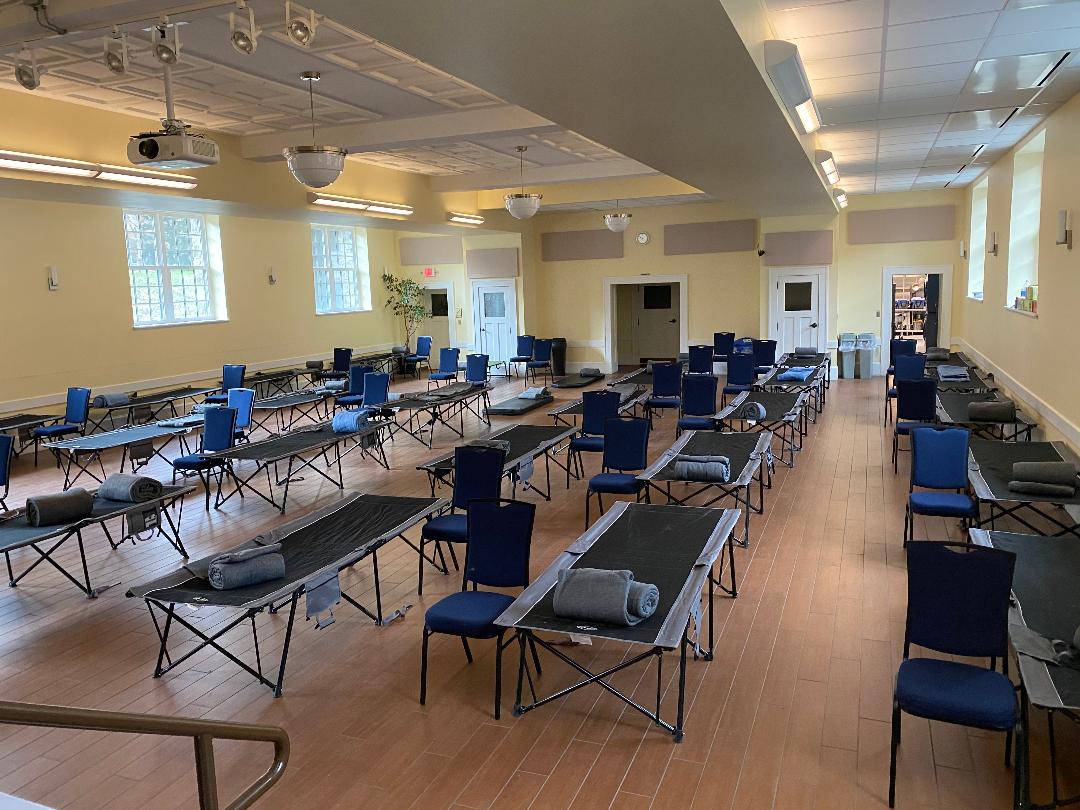
Another example of our own beloved community spilling out to create beloved community beyond our church has been partnering with the Western Carolina Rescue Mission to provide space for a Code Purple shelter this winter.  As of yesterday, Code Purple has officially ended.  We’ve gotten word from the city that 379 different individuals made use of the shelter.  That is a remarkable number.  2121 beds were filled during 68 Code Purple nights.  That’s 2121 times someone didn’t have to sleep in below-freezing weather on the streets.  

Code Purple Cots, November 2020

Here’s the opportunity to expand our efforts at creating beloved community beyond our church community.  Because it’s a BIG possibility, it will take time to think and talk it through.  Please put Sunday, May 16th on your calendars.  That’s when we’ll have a Congregational Conversation about this possibility.  This thing is so big that we aren’t in a position right now to say yes or no.  Some of you will say a quick yes.  Others will say a quick no.  As a community, though, we don’t yet have enough information to make a determination. 

The city, county, rescue mission, and so many clients have expressed deep gratitude to First Congregational for providing space for the Code Purple shelter this year.  “This is exactly what church is supposed to do,” one person said.  When I spoke with Marc, host for the shelter, he told me stories of people who made use of the shelter…including a woman who’d just had a baby who was able to take time, to spread out her things, and get her head clear.  He talked about the wide diversity of folks who came each night.  He expressed gratitude that the EMS folks were located just across the parking lot.  He couldn’t say thank you enough.

Here’s the opportunity.  The city has asked if we might continue providing space for a shelter for some of our most vulnerable unsheltered neighbors.  The city will use stimulus funds to create a permanent shelter for these folks, but it will take some time to create that shelter.  In the meantime–for at least 6 months, maybe more–they’re looking for a temporary site to shelter those folks.  The city wonders if we might provide space for that shelter.

I told you it was BIG!  I don’t have any idea whether we’ll be able to offer space for the shelter the city is imagining.  When the Board talked it over on Thursday night, they didn’t have any idea either…but they were very clear:  “We have to take this to the congregation.”  Which is why we’ve scheduled a congregational conversation about it on May 16th.  

As followers of Jesus, we are called into community.  But we aren’t called into community just for ourselves.  We are called to be community for the world.  We are called to create beloved community with each other, because that is how we help to create beloved community in the world.  Day by day, they worshiped, prayed, and broke bread together.  Day by day, God added to their number.

It’s true that we’ve fallen down a few times, both with our own beloved community and with the wider beloved community.  What will it look like to get up this time?  How will we continue practicing resurrection now?  How will we nurture the new life sprouting up all around us?  This time, now, in this moment, how will we begin again?

In the name of our God, who creates us, redeems us, sustains us, and hopes for our wholeness.  Amen.

Kimberleigh Buchanan © 2021

Posted in Uncategorized | Leave a comment

Sermon: “Resurrection Joy?” (EASTER, 4/4/2021) Mark 16

There’s no doubt they were traumatized.  Just two days before, the one who’d taught them, who’d given them hope, who’d invited them to see the world as more just and loving…just two days before, betrayed by both the government and their religion, the one in whom their hope resided was executed.

A couple of hours after Jesus died, Sabbath began.  Sabbath…a time to cease from labor, a time when most actions were forbidden.  “Holy Saturday,” the church has come to call it.  For those experiencing the first one, it probably felt more like an UNholy Saturday.  Sitting with the trauma, prohibited from taking any action.  Images and sounds from the previous day replaying in their minds.  Waves of grief hitting them again and again.

No wonder those women–seeing the first ray of sunshine announcing Sabbath’s end–headed straight for the market to buy spices, then on to the tomb in which Jesus had been laid.  Not only was anointing his body a necessary task, it was a task.  Finally, after what must have felt like the longest Sabbath in history, finally, they had something to do.

On the way to the tomb, they chatted…mostly about how the three of them, Mary Magdalene, James’ mother, and Salome, were going to remove the large stone that had been placed over the tomb’s opening.

It’s easy to forget sometimes just how much emotional work the women had done in the hours since Jesus’ death.  Jesus’ trial and death had happened in a flash.  Since that time, the women, somehow–even amid the trauma–had accepted Jesus’ death.  Those of us who’ve lost a loved one through unexpected violence know…accepting the death is hard.  Simply believing that it happened takes tremendous emotional and mental work.

The women’s arrival at Jesus’ tomb that morning–bearing death spices–is a testament to the emotional work they’d done.  They had accepted the fact:  Jesus was dead.  

So when they arrived at the tomb–the stone rolled away–and a young man dressed in white saying Jesus wasn’t there– “Look where he was laid.  See?  He’s not here!”  Would you believe it?  You’d already spent the time since the crucifixion trying to accept the unbelievable fact of Jesus’ death.  Now you’re supposed to accept a second unbelievable fact:  that Jesus is alive?  A person’s imagination– not to mention her heart–can only hold so much.  Having your world turned completely upside down twice in three days?  That’s a lot.  A lot.  Is it no wonder the women fled?  Is it no wonder they were afraid?

Last week in Sunday School, as we discussed theologian James Cones’ view of the cross, one person said, “I think I’m still really focused on the crucifixion.  I haven’t yet made it to the resurrection.  I will at some point.  Right now, though, I’m focused on the crucifixion.” 

It’s easy to get stuck on crucifixion, on injustice, on pain and suffering and death… especially when the Sunday School teacher spends so much time talking about it all Lent long!  How do we shift from crucifixion-thinking to resurrection-thinking?  How do we shift from terror to joy?

Another of our conversation partners this Lent has been German theologian, Jurgen Moltmann.  As a teenager drafted into Hitler’s army, Moltmann experienced tremendous suffering.  He watched his hometown of Hamburg decimated by the British.  He saw friends die.  He spent three years in a prisoner-of-war camp in Scotland.  It was only when he experienced God’s presence in the midst of his very real suffering that Moltmann was able to believe in God.  

Moltmann’s theology took us to deep, hard places…which is why I was surprised by what I saw in a recorded interview with him.  Jurgen Moltmann exudes joy!  When asked how one moves from the experience of terror to an experience of joy, Moltmann starts with Jesus’ cry on the cross:  “My God, my God, why have you forsaken me?”  Reading that statement as a teenage soldier, Moltmann knew he had “a divine brother who knew how he felt.”  “When I feel the presence of God (in my suffering), my heart is lifted up.  I see God coming into the future.  Thus, is joy awakened in me.”  

As today’s resurrection story ends, the women are afraid and, though entreated to tell Peter and the disciples about the empty tomb, they say nothing to anyone.

But, obviously, they did say something to someone sometime.  If they hadn’t, we wouldn’t be sitting here today celebrating the resurrection!  At some point, the women’s terror shifted to joy.  

If you read past today’s resurrection story in the Gospel of Mark, you’ll see the work of a couple of nervous editors.  The women leaving the empty tomb in fear saying nothing to anyone…that wasn’t going to get a movement started.  “The women fled the tomb in terror and didn’t say anything to anyone.  Come join our movement!”  So, some editors got creative and filled in the blanks.  And immediately they reported all these instructions to Peter and his companions.  After this, through them, Jesus sent forth the holy and imperishable proclamation of eternal salvation.  Whew!  Problem solved.

To be clear, the two Marys and Salome must eventually have gotten to joy from terror.  But the original ending of the story–with the women still focused on crucifixion– suggests that getting from terror to joy doesn’t turn on a dime.  It takes time.  Sometimes, a lot of time.

But something that might help, as Jurgen Moltmann suggests, is facing squarely the terror and the circumstances that are causing it, then find God in the midst of the terror, in the midst of the suffering.  If we face the terror squarely, if we experience the suffering, if we experience God’s presence in the midst of the suffering, then we’ll be able to experience the joy.

In July 2018, 39 of us made a pilgrimage to Montgomery to visit the newly-opened National Memorial for Peace and Justice, also known as the Lynching Memorial.  The Memorial consists of large, metal pillars suspended from the structure’s ceiling.  The likeness to hanging bodies is clear.  Each pillar represents a county in which lynchings occurred.  The names of victims and dates of their deaths are recorded on each pillar.  

Descended from slaveholders, I joined the pilgrimage with trepidation.  When I learned of my family’s slaveholding past, the feelings of guilt nearly incapacitated me.  How could people with my DNA think they could own other human beings?  How could I ever atone for their cruelty?  How could I, a white Southerner descended from slaveowners, do anything in the cause for racial justice?

I entered the memorial feeling the weight of those questions.  Just ten steps in, the horror hit full force.  So many pillars.  So many names.  So much cruelty.  So much death.  Executions occurred for the tiniest of crimes—knocking on someone’s front door, looking another person in the eye, writing a note to a white person.  A plexiglass box at the center of the Memorial contains dirt collected from sites of lynchings across the South.  Whose DNA might be mingled with those grains of soil?  Whose lifeless body hung above these bits of dirt?  

At the Memorial’s lowest point, a sheet of water cascades down a wall dedicated to thousands of lynching victims whose deaths were not documented.  As I sat amidst the horror, weighed down by guilt, I wondered—did the water represent tears for those who were lost?  Or did it represent the prophet’s call to let “justice roll down like water, righteousness like an ever-flowing stream”?  Did it proclaim tears or justice?  Did it depict crucifixion or resurrection?

The answer to those questions came to me as I walked up the ramp leading out of the depths of the Memorial.  I had expected to feel even more devastation, even more shame.  But, oddly, I didn’t feel either.  As I emerged into the sunlight that day, what I felt was…hope.  Now that I had faced squarely (to the extent that I as a white person am able to do so) the terror of lynching and, potentially, my ancestors’ participation in it, now that I had seen (to the extent that I am able to see it) the crucifixion of so many people, suddenly, surprisingly, resurrection felt possible.

I know.  Easter’s supposed to be about joy, joy, joy!  And it is.  Easter is joy.  Easter is the deepest kind of joy there is.  In fact, Jurgen Moltmann says the thing that makes Christianity unique from other faiths is that at the center of our faith is joy.  Our core message is the Gospel, which means good news.  And what accompanies good news?  Joy, right!

Emerging from the Memorial that day, I felt the good news.  I felt deep hope.  Regarding achieving racial equity, I don’t yet feel joy, but I am beginning to believe in the possibility of resurrection.  That, in itself, feels like a miracle.

Are you joyful today?  Are you hopeful?  Is there some circumstance about which you have received some good news?  Are you beginning to believe in the possibility of resurrection?  If so, that is good news–very good news, indeed!

In the name of our God, who creates us, redeems us, sustains us, and hopes for our wholeness.  Amen.

Kimberleigh Buchanan  © 2021

Posted in Uncategorized | Leave a comment

Sermon: “Faces in the Crowd” (Palm Sunday, 3/28/2021) Mark 11:1-11

In preparing for Palm Sunday, my mind keeps drifting to Epiphany.  January 6th.  Our nation’s capital.  Insurrection.

On the face of it, the two events–a hoard of people violently over-running the halls of Congress and the cheering crowd in Jerusalem on Palm Sunday–seem to have little in common, except for the large number of people involved.

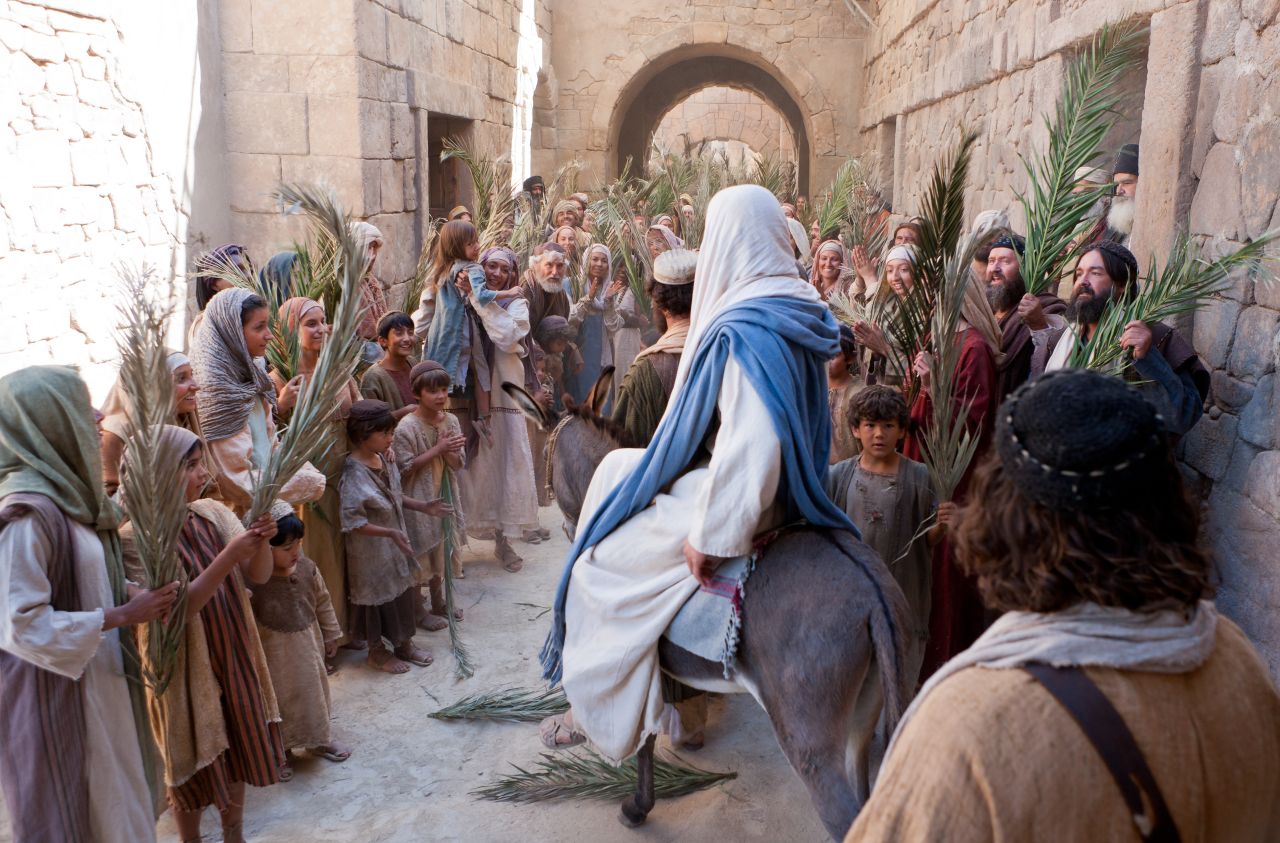
Holy Week - Palm Sunday | ComeUntoChrist
How the Capitol insurrection affects those who live and work in Washington  - Marketplace

But…I wonder.  Who was in the crowd in Jerusalem that day?  Was everyone cheering for the same reason?

Things were so chaotic on January 6th in Washington, it’s taking a lot of time to sort out exactly what was going on.  Was it an insurrection?  Was it a protest of a so-called fraudulent election?  Was everyone there intent on taking over the government?   

Interviews with rioters after the fact reveal a diversity of reasons people stormed the Capitol that day.  Some wanted to “take back their country.”  Some were intent on harming legislators.  Some wanted only to follow their president.    

Why did people line the streets of Jerusalem that first Palm Sunday?  Why did they wave palm branches, then lay them on the road to prepare Jesus’ way?  Why did they cry, “Hosanna!  Blessed is the One who comes in the name of our God!”  Did everyone in the crowd that day come for the same reason?  

As reports and photos from January 6th emerge, many of the protesters are being identified; some of them are well-known.  Papers often publish pictures with the image of the person in question highlighted.  Those pictures humanize the crowd.  A mob isn’t just a mob, it’s a conglomerate of individuals, each with his or her own reason for being present and participating.

If they’d had cellphones that first Palm Sunday, and if the faces of those in the crowd were highlighted, who would we see?

We’d see one of Jesus’ disciples, who’d just completed yet another weird task for Jesus, aka, stealing the colt he was riding into town.  We’d see a pilgrim, just arrived from a nearby village, ready to celebrate the high holy days of Passover.  We might see the formerly hemorrhaging woman standing a little taller in the crowd that day, or the man with the formerly withered hand, clapping for joy.    

Cellphone photos that first Palm Sunday, would, no doubt, have revealed many adoring followers in the crowd.  If what happens at the end of the week is any indicator, though, all of the crowd that day wasn’t adoring.  

Some were looking to Jesus to overthrow the Roman government.  Even one of the twelve disciples–Simon the Zealot–was in this group.  Others were looking to make Jesus a king.  Then there were those who’d heard the rumors about Jesus overthrowing the government and becoming king…and didn’t like it.  I’m talking here, of course, about the people in power– the emperor, the ruler of the region, Pontius Pilate, the leader of the Jewish community in the region, Herod, and the religious leaders, the Scribes, Pharisees, and Saducees.  

Were some of these powerful people in the crowd that day?  Did they incite the crowd?  Or did they simply observe and begin making their plans to erase this threat to their power?

Mobs or large crowds–for whatever reason–they don’t happen out of the blue, do they?  The women’s march on Washington in January 2017–that didn’t happen out of the blue, did it?  No, it grew out of a weariness of centuries of the diminishment and denigration of women.  The women–many from this congregation–traveled to Washington to demonstrate and celebrate women’s strength and solidarity.

The protests after George Floyd’s murder didn’t happen out of the blue, did they?  No, they grew out of the agony of centuries of oppression and dehumanization of our sisters and brothers with Black skin.  The gatherings the past two weeks in support of Asian Americans, whose experience of racial violence often is overlooked…they didn’t happen out of the blue, either.  No, people who’ve endured violence in silence for so long have had enough.  

The mob at the Capitol building on January 6th didn’t come out of the blue, either.  The crowd was groomed and prodded and prepared.  Decades of frustration with the political system in our country made people vulnerable to the manipulations of the people who incited them.  It’s clear from interviews after the fact that some of the rioters regret having participated.  They weren’t there to hurt anybody.  It’s likely they’re beginning to realize they were simply pawns in someone else’s game.

Were the people gathered in Jerusalem that day, the ones who were throwing down palm branches and cloaks to pave Jesus’ way….were they also being manipulated?  Later, when Jesus was crucified, did they realize they’d been used and were only pawns in someone else’s game?

One of the sadder parts of growing up is learning to recognize power games going on behind the scenes.  We look at a situation and celebrate it.  But when we look deeper, we see the power differential, we see injustice.  For instance, we celebrate the large number of homes purchased by veterans returning from World War II on the GI bill, but the vast majority of the 2.5 million homes purchased went to white families.  Unfair lending practices to black farmers has recently come to light, as well.  And we celebrate pioneers in the early days of our country, but tend to gloss over the fact that their land was obtained by cheating–and worse–the native people already on the land. 

Learning to recognize power games going on behind the scenes is one of the sadder parts of growing up, and it’s important.  It’s important that we learn to see the unlevel playing field created by our social, economic, justice systems.  It’s important to learn to see the world as it really is.

As grown-up followers of Jesus, we’re called, not only to see those systems, but to do what we can to transform them.  That’s where Jesus can be our guide. 

Besides the Palm Sunday story, there were several times in the gospel of Mark when the people wanted to make Jesus king.  Every time, he refused.  Why did he refuse?  Maybe because he understood that becoming king, or emperor, or chief priest wouldn’t change anything.  If Jesus were to become a king, emperor, or chief priest, the oppressive political, religious, and social systems wouldn’t change at all; they’d just be replacing one leader for another in a system that still would be unjust.  Maybe Jesus resisted calls for his coronation because he understood that, if the oppressive system was going to be transformed, something different, something more profound would have to happen. 

Today’s story ends with Jesus in the Temple, “looking around at everything that is there.”  The next day, he’ll clear the Temple out.  But on this day, the day when the crowds celebrated him, the day when he heard more calls for him to become king, he entered the Temple and “looked around,” then, because it was late, returned with the twelve to Bethany.

But those moments in the Temple, seeing evidence of the religious system that was in place, did Jesus also get a glimpse of what it would take to transform that system?  Like the prophets of old, did he get a vision of what to do and say to wake people up to what was happening?  Standing there in the Temple that evening–loud hosannas still ringing in his ears–did Jesus begin to grasp what would happen by week’s end?  Did he get a vision of what profound thing would need to happen in order for the world to be transformed?

Did he have a vision of a cross?

The invitation as we enter Holy Week is to open our minds and hearts again to this pivotal part of our faith story.  Each step of the way, let us ask, What is Jesus doing?  How is he seeking to transform and heal the world? 

And what might we learn from Jesus’ journey to the cross about transforming and healing our own world?

In the name of our God, who creates us, redeems us, sustains us, and hopes for our wholeness, Amen.

Kimberleigh Buchanan  © 2021

Posted in Uncategorized | Tagged , | Leave a comment

Sermon: “Please, We Wish to See Jesus” (3/21/2021)

When Allen and I travel–we can’t help ourselves–we visit churches.  And when we visit those churches–I can’t help myself–I climb into the pulpit.

The pulpit in a Presbyterian Church in Charleston is a large elevated structure in the center of an otherwise unadorned room.  As we came through the church’s doors the first time–I think it was on our honeymoon in 1995–I made a beeline for the structure.

About halfway up the staircase to the pulpit was a brass plaque engraved with these words:  “Sir, we wish to see Jesus.”  Except for the “Sir” part, I liked it.  I stood in the pulpit and imagined how I might preach so that people might see Jesus.  I still try to do that.

The people who approached Philip in today’s Gospel story wanted to see the actual Jesus, to be in his physical presence.  For us, who aren’t able to be in the flesh-and-blood Jesus’ presence, seeing Jesus isn’t as clear a thing.  Each of us sees Jesus from a different perspective.

Last week in Sunday School, we explored St. John of the Cross’ idea about the dark night of the soul.  John was a priest who lived in the 16th century and was good friends with Teresa of Avila.  

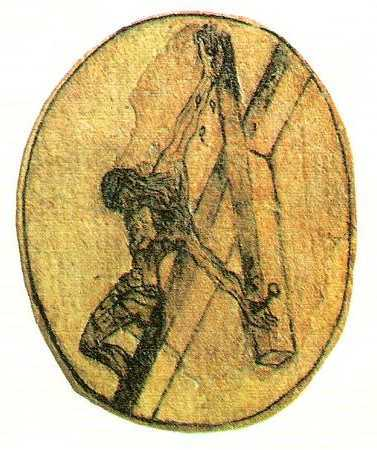
Once, when John was praying in the loft of the chapel at the monastery in Avila, he had a vision of Jesus on the cross.  He sketched what he saw.  Here’s what it looked like.

Kim:  From his high perch in the loft, John was looking down on the chapel’s crucifix.  He saw the crucified Jesus from a perspective he’d never seen before.

In our exploration of different theologies of the cross in Sunday School, we’re seeing Jesus, his death, and resurrection from many perspectives.  As a Lenten practice, I decided to explore some of those perspectives by rewriting the old Gospel hymn, “Beneath the Cross of Jesus.”  Rather than looking at the cross from only one perspective–from beneath it, as the original version of the hymn did–I chose to view it from several perspectives.  That’s when I started playing with pronouns–beneath, beside, behind the cross of Jesus.

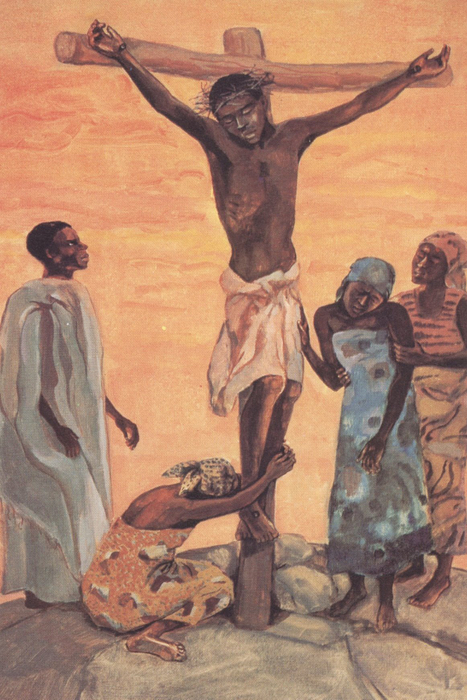
As I visualized the crucifixion and looked beneath the cross, I saw the beloved disciple and Jesus’ mother, Mary.  Listen.  

Wes:  A reading from John.  When Jesus saw his mother and the disciple whom he loved standing there, he said to his mother, ‘Here is your son.”  Then he said to this disciple, “Here is your mother.”  From that moment, the disciple took her into his household.  (John 19:26-27)

Ty (and Betty):

Beneath the cross of Jesus

His mother, closest friend

Standing close, their heads bowed low

Hearts clutched with grief for him

Their loved one spoke with rasping breath

He gazed upon each one 

“Friend, this is your mother now,

And Mother, here’s your son.”

Kim:  Then my mind’s eye was drawn to the figure on the cross beside Jesus’ cross.

Wes:  A reading from Luke.  One of the criminals who hung there beside him insulted Jesus, saying, “Are you really the Messiah?  Then save yourself–and us!”

But the other answered the first with a rebuke:  “Don’t you even fear God?  We are only paying the price for what we have done, but this one has done nothing wrong!”

Then he said, “Jesus, remember me when you come into your glory.”

Jesus replied, “The truth is, today you’ll be with me in paradise!”  (Lk. 23:39-43)

Ty (and Betty):

Beside the cross of Jesus

A man condemned to die

Judged a criminal by law

He, too, was crucified

As each one’s life drained fast away

The man sought Jesus’ eyes.

“Friend,” he said, “tonight you’ll be

With me in Paradise.”

      Kim: Then I looked behind the cross and saw the executioners gathering up their death tools.

Wes:  A reading from Luke.  The people stood there watching.  The rulers, however, jeered him and said, ‘He saved others, let him save himself–if he really is the Messiah of God, the Chosen One!”  The soldiers also mocked him.  They served Jesus sour wine and said, ‘If you are really the King of the Jews, save yourself!”  (Lk. 23:35-38)

Ty (and Betty):

Behind the cross of Jesus

The ones who raised it high

Pawns within a power game

Created by a lie

As they drove the final nail

As they watched him die

Did they wonder what they’d done?

Did they wonder why?

Casey, Use this picture while WEs is reading and Ty is singing.

Kim:  “Please, we want to see Jesus.”  But when we look at Jesus, we all see something different, don’t we?  Historically, different visions of Jesus have led to fractures within the Christian church–the Great Schism in the 11th century and the Protestant Reformation in the 16th, to name two.  

But maybe the point isn’t to have just one understanding of who Jesus was and is.  Maybe the goal isn’t to get everyone to see the same thing when they look at Jesus.  Maybe the deeper understanding comes when each of us, having seen Jesus clearly for ourselves, shares what we have seen of Jesus with each other.  And maybe our own visions of Jesus come into even greater focus when we hear from others how they see Jesus.

The hymn’s last stanza brings three perspectives of Jesus on the cross together.

Unknown artist

Ty (and Betty)

Before the cross of Jesus

We stand and wonder how

Jesus’ cross so long ago

Has meaning for us now

When we question power’s aims

When we live God’s grace

When we love each other well

The cross has found its place

Kim:

“Please, we wish to see Jesus.”  So, how do you see Jesus?

In the name of our God, who creates us, redeems us, sustains us, and hopes for our wholeness.  Amen.

Video montage:  Each of the pictures on screen for a few seconds.  I’ll send some music.

Posted in Uncategorized | Leave a comment