FCUCC Worship: Bulletin for 3/22/2020

Third Sunday in Lent

March 22, 2020, 10:30 am


Prelude                                                            Prelude                         by Reinhold Glière

Welcome

Prepare . . .

Silence

Trinity Chime

Call to Worship

We gather again among the electrons to worship.                                                                                  But it’s so different!  We can’t even see each other!                                                          Quarantine does that.  It affects every aspect of our lives, even what we can see                  with our eyes.                                                                                                                                               What about other ways of seeing?                                                                                            Hmm…say a little more.                                                                                                                              Maybe not being able to see like we usually see will help us to see in                                other ways.                                                                                                                                       Now, that is an interesting idea.  Perhaps we can open ourselves to many ways of                seeing as we join together for worship.  What do you say?                                                               Come, let us worship together!                                                                                                  And so, we shall.

Hymn of Praise1                                                        Be Now My Vision                               SLANE

Be now my vision, O God of my heart.                                                                                  Nothing surpasses the love you impart–                                                                                    You might best thought, by day or by night,                                                                                Waking or sleeping, your presence my light.

Be now my wisdom, and be my true word;                                                                              Ever within in me, my soul is assured;                                                                                      Mother and Father, you are both to me,                                                                                    Now and forever your child I will be.

Riches I heed not, nor life’s empty praise,                                                                                 You, my inheritance, now and always.                                                                                        You and you only are first in my heart,                                                                                   Great God, my treasure, may we never part.

Sovereign of heaven, my victory won,                                                                                          May I reach heaven’s joys, O bright heaven’s Sun!                                                                    Heart of my own heart, whatever befall,                                                                                    Still be my vision, O Ruler of all.

Prayer of Confession

Silent Confession

Assurance of Grace2

One fact remains that does not change, God has loved you, loves you now, and will always love you.  This is the good news that brings us new life.  Thanks be to God!


Anthem                                                 Hymn of Promise                              by Natalie Sleeth                                                                                                                                         arr.,  Ferguson

sung by Marika Straw, In honor of Mary Cowal                                                                                    (Feel free to sing along!)   

In the bulb there is a flower; in the seed, an apple tree; 

in cocoons, a hidden promise: butterflies will soon be free!

In the cold and snow of winter there’s a spring that waits to be, 

unrevealed until its season, something God alone can see. 


There’s a song in every silence, seeking word and melody; 

there’s a dawn for every darkness, bringing hope to you and me. 

from the past will come the future; what it holds, a mystery, 

unrevealed until its season, something God alone can see. 


In our end is our beginning; in our time, infinity; 

in our doubt there is believing; in our life, eternity. 

In our death, a resurrection; at the last, a victory, 

unrevealed until its season, something God alone can see. 


Listen . . .

Gospel Lesson                                                            JOHN 9:1-41

If you respond to these words, then for you they have become the word of the still-speaking God.  Thanks be to God!


Sermon                                      Believing is Seeing                    Rev. Dr. Kimberleigh Buchanan

Marion Sheppard showing her dance moves.

Respond . . .

Silence

Joys and Concerns

This is my prayer to God.  Your prayer is now our prayer.

Prayers of the People

                    God in your mercy, Hear our prayer.

Prayer of Jesus

Our Mother and Father in heaven, hallowed be thy name. Thy kindom come, thy will be done on earth as it is in heaven. Give us this day our daily bread and forgive us our sins, as we forgive those who sin against us.  And lead us not into temptation, but deliver us from evil. For thine is the kindom, the power, and the glory forever. Amen.

Offering:  A Note from Our Treasurer

Dear Congregants of FCUCC,

We ask that during this time of physical distancing and suspension of on-site church activities that you NOT forget to continue your faithful financial support of our church.  The operating costs of our facility and the staff salaries need your continued support.  Your gifts can be given in any of the following ways:

  1. Mail checks to: FCUCC, PO Box 3211, Asheville, NC 28802
  2. Go to the church website: uccasheville.org

Scroll to the bottom of the home page where there is a yellow DONATE button.  Press that button to go to a page where payments can be made using PayPal or a credit card

  1. If you have not elected to start automatic withdrawals from your checking account for regular giving we would be happy to provide the form needed to get that started.

For further information concerning finances please contact Joanne Roudebush, Treasurer at 785-221-0390 or jroudebush5@gmail.com.

Offertory              Sweet Hour of Prayer      by Bradbury,  arr. Johnston                                                                                                                                                                                                   Doxology                                                                                       OLD HUNDREDTH

Praise God from whom all blessings flow

                    Praise Christ all creatures here below

                    Praise Holy Spirit, Comforter

                    One God, Triune, whom we adore.


Prayer of Dedication (by Phil Adams)

Empowering and equipping God, the scriptures teach us that even the most unlikely and ill-prepared can be chosen by you for greatness in service.  We offer these gifts to you as a recommitment of ourselves to carry on in the work of your kindom, offering your love and light to all people.  As the cold gray days of winter give way to the promise of newness in the light and warmth of spring, let us embody that renewal in our lives.  May our spirits grow and turn toward your light as our eyes are opened to how it is that you would have us serve.  Amen.

Closing Hymn4                                          Amazing Grace                                NEW BRITAIN

Amazing Grace, how sweet the sound that saved a wretch like me!                                          I once was lost, but now am found, was blind but now I see.

‘Twas grace that taught my heart to fear, and grace my fears relieved;                            How precious did that grace appear the hour I first believed!

Through many dangers; toils, and snares, I have already come;                                            ‘Tis grace has brought me safe thus far, and grace will lead me home.

My God has promised good to me, whose word my hope secures;                                            God will my shield and portion be as long as life endures.

When we’ve been there ten thousand years, bright shining as the sun,                                We’ve no less days to sing God’s praise than when we’d first begun.

Benediction

Postlude                                 Invention in B-flat Major                                       by J. S. Bach                    


  1. Copyright ©1927, Oxford University Press. Tune SLANE, Lyrics: Eleanor H. Hull 1912. All Rights Reserved.

OneLicense.net #A-715609

  1. Copyright 2020 Justice Local Church Ministries, Faith INFO Ministry Team, United  Church of Christ, 700 Prospect Avenue, Cleveland, OH  44115-1100. Permission granted reproduce or adapt this material for use in services of worship or church education.  Allpublishing rights reserved.
  2. Phil Adams
  3. Tune: Amazing Grace, Columbia Harmony, Cincinnati 1929, Arr. Edwin O. Excell, 1900. All Rights Reserved.

OneLicense.net #A-715609


OUR MISSION

We believe God calls us to:

Embody a forward-thinking, courageous, and diverse Christian community.

Follow the ways of Jesus the Christ as a grace-filled, spiritual congregation. Practice affirming and radical hospitality. Engage our local and global community with acts of love, mercy, peace, and justice.


Posted in Uncategorized | Leave a comment

Bulletin: Taize (3/15/2020)

Welcome

Songs for Gathering

         Come and Fill Our Hearts  

         Come and fill our hearts with your peace, you alone, O God, are holy. 

         Come and fill our hearts with your peace, Alleluia!


         Give Peace

         Give peace to every heart.  Give peace to every heart.

         Give peace.  Give peace.

Scripture Reading PSALM 91:14-16   

Those who love me, I will deliver; I will protect those who know my name.  When they call to me, I will answer them; I will be with them in trouble, I will rescue them and honor them.  With long life I will satisfy them, and show them my salvation.


Moments for silent reflection


Prayers of intercession 

         All Shall Be Well

         All shall be well.  All shall be well.

         Even in the hardest times, all shall be well.

Holy One, we come tonight acutely aware of the world’s suffering.  Our hearts are breaking with the world’s pain. And yet…there still are pockets of praise inside us.  We come tonight to nurture those fragile places of praise and joy and hopefulness. And so we sing: (Sing)  All shall be well…

Silence

Holy One, With this coronavirus, we do feel like we’ve been sent on a trip without a map.  Everything is new–social distancing, canceled events, uncertainty about when it’s all going to end.  Holy One, we need you now more than ever. Still we sing…, (Sing)  All shall be well…

Silence

Holy One, We pray for all who are being affected physically by this virus…for those who are sick, for those who are dying, and for their loved ones, who are anxious and grieving.  We pray, too, for healthcare workers who are on the front lines. We pray for scientists and government officials who are doing the best they can to create tests and, hopefully, to find a cure.  We still sing: (Sing)  All shall be well…

Silence

Holy One, We pray for the least of these…for children who might go hungry without school lunches…for parents struggling to find childcare…for people without healthcare, who literally can’t afford to get sick…for the lonely and already-isolated among us.  We are so worried about so many…and yet we sing: (Sing)  All shall be well… 

Silence

Holy One, we pray for ourselves.  We’re scared. We’re frustrated. We’re angry.  We’re hopeful. We’re wistful. We’re all of it.  We need you, God. We need friends to journey with us during this surreal season.  If you remain with us, we know that: (Sing)  All shall be well… 

Silence

Holy One, in silence, we pray for our own intentions.  

Silence  

Still we sing,   (Sing)  All shall be well…


Prayer of Jesus

Our Mother and Father in heaven, hallowed be thy name.  Thy kindom come. Thy will be done on Earth as it is in heaven.  Give us this day our daily bread. Forgive us our trespasses, as we forgive those who trespass against us.  Lead us not into temptation, but deliver us from evil. For thine is the kindom, the power, and the glory forever.  Amen.


Songs  

Nothing Can Trouble

Nothing can trouble, nothing can frighten,

Those who seek God shall never go wanting.

Nothing can trouble, nothing can frighten.

God alone fills us.


Ubi Caritas   

Ubi caritas, et amor.

Ubi caritas, Deus ibi est.

Live in charity and steadfast love,

Live in charity; God will dwell with you.


Benediction

As you go from this space of prayer, may God’s spirit continue to uplift you and uphold 

you and surround you with love…and give you peace.  Amen.


Image result for picture candles


Posted in Uncategorized | Leave a comment

FCUCC Home Worship (3/15/2020) “Good News amid the Shipwreck”

Prepare…


Settle into your seat, feet planted on the floor, spine stretched.  Concentrate on your breath. Breathe in God’s love… Breathe out God’s love…  Breathe in God’s love… Breathe out God’s love.

Hold Silence

Hymn of Praise Joyful, Joyful, We Adore Thee   HYMN TO JOY

Joyful, joyful, we adore you, God of glory, God of love;

Hearts unfold like flowers before you, opening to the sun above.

Melt the clouds of sin and sadness, drive the storms of doubt away;

Giver of immortal gladness, fill us with the light of day.


All your works with joy surround you, Earth and heaven reflect your rays,

Stars and angels sing around you, center of unbroken praise,

Field and forest, vale and mountain, flowery meadow, flashing sea,

Chanting bird and flowing fountain, teach us what our praise should be.


You are giving and forgiving, ever blessing, ever blessed,

Wellspring of the joy of living, ocean depth of happy rest!

Loving Spirit, Father, Mother, all who love belong to you;

Teach us how to love each other, by that love our joy renew.


Mortals, join the mighty chorus which the morning stars began;

Boundless love is reigning o’er us, reconciling race and clan.

Ever singing, move we forward, faithful in the midst of strife.

Joyful music leads us onward in the triumph song of life.


Prayer of Confession

Take a moment to examine your heart and mind.  What do you find? What fears? What 

hopes?  What regrets?  What joys? Offer all these thoughts and feelings to God.

Silent Confession

Assurance of Grace

Say these words aloud:  One fact remains that does not change:  God has loved me, loves me now, and will always love me.  This is the good news that brings me new life. Thanks be to God!

Listen…

New Testament Lesson: ACTS 27:1 – 28:10

Once it was decided that we should sail for Italy, Paul and some other prisoners were put into the custody of a centurion named Julius, of the Augustan cohort.   We embarked in a ship from Adramyttium, bound for ports along the province of Asia Minor. Accompanying us was Aristarchus, a Macedonian from Thessalonica.  

The next day, we landed at Sidon, and Julius was considerate enough to allow Paul to go to his friends for provisions.  We embarked from there and sailed to the leeward side of Cyprus because of headwinds. Then we sailed in open water along the coast of Cilicia and Pamphylia, and in two weeks arrived at Myra in Lycia.  There the centurion found a ship from Alexandria bound for Italy, and put us aboard.  

For the next several days we made little headway and arrived off  Cnidus only after much difficulty. The wind made it impossible to land there, so we sailed to the leeward side of Crete, off Cape Salmone.  We coasted along with difficulty until we reached a place called Fair Havens, near the town of Lasea.

 All of this had consumed a huge amount of time, and sailing was now dangerous since it was so late in the year—even the Day of Atonement had come and gone. Paul warned everyone, “Friends, I perceive that this voyage now faces dangerous weather; we run the risk of losing our cargo, our ship and even our lives.”  

But the centurion gave more heed to the captain and the ship’s owner than to Paul.  

Because the harbor was unsuitable for wintering, the majority agreed to set sail with the hope of reaching Phoenix, a harbor in Crete facing both southwest and northwest, to spend the winter there.  A mild breeze out of the south came up and, sensing this as a good omen, they weighed anchor and sailed close to the shore of Crete.  

Before long, a hurricane force wind called a “northeaster” struck down on them from across the island.  The ship was enveloped by the storm and couldn’t be turned into the wind, so we had to give way to the wind and allow ourselves to be driven along by its force.  

As we ran along the leeward side of an island known as Clauda, we managed with difficulty to gain control of the ship’s dinghy.  Next they passed cables under the ship itself. Then, for fear of running aground on the shallows of Syrtis, they lowered the sea anchor and let themselves be driven along. We were being buffeted by the storm so violently that on the next day they tossed some of the cargo overboard.  Washington State!  On the third day, they tossed the ship’s gear overboard with their own hands.  For several days neither the sun nor the stars were visible, while the storm was assailing us.  At last we gave up all hope of surviving.

Then, when they had been without food for a long time, Paul stood up among them. “Friends,” he said, “had you heeded my advice and not set out from Crete, you would not have suffered all this loss, all this damage.  But now I ask you to hold on to your courage. For none of you will be lost, only the ship. Last night an angel of the God to whom I belong and whom I serve stood beside me and said, ‘Don’t be afraid, Paul. You are to stand trial before Caesar, so God has granted you the safety of all who sail with you.’  So, take heart, friends, for I believe that events will take place just as I have been told. We are to run aground on an island.” 

After another two weeks—we were still drifting and in the Adriatic Sea by now—the crew sensed that we were near land. They took soundings and measured twenty fathoms. a  little later they measured fifteen fathoms. So, for fear of running aground on a reef, they let out four anchors from the stern and prayed for the sun to rise.  

The crew then tried to abandon ship.  They lowered the dinghy into the water with the pretext that they were going to lay out anchors from the bow.  But Paul said to the centurion and his soldiers, “If the crew doesn’t stay aboard, you won’t be saved.” So the soldiers scuttled the dinghy by cutting its ropes. A little before daybreak Paul urged them all to eat something. “For the last two weeks,” he said, “you have been under constant tension and have eaten nothing.  I urge you to have something to eat; there is no doubt about your safety. Not a hair of your head will be lost.” 

With this, he took some bread and gave thanks to God while standing before them all.  Then he broke the bread and began to eat. They were all encouraged by this and began to eat as well. In all, there were two hundred seventy-six aboard.  After they all had their fill, they lightened the load by tossing the wheat overboard. 

At daybreak, even though they didn’t recognize the land, they spied a bay with a beach.  Intending to run the ship aground at this point, they cut loose the anchors to abandon them to the sea, loosened the lines of the rudder, and hoisted the foresail to the wind and tried for the beach.  But the current carried the ship into a sandbar and grounded it. The bow was so wedged that it couldn’t be moved, and the pounding surf began to break up the stern. 

Initially, the soldiers intended to kill the prisoners to keep them from escaping by swimming away, but the centurion intervened and thwarted their plan, because he wanted to spare Paul’s life.  He ordered those who could swim to jump overboard and make for shore. He ordered the others to follow on planks or pieces of debris from the ship. All came ashore safe and sound.  

Once safely ashore, we learned that the island was Malta.  The inhabitants were especially friendly. They built a huge fire and bade us welcome, for it had started to rain and was cold. 

Paul had collected an armful of firewood and was putting it onto the fire when a snake, escaping from the heat, fastened itself onto his hand.  When the locals saw the snake hanging from his hand, they said to one another, “He must be a murderer. For divine justice would not let him live, even though he escaped the sea.” 

Paul, meanwhile, shook the snake into the fire with no ill effects.  They waited, expecting him to swell up and suddenly drop dead. After a long wait, and unable to detect anything unusual happening, they changed their minds and decided he was a god.  

Nearby there were estates belonging to Publius, the chief official of the island.  He welcomed us with open arms and entertained us cordially for three days. It so happened that Publius’ father was ill, suffering from dysentery and a fever. Paul went in to see him, and after praying, healed him by the laying on of hands.  Once this happened, others suffering from illnesses came and were healed. They honored us with many gifts. When it came time to sail, they supplied the provisions.


Questions for Reflection

–What strikes you about this story?

–In particular, what strikes you about what happens on the island of Malta after the shipwreck? 

–What parts of this story resonate with your experience thus far of the coronavirus pandemic?


Sermon                            Good News amid the Shipwreck                      Kim Buchanan


I woke up yesterday morning thinking about Paul’s shipwreck at the end of the book of Acts.  I’m not sure why. Maybe because, like Paul and his companions on the ship in the Mediterranean, everything was going along fine…until it wasn’t.  After calling in at a couple of ports and changing ships once, they were hit by a ‘northeaster.’ Hurricane force winds pummeled the ship. Everyone on board was prepared to die.

Of course, maybe this story came to mind because the ship was taking Paul to Rome.  Yeah. Not a good idea right now. Paul had been arrested in Jerusalem for defying Roman law.  Because he was a Roman citizen, they were transporting him to Rome for trial. 

The description of Paul’s journey in Acts 27 is riveting.  It’s like you’re on the boat, feeling the impact of every wave.  When the ship eventually goes down, you go down with it.  

Reading through Acts 27, I’ve been trying to figure out where we are in the narrative related to our coronavirus journey.  We’re definitely beyond the smooth sailing part. The empty toilet paper aisles in the grocery stores attest to that. And, as surreal as this new social distancing lifestyle is, I don’t think this ship is wrecked yet.  Thanks be to God!

But the going has gotten tougher, hasn’t it?  We’re definitely sailing into headwinds. It’s difficult to tell whether the dark clouds gathering on the horizon are the kind that simply pass over, or the kind that bring waves that wreak havoc and destruction.  We’re in that disconcerting in-between time when we aren’t sure what’s going to happen, but we know that wherever the story takes us, things will be very different by the end of it.

Friday night on the PBS Newshour, David Brooks shared some of what he’s been reading about pandemics in the past.  “They’re not good for social trust,” he began. “People go into them thinking ‘I’m going to be a good citizen for the people around me.’  But when the fear gets going, they stop seeing each other, they stop caring about each other, they stop volunteering.  

“I’ve always wondered,” Brooks said, “why the 1918 Spanish Flu–that killed 675,000 Americans–left no trace on the national culture.  Reading about what it was like, people were ashamed of how they behaved, because they just looked after themselves. That’s understandable, because fear is just a terrible thing.  We haven’t really been hit yet by the raw, gut-wrenching fear of seeing hospitals overwhelmed and stuff like that, but we will. We need to take moral steps and social steps as well as we take health steps to mitigate that.”

That’s one of the wisest statements I’ve heard since this pandemic began…well, besides “wash your hands.”  “We need to take moral and social steps as well as health steps” during this pandemic.

So, what happens when Paul’s ship goes down?  What happens when everything changes for them?  What happens after the crew and passengers float on debris to the shore of the nearest island?  This is one of the best stories in the Bible. Listen.

Once safely ashore, we learned that the island was Malta.  The inhabitants were especially friendly. They built a huge fire and bade us welcome, for it had started to rain and was cold. 

Paul had collected an armful of firewood and was putting it onto the fire when a snake, escaping from the heat, fastened itself onto his hand.  (As if being arrested and shipwrecked weren’t enough.) When the locals saw the snake hanging from his hand, they said to one another, “He must be a murderer.  For divine justice would not let him live, even though he escaped the sea.” 

Paul, meanwhile, shook the snake into the fire with no ill effects.  They waited, expecting him to swell up and suddenly drop dead. After a long wait, and unable to detect anything unusual happening, they changed their minds and decided he was a god.  

Nearby there were estates belonging to Publius, the chief official of the island.  He welcomed us with open arms and entertained us cordially for three days. It so happened that Publius’ father was ill, suffering from dysentery and a fever. Paul went in to see him, and after praying, healed him by the laying on of hands.  Once this happened, others suffering from illnesses came and were healed. They honored us with many gifts. When it came time to sail, they supplied the provisions.  

This is just the best story ever.  Prisoners and guards, people from vastly different cultures…everyone just meeting each other where they were.  Meeting each other as human beings. Doing whatever they could to help each other.  

After three months, Paul and the others left on a new ship.  Eventually, after his trial, Paul was executed…so the larger story doesn’t have a happy ending.  But for a brief time on the island of Malta, people cared for each other. Despite the fact that they all had significant struggles, they helped each other.  They offered each other their unique gifts and, for a season, eased each others’ journeys.

The times we’re in are fraught.  The economic toll the pandemic is taking already is being felt.  Social distancing certainly will bring challenges of its own. Yet, even in fraught times, there is hope.  Even in fraught times on the island of Malta, Paul, his companions, and the islanders lived in hope.

Julian of Norwich lived through fraught times.  Several of them. When she was 6 years old–in 1342–the first wave of the plague known as the Black Death tore through her town of 10,000.  Julian survived, but within a year, three quarters of the town’s population had died. Thirteen years later, the plague came again…then again in 1368.

In 1372, Julian herself became ill with a fatal disease.  As the disease ran its course, Julian had several visions.  After experiencing one of those visions, she began to get better.

After recovering, Julian chose the life of an Anchoress.  She lived in a cell attached to St. Julian’s Church in Norwich.  Through a small window, she would dispense wisdom to all who came to see her.  She eventually wrote a book about her visions, Showings. By many accounts, it’s one of the first books written in English.  That it was composed by a woman is even more remarkable.

Why am I telling the story of Julian?  To set the context for the one line she’s most known for, even 600+ years later.  That line? “All shall be well, all shall be well, all manner of things shall be well.”  The words by themselves are remarkable. When you consider the context in which they were written, they’re even more remarkable.  Even with all she had experienced–both personally and in her city–Julian could say, “All shall be well, all shall be well, all manner of things shall be well.”

In these fraught times in which we’re living, we’ll do well to make Julian’s words our mantra:  “All shall be well, all shall be well, all manner of things shall be well.”

Wherever you are right now, whatever is causing you unease, whatever your hopes, your fears, your concerns…wherever you are, whatever you’re experiencing, know this:  All shall be well, all shall be well, all manner of things shall be well. 


In the name of our God, who creates us redeems us, sustains us, and hopes for our wholeness.  Amen.

Kimberleigh Buchanan  © 2020


Respond…


Hold Silence

Prayer

Suggestions for prayer….

–for those who have contracted the coronavirus

–for healthcare workers

–for those who are losing work or pay

–for children

–for families

–for all who are frightened right now, or simply out of sorts

–for a lessening of the effects of social distancing

–for a sense of unity to descend across the globe

–for our own FCUCC community


Holy One, our heads are spinning from all that has happened in the last week…all the precautions we’re having to take…all the plans that have been canceled…the need to engage more intentionally with technology…wondering where this is all going to end….wondering WHEN this is all going to end…and, of course, wondering when we’re going to run out of toilet paper…

The times we’re in are unprecedented for most of us.  As unsettling as the times are, though, we remember all the things that are staying the same…Your love for us…our love for each other…our call to act each other into wellbeing…our responsibility to care for the least of these.  Keep our minds and hearts focused on the work that never changes–our work of making your dreams for the world come true.

We ask your presence with us, Holy One.  And we ask for an extra dose of imagination as we seek to be present with others in the days and weeks to come.


PRAYER OF JESUS  Our Mother and Father in heaven, hallowed be thy name. Thy kindom come, thy will be done on earth as it is in heaven. Give us this day our daily bread and forgive us our sins, as we forgive those who sin against us.  And lead us not into temptation, but deliver us from evil. For thine is the kindom, the power, and the glory forever. Amen. 


Offering:  A Note from Our Treasurer

Dear Congregants of FCUCC,

We ask that during this time of social distancing and suspension of church activities that you NOT forget to continue your faithful financial support of our church.  The operating costs of our facility and the staff salaries need your continued support. Your gifts can be given in any of the following ways:


  • Mail checks to: FCUCC, PO Box 3211, Asheville, NC 28802


  • Go to the church website: uccasheville.org  Scroll to the bottom of the home page where there is a yellow DONATE button.  Press that button to go to a page where payments can be made using PayPal or a credit card


  • If you have not elected to start automatic withdrawals from your checking account for regular giving we would be happy to provide the form needed to get that started.


For further information concerning finances please contact Joanne Roudebush, Treasurer at 785-221-0390 or jroudebush5@gmail.com.

Doxology

                  Praise God from whom all blessings flow   

                  Praise Christ all creatures here below   

                  Praise Holy Spirit, Comforter   

                  One God, Triune, whom we adore. 


Prayer of Dedication  (by Phil Adams)

O God, our creator and provider, you see to our needs, provide us with spiritual gifts, and offer an unending stream of love for our souls, yet our human nature somehow causes us to be stingy with our abundance of these resources.  As you have given so much to us, we now return these gifts to you and to all the world, sharing in the eternal flow of giving and receiving grace. May our lives become fountains of your love for the world as we worship you in spirit and truth, reaping and sowing as one earthly community, and working together for the reconciliation of humankind with each other, all creation, and with you our maker.  In Jesus’ holy name we pray. Amen.


Closing Hymn            Guide Me, O My Great Redeemer                            CWM RHONDDA

Guide me, O my great Redeemer, pilgrim through this barren land; 

I am weak, but you are mighty, hold me with your powerful hand.

Bread of heaven, bread of heaven, feed me till I want no more, 

Feed me till I want no more.


Open now the crystal fountain, where the healing waters flow.

Let the fire and cloudy pillar lead me all my journey through.

Strong deliverer, strong deliverer, ever be my strength and shield,

Ever be my strength and shield.


When I reach the River Jordan, bid my anxious fears subside.

Death of death, and hell’s destruction, land me safe on heaven’s side.

Songs of praises, songs of praises, I will ever sing to you,

I will ever sing to you.


Benediction

May the Christ who walks on wounded feet, 

walk with you on the road;

May the Christ who serves with wounded hands, 

stretch out your hands to serve;

May the Christ who loves with a wounded heart, 

open your heart to love;

May you see the face of Christ in everyone you meet, 

and may everyone you meet see the face of Christ in you.  Amen.


Postlude


Posted in Uncategorized | Leave a comment

Bulletin: FCUCC Worship, 3/15/2020

THIRD SUNDAY IN LENT   (March 15, 2020, 10:30 am) 

Prelude

Welcome

However you’ve come to this worship service, know this–you are loved by God.  And no amount of “social distancing” can ever keep God away from you. From us.  Ever.

Prepare…

Silence

Trinity Chime

Call to Worship

                    Come, people of God, just as you are, whether in your Sunday best with Bible                      in hand, or in your PJs, bleary-eyed and unshowered.  

                   We have come to worship–just as we are.

                   Come, people of God, just as you are, whether frightened or frustrated,                                   despairing or hopeful, harried or calm.

                   We have come to worship–just as we are.

                   Come, people of God, even among the electrons, God with us, comforting us,                         challenging us, loving us…

                   Just as we are!

                   Let’s worship!


Hymn of Praise Joyful, Joyful, We Adore Thee   HYMN TO JOY


Joyful, joyful, we adore you, God of glory, God of love;

Hearts unfold like flowers before you, opening to the sun above.

Melt the clouds of sin and sadness, drive the storms of doubt away;

Giver of immortal gladness, fill us with the light of day.


All your works with joy surround you, Earth and heaven reflect your rays,

Stars and angels sing around you, center of unbroken praise,

Field and forest, vale and mountain, flowery meadow, flashing sea,

Chanting bird and flowing fountain, teach us what our praise should be.


You are giving and forgiving, ever blessing, ever blessed,

Wellspring of the joy of living, ocean depth of happy rest!

Loving Spirit, Father, Mother, all who love belong to you;

Teach us how to love each other, by that love our joy renew.


Mortals, join the mighty chorus which the morning stars began;

Boundless love is reigning o’er us, reconciling race and clan.

Ever singing, move we forward, faithful in the midst of strife.

Joyful music leads us onward in the triumph song of life.


Prayer of Confession


Silent Confession


Assurance of Grace

               One fact remains that does not change:  God has loved you, loves you now, and                   will always love you.  This is the good news that brings us new life.  Thanks be                   to God!

Listen…

Passing the Peace of Christ

Song Give Peace Taize

             Give peace to every heart, Give peace, to every heart,

             Give peace,  God.  Give peace, God.

Epistle Lesson                                                                                   Acts 27:1-28:10

Image result for picture acts 27

Sermon                       Good News amid the  Shipwreck         Kim Buchanan


Respond…

Song                                      All Shall Be Well                              Kim Buchanan

                 All shall be well.  All shall be well.

                Even in the hardest times, all shall be well.

Joys and Concerns

                This is my prayer to God.  Thanks be to God!

Prayers of the People

                 God in your mercy, hear our prayer.

Offering:  A Note from Our Treasurer

Dear Congregants of FCUCC,

We ask that during this time of social distancing and suspension of church activities that you NOT forget to continue your faithful financial support of our church.  The operating costs of our facility and the staff salaries need your continued support.  Your gifts can be given in any of the following ways:

  1. Mail checks to: FCUCC, PO Box 3211, Asheville, NC 28802
  2. Go to the church website: uccasheville.org

Scroll to the bottom of the home page where there is a yellow DONATE button.  Press that button to go to a page where payments can be made using PayPal or a credit card

  1. If you have not elected to start automatic withdrawals from your checking account for regular giving we would be happy to provide the form needed to get that started.

For further information concerning finances please contact Joanne Roudebush, Treasurer at 785-221-0390 or jroudebush5@gmail.com.

Offertory

*DOXOLOGY                       OLD HUNDREDTH   

                  Praise God from whom all blessings flow   

                 Praise Christ all creatures here below   

                 Praise Holy Spirit, Comforter   

                 One God, Triune, whom we adore. 

Prayer of Dedication  (by Phil Adams)

O God, our creator and provider, you see to our needs, provide us with spiritual gifts, and offer an unending stream of love for our souls, yet our human nature somehow causes us to be stingy with our abundance of these resources.  As you have given so much to us, we now return these gifts to you and to all the world, sharing in the eternal flow of giving and receiving grace. May our lives become fountains of your love for the world as we worship you in spirit and truth, reaping and sowing as one earthly community, and working together for the reconciliation of humankind with each other, all creation, and with you our maker.  In Jesus’ holy name we pray. Amen.


Closing Hymn            Guide Me, O My Great Redeemer                            CWM RHONDDA

             Guide me, O my great Redeemer, pilgrim through this barren land; 

             I am weak, but you are mighty, hold me with your powerful hand.

            Bread of heaven, bread of heaven, feed me till I want no more, 

            Feed me till I want no more.


            Open now the crystal fountain, where the healing waters flow.

            Let the fire and cloudy pillar lead me all my journey through.

            Strong deliverer, strong deliverer, ever be my strength and shield,

            Ever be my strength and shield.


            When I reach the River Jordan, bid my anxious fears subside.

            Death of death, and hell’s destruction, land me safe on heaven’s side.

            Songs of praises, songs of praises, I will ever sing to you,

            I will ever sing to you.


Benediction


Postlude


Posted in Uncategorized | Leave a comment

Sermon: “I Believe?” (Lent 2, John 3:1-17) [3/8/2020]

What do you believe?  It’s a dicey question these days, isn’t it?  Fake news.  Mis-information.  Foreign governments trying to influence each others’ elections.  Classes on “detecting fake news” are popping up everywhere.

As dicey as the process is of figuring out what’s real news, the process of figuring out what we believe about our faith can be way more complicated.  Is there really a God, or is God just an idea we made up?  Does love really permeate the universe, or is the idea of universal love the result of wishful thinking?  Does religion make a difference, or is all of it one big projection onto the universe spurred on by human desperation?

What do you believe…about God?  About life?  About love?  Are you satisfied with what you believe?  Do your beliefs bring you peace?

Several years ago, when asked what she believed about God, 8-year-old Madison wrote this:  I believe when the wind blows in your face, it’s a sign of God.  And I believe when we’re scared or sick or sad, God can help us.  I think God is really interesting.  I think God is watching over us.  I think God really loves us, and will no matter what.  I believe the brightest star is God.

What do you believe about God?  Do your beliefs bring you peace?

There’s a note in your bulletin under the anthem title, “I Believe.”  It refers to the complex history of the text used in the piece.  I encourage you to read that series of four posts. (https://humanistseminarian.com/2017/03/19/i-believe-in-the-sun-part-i-look-away/) The first is titled, “Look Away.”  If you don’t want to have what you’ve been told about this text challenged, stop reading.  Look away, the blogger said.  Because what you’ve heard before, what you’ve come to believe about this story, probably isn’t true.

In the most familiar version, the poem was found on a wall in the cellar of a house in Cologne, Germany, a house that had harbored several Jews during World War II.  It wasn’t long before the story was embellished.  The Jews were hidden in the house by a group of Catholics.  It wasn’t just any Jewish person who wrote the poem, but a 12 year old girl.  A 12 year old girl, one author said, named Anne Frank.  Another version has the words written on the wall of a prison in Cologne.  Yet another places it on a wall in Auschwitz.

The blogger listed in the bulletin set out to find the true origin of the poem.  The first mention of the poem they could find was a transcript of a BBC interview with a German prisoner of war—code-named “FB”—in England in July 1945, shortly after the war’s end in Europe.

He said he’d always been disturbed by the actions of the German army—of which he was a part—mostly, because of his commitment to doing what he could to build up humanity.

Even my five years as a soldier, FB said, have not been able to shake my resolution (to build up humanity), but have only deepened and strengthened it. Mountainous difficulties tower up before us, and no amount of goodwill will be able to surmount them, unless this good will is borne up by pure love of our fellow human beings and true faith in God.

In a shelter in Cologne, where young Catholics were keeping some Jews in hiding because their lives were threatened, American soldiers found the following inscription:

I believe in the sun—even when it is not shining.

I believe in God—even when He is silent.

I believe in love—even when it is not apparent.

This inscription is only one of those signs which give us cause to believe that faith and humanity have not died.

On the face of it, beautiful words.  And because the words were published just four months after Cologne was liberated, it’s likely this is the first published reference to them.

So, let’s think about this.  A German prisoner of war in England just weeks after the defeat of his country.  A person who, despite his commitment to building up humanity, was part of an army that had been tearing humanity down in horrific ways for years.

Could FB’s take on this story have been influenced at all by guilt?  Or even fear?  He was, after all, still a prisoner of war.  Or maybe it was simply wishful thinking…that despite all the atrocities that had occurred–some, perhaps by his own hand–humanity still had won out.

It’s impossible to know F.B.’s intention in telling this story the way he did.  It is clear, though, that if the words were written by a Jewish person in hiding, this Christian man assigned his own meaning to them…a meaning that downplayed his role in the atrocities that had occurred.

It can be hard to learn that the story you have known about something might not be true as you knew it…especially, if you’ve had positive associations with it.  I am grateful to the blogger, though, for doing the research on this story.  The words are beautiful.  It is good that they are remembered.  But to assign meaning to them without knowing the actual context in which they were written is to coopt blindly another person’s experience.  Coopting someone else’s words about their own beliefs, especially beliefs about God…

…is something we do all the time, isn’t it?  We often quote other people’s beliefs about God.  Sometimes we quote them and pretend those beliefs are our own.  Sometimes we quote other people’s stated beliefs about God to explain why we no longer believe in God.

Why do we do that?  Why quote other people’s beliefs about God?  It’s no great mystery.  We quote other people because articulating our own beliefs in God is really hard, isn’t it?  And it’s hard because figuring out what we believe about God is even harder.  It’s easier to quote someone else’s beliefs than it is to compose and profess our own.

If I could interview FB, the German prisoner of war, I would ask him about his own beliefs in God, especially in light of what he’d had to do during the war.  He said what he believed about humanity, but what did he—he himself—believe about God?

Figuring out what we believe about God…it’s hard work.  Were we to interview Nicodemus, I suspect he would concur.  As a Pharisee, he had all the “right” answers to the “Who is God?” question.  But he’d begun to have questions about the answers he’d been given.  His questions were pointed enough, that he came to Jesus.  At night.  Away from prying eyes.

He might have been embarrassed by his questions, but Nicodemus was still brave enough to ask them.  Even as Jesus kept talking over his head, Nicodemus stayed in the conversation.  Did Nicodemus come to a deeper understanding of his own beliefs because of the conversation with Jesus?  Perhaps.  When Jesus dies, he makes arrangements for Jesus’ burial.  Regardless of where he ended up in terms of his own belief, Nicodemus is one of my heroes…not because of where he ended up, but because he dared to ask—and wrestle with—his own God questions.

A story written in 1947 by Holocaust survivor, Zvi Kolitz, shows the results of one person’s decision to ask their own God questions.

“Yosl Rakover Talks to God” is set in the final conflagration of the Warsaw Ghetto in Poland.  By this point, Yosl has lost his wife and all six of his children.  The room he’s in–in one of the few houses not already on fire–is strewn with the corpses of friends.  As he awaits death, Yosl writes a letter to God.

Here’s part of what Yosl writes.  “God of Israel, I have fled to this place so that I may serve You in peace, to follow Your commandments and glorify Your name.  You, however, are doing everything to make me cease believing in You.  But:  if You think that You will succeed with these trials in deflecting me from the true path, then I cry to You, my God and the God of my parents, that none of it will help You.  You may insult me, You may chastise me, You may take from me the dearest and the best that I have in the world, You may torture me to death–I will always believe in You.  I will love You always and forever–even despite You.”

This story begins by quoting the words sung by the choir this morning.  I believe in the sun—even when it is not shining. // I believe in love—even when it is not apparent. // I believe in God—even when He is silent.  By the end of the story, Yosl has not simply accepted these words written by someone else.  He has done his own wrestling with God and—for himself—has decided to love God…and, truth be told, to hold God accountable.

At the end of his letter to God, Yosl offers these words as a counterpoint to the “I believe in the sun” poem.  “I die at peace, but not pacified; conquered and beaten but not enslaved; bitter but not disappointed; a believer but not a supplicant; a lover of God but not God’s blind  Amen-sayer.”  

I suspect that the peace Yosl professes at the end of his life comes from knowing—with certainty—what he believes.  He asked and wrestled with his own questions and came to his own conclusions about his relationship with God.

What are your own personal God questions?  Have you wrestled with them?  Do you know what you yourself believe about God?  Do your beliefs bring you peace?  Do you believe when the wind blows in your face, it’s a sign of God?  Do you believe that God is really interesting?  Do you believe the brightest star is God?

What do you believe about God?  Does it bring you peace?


In the name of our God, who creates us, redeems us, sustains us, and hopes for our wholeness.  Amen.

Kimberleigh Buchanan  © 2020


Posted in Uncategorized | Leave a comment

Sermon: “What’s Your God Story?” (Mt. 4:1-11, Lent 1) [3/1/2020]

“What’s Your God Story?”  Isn’t that a great sermon title?  Full disclosure:  I stole it.  Somebody visited another church and told me about this terrific sermon they heard that asked the question:  “What’s your God story?”  I liked the title and the question…so I stole it.  We clergy call that homiletical research.

Last week, you heard a little about my God story, about feeling called to pastor during seminary when the fundamentalists were taking over…about buying two stoles in Bethlehem, about deciding one day under the chapel at Emory University to follow–really follow–Jesus.

That was my God story.  What’s yours?  Have you always been aware of God’s presence with you?  Or maybe you loved God and felt accepted by God…until you realized that, because of who you were born to be, the God you’d been given by your tradition did NOT love you?  Did you give up on believing in God for a while?  Maybe for decades?  Are you still wondering if there really is a God?  Or maybe you loved God, doubted God, then after a long process of wrestling, came to a new understanding of God and now cherish that relationship.

What’s your God story?  What difference does it make for how you live your life?  That might be a good ice breaker for Midwinter dinners!  Everybody sharing their God stories.

If Jesus came to your Midwinter dinner, what might he say about his God story?

“Yeah, so, I was hanging out with God, helping create the universe and stuff.  Things were going well, but then one day, God sat me down and said, ‘We need to talk.’  Uh oh.

“You won’t believe what God said to me!  God said I was being sent to Earth.  I was going to experience everything about what it means to be human.

“At that point, I reminded God that I was part of the team of creaTORs, not the creaTED.  It didn’t make sense!  But I could tell God wasn’t going to back down, so, I asked, ‘Where are you going to send me?  A mountaintop?  An ashram?  The Temple?  A synagogue?’

“A uterus?  You’re sending me to a uterus?  Yep.  God sent me to a uterus.  When God said I was going to experience humanity fully, that meant from the beginning of life to the end.

“So, I was born–just like all human beings are born.  I think I forgot about the special relationship I had with God for a while, at least I don’t remember having many ideas about God on my own.  But my parents taught me, Mary and Joseph.  They were good people.  They took me to synagogue.  We went to Jerusalem the years we could for Passover.  They were patient with me–most of the time.

“There was that one time, I think I was 12.  We’d been in Jerusalem for Passover.  I loved it!  The rituals, the stories, the seder.  At the Temple, what really drew me in was all the back and forth among the teachers about the sacred writings.  Something about reading the scriptures and hashing them out together…something about that felt holy.  I think that’s when I started remembering the special relationship I had with God.  Reading and talking about all those stories and poems and laws…I felt close to God.

“After that trip to the Temple, I obsessed a little on Scripture and going to the synagogue and debating with the rabbis and teachers.  I worked with my dad in the carpentry business, but I felt most at home at the synagogue.  So, I spent a lot of time there.

“I learned a lot in those conversations at the synagogue.  I’ll be forever grateful to Rabbis Joshua and Jakob and the wise woman Leah.  When I first started opening up to God, when I began making the faith my own, they guided me well.  I’ll always be grateful to them.

“At some point, though, it wasn’t enough.  I needed something more.  Maybe I should say, I felt called to something more.  The carpentry work was fine, though I knew I’d never be the craftsman my dad was.  Debating with the rabbis over Scripture was good, but it had gotten to the point that I was the one asking hard questions, not the other way around.

“And it seemed like keeping all that wrestling with Scripture inside the synagogue…it just seemed like it wasn’t enough anymore.  When Isaiah said to “loose the bonds of injustice,” didn’t that mean we were supposed to do something about it?  When it was written in Leviticus that we were to welcome the refugee, didn’t that mean we were supposed to do it?  When the Psalmist wrote, “You are fearfully and wonderfully made,” wasn’t that a message that needed to be shared with all the people?

“Eventually, I couldn’t do it anymore.  The routine of working and going to synagogue, work, synagogue, work, synagogue, it wasn’t enough anymore.

“So, one day, I walked out to the Jordan, where my cousin John was preaching and baptizing people.  I didn’t know John real well.  He’d kept to himself out in the wilderness from the time he was a teenager.  On occasion, we did have some enlightening conversations about the prophets.  Mostly, though, those of us in the family left John to his own devices.

“But the crowds had been gathering…and lingering.  John preached about repentance, about the need to turn our lives around and about the new life waiting for us once we do.  It’s true he preached with, um, volume.  But lives were changing as a result of his preaching.

“When I arrived, I felt drawn to the river.  When John saw me, he stopped what he was doing.  We locked eyes.  I told him I wanted to be baptized.  Cousin John, always the stubborn one, said, “No!  I should be baptized by you!” I gave him that special glare I’d received so many times from Mom.  It did the trick.  John shrugged, then reached out his hand.  I waded in.

“When I left God three decades ago, I forgot about the special relationship we’d had.  Along the way, I was blessed to have parents and teachers who re-introduced me to God.  They nurtured in me a love for God, a love grounded in God’s love for me.  They so convinced me about God’s love, that I couldn’t help myself.  I kept studying, studying, studying…until I began opening myself to God again.  By the time I waded into the Jordan, walking toward John’s outstretched hand, it felt like God and I were almost back to where we’d been at the beginning.

“We got even closer–like, really close–when I was coming up out of the water.  As the water rushed down my face and back, I saw a light…and a dove descending.  I heard a voice.  “This is my beloved child.  I am well-pleased with him.”  In that moment, it all came back…well, almost all of it.  I remembered and felt the special connection I had with God.  In a flash, I also realized my mission, my calling.  Just as God had said at the beginning, my mission was to experience the fullness of being human.  Standing there in the Jordan, that’s what I decided to do–to be fully human.  Even unto death.

“As I headed back into town, I think I might have floated a little.  Not really floated.  Who do you think I am, Jesus or something?  No, I was just happy…until I felt drawn to take that turn into the wilderness.  Forty days.  Forty nights.  No food or water.  Temptation.  Lots of temptation…mostly, I was tempted not to believe in the truth I’d come to recognize in my baptism–that God had called me to experience the fullness of humanity and to do everything I could to share God’s love with the world.

Image result for jesus in the wilderness pictures

“I think maybe I passed the tests?  I’m not sure.  After not eating for 40 days, I’m famished.  So!  Midwinter dinner!  What’s for supper?”

The mom of a precocious 6 year old once shared a conversation they’d had.  “So, Mom,” little Johnny said.  “If Jesus is God’s child and we’re all God’s children, what’s the big diff?”

What is the big diff between Jesus and us?  When you think about it, not much.  We’re born.  We count on our parents and other adults around us to introduce (or re-introduce) us to God.  Through teaching and learning and worshiping, we slowly begin opening ourselves to God.  Eventually, we take the faith for ourselves.  Or not.  In baptism, we understand ourselves to be beloved children of God.  God says God is well-pleased with us, just as we are.

It’s significant that a dove descends when Jesus is baptized.  A dove.  A symbol of peace.  As Jesus opens himself fully to God in baptism, a peace settles on him.  As he accepts God’s acceptance of him, as he connects in his deepest self with who he is and what he is called to do, peace descends…and settles…

…which might be why he is able to withstand the temptations in the wilderness.  He isn’t swayed by the temptations because, in his baptism, he’d become clear about who he was and what he was called to do…and becoming clear about who he was and what he was called to do–that brought him peace.  Can you imagine if Jesus had tried to do his thing without being at peace with himself?  I doubt he would have lasted three years…maybe not even three days.

As each of us begins our journey into peacemaking this Lent, we might do well to follow Jesus in asking:  Am I at peace?  Have I become clear about who I am?  Have I accepted God’s acceptance of me?  Am I clear about what I am called to do?  Am I at peace?

Are you?  Are you at peace?

In the name of our God, who creates us, redeems us, sustains us, and hopes for our wholeness.  Amen.

Kimberleigh Buchanan  ©2020


Posted in Uncategorized | Leave a comment

Welcome to Worship (2/23/2020)

Each Sunday at the beginning of worship, I offer a welcome.  Here’s the welcome from last Sunday.

      I had a moving experience at radiation this week.  Attached to a wall in the waiting room is a bell–the kind they have at Arby’s to “ring if you had good service.”  Painted on the wall beside the bell at radiation is this poem: “Ring this bell 3 times well, its toll to clearly say, My treatment’s done, this course is run, and I am on my way.”

Image may contain: possible text that says 'RINGING OUT Ring this bell Three times well Its toll to clearly say, My treatment's done This course is run And am on my way! Irve Le Moyne'

       Tuesday, someone rang the bell.  The waiting room was full. Everyone clapped and cheered.  I’d heard about this ritual, but hadn’t thought much of it.  The bell just looks so much like the one at Arby’s, you know?  

      But all of us there knew what ringing that bell meant to that woman.  As we waited for our own next treatments, together we rejoiced with this woman that her treatments were over.

      Will everyone in that room get to ring the bell someday?  I hope so, but it’s not guaranteed. A friend responded to my Facebook post by saying that his husband Bill never got to ring the bell.  Even so, Mike rejoices with everyone who is able to ring the bell.

      Church feels a lot like that waiting room on Tuesday.  All of us are here, together, sharing many of the same struggles, doing what we can to get from one day to the next…we’re also ready to celebrate with anyone the joys of life when they come.

      Our own bell will ring three times in a minute.  When it does, may it remind us of all we have in common with everyone else in this room…that each of us struggles…and that each of us every so often needs people to clap and cheer for us when things go well.

       As we contemplate the good gift of community, we breathe in God’s love…

Posted in Uncategorized | Leave a comment

Sermon: “God Is Still Speaking” (Transfiguration, Ex. 24:12-18; Mt. 17:1-9) [2/23/2020]


I got a call this week inviting me to participate in a podcast panel discussing this question:  What are challenges to Christianity these days?  We’ll record the podcast on April 2, so I’ve got some time to think about it…and to hear from you all.  What do you think?  What are some of the challenges to Christianity these days?  (Responses)

To be sure, Christianity faces many challenges in the 21st century.  Perhaps the greatest one, though, is credibility.  Clergy sex scandals, Christian support for policies antithetical to Jesus’ teachings, oppression of the least of these…  When our nation’s president, who is supported by millions of evangelical Christians, disagrees with Jesus’ command to love our enemies…yeah.  Maintaining credibility these days is a big challenge.

In these incredulous times, it makes sense that millions of people– particularly young people–are ditching Christianity.  When the people most-identified as Christians don’t act like Christians, it’s hard to make the case for following Jesus.

I’ve told this story before…and probably will tell it again.  That’s because it explains where I’m coming from, not only as a follower of Jesus, but also as a pastor, as your pastor.

Some of you know that I attended the Southern Baptist Theological Seminary when fundamentalists were taking it over.  The big issue for those people was women in ministry.  It was brutal.  Seminary felt like one long assault on my gender.

I spent my first year in doctoral work at Emory trying to heal from that experience.  The healing actually took much longer….but that first year, I had an epiphany.

On a walk through campus, my path took me under the chapel.  When I realized where I was, I stopped.  I couldn’t move.  For the first time in my life, I was, at Emory, surrounded by people who practiced other faiths…and many, no faith at all.  There beneath the chapel, I realized I could choose.  I could continue being Christian…or not.  It was a simple as that.  At seminary, I had experienced the underside of Christianity.  Standing under the chapel at Emory, I suddenly felt free.  I could let go of the faith tradition in which I had experienced such abuse.

Image result for picture cannon chapel at Emory University

I stood thinking about it for a long time.  Then, as he is wont to do, Jesus came to mind.  I thought of everything he taught…of how his followers haven’t even begun to scratch the surface of living what he taught.  There beneath the chapel, I decided that if a community of people tried to follow Jesus–they didn’t even have to get it right!–if a community just tried to follow Jesus, I believed it would change the world.  I still do.

In that moment, I felt called to lead that kind of community–one that tries to follow Jesus…a community that works hard at figuring out what Jesus was teaching so we can live our lives in ways that will create the world of which God dreams…a world where everyone has enough food to eat…a world where everyone can live as the person God created them to be without fear…a world where all people can live freely in the countries in which they were born…a world where we realize that we’re all connected, that we’re all in this thing together.

So, how do we do it?  How do we do the work of figuring out how to live Jesus’ teachings from 2,000 years ago in the year 2020?  Today’s Gospel story shows one way.

I gotta warn you, though:  it’s a strange one.  Jesus takes Peter, James, and John up a mountain.  Before their eyes, Jesus is transfigured— his face becomes as dazzling as the sun and his clothes as radiant as light.  (Reading this passage while I’m taking radiation treatments is a bit surreal.)  Suddenly, Moses and Elijah appear, conversing with Jesus.  

Overcome by what he’s experiencing, Peter offers to build three shelters, one each for Jesus, Moses, and Elijah.  While he’s still speaking, a bright cloud overshadows them.  Out of the cloud they hear a voice:  This is my Beloved.  Listen to him!” 

So…we’ve got a glowing Jesus…then Moses, representing the law, and Elijah, representing the prophets, join Jesus for a little confab.  Then a voice repeats the words spoken at Jesus’ baptism:  “This is my Beloved.  Listen to him!”

As fantastical as the scene is, its meaning is plain.  First, came the law.  Then came the prophets.  Jesus is descended directly from the law and the prophets.  He’s also the one who will take the teachings of the law and the prophets to the next level.  Jesus will, in his own unique way, reinterpret the religious tradition for the time in which he lives.

Our task as followers of Jesus in the 21st century is the same.  We are descended from the law, the prophets, Jesus, and myriad other teachers of the faith.  Our job is to reinterpret everything we’ve learned from everyone who’s gone before us for the time in which we live.  That’s what’s happening in the class Brenda is teaching on Isaiah—reinterpreting the words of the prophet for our 21st century context.

It’s tempting sometimes to ditch the traditions and stories of our faith.  It’s especially tempting to ditch the Bible.  I fear when we do, though, we’re throwing the baby out with the baptismal water.  If we are to follow Jesus’ example, we’ll keep the baby.  We’ll continue wrestling with the tradition and with Scripture and wrest from them truth for our time.

I’ve been to the Middle East twice, once in 1992, and again in 2006.  When in Israel, the guides will tell you—this is the location of the Sermon on the Mount.  Or, this is place where John baptized Jesus.  Or, this is the tomb in which Jesus was laid.  In truth, though, we really don’t know.

While not believing I was seeing the exact locations of events in the Bible, I was deeply moved by visiting the sites.  The meaning came, not from what purportedly happened at the sites, but from the recognition of just how many millions of people over the centuries had visited them.

Was Jesus buried in the tomb at the Church of the Holy Sepulchre?  We don’t know.  But standing in line with the faithful to see it?  That was holy.  Did Jesus really lead a procession, riding a donkey, down from the Mount of Olives into Jerusalem on what we’ve come to call Palm Sunday?  We don’t know.  But walking with friends down the road and into the city?  That was holy.  Did Mary really give birth in the grotto beneath the Church of the Nativity in Bethlehem?  We don’t know.  But standing in line with the faithful to visit it?  That was holy.

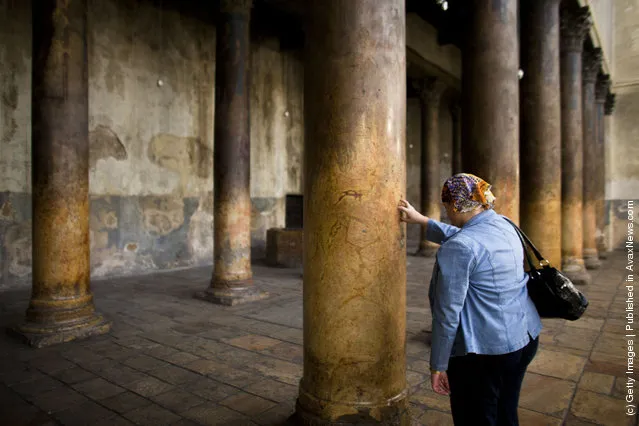
The line to see the grotto where Jesus might or might not have been born passes through a large Byzantine church.  No longer a place for worship, the cavernous room is lined on each side by thick, soaring columns.  Visitors pass by the columns on their way to the cave below.

On one of the columns, roughly eye-level, are five indentations, each worn smooth by  people placing their fingers in the same holes day after day for centuries.

Image result for 6th column church of the nativity picture

When you think about how many people it took to create holes that deep…millions of the faithful touching the same piece of marble, over and over…then place your fingers in the same holes…and feel the faith of millions beneath your fingers…it is a deeply moving experience.

Image result for 6th column church of the nativity picture

Figuring out how to live the faith of Jesus today is a lot like touching the indentations in that column in Bethlehem.  Is the cave below the Church of the Nativity the actual site of Jesus’   birth?  We don’t know.  But the column’s indentations attest to the millions who have come to see if it might be true, or how it might be true for them.

In the same way, we read, wrestle with, and interpret texts and stories that millions of other faithful people over the centuries also have read, wrestled with, and interpreted.  In fact, that’s our job as followers of Jesus…not simply to accept—or reject—the tradition that’s come down to us.  Our job as followers of Jesus is to wrestle—hard—with our tradition and find within it meaning for today.  We visit Moses.  We visit Elijah.  We visit Jesus.  Then, using our own intellect and our own experiences, we reinterpret their teachings for the times in which we live.

I bought the stole I’m wearing today on my second trip to Bethlehem.  A Lutheran Church there supports Palestinian women by providing supplies for them to create crafts.  The crafts are sold in a gift shop at the church.

My first visit to Bethlehem came right after I graduated from seminary.  In a bold act, I bought a stole created by one of the Palestinian women, saving it for the day when I would pastor a church.  By the time I got home from the trip, though, my hope had died.  How was I, a woman, going to become a pastor?  I gave the stole away to a friend who was pursuing ordination in the Episcopal Church.

By the time I returned to Israel in 2006, I’d been pastoring for 5 years.  From the moment I decided to go, I planned what I would do in Bethlehem:  I was going to buy another stole.

Along the way, I shared my intention with the rest of the group I was traveling with.  When we arrived at the church in Bethlehem, they let me go first. I found this stole and bought it.  I wear it mostly on Christmas Eve…because I bought it in Bethlehem.

Today, I wear it as a reminder of just how important it is to keep wrestling with our faith and with our tradition.  The epiphany I shared earlier—the one that came on the underside of the chapel at Emory—happened a few months after I got back from my first trip to the Middle East, just a few months after I gave the first stole away.  I had given up.  But that one moment of reflection, of wrestling, was enough to open my mind and my heart to another possibility.

What might happen if we, as a community, continue reflecting and wrestling with our tradition?   What new possibilities might present themselves?  What new light and truth might break forth from God’s word?  Might we yet discover that God is indeed still speaking?

In the name of our God, who creates us, redeems us, sustains us, and hopes for our wholeness.  Amen.

Kimberleigh Buchanan  ©2020

Posted in Uncategorized | Leave a comment

Sermon: “We’re All in this Thing Together” (I Cor. 3:1-9; Mt. 5:21-26, 37) [2/16/2020]

A couple of weeks ago, we looked at the beginning of Paul’s first letter to the Corinthians.  After expressing thanks to God for the church at Corinth, Paul lit into them for their divisiveness.  “I appeal to you, brothers and sisters…that all of you should be in agreement and there should be no divisions among you.  You should be united in the same mind and the same purpose.”  “Each of you says ‘I belong to Paul,’ or ‘I belong to Apollos,’ or ‘I belong to Cephas.’

Remember how we expressed gratitude that churches had evolved enough in the last 2,000 years, we couldn’t relate at all to what Paul was writing?  🙂  Yeah.  That’s not what happened.  In fact, we reflected on just how familiar Paul’s words seemed.  Because we are human beings, clique-ishness and divisions are a temptation in any community.  Living in community is hard.  Like, really hard.  Talking about community, about “being one” and all that, feels good, but when it comes down to it, actually creating community is hard.

All things considered, I was glad when that sermon was over, weren’t you?  It was… uncomfortable.  As it turns out, though, Paul isn’t done yet talking about community.

He’s still a little testy, telling the Corinthians he can’t feed them solid food because they’re spiritual babies.  Once he gets that out of his system, though, Paul teaches them a pretty good lesson.  “What then is Apollos?  What is Paul?…  I planted, Apollos watered, but God gave the growth.  So neither the one who plants nor the one who waters is anything, but only God who gives the growth.  The one who plants and the one who waters have a common purpose…For we are God’s, working together.  You are God’s field.”

Paul could have said the Apollos people were right, or Chloe’s people, or Peter’s people.  But doing so only would have further entrenched the divisions.  Instead, Paul helped the Corinthians to see that every leader in the community had served an important role.  The leaders weren’t working at cross purposes; one wasn’t better than another.  They all were working for the same purpose–to help the community increase its effectiveness in making God’s love real in the world.  “I planted, Apollos watered, but God gave the growth.  We—all of us—are God’s, working together.  We are God’s field.”

We are God’s field.  This community is God’s field.  We are the place where what God sows grows.  We are the plot that produces the crop that feeds the world.  We–this community–is the means by which God chooses to act the world into wellbeing.  We are God’s field.

So.  What kind of field are we?  Or, to put it more pointedly, if God were to plant something here, would it grow?

Good farmers understand that good crops don’t just happen.  Knowing something about the field into which seeds are planted is crucial to ensuring a healthy crop.

An agriculture website lists four good practices of field management.  First, know the exact location of the field so you can track weather conditions for it.  Second, know the size of the field and its utilization (that is, the percentage of crops planted in the field).  Size and utilization determine which crops will grow best in the field.  Third, practice crop rotation.  Planting the same crop in the same field year after year can deplete the soil’s nutrients.  Rotating crops increases the chemical diversity in the soil.

The final consideration is knowing the chemical make-up of the soil, including the PH value and soil type.  Soil type determines which crops can be grown in a specific field (some crops thrive in clay, others in sandy soils).  Soil type also determines water management (for instance, sandy soil requires frequent irrigation with smaller amounts of water due to its high porosity).  Another blogger notes that “Soil is the fundamental resource for every crop production.  To achieve successful and sustainable farming, the soil needs to be healthy.”

            If what I’ve read thus far hasn’t convinced you of the aptness of the field as a metaphor for the spiritual community, perhaps this sentence will.  “Soil is full of living organisms such as fungi, bacteria, worms and millions of other microscopic organisms.”   Doesn’t that sound just like church?  Ooo, ooo, ooo!  I’m a bacteria!  I’m a worm!  Me?  I’m a fungus.  It’s not as bad as it sounds.  As the blogger writes, all the organisms in soil “play a vital role in the creation of the organic matter which reflects on soil conditions and finally its health.”

We are God’s field.  We’re even laid out in neat rows like a field!  So, how do we tend to our community to ensure we’ll be fertile ground for growing what God sows in the world?

At the Board retreat a couple of weeks ago, we had some lively discussion about who we are and where we’re headed.  As a result of that conversation, we’re in the process of planning a visioning/dreaming process.  A planning team will organize the process, but the bulk of the work will be done by all of us, the whole congregation.  It’s not going to happen this week, but it will happen soon.  So, stay tuned!

As we fine-tune our vision for where we’re heading, as we recommit ourselves to our unique mission, it might help to think about being God’s field.  Like the wise farmer, we’ll determine precisely where we are.  We’ll consider our size and utilization, so we can determine which crops—aka, ministries—will grow best in this field.  We can consider whether it might be time to rotate our crops or ministries.  And, last, we can determine the health of our soil.

Personally, that’s the part I’m most excited about.  The thing that makes soil healthy, after all, is diversity.  How does our diversity nurture us?  How do our fungi and bacteria and worms work together to form a healthy field in which’s God’s dreams can be planted and harvested?  (The title of last week’s sermon was “Salty Christians.”  Maybe I should have titled this one, “Dirty Christians.”)

The poetic-minded among us likely have enjoyed this extended metaphor of being God’s field.  Here’s a bit for the more pragmatic-minded–the verses we heard from Matthew.

If our community is to be fertile ground for God doing God’s thing in the world, our community needs to be strong, healthy, diverse.  If our community isn’t strong, healthy, and diverse, then we’re simply a collection of people who come here on Sunday mornings, each doing our own thing, each on our own spiritual journey.

To be sure, each of us is on our own spiritual journey.  Each of us is living our faith in the world in our own way.  All that’s important.

There is, though, something unique about living faith as a community.  There are some things the world can only learn about God’s love–that we can only learn about God’s love–through community.  That’s why what we do here every week is so important.

Paul knew that, which is why, I suspect, he was so hard on the Corinthians.  Jesus knew it, too… which is why he got so practical in today’s verses from Matthew.  He begins with what was written in the law, “You shall not murder.”  Then he riffs on that.  Updates it.  Gives an example of how to live that law from the center of your being.  So when you are offering your gift at the altar, if you remember that your brother or sister has something against you, leave your gift there before the altar and go; first be reconciled to your brother or sister, and then come and offer your gift. 

Going from murder to making your offering in worship might seem a big conceptual leap…until you think about it.  In each instance, the full humanity of the other is denied, right?  The scale is different, to be sure, but it’s the same dynamic.  The old line, “He’s dead to me!” makes a lot of sense.  Sometimes, we get so angry at someone, they cease to be a person to us.

The thing is, when we say someone’s dead to us, a little piece of us dies, too.  And if a little piece of us dies, then we’re not fully human, either.  And if you have a community of people who are—because of grudges and anger and spats—not fully human, the community will not thrive.  Soil whose nutrients have been depleted can’t sustain a healthy crop.

We are God’s field.  What God sows will grow here…if we tend well to our community;  if we see each other as fully human, as, perhaps, different from us, but equally loved by God; if we treat each other with respect and nurture our relationships with each other…

…basically, if we keep doing what Mary Cowal did her whole life.  We said goodbye to Mary yesterday.  Because I only met her two years ago, I didn’t know Mary very well.  Hearing all the stories about who she was, about how she welcomed everyone into her life and into her home, about how everything she did, she did with love…first, hearing those things made me wish I’d known Mary longer.  Then, hearing about who Mary had been, seeing all the people who showed up yesterday, feeling the sadness at her death in the room…yes.  Mary tended well to her part of God’s field.  And we are a stronger community because of it.

Mary knew—and lived as if—we’re all in this thing together.  The sermon title comes from a song by Old Crow Medicine Show, a bluegrass group that usually sounds like it’s mainlining caffeine.  Allen and I heard them at the Ryman a few years ago.  At one point, the pace slowed and I heard these beautiful words:  “We’re all in this thing together, walking the line between faith and fear.  This life don’t last forever.  When you cry, I taste the salt in your tears…”  I think Paul—and Jesus—would be down with those words.  We are all in this thing together.  If we remember that in everything, everything we do, we will become a stronger community, a fertile field, a place where what God sows will grow and thrive.

We are God’s field.  Let the growing begin!


Posted in Uncategorized | Leave a comment

Sermon: “Salty Christians” (Mt. 5:13-16) [2/9/2020]

How are you feeling about the world today?  Certainly, there are good things happening.  Sweeping LGBT rights legislation that bans discrimination in employment, housing and public accommodations sailed out of the Virginia Senate and House on bipartisan votes Thursday.  Pope Francis has turned one of the Vatican’s properties into a home for Rome’s homeless population.  The EU will be decreasing use of single-use plastics.

Yes, good things are happening in the world.  In some small pockets, God’s dreams for the world are coming true.  But a lot of days it feels like the wheels are coming off, doesn’t it?  Political turmoil.  Incivility.  Ecological devastation.  Abhorrent treatment of people at our southern border.  For one friend, a radio personality known for his racist and misogynistic rhetoric receiving the nation’s highest civilian honor–while a centenarian Tuskeegee airman looked on–was the straw that broke the proverbial camel’s back.  She is now at despair.

Knowing how to preach in these, what feels like, unprecedented times…does anybody else want this job?  It’s not easy.  First, there’s trying to decide which dire event to address… then figuring out a faithful response to that event…then trying to communicate that faithful response for that particular event to people who are inundated and overwhelmed by all the events in the world right now… The issues are so numerous and so dire, I often feel like the steel ball in a pinball machine, ricocheting from one thing to another.  Maybe you feel like that, too.

What’s a pastor to do?  What’s a follower of Jesus do in these fraught times?

As I watched the news this week, and fretted yet again over finding some adequate word to say, I read today’s Gospel lesson.  “You are the salt of the Earth,” Jesus says in the Sermon on the Mount.  “You are the light of the world.”  The words are familiar.  They are great images.  But what do they mean?  Any ideas, Marika?

You are the light of the world!  //  You are the light of the world!

But if that light is under a bushel, //  Brrr, it’s lost something kind of crucial

You got to stay bright to be the light of the world


You are the salt of the earth  //  You are the salt of the earth

But if that salt has lost its flavor  //  It ain’t got much in its favor

You can’t have that fault and be the salt of the earth!


Ah!  So, salt is salt and light is light.  If salt doesn’t flavor, it ain’t got much in its favor.  If our light’s under a bushel, it’s lost something kind of crucial.  Salt and light have only one purpose— to salt and to shine.  Every time you pour salt on something, it becomes salty.  It doesn’t become sweet.  It doesn’t become tart.  When you salt something, it becomes salty.  Likewise, every time you shine a light on something, it’s lit.  The substance or circumstances don’t matter.  Salt is salt and light is light.

The same is true for us who try to follow Jesus.  The circumstances don’t matter.  Whatever the state of the world, no matter how unprecedented the times, we are called to follow Jesus.  If the planet’s suffering continues to speed up—we follow Jesus.  If our country’s policies at the border continue to demean and traumatize—we follow Jesus.  If some states continue enacting legislation that denies rights to folks who are LGBTQ—we follow Jesus.  If our country’s leadership loses its moral compass—we follow Jesus.

What does it mean to follow Jesus?  It means immersing ourselves so deeply in the teachings and the person of Jesus that every single thing we do, every action we take, every interaction we have, reflects what Jesus taught, what Jesus did.  Focusing on dire events in the world, I’m convinced, will keep us in a state of anxiety.  Focusing on following Jesus, though, will give us clarity—both about who we are and what actions we should take.

A case in point—Senator Mitt Romney.  After an exceedingly contentious and partisan impeachment process, Senator Romney’s speech on the Senate floor before the vote on Wednesday was remarkable.  He spoke of conscience.  He spoke of doing what was right.  And he prefaced all of it by saying “I am profoundly religious.  My faith is at the heart of who I am.”  After saying that, he had to gather himself, the words were so true and so deep.

On one of the articles of impeachment, Senator Romney voted to convict.  In his speech, he acknowledged that his vote wouldn’t make a difference in the outcome of the proceedings.  He also accurately predicted intense political fallout for voting his conscience instead of voting with his party.  But the results of his vote weren’t the main concern for Senator Romney.  His main concern was to follow his conscience, which has been formed by his faith.

Progressive Christians are sometimes leery of talking about Jesus…or even calling ourselves Christians.  A lot of terrible things have been done by Christians.  A lot of terrible things have been done to us by people calling themselves Christians.

And yet…there is so much truth and love and healing in following the way of Jesus.  I follow the way of Jesus because I believe it is an effective and powerful means of healing the world.  I worry, sometimes, that we spend so much time trying to make the message of Jesus more palatable to those who aren’t into religion or who have been hurt by religion, that we miss the Jesus message all together.

What might happen if we took Jesus back from the people who claim him, but don’t follow him?  What might happen if, like Senator Romney, our public actions grow even more intentionally out of our personal faith?  What might happen if we begin our day, not with our newsfeed, but with the Sermon on the Mount, from which today’s verses come?

Mahatma Gandhi wasn’t a Christian, but he did read the Sermon on the Mount every day.  He said it almost convinced him to become a Christian…but then he met some Christians.

To be clear, he wasn’t talking about rank-and-file Christians who try to follow Jesus in caring for the least of these.  Most of the Christians Gandhi encountered were part of the British colonial government, which had oppressed the Indian people for well over a century.

In 1757, India became a British colony.  After a century of exploitation, British coffers were overflowing, while the people of India were starving.  “By British figures, 400,000 Indians died of starvation in the 2nd quarter of the 19th century, 5 million in the 3rd quarter, and an appalling 15 million between 1875 and 1900, the years in which Gandhi was coming of age.”  (Easwaran in The Essential Gandhi)

Indians had from time to time attempted to re-gain their independence, but those efforts had been disorganized and, in some cases, violent.  Gandhi’s approach—largely in conversation with the Sermon on the Mount—was unique in its insistence on nonviolent resistance.

The event that finally led to India’s independence happened in 1930.  Perhaps taking the “you are the salt of the Earth line” literally, Gandhi called on the Indian people to defy the British government’s oppressive laws regarding salt.

“Britain’s Salt Acts prohibited Indians from collecting or selling salt, a staple in the Indian diet.  Citizens were forced to buy [it] from the British, who, in addition to exercising a monopoly over the manufacture and sale of salt, also exerted a heavy salt tax.  Defying the Salt Acts, Gandhi reasoned, would be a simple way to break a British law nonviolently.”

On March 12, 1930, Gandhi set out with several dozen followers on a journey of 240 miles to the coastal town of Dandi on the Arabian Sea. The Salt March had begun.

Image result for gandhi salt march

They planned to defy British policy by making salt from seawater.  Along the way, Gandhi spoke to large crowds about what they were doing.  Each day more people joined the march.  By the time they reached Dandi on April 5th, the crowd numbered tens of thousands.

The morning of April 6th, Gandhi walked down to the sea, reached down and picked up a small lump of natural salt out of the mud.  In that simple act, he defied British law.  His action inspired tens of thousands of others across the country to do the same.  When all was said and done, 60,000 Indians had been arrested.  It took another 17 years, but the Salt March was the event that initiated the movement that eventually led to India’s gaining its independence, which eased the suffering of millions people.

Image result for gandhi salt march

So, here’s what I wonder.  I wonder what might happen if, instead of starting with our newsfeeds, we started each day with the Sermon on the Mount.  What might happen if we began each day with the words of Jesus rather than the opinions of the pundits?  What might happen if we used the words and person of Jesus to frame the way we see the world rather than the other way around?

Might we then become the salt of the Earth?  Might we then become the light of the world?  Might we then become less anxious, less despairing, and more energized for our work in healing the world?  What might happen if we renew our commitment to following Jesus?  What might happen to Asheville?  What might happen to this church?  What might happen to our country?  What might happen to our world?

What might happen if we decide—every morning of every day…What might happen if we decide to follow Jesus?   (Sing, We Are Marching in the Light of God)


In the name of our God, who creates us, redeems us, sustains us, and hopes for our wholeness.  Amen.

Kimberleigh Buchanan  ©2020


Posted in Uncategorized | Leave a comment