Sermon: “Acting Each Other into Well-being” (1/31/16)

The past two weeks, we’ve spent some time with I Corinthians 12, where Paul explains his Mr. Potato Head theology:  “Now there are varieties of gifts, but the same Spirit…To each is given the manifestation of the Spirit for the common good…The body of Christ does not consist of one member but of many…If the whole body were an eye, where would the hearing be?  If the whole body were hearing, where would the sense of smell be?”  The “still more excellent way” Paul described is found in calling forth each person’s gifts “for the common good.”

Then I asked how we might find our own “still more excellent way” here at Pilgrimage, and said to “stay tuned,” because I’d share some thoughts this week.  That’s when someone guffawed.  J  …and when I invited you to dream up your own ideas about helping us find a “still more excellent way.”  I invite you to write those ideas down and place them in the basket.   As promised, here are a few of my ideas….actually it’s just one idea.  And it grows directly out of today’s Scripture text, the love poem Paul felt compelled to include in his letter to the conflicted Corinthian community.

Want to know my idea?  Here goes.  My idea is that before we do anything new in the community–or maybe while we’re doing anything, old or new–we take a minute to speak aloud together I Corinthians 13:4-7.

Before you dismiss the idea as silly—or guffaw—let’s try it.  I’ll name something that’s happening in our community, say “Love is patient,” and you all respond with I Cor. 13:4-7.

The visit next week by some of our Muslim friends….

Love is patient; love is kind; love is not envious or boastful or arrogant or rude. It does not insist on its own way; it is not irritable or resentful; it does not rejoice in wrongdoing, but rejoices in the truth. It bears all things, believes all things, hopes all things, endures all things.  Love never ends.


The youth group’s plan to attend the UCC National Youth Event in July…

Love is patient; love is kind; love is not envious or boastful or arrogant or rude. It does not insist on its own way; it is not irritable or resentful; it does not rejoice in wrongdoing, but rejoices in the truth. It bears all things, believes all things, hopes all things, endures all things.  Love never ends.


Next summer’s theme of “Acting the World into Well-being”….

Love is patient; love is kind; love is not envious or boastful or arrogant or rude. It does not insist on its own way; it is not irritable or resentful; it does not rejoice in wrongdoing, but rejoices in the truth. It bears all things, believes all things, hopes all things, endures all things.  Love never ends.


It wasn’t by design that we scheduled the budget meeting for the day the love chapter  came up, but here we are:  1 Corinthians 13 on the day of our congregational meeting to vote on the 2016 Mission Spending Plan.  Either God’s Spirit has a wicked sense of humor, or is, perhaps, trying to tell us something.  So, let’s try it…the congregational conversation in a few minutes to vote on the 2016 Mission Spending Plan…

Love is patient; love is kind; love is not envious or boastful or arrogant or rude. It does not insist on its own way; it is not irritable or resentful; it does not rejoice in wrongdoing, but rejoices in the truth. It bears all things, believes all things, hopes all things, endures all things.  Love never ends.


In part, I’m being playful….but mostly not.  We just sang “They’ll Know We Are Christians by Our Love.”  We like that song a lot…mostly, I suspect, because it counters most popular images of Christians these days.  But also because it goes to the heart of what we believe and try–to the best of our ability–to practice here.  Following Christian ethicist Beverly Harrison’s definition of love, we work hard here to “act each other into well-being.”

In truth, everything we do here we do–or try to–in a spirit of love, of working together for the common good, of acting the community into well-being by acting each other into well-being.  So, I’m not so much inviting us to try something new.  Instead, I’m inviting us to deepen our awareness of doing everything we do in and out of love.

What I’m inviting us to do…Scratch that.  What I’m challenging us to do–is to get down to the marrow of what it means to be a community of Jesus’ followers.  I’m not suggesting that we add activities to our already burgeoning schedules, though we might feel led to add (or maybe even subtract) a few.  I’m not suggesting that we change any of our ministries, though that could happen.  I’m not suggesting that we have a membership drive or a big building campaign, though we might choose to do those things.

What I’m suggesting is that we go deep into the core of our faith, deep into the core of who we are and what we’re about as a community of Jesus’ followers….What I’m suggesting is that we plunge ourselves even more deeply into the beautiful, terrifying, absolutely REAL love of God.  Because without that, does any of the rest of it really matter?

Here’s the thing about love, about acting each other into well-being–it isn’t easy.  In fact, it’s just about the hardest thing in the world to do.  I think that’s why it’s getting harder these days–not just in this church, but in all faith communities–to get folks to commit to joining and participating.  Because living in community is hard.  Hard.  Hard.  Hard.  That’s a direct quote from last week’s sermon.  I say it again because I want to say this:  community is hard!  Especially when you talk about and really try to love each other.

So it makes sense that Paul included this poem about love when he wrote to the conflicted Corinthian community.  We’ve all got different gifts, Paul says.  Those differences are bound to create conflict.  Just remember that it’s the same Spirit–God’s spirit–that gives every gift.  “To each is given the manifestation of the Spirit for the common good.”  When conflicts arise, the thing that will help get the community back on track is remembering why it exists in the first place:  to live out God’s love here on earth.  We are here for love.  Period.

Here’s what I like about this love passage–It’s not syrupy sweet or abstract and philosophical.  In fact, it’s about as pragmatic as you can get.  Say it with me one more time:

Love is patient; love is kind; love is not envious or boastful or arrogant or rude. It does not insist on its own way; it is not irritable or resentful; it does not rejoice in wrongdoing, but rejoices in the truth. It bears all things, believes all things, hopes all things, endures all things.  Love never ends.

In March, I moved Mom into a Senior Living facility in Gainesville, Florida.  I observed a lot about the challenges of community life on my visits to the Atrium.  The 5 story building with a total of 225 apartments has 3  v e r y  s l o w  elevators.  And when many residents use walkers or scooters–you spend a lot of time waiting to go up or down.

Each floor has a laundry room–with three washers and two dryers, most of which work some of the time.  That’s for 48 apartments on one floor.

The community shares meals 3 times a day…where the service is slow and many of the residents are halfway into dementia.

And there’s this one lady who has the meanest Dachsund I’ve ever seen.  Every time I took my mom’s dog, Mike, out for a walk, I always had to peek out the door to see whether that woman and her dog were there before we exited.

Yes, living in community with folks who are in their 80s and 90s can be challenging.

Despite the difficulties, though, Mom made some good friends in her 10 months at the Atrium.  There were Tom and Joanne, who helped us move.  Joanne has significant mobility issues, but that didn’t slow her down at all.  At one point, I think I counted 12 tote bags on her walker!  Tom’s mobility is good, but he was helping us move two days before starting chemo for leukemia.  Neither Tom nor Joanne would hear of NOT helping us.

Charlie offered to help, too.  He really wanted to help.  And he probably could have, but Charlie’s 93.  We decided to give him a bye this time.  Steve is 94, and he works at Publix bagging groceries.  They call him “The Ambassador.”  Steve offered to help us move, too, but when he’s not working, he has to keep close tabs on his wife, Virginia, who has advanced dementia, so it really wasn’t possible for him to help.

Steve is a former Tuskegee Airman and a Baptist minister.  We always seem to have a lot to talk about.  J  Steve has had a hard time with Mom’s move.  As we talked about it at our last meal together at the Atrium, Steve said this:  “You can’t ever let circumstances get in the way of friendship.  You always stay in touch with your friends.”

I think in his way, Steve was telling Mom that he has come to see her as a friend, that he cares about her, that he loves her.   And despite changing circumstances, that care, concern, and love will not fade.

I think that’s what Paul was telling the Corinthians, too.  I think that’s why he included the love poem.  He wanted to remind them that no matter the circumstances, no matter what’s going on in the community, it can’t ever get in the way of friendships, relationships.  No circumstance faced by the community can ever get in the way of the community’s mission…and if that community is a group of Jesus’ followers, that mission is love—sharing God’s deep, abiding, terrifying, beautiful, absolutely REAL love with others.  If anything distracts us from that, we will have lost our way.  Because that is what we’re here for.  It’s the only thing we’re here for.  We are here for love.

If we stay focused on that, everything else will fall into place.  Our next steps forward will be clear…we will discover that through it all, we have indeed found a “still more excellent way.”
FullSizeRender (28)


In the name of our God, who creates us, redeems us, sustains us, and hopes for our wholeness.  Amen.

Kimberleigh Buchanan  © 2016

Posted in Uncategorized | Leave a comment

Sermon: A Still More Excellent Way (1/24/16)

Since I became your pastor in 2001, we’ve accomplished a lot together.  We’ve lived in to our ONA identity in some beautiful ways, including celebrating our first Transgender Sunday last November.  In 2001, I never would have dreamed that I would one day perform a legal gay wedding in this sanctuary!  And I’m delighted to hear that our ONA Team is re-forming.

We’ve also challenged ourselves to learn about and become active in addressing several social justice issues–child sex trafficking, homelessness (with our work with Family Promise and Lost and Found), Islamophobia (offering support to our Muslim brothers and sisters).  And that only scratches the surface.

And how about the music program?  There’s no way a church of our size should have a choir of that size.  Can you believe it?  And the really cool thing about the choir and other musical groups?  It’s not just the music-making that’s beautiful.  Those people love each other.  And care for each other.  And pray for and with each other.

Last month, several of us drove to Norcross to participate in a prayer vigil and information session with the Ahmadiyya Muslim community.  At that meeting, I was pleased to hear so many refer to Pilgrimage as a “great place.”  It was the first time I realized that we are gaining a reputation as a loving, service-oriented community.

In addition to all the things we are doing together as a community, several of you are leading service projects of your own.  Many of you participated–either in person or by making contributions–to Holly CothranDrake’s wild idea of purchasing Christmas gifts for every patient at the Shepherd Center.  Others of you contributed to Laurie Spencer’s efforts to replace Christmas gifts stolen from a local congregation.  Some of you take your ministry to the streets by engaging with teens feeding others who are living on the streets.  Chris and Jim work closely with the Kairos prison ministry.

Whether it’s food for MUST, gifts for Lost and Found, or any number of service opportunities, you all respond with radical generosity.  And it is so heartening to see.

How have we accomplished these things?  How have we gotten the energy and vision to act others out there into well-being?  We’ve done it by acting each other into well-being.

What we do up here is vital to what we do out there.  If we’re going to have anything to give to others, we’ve got to keep the home fires burning.  We must continue growing deeper into community.  We must continue worshiping together the God who “has loved us, loves us now, and will always love us.”  We must continue to give to and receive from each other God’s deep and abiding love.  Our main source of strength and inspiration for what we do outside these walls depends largely on what we do inside these walls.

Paul understood the strong connection between how a community lives God’s love inside the community and outside it.  That’s why he wrote a letter to the church at Corinth.

The church at Corinth was a happening place.  Full of energy.  Full of diversity.  Full of egos.  The more powerful people in the community began prioritizing some spiritual gifts over others.  Deep divisions and chaos ensued.  Paul knew that if the community didn’t work some things out, their purpose for being—sharing God’s love with others—wasn’t going to happen.

Paul himself was an excitable fellow.  And a wordy one.  When he got worked up about something, he wrote.  And wrote.  And wrote.  And, IMHO, he could have used an editor.

Because the issue at Corinth was the prioritizing of gifts—creating a hierarchy of abilities, where some were more highly valued than others—the thing Paul got worked up about in I Corinthians 12 is the diversity of spiritual gifts.  Nobody’s gift is more important than any other person’s gift, Paul says.  If the community is going to work well, it’s going to need all the gifts of everyone in the community working together.  As he said in I Corinthians 12:7, “To each is given the manifestation of the Spirit for the common good.”

Now, Paul could have said what I just said, but he chose instead to go all Mr. Potato Head on the Corinthians.  “If the whole body were an eye, where would the hearing be…”  and he riffs on that for a while

.mixed up potato head

The one thing I find perplexing is where Paul goes at the end of today’s passage.  Listen:

27Now you are the body of Christ and individually members of it. 28And God has appointed in the church first apostles, second prophets, third teachers; then deeds of power, then gifts of healing, forms of assistance, forms of leadership, various kinds of tongues.

Okay.  Does that not sound like a hierarchy of spiritual gifts?  What happened to all gifts being equally important?   Then Paul says, But strive for the greater gifts.  And I will show you a still more excellent way.”  The greater gifts?  Which gifts are greater?  I thought all gifts were created equally!

Had I been Paul’s editor, I would have pointed out this contradiction.  Then I would have asked what he was really trying to say.  This is only a guess, but judging from all that has gone before, maybe the “greater gifts” are the ones that help the community work together, to help folks use all the gifts the Spirit bestows for the common good.  If that’s the case, then maybe in this coming together of our diverse gifts is where we’ll find the “still more excellent way.”

In any given week, I hear several times that Pilgrimage “is a special place.”  And it is.  I want to tell you a story I’ve told before that demonstrates just how special.

One day walking the campus at Emory, just a few months after fleeing the Baptist battles at my seminary, I found myself standing under the chapel.  Like most of my Baptist friends at the time, I was completely beaten down by years of denominational conflict.  I’d experienced the underbelly of the Christian church and was dangerously disillusioned.

As I stood there, I thought:  “You know, Kim, you don’t have to do this.  You don’t have to stay in church.  You don’t even have to remain Christian.  You can leave.  Do something else entirely.  Why stay?”  I stood there thinking for a long while.

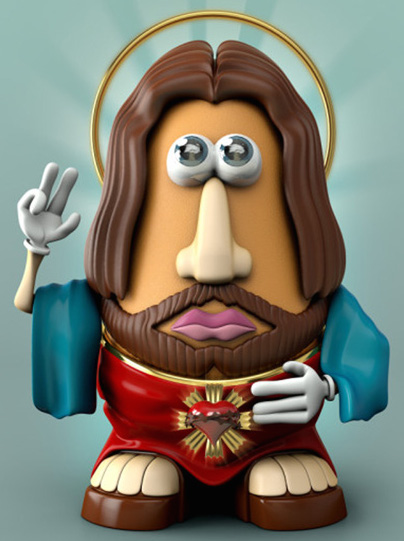
Then, as he is wont to do, Jesus came to mind. Potato-Head-Jesus-2

I thought about all the things Jesus said, all the things he did.  I thought about how he spent time hanging out with the hurting people of the world, the outcasts, the labeled, the abused.  And I thought of how he helped those people to see and experience the deep, abiding, non-judgmental love of God.

And standing there beneath the chapel, I decided that if a community tries to follow Jesus–they don’t even have to be successful…If a community just tries to follow Jesus, the world will be transformed.  In that moment, under that chapel, I committed myself to the Christian church and to leading a community that would try—just try–to follow Jesus.

Many of you have heard that story before.  I’m telling it again because I want to say this:  I have found the community I dreamed of that day in 1993.  I have found the community who would try—just try—to follow Jesus, the community who would, through its loving efforts, transform the world.  That community is you.

That doesn’t mean we get everything right all the time.  Living life in community is hard.  Hard, hard, hard.  At some point, someone’s going to make you mad.  At some point, someone’s going to disappoint you.  At some point, you’re going to be afraid you’ve done something irreparable, unforgiveable, unredeemable.

Pastor Nadia Bolz-Weber welcomes new members to the Church for All Sinners and Saints that she pastors in Denver by making sure they know that at some point, the community will let them down.  “That I,” she says, “will say or do something stupid and disappoint them.  And then,” she says, “I encourage them to decide before that happens if they will stick around after it happens.  If they leave, I tell them, they will miss the way that God’s grace comes in and fills in the cracks left behind by our brokenness.  And that’s too beautiful to miss.”

In her book, Accidental Saints, Pastor Nadia also says this:  “Church is messed up.  I know that.  People, including me, have been hurt by it.  But as my UCC pastor friend Heather says, “Church isn’t perfect.  It’s practice.”  (Accidental Saints, K2425)

THAT is what I’ve witnessed here over the last 14 years.  We aren’t always successful in following Jesus, sometimes we disagree, sometimes we even hurt each other…but even in the midst of all the messiness of being a Christian community, because we have continued to seek to follow Jesus as best we can, the world is being transformed.  That’s what all those shout-outs from people in the larger community tell me.  Because we are working together, because we are honoring—and calling out—each other’s spiritual gifts and using them for the common good, we are beginning—just beginning to get a glimpse of God’s kin-dom here on earth, a kin-dom we are helping to create.

Now the question becomes:  What’s next?  What’s our vision as a community of Jesus’ followers?  We’ve worked hard.  We’ve accomplished a lot.  We are successfully following Jesus in many ways.  But what’s next?  How do we find the “still more excellent way?”  If Paul is to be believed—and think he’s right on with this—we’ll find the more excellent way when we honor our diverse gifts, and when we pool those gifts and seek the common good, not only our common good here at Pilgrimage, but the common good of the larger community as well.

So, how do we get started?  Stay tuned.  I’ll share some of my thoughts next week.  Until then, see what your imagination dreams up.

In the name of our God, who creates us, redeems us, sustains us, and hopes for our wholeness.  Amen.

Kimberleigh Buchanan  © 2015

Posted in Uncategorized | Leave a comment

Colorful Creator #2: Rainbow Boy

FullSizeRender (27)

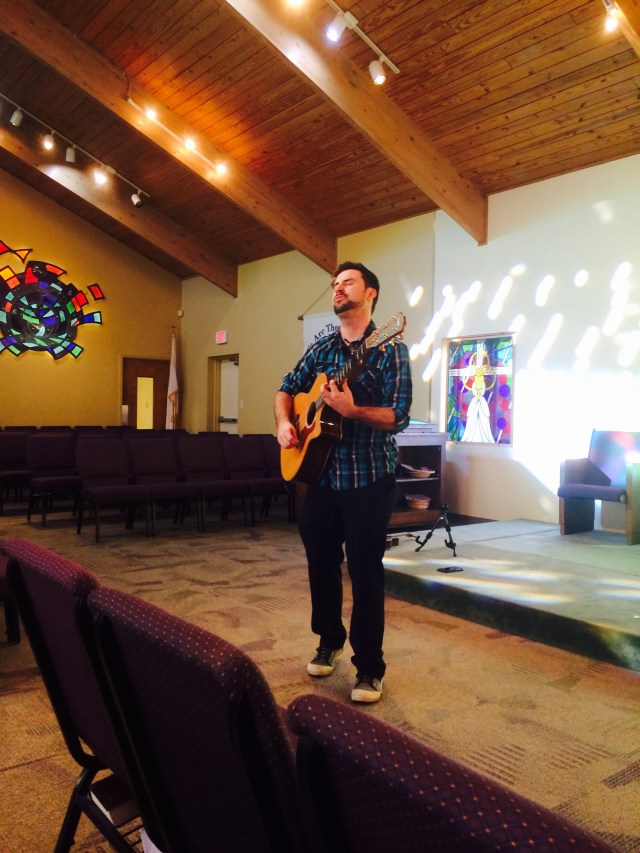
Today, Pilgrimage hosted the delightful singer-songwriter, Bobby Jo Valentine.  This was Bobby Jo’s second visit to Pilgrimage.  (His first happened while I was on sabbatical.)  So wonderful to hear a full-on concert at our very own church!  I’m kind of amazed at what Bobby Jo can do with his voice.  Wow!

In the midst of his singing, Bobby Jo shared his story with us.  Raised in a fundamentalist Christian community, Bobby Jo’s gift for songwriting wasn’t appreciated.  Nor was his homosexuality.  After years of hiding who he was, Bobby Jo finally was able to come out as a gay man AND as a singer-songwriter!  I told him this afternoon–and I’m telling you now–I am so glad Bobby has found the place where he belongs!

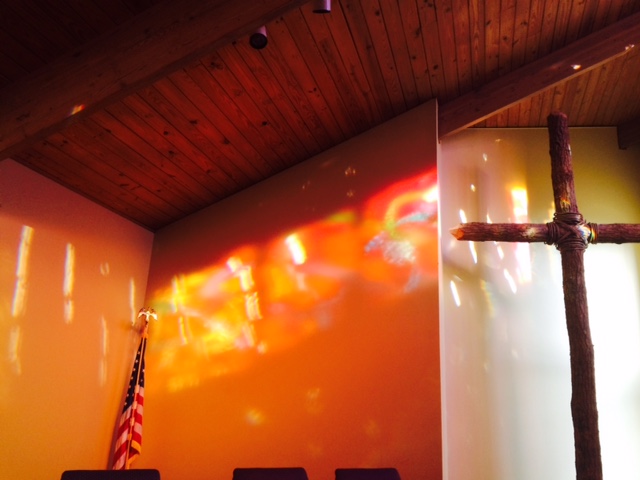
As you know, I’m the tiniest bit obsessed with the colors in our sanctuary these days.  Later in the week, I’ll share a couple more of the pictures I took today.  For now I want to share two more of Bobby.

For the first part of the concert, Bobby stood on the platform.  Had I been able to take video, it would have captured a beautiful young man literally dancing in the rainbow.  The two pictures below catch just a tiny bit of the color and light that bathed Bobby this afternoon.  How appropriate that this one who is living his true colors was–for this day–our Rainbow Boy!

FullSizeRender (26)

FullSizeRender (25)

Check out Bobby Jo’s website:  http://www.bobbyjovalentine.com/

Posted in Uncategorized | Leave a comment

Sermon: “Would You Baptize an Extraterrestrial?” (1/10/16)

Have you heard?  Last September, NASA announced the discovery of water on Mars!  My first thought when I heard the news?  I’m sure this is where your mind went, too:  “When’s the first Martian baptism?”  The next logical question, of course, was “What would it take for ME to perform the first baptism on Mars?”

As I was contemplating the brave new world of interstellar baptism a couple of months ago, a book popped up on a Kindle Daily Deal:  Would You Baptize an Extraterrestrial?  Yes!  I cried, as I clicked the “Buy” button.  http://www.amazon.com/Would-You-Baptize-Extraterrestrial–box/dp/0804136955/ref=sr_1_1?ie=UTF8&qid=1452437179&sr=8-1&keywords=would+you+baptize+an+extraterrestrial


The book is written by Br. Guy Consolmagno, an American research astronomer and Director of the Vatican Observatory.  Can you imagine a more fascinating job?  Or a scarier one?  Walking that thin line–or is it a great divide?–between science and religion?

Would you Baptize an Extraterrestrial? looks at the relationship between science and religion through the lenses of several age-old conundrums.  “Biblical Genesis or Scientific Big Bang?”  “What Was the Star of Bethlehem?”  “What Really Happened to Galileo?”  I’ll bet Fr. Guy researched that question very well before taking that job at the Vatican.

With Baptism of Jesus Sunday bearing down, I went straight to the final chapter.  “Would I baptize an extraterrestrial?”  Yes!  Absolutely!  Then I read the chapter.

The book’s title comes from a reporter’s question.  When asked whether or not he’d baptize an extraterrestrial, Br. Guy playfully responds, “Only if she asks!”  Then he talks about actually getting to know ET, learning whether she understands what it means to be part of the Kin-dom of God, loving her neighbor, acting the least of these into well-being.  Ultimately, Br. Guy says, “It’s not our place to decide whether ET can be a citizen of the Kin-dom of God.  It’s our place to treat ET like the least one of Christ’s brothers and sisters, and to live in the hope that ET will treat us likewise.”

So, would I baptize ET?  Now, I’m not so sure. J

On the face of it, Would you baptize an Extraterrestrial? sounds like a silly question, completely academic.  But the playfulness of the question points to the poignancy of a prior question:  What does baptism mean to us

Br. Guy’s interpretation of baptism being a sign of a commitment to living out the Kin-dom of God—acting the least of these into well-being—resonates well.  There is, though, another aspect of baptism that might deepen our insight, an aspect evident in the baptism of an earthling you might have heard of—Jesus.

In all three Gospels that tell the story of Jesus’ baptism, God’s words to Jesus appear verbatim:  “You are my child, the beloved.  With you I am well-pleased.”

It’s a kind of love the prophet Isaiah expresses well:  “But now thus says the Lord, the one who created you, who formed you:  ‘Do not fear, for I have redeemed you; I have called you by name, you are mine.  When you pass through the waters, I will be with you; and through the rivers, they shall not overwhelm you;  when you walk through fire you shall not be burned, and the flame shall not consume you…Because you are precious in my sight…and I love you.”  God’s words to God’s people.  God’s words to us.  Words it’s sometimes hard to believe.

In a recent On Being interview, actor Martin Sheen shared his struggle to feel God’s love.

http://www.onbeing.org/program/martin-sheen-spirituality-of-imagination/8257

Raised Catholic, Martin drifted away from church in adulthood.  During filming for Apocalypse Now, he got very ill.  At the end of filming, not only was his body broken, but his spirit as well.  Martin describes the four years between Apocalypse and Gandhi as a time of reflection, alcohol abuse, insecurity, anger, resentment, and a near breakup with [his] family.  “I was searching,” he says, “for that elusive thing that all of us search for.  Most of the time we’re not even conscious of it, but we’re searching for ourselves in an authentic way.  We want to recognize the person we see in the mirror, and embrace that person with all the brokenness, all the things that only we are aware of in the depths of our being.

“That’s what I was offered an opportunity to deal with when I arrived in India in 1981 to do this part in Gandhi.  That was the turning point, because I saw a poverty very up-close and personal that I could not have imagined.  And it really went to the center of my being and took me out of myself.  That’s what changed my life.”


Shortly after completing Gandhi, Martin went to Paris to make another film.  Still mired in his spiritual struggle and deeply moved by his reading of The Brothers Karamazov, he wandered into an English-speaking Catholic Church.  It was there that he experienced deep conversion.  Of that moment, Martin says, “I came back to Catholicism, and it was the single most joyful moment of my life, because I knew that I had come home to myself.”

Interviewer Krista Tippett remarked, “’love’” is a word you use when you talk about that conversion, that experience you had.”

Martin said, “Yeah, the love that I longed for, and I think all of us really long for, is knowing that we are loved.  A knowingness about our being that unites us to all of humanity, to all of the universe…that despite ourselves, we are loved.  And when you realize that, and embrace that, you begin to look at everyone else and you can see very clearly who knows they’re loved and who does not.  And that makes all the difference.  And I began to give thanks and praise for that love.

“You know how, so often, people say  — I said it, too —  “I’m looking for God.”  But God has already found us!  We have to look in the spot where we’re least likely to look, and that is within ourselves.”   “That’s the genius of God–to dwell where we would least likely look, within the depths of our own being, our own shallowness, our own darkness, our own humanity.

“And when we find that love, that presence, deep within our own personal being —  it’s not something you can earn, or something you can work towards.  It’s just a realization of being human, of being alive, of being conscious.  And that love is overwhelming.  And that is the basic foundation of joy.  We become joyful!  Then we see it in others, and we seek to ignite that love in others.  You can’t do it.  You can’t force someone to realize they’re loved, but you can show them.  Most of the effort we make is just by living our lives, by being compassionate, and loving, and respectful, and [serving] others.  That’s what feeds that love.”

So, yes.  If ET walked through our doors, I would want to spend time with her, I would try to treat her with great love.  And I would hope that she might come to know—if she didn’t know it already—God’s profound love for her.  After that—if she asked—I’d baptize her.  J

Back to Fr. Guy.  At one point he asks, “What if whatever it is that God loves about us is not something that distinguishes us from the rest of the universe, but rather is something we have in common with the rest of the universe?”  “If God is Love, and we are made in God’s image, then perhaps love is, in some sense, the basic stuff of the universe.”  “Carl Sagan was famous for pointing out that ‘we are star-stuff.’  But maybe the stars also share in ‘we-stuff.’”  “Maybe the stuff we share with the stars is not just (or even primarily) matter and energy, but perhaps something else—like love.”  (4391)

Does that not blow your mind?  To think that the basic ingredient of the entire universe is love?

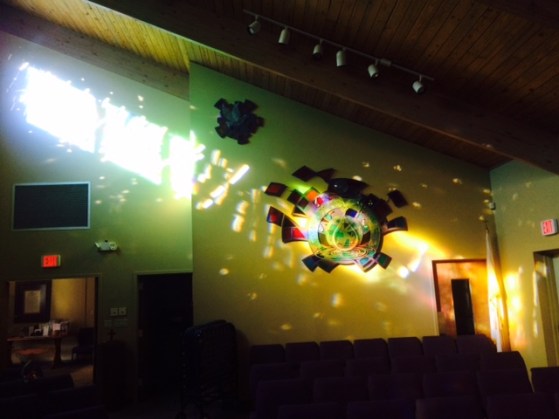
I’ve given myself a gift this year:  I’m blogging about finding God in color, particularly in the colors in this room.  I did a post this week that included several pictures I took here on Wednesday—Epiphany.  Sometimes I wish we could all stay here all the time.  Just coming on Sunday mornings, you miss some of the prettiness!

One of the qualities of color is that we don’t see it until light hits something.  Before our stained glass windows were installed, we only saw light, not even that because we kept the windows covered.  But now—because of the stained glass windows—we’re able to see the color that’s been in the air around us all along.  When I started thinking about that—this realization that all the colors are all around us all the time—I began to imagine them to be like (or maybe to be) God’s love.

Then I began to think of my work as a preacher.  I’m beginning to see myself as a prism.  God’s love inhabits every atom of the universe.  But like color, no one sees it until God’s light hits something.  When I– or anyone else– preaches, we become the thing God’s light hits and folks are able—through us—to get a tiny glimpse of God’s love.

Then as I thought about baptism, about how this ritual immerses us in God’s love, I realized that ALL of us are prisms!  Each of us reflects God’s love in our own unique, beautiful way.  Is that not amazing?  Every single one of us is a beautiful reflection of God’s love!

I know.  It’s not always easy to remember that, is it?  Traffic is one of those times for me.  When I’m stuck on Hwy 92, I don’t want to be God’s reflection.  I just want those people to GO!

It’s for those times when we forget about (or willfully ignore) our divine reflectivity that we renew our baptismal vows…because remembering our vows reminds us all over again of just how much the creator of the universe loves us and every created thing.

After a brief moment of reflection, we’ll join together in renewing our baptismal vows, in remembering in this simple ritual God’s deep and abiding love for us.  The invitation is open to all—no matter who you are, no matter where you are on life’s journey, no matter what galaxy you call home, you are welcome here!


In the name of our God, who creates us, redeems us, sustains us, and hopes for our wholeness.  Amen.

Kimberleigh Buchanan  © 2016
Posted in Uncategorized | Leave a comment

Colorful Creator #1 (Epiphany!)

I took these pictures yesterday–Epiphany!  A few thoughts….

This first one looks like a hand with a paintbrush adding color to the wall.  The lighted sculpture above (it contains a dove) represents God’s Spirit. Colorful Creator, indeed!

FullSizeRender (7)

Below — Reality and reflection….both announce the beauty of color and light.  (And notice the heads of the magi in the banner.  Epiphany!)

FullSizeRender (8)

Afternoon sun–Orange!  Yellow!  Light!

FullSizeRender (9)

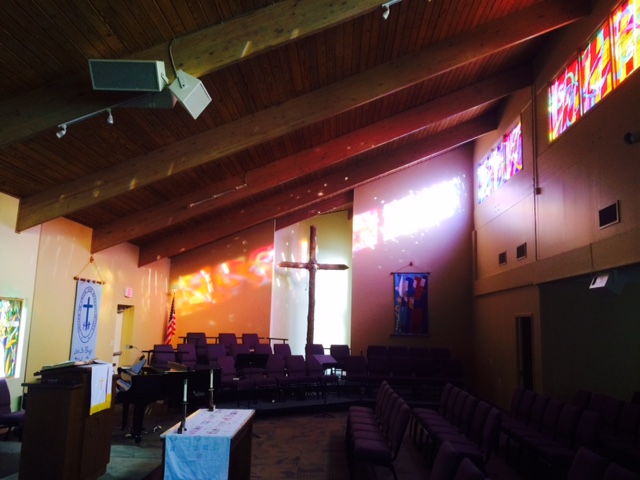
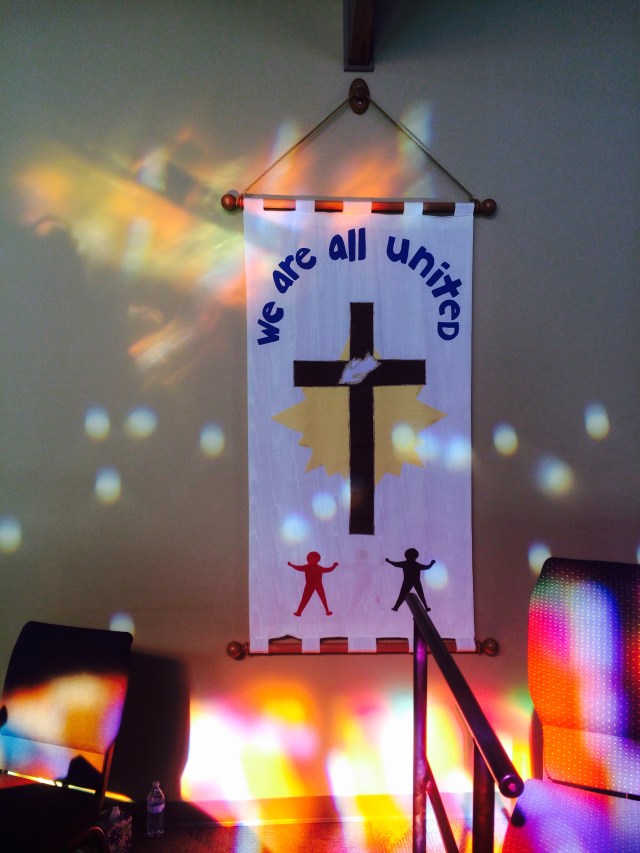
Below — A good shot for Epiphany:  So much light!  Banner of the magi beneath where the light is brightest.  The cloth covering the communion table was made by the children a few VBS’s ago.  It reads:  “Guide our feet into the way of peace.”

FullSizeRender (10)

Below:  My chair on the platform.  This obviously is the afterglow of my aura from Sunday’s worship.  🙂

FullSizeRender (12)

Just in case you missed it.  🙂   The guitar stand and its shadow…I’ll have to think about that one for a bit.

FullSizeRender (17)

FullSizeRender (13)

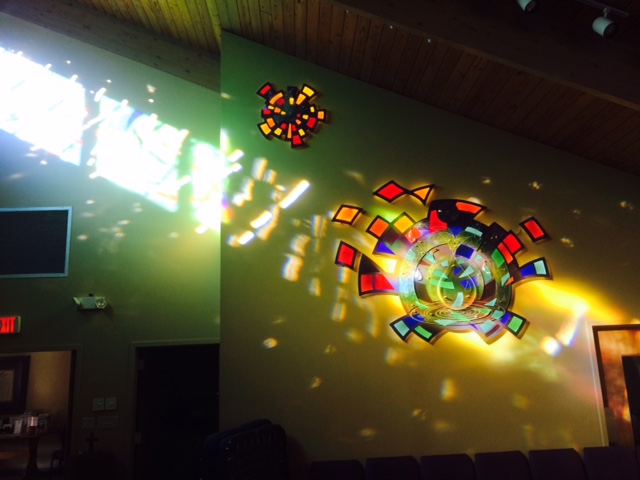
Above — Late morning–more white light than color.  See the reflection on the bottom of the glass water drop in the middle of the baptism sculpture?

FullSizeRender (19)

Same shot, about the same time, but with the lights behind the wall art turned off.  The water drop in the center of the sculpture is even better defined.  Notice that all appears as white light (probably from my location in the sanctuary.  Had I been closer, the colors would have been more, um, colorful).  Colors reappear near the far kitchen door–soft blue and red/pink.

FullSizeRender (15)

I took this because all those little splotches of light look like paw prints.  Reminds me that God shows loves for us through the animals in our lives.

FullSizeRender (18)

Above — “Arise, shine, for your light has come!”  (Is. 60:1)  Epiphany text.  Colors from the stained glass help proclaim this hopeful message!


FullSizeRender (22)

Late morning light — January 6, 2016 (Epiphany)  Can you spot the dove in the blue patch?


Posted in Uncategorized | Leave a comment

“Colorful Creator”


My article from the January 2016 Pilgrim’s Progress newsletter.

            A couple of weeks ago in Sunday School, I surprised myself by saying that I find God in color.

In 2008 when we began planning for the renovation of our worship space, Ric Reitz asked me about incorporating stained glass into the design.  My response?  “We’re not a stained glass church.”  Can you believe I said that?

Fortunately, I came to my senses and remembered Merridy Palmer, a regular visitor who was—wait for it—a stained glass artist.  I sent her contact info to Ric.  What you see each Sunday (and in lots of FB posts from me) is the result of Merridy’s amazing design.

But back to God…

Since my surprise confession that I find God in color, every time I enter the sanctuary, I think—How are the colors, the light, the lack of light—helping me encounter God?  THEN I got a crazy idea.  Why not blog about the colors and what the different manifestations of color and light are teaching me about God?

So, that’s what I’ll be doing.  I’m going to blog about our Colorful Creator in 2016.  I know.  In the past, I’ve promised to blog consistently and haven’t always (ever?) followed through.  But I’m going to try really hard this time!  And I hope as the year progresses, you’ll share with me some of your experiences of God in color and light.

pucc.cross

Afternoon light, mid-December


Posted in Uncategorized | Leave a comment

Sermon: They Will Be Called Nazoreans (1/3/16)

We do love this story, don’t we?  We hear it every Epiphany, which technically is Wednesday, but which we’re celebrating today.  It’s the story about the magi following a star, finding the child to whom the star points them, and paying him homage.  Honoring him.

They honor him, but notice they don’t worship him.  These adherents of another faith–likely Zoroastrians–journey for up to two years to honor a small Jewish baby, then take another two years to return home to their own country.  They don’t experience conversion; they simply go on pilgrimage, offer their gifts, then return home.

It’s a good story…and a great example of interfaith engagement, of showing profound respect for people of another faith.  But it’s not the whole story.

In the usual narrative flow of the season, we go straight from Epiphany to Jesus’ baptism.  When we do that, though, we miss a lot.  Listen.

The Escape to Egypt  (Matthew 2:13-15)

Now after the magi had left, an angel of the Lord appeared to Joseph in a dream and said, ‘Get up, take the child and his mother, and flee to Egypt, and remain there until I tell you; for Herod is about to search for the child, to destroy him.’ Then Joseph got up, took the child and his mother by night, and went to Egypt, and remained there until the death of Herod. This was to fulfill what had been spoken by the Lord through the prophet, ‘Out of Egypt I have called my son.’

The Massacre of the Infants   (Matthew 2:16-18)

When Herod saw that he had been tricked by the wise men, he was infuriated, and he sent and killed all the children in and around Bethlehem who were two years old or under, according to the time that he had learned from the wise men.  Then was fulfilled what had been spoken through the prophet Jeremiah:   ‘A voice was heard in Ramah, wailing and loud lamentation,

Rachel weeping for her children;  she refused to be consoled, because they are no more.’

The Return from Egypt   (Matthew 2:19-23)

When Herod died, an angel of the Lord suddenly appeared in a dream to Joseph in Egypt and said, ‘Get up, take the child and his mother, and go to the land of Israel, for those who were seeking the child’s life are dead.’ Then Joseph got up, took the child and his mother, and went to the land of Israel. But when he heard that Archelaus was ruling over Judea in place of his father Herod, he was afraid to go there.  And after being warned in a dream, he went away to the district of Galilee.  There he made his home in a town called Nazareth, so that what had been spoken through the prophets might be fulfilled, ‘He will be called a Nazorean.’

Truly a tale of terror…one that might resonate with what our sisters and brothers in Syria have been experiencing the past several years—people doing whatever they can to keep their families safe…even when it means heading to one place, only to be turned away and have to flee again and again and again because of more and more violence.

In patriarchal cultures–like most Middle Eastern cultures are–it’s the husband and father who heads the household.  Care for the entire family falls on him.  The weight of that responsibility when there is no place to go, when there is no home to be had–I wonder what that stress is doing to all the Syrian fathers trying to find safety for their families?  The image of that father selling pens, holding his little girl–the anguish on his face–speaks to the heartbreak of so many fathers trying to care for their families at any cost.

I’m grateful to Keith for singing “Joseph’s Lullaby” again this morning.  So much of the Christmas story focuses on Jesus and Mary.  Joseph always seems to get shoved to the margins of the story.  But when you read all of Matthew 2, you see that Joseph, too, was determined to do whatever it took to keep his family safe.  …which meant going from region to region, town to town until he found a place that would welcome him and his family.  That place?  Nazareth.

In a different telling of Jesus’ story–the Gospel of John–a disciple named Philip talks to his friend Nathaneal about a prophet who comes from Nazareth.  Nathaneal responds:  “Can anything good come from Nazareth?”  Reading Matthew 2 and hearing of all the travails of one refugee family and knowing that their arduous journey ended when the people of Nazareth welcomed them in?  If Nathaneal had known that back story, I don’t think he would have asked the question.  Because a town that welcomes a family beaten down by a life on the run?  That’s a place that’s going to raise up some mighty fine people.

The Syrian refugee crisis remains dire.  Some countries have extended welcome quickly and confidently—Germany, Ireland, Canada.  Other countries—like our own—have been slower to extend a hand of hospitality.  Regardless of how any of us feels about whether or not we should receive Syrian refugees and, if so, how many and by what process, none of us can deny that this moment is calling all the world’s countries to ask if we will extend the same kind of hospitality the Nazoreans did with Joseph, Mary, and Jesus.  Will we also welcome refugees?

Of course, welcoming refugees isn’t as easy as that question makes it sound.  There rightly is a regulated process for receiving refugees.  But there also is a processing of preparing ourselves—our thoughts, our hearts—to receive refugees.  It’s not just a matter of persuading our elected officials to make the right call with welcoming refugees, writing letters, making phone calls, that sort of thing.

As important as that work is, an equally important part of the process is searching our own minds and hearts, and cultivating in them an informed and authentic hospitality.  One step in that searching process in the current refugee crisis is learning what we can about Islam.

Many of my colleagues have taken presidential candidates to task for their calls for registering Muslims, barring immigration of any adherents of the Islamic faith.  I haven’t said a lot because I honestly can’t believe people believe any of that extremist talk.  Do I really need to say that what those politicians are espousing is ignorant, evil, un-American, un-Christian and—in some cases, perhaps—actionable?  If I do, let me go on record as saying that registering people of any faith, barring immigrants because of their faith, advocating the use of firearms against people because of their faith—it’s ignorant, evil, un-American, un-Christian, and—in some cases, perhaps—actionable.

Writing letters is important.  Making statements like I just made, that’s important, too.  But when I think about those folks in Nazareth who welcomed a frightened, weary family into their community, I’m aware that writing letters and making statements isn’t enough.  If we are to live our community life with integrity, if we are to live out our faith in authentic ways, if we are to do our part creating the world God is hoping for, we’ve got to start right here where we are.

So, what might we do?  How might we begin to counter all the anti-Muslim rhetoric happening these days?  The best way to counter mis-information is to share correct information.  So, maybe a good place to begin is learning more about Islam.  What better way to do that than to spend time with friends who are Muslim?

We’ve got two opportunities coming up to do just that—one this afternoon, and one on February 7.  This afternoon and this week, some women from the Ahmadiyya Muslim community will help us serve meals to our Family Promise guests.  The one time Mahmooda and her crew weren’t able to help out, their presence was sorely missed!

A couple of weeks ago, ten of us attended a prayer vigil and information session at Ahmadiyya Community in Norcross.  Our own Julie Binney spoke at the event about our work together in Family Promise.  At that event, Mahmooda’s husband, Nafis, offered to come meet with us sometime.  We’ve cleared our schedules.  On February 7, Nafis, Mahmooda, and hopefully some other people from their community will come share with us in a time of fellowship and learning.

I don’t know where any of this will lead—that’s part of the fun of being on a journey!—but in this season of rampant Islamophobia, learning more from our friends who are Muslim seems like the next logical step.  Once we meet together, I suspect the next steps after that will become clear.

On sunny days at certain times of the year, we call this area (by the kitchen) the “Road to Damascus” section.  Often you’ll see people wearing sunglasses to help cut the glare of the sun.  We got the phrase from the story in Acts 9 about Saul of Tarsus.  Saul was a Jew who was systematically destroying Christians.  On the road to Damascus, he experienced a bright light.  A voice from the light asked Saul why he was persecuting his followers.  In that moment, Saul became Paul and began following Jesus.  It was a moment of conversion.

A couple of weeks ago, it struck me that Damascus is in Syria.  On my first trip to the Middle East, we flew from Frankfurt into Damascus.  I think of the Umayyad Mosque, of our bus driver Walid, who since has had to immigrate to Sweden.  I think of this Qu’ran I bought in the Suq in Damascus.  I think of the wonderful meal we had at a venerable restaurant in the city.  I remember posters of Hafez al-Assad plastered on everything.  I think now of the city as little more than heaping piles of rubble.

We’ve used the “road to Damascus” as a playful metaphor, likening our experience of being blinded by the light with Saul’s experience on the road to Damascus.  Perhaps now when we look to this section and see the glare, we might think of those who have been forced to travel the road from Damascus, those refugees who have gone from place to place looking for a community to welcome them.

And as we think of those frightened, weary people, let us also remember those folks in first century Nazareth who extended hospitality to a frightened, weary family.  Let us learn from them how we might extend hospitality to frightened, weary families looking for a community to welcome them.  Who knows?  We might just experience an epiphany of our own.

In the name of our God, who creates us, redeems us, sustains us, and hopes for our wholeness.  Amen.

Kimberleigh Buchanan  ©2016


Posted in Uncategorized | Leave a comment

Christmas Eve Homily (2015)

At the beginning of Advent, a clergy colleague said, “Easter and resurrection?  Oh, anybody can believe in that.  Believing in ‘Peace on earth, good will to all?’  That’s hard work!”

Peace on earth, good will to all….It is getting harder to believe in, isn’t it?  On the whole, in the western world–perhaps especially in the United States–we have been insulated from random violent attacks.  This year, our insulation is thinning.  San Bernardino, Charleston.  Colorado.  Chattanooga.  Add to those, attacks in Paris, Nigeria, and ongoing conflicts in Israel, Palestine, Iraq and Afghanistan… And peace on earth feels about as elusive as it ever has.

I’ve recently begun reacquainting myself with science fiction.  When I was a child, I loved science fiction.  I loved the thought of space travel, of transporters and transponders like they had on Star Trek.  I remember one book I read had a picture of a little boy talking to someone through a small TV sitting on his desk.  Pure fantasy, it seemed!  With new devices coming out all the time, I’ve decided that techies are really Trekkies–they’re trying to make everything we saw on Star Trek a reality.  🙂  (With traffic these days, I’m ready for that transporter technology….like, NOW!)

In addition to what seemed at the time far-fetched techie gadgets, both Star Trek and Star Trek the Next Generation dealt with social issues.  In the midst of all the transporting and warp-speeding, the concern to treat every being humanely was central to both shows.  Gene Roddenberry and his successors invited us to imagine a more hopeful, more humane future.  They invited us to see a better, more evolved human race.

In contrast, other science fiction is more cautionary.  Works in this vein show us what the world will look like if we fail to evolve ethically and spiritually.  In the movie Children of Men, the time is 2027.  The story begins with the death of the youngest person on the planet, a 25 year old man killed in a bar brawl.  Joseph Ricardo was the last child born before the world was seized by infertility.

What does a world without children look like?  Pollution has turned the sky permanently gray.  Schools and playgrounds are abandoned.  One by one, cities are dying.  The people who are left constantly fight each other.  Refugees are caged.  Compassion is a rare commodity.

In this violent, infertile world, a young woman becomes pregnant.  Fearing for her safety, a group of resistance fighters protects the young refugee to ensure a safe delivery for her baby.

Shortly after the baby’s birth, mother, child, and a friend find themselves in an apartment building under siege by fighting actions.  Desperate to keep the baby safe amidst the gunfire, the mom and friend try to hide the child.

But the baby cries.  The strangest thing happens when those around the child hear it.  They drop their guns.  A hushed murmur begins, “A baby!  A baby!”  The young woman—clutching the baby to her breast–and her friend, slowly walk through the crowd, down the steps, and outside.  As they walk, guns are lowered; a hush descends; everyone stares in wonder.

As the trio makes its way down the road, a wave of resuming gunfire rushes in behind them.

Believing in “peace on earth”…It does take a lot of work, doesn’t it?  So maybe we too should look at the baby in our midst, the one we’ve come here tonight to celebrate, a baby also born into a chaotic, violent world….  If we long for peace, good will to all, perhaps we too need to turn our attention to the baby…then drop our weapons—drop our guard–and allow ourselves to be overcome with wonder in the presence of the baby.

Perhaps then we’ll be able to believe in peace on earth.  Perhaps then we’ll be able to create it.  I can almost hear God saying—with a suave British accent—“Make it so, Number One.  Engage.”


Christmas Day prayer by Apollo 8 astronaut Frank Borman, 1968


Posted in Uncategorized | Leave a comment

Sermon: Power in Humility (12/20/15)

When I received this month’s issue of National Geographic and read the title aloud:  “Mary, the Most Powerful Woman in the World,” my husband remarked, “But isn’t Mary supposed to be humble?”  I’m not sure, but I think he might have smirked.

The article focused on the adoration of Mary, especially among the world’s Catholics. What some call the “cult of Mary,” holds significant sway in the lives of millions of people across the globe–which is why the author calls Mary the “most powerful woman in the world.”

My response to Allen’s query about Mary’s humility–you know I had one–was this:  “But isn’t her humility the source of her power?”

I was, of course, only trying to counter what I perceived to be my beloved’s smirk… but it got me thinking.  Is humility a source of power?  Was Mary both humble and strong?

The story begins when the angel Gabriel appears to Mary and delivers a message similar to the one he delivered to Zechariah a few verses before:  “Surprise!  You’re going to have a baby!”  For Zechariah and his wife, Elizabeth, the surprise is that they’re older than you’d think new parents would be.  For Mary, the surprise is that she’s younger, or at least less married.

The message Gabriel delivers to these two sets of parents is similar, but how he responds when they doubt the veracity of the message is quite different.  When Zechariah expresses doubt, he is struck mute.  When Mary expresses doubt, Gabriel patiently walks her through everything that’s going to happen.  He even gives her a ready-made support system–her kinswoman Elizabeth.  If I were Zechariah, I’d be filing a grievance with somebody!

It’s after Zechariah gets the announcement about his impending fatherhood, but before his son is born, that Mary arrives with the news of her pregnancy.  So, when Mary shows up, Zechariah is still mute and Elizabeth is six months pregnant.

Luke tells us that “When Elizabeth heard Mary’s greeting, the child leapt in her womb. And Elizabeth was filled with the Holy Spirit 42and exclaimed with a loud cry, ‘Blessed are you among women, and blessed is the fruit of your womb.”

Elizabeth goes on like that for a while.  Then Mary responds the way most folks in the Gospel of Luke respond–she breaks into song (I like to call Luke the “Broadway Gospel.” J). We sang a version of Mary’s song before the sermon.  As we hear the Scripture text on which the hymn is based, see what you think:  Is Mary powerful, humble, or both?

‘My soul proclaims your greatness, O God,

47   and my spirit rejoices in you, my Savior,

48 for you have looked with favor upon your lowly servant

And from this day forward all generations will call me blessed;

49 for you, the Almighty, have done great things for me,

and holy is your name.

50 Your mercy reaches from age to age

for those who fear you

51 You have shown strength with your arm;

You have scattered the proud in their conceit.

52 You have deposed the powerful from their thrones,

and raised the lowly to high places;

53 You have filled the hungry with good things,

While you have sent the rich away empty.

54 You have come to the aid of Israel your servant,

Mindful of your mercy,

55 the promise you made to our ancestors,

to Sarah and Abraham and their descendants forever.’


So, what do you think?  Is Mary humble?  She begins by offering praise to God, which hints at humility, but then she goes on about her humility for a verse and a half.  God has lifted up her lowliness; God has done great things for her…which, she off-handedly mentions, will lead people from generation to generation to call her blessed…  So, here’s a question:  If you have to tell folks how humble you are, how humble are you?

What is humility, anyway?  Often, we equate it with humilitation.  But what I’ve learned  from the Benedictines is that humility isn’t about beating up on ourselves or allowing others to do so.  Rather, true humility comes from seeing things as they are, from seeing ourselves as we are.  Benedictine Sr. Joan Chittister suggests that humility is about “knowing our place in the universe, our connectedness, our dependence on God for the little greatness we have,” (77).  “Humility lies in knowing who we are,” (82).  Poet Mary Oliver describes this kind of humility as “knowing our place in the family of things.”

So, looking at Mary in light of this understanding of humility, is she humble?  Absolutely.  As shocking as Gabriel’s news is to her, she takes time to process it, then accepts it and goes with it.  “Let it be with me as you say,” she tells Gabriel.

What if Mary had continued in her reticence?  What if she’d said, “Oh, no.  I just couldn’t.  I can’t do what you’re asking me to do.  I’m just a teenager!  I’m not smart enough!  I’m not brave enough!”  If Mary had not been clear-eyed about who she was and believed in what Gabriel was telling her her life was meant to be, it’s doubtful Jesus would have gotten the parenting he needed to discover what his life was meant to be.  If Mary hadn’t accepted her place in the family of things, it’s doubtful Jesus would have discovered his.

So, Mary is humble—after some discernment, she discovers what she is called to do and be…and in accepting that calling, in finding her place in the family of things, she also finds great strength.  Sr. Joan acknowledges this paradox when she writes:  “The irony of humility is that, if we have it, we know we are made for greatness, we are made for God.”  (82)  So, my response to Allen’s question about Mary’s humility (and I say this with great humility) was right on the mark— Mary’s humility was the source of her power.

And look what she did with that power!  She raised Jesus to become all God created him to be.  Where did Jesus learn to stand with the poor, to seek justice for the down-trodden, to live God’s love by acting others into wellbeing?  Where he did get the image of a God who “scatters the proud, deposes the powerful, raises the lowly, fills the hungry with good things, and sends the rich away empty,” if not at his mother’s knee?  Who knows?  Maybe Mary sang him the song she sings Elizabeth and Zechariah.  Perhaps it was this ancient song sung by his mother that inspired Jesus to work to discover his place in the family of things.

Power in humility.  That’s Mary’s lesson for us today.  There is great power in seeing ourselves exactly as we are—not as we want to be, not as we once were, and not as others want us to be.  No.  The greatest power we have comes from being who we are created to be.  And when we are who we’re created to be?  That’s when God can really start using us.

That’s what happened with Sarah and Angelina Grimke in early 19th century Charleston, South Carolina.  Allen and I spent a couple of days in Charleston this week celebrating our 20th wedding anniversary.  While there, we took the Grimke sisters tour.  http://grimkesisterstour.com/

Sarah and Angelina, the Grimke' Sisters".  The info - size (54" x 36") and "acrylic on canvas. Prints can be purchased on request.

The tour is based on sites and stories included—and some that aren’t–in Sue Monk Kidd’s historical novel, The Invention of Wings.  (The book club will be discussing the book at its Jan. 5th meeting.)

As daughters of a wealthy planting family in the early 1800s, Sarah and Angelina were expected to receive a small bit of education—enough to be able to run the household—then to attend finishing school, find a suitable husband (which meant someone of equal or higher economic status), and have babies.  That’s the position in life their upper class society had assigned them, but it wasn’t the life God imagined for them.

Extremely bright, Sarah always hoped to become a lawyer like her father and brother.  Her father even told her once that she’d make an excellent attorney, “If you were male.”  But she wasn’t male.

Sarah also wasn’t willing to sit idly by while her fellow human beings were treated savagely through the legal practice of slavery.  Sarah, and later her 11 year younger sister Angelina, both committed themselves fully to the causes of abolition and women’s rights, traveling around the country—mostly in the northeast—speaking against the woeful (and shameful) circumstances of slavery and advocating for equal rights for women.

In 1836, Angelina wrote An Appeal to the Christian Women of the South, urging southern women to petition their state legislatures and church officials to end slavery.  Three months later, Sarah followed up with a similar letter to Charleston’s clergy.  It wasn’t long before the sisters’ activism made them pariahs in the south.  From the late 1830s until their deaths after the Civil War, the sisters lived in the north.

When I hear about all the radical, brave things the Grimke sisters did in the cause for justice, I don’t know about you, but I feel lazy, ordinary, not so brave.  We’re also facing some pretty intense social justice issues in the 21st century.  Our world needs some people—a lot of people—like Sarah and Angelina.  But I just don’t know that I can do the kinds of things the Grimke sisters did.  I just don’t feel that strong.

Huh.  So, if I don’t feel strong, maybe I need to work on my humility.  Maybe that’s true for all of us.  When we feel overwhelmed by the world’s needs, when we feel powerless in the face of all that must be done, maybe that’s when we need to center ourselves and get in touch again with who we are, reacquaint ourselves with our unique place in the family of things.

Howard Thurman said it this way:  “Don’t ask yourself what the world needs.  Ask yourself what makes you come alive and then go do that.  Because what the world needs is people who have come alive.”

Sarah and Angelina Grimke–and Mary–were able to do the things they did because they had come alive; they had found their places in the family of things.  Have you?

In the name of our God, who creates us, redeems us, sustains us, and hopes for our wholeness.  Amen.

Kimberleigh Buchanan  © 2015


Posted in Uncategorized | Leave a comment

Reflection: How Can We Keep from Singing? (12/13/15)

(Intro to today’s Christmas Music program at church.)

An organization called Faiths United to Prevent Gun Violence (http://marchsabbath.org/) has declared this weekend Gun Violence Prevention Sabbath Weekend.  The dates they suggest—Dec. 10 – 14—are significant.  December 10, 1948 is the date the UN’s Declaration of Human Rights was finalized.  December 14, 2012 is the date of the horrific events at Sandy Hook Elementary School in Newtown, Connecticut.

The hope for this Sabbath is that people of all faiths will come together to remember those who have lost their lives to gunfire, pray for those whose lives have been forever changed because of the loss of a loved one, and to educate one another on proven strategies to reduce gun violence.

When I talked with Missions Co-chairs Janet Alspach and Julie Binney, we all agreed that we’d like to do something, but we didn’t feel like we had time to pull together a whole service for today.  And besides, the choir already was scheduled to present their Christmas program. We didn’t want to detract from that.  While we do want to begin exploring ways in which we might add our voices to the important work of ending gun violence, for today, we decided to focus on the Advent theme of Joy.

When the world gets crazy like it has been lately—with terrorist attacks in Paris and San Bernardino, with college presidents and presidential candidates inciting hatred toward Muslims—sometimes we feel guilty for feeling happy.  When so many people are grieving tragic, evil events, or are terrified because their religion is being targeted by hate-mongers, it seems rude or, at the least, unkind to laugh or feel joy.

But sometimes, that’s exactly what we need to do.  We need to remind ourselves that joy, happiness, wholeness for all people is the goal of this life.  What better way to remind ourselves of that fact than to celebrate a little?

So today, we’re going to remind ourselves again of the hope our faith brings, the peace we are called to create, and the joy that it is all around us, even when things look grim.  We’re following Leonard Bernstein’s advice:  “This will be our reply to violence: to make music more intensely, more beautifully, more devotedly than ever before.

Posted in Uncategorized | Leave a comment