Poem: Morning Lesson (May 2014)

Found this poem in my journal from sabbatical.  Reminds me of Betty Woodward, my college mentor whose memorial service I’ll be attending tomorrow.  Mrs. W loved hummingbirds!

May 28, 2014   (Wednesday, 10:26 a.m)

Morning Lesson

I pause on the boardwalk

fiddle with my camera

try to zoom in

on white blossoms

doused with morning dew

when she appears–

Hummingbird!

Alive with flutter!

Deep with color!

Pink!  I mean, PINK!

Calm.

Then–

gone.

Too quick for my camera.

But not for my soul.

I dance out my thank you

then slip the camera

into its case…

where it belongs.

kjb

Posted in Uncategorized | 1 Comment

Sermon: “Community To-Done List” (8/23/15)

Has anyone been dreading today’s sermon–I mean more than usual?  I sure was.  After dealing with that loooong to-do list in Romans 12:9-12 last week, I really didn’t want to add 12 more items to the list.

Happily, before writing this sermon on Romans 12, I read it.  In light of this summer of “growing deeper into community,” I quickly realized that Romans 12 contains not so much a “to-do” list, as a “to-done” list.  It lists, not things we need to do, but things we already do.  Listen.

Do not be conformed to this world, but be transformed by the renewing of your minds, so that you may discern what is the will of God—what is good and acceptable and perfect.

In a world where attention spans are gnat-sized and where “friending”–or “unfriending”–takes only a single key-stroke, growing deeper into community is among the most counter-cultural things we can do.  And this summer we’ve done it!

3 For by the grace given to me I say to everyone among you not to think of yourself more highly than you ought to think, but to think with sober judgement, each according to the measure of faith that God has assigned. 4For as in one body we have many members, and not all the members have the same function, 5so we, who are many, are one body in Christ, and individually we are members one of another.

As soon as I got the idea for this summer’s theme, I asked Allen if we could have the handbells play.  Handbells are the best example I know of community effort, of everyone having his or her own function.  And if someone doesn’t play his or her note, the whole piece gets off track.  (Handbell demonstration)

We have gifts that differ according to the grace given to us: prophecy, in proportion to faith;

Example:  Ryan Durkee’s vision of those picnic tables.  He envisioned us getting outside more for community building activities.  Ta-da!  7

Ministry, in ministering;

One word:  Deacons.

The teacher, in teaching;

Miss Janet and everyone else who worked in Vacation Bible School.

The exhorter, in exhortation;

I guess that’s me.

The giver, in generosity;

That’s definitely you all.  When you learned that we were running behind on the Mission Spending Plan, you stepped up to the plate…and how!

The leader, in diligence;  

Many thanks to Joyanna, Duke, and Dana, who ably have led us as President and/or VP.

The compassionate, in cheerfulness.

That would be every last one of you.

Let love be genuine;

Y’all are the loving-est people I ever met!

Hate what is evil, hold fast to what is good;

We’ve got that:  Last week we chose to listen to only one sermon instead of 11!

Love one another with mutual affection;

Too many examples to name.

Outdo one another in showing honor. 

 Okay.  So sometimes we might go a little overboard on this.  A case in point.  Last week, I recognized choir members at 10:00.  When I said they hadn’t sung all summer long, the congregation erupted into applause.  Isn’t it customary for someone to do something before you clap for them?  I’m just saying…

Do not lag in zeal, be ardent in spirit, serve the Lord. 12Rejoice in hope, be patient in suffering, persevere in prayer.  

A detailed description of our prayer time, don’t you think?

Contribute to the needs of the saints;

We do that with our special offerings—One Great Hour of Sharing and Neighbors In Need.  We haven’t taken any special offerings this summer—except for the Deacons Fund–but Neighbors in Need is coming up in a couple of months.

Extend hospitality to strangers.

Family Promise.

Bless those who persecute you; bless and do not curse them.

We haven’t experienced persecution as a community.  I suspect, though, that many people in our congregation have experienced persecution outside this place–the persecution of discrimination, of humiliation, of bullying.  For those who have experienced that kind of persecution, I’m sure being part of this community gives them the strength and courage they need to “bless and not curse” their persecutors.

Rejoice with those who rejoice, weep with those who weep.

Joys and concerns every week!

Live in harmony with one another;

Here’s the thing about harmony—it doesn’t happen unless people are singing different notes.  Community isn’t about group-think, about everyone saying and doing the same things and never having any conflict.  Harmony requires diversity.  And how beautiful that diversity is!  How beautiful our diversity here at Pilgrimage is.

Do not be haughty, but associate with the lowly;

Haughty is naughty.  Never!

Do not claim to be wiser than you are.

 If anything, we could learn to better trust the wisdom we do have.

Do not repay anyone evil for evil, but take thought for what is noble in the sight of all.  If it is possible, so far as it depends on you, live peaceably with all.  

 If I were Paul’s editor–and I often wish I were–I’d tell him to rework this sentence.  It’s clunky, isn’t it?  If it is possible, so far as it depends on you, live peaceably with all.  Grammar and writing-style aside, Paul’s intent is clear–living peaceably with all is hard work.  And living peaceably with all requires the participation of all.  “So far as it depends on you”….You do your part.  Others will have to do theirs.

Beloved, never avenge yourselves…No, ‘if your enemies are hungry, feed them; if they are thirsty, give them something to drink…’ Do not be overcome by evil, but overcome evil with good.

In these final verses, we hear Paul’s word to a persecuted people.  As a community, we can only imagine the kind of persecution he’s talking about.  Our calling as a faith community that does not experience persecution is to stand with those who do experience it.

Folks from our community did that twice last Sunday.  Early in the afternoon, nine of us attended an event at Temple Kol Emeth to mark the 100th anniversary of the lynching of Leo Frank.  We did so to stand in solidarity with one who was wrongly accused then murdered by a lynch mob.  Later last Sunday afternoon, four other folks from Pilgrimage attended the premier of a documentary called Unconditional, which illustrates the plight of homeless LGBTQ teenagers.  It was another way of standing in solidarity with those who experience persecution.

After 3 months of trying to grow deeper into community together, it’s heartening to read this quintessential passage on Christian community and find our community in nearly every verse.  On your bulletin cover is a label with a phrase from Romans 12.  The invitation is to do something with that phrase this next week—act it out, offer thanks for the way it’s done in this community, draw a picture of it.  Anything to engage what’s listed.

It’s been heartening to find the Pilgrimage community in every verse of Romans 12, but ultimately, growing deeper into community isn’t an end in itself, but a means to an end.  The end of Christian community is reaching outside this community to share the good news of God’s love with others.  As much fun as we’ve had this summer, as much as we’ve learned about and practiced growing deeper into community, the point of it all has been to strengthen this community so that we can share God’s love with the larger community.

We already do that in many ways.  And I’m sure we’ll come up with many other ways.  Beginning today, we’ll have a little assistance.

IMG_0240

Let me say from the get-go, this is a fund-raiser.  Our new PUCC magnets cost $10 apiece.  This isn’t a plug for you to buy one…though if you are so inclined.  J  I want to speak about the magnets in more symbolic terms.

Think of it as taking everything you’ve learned about and experienced of community in this place and sharing it with everyone you meet.  The magnet will stick to your car; but the love of this place, that will stick to you.  Just as people in a parking lot might see this magnet and, curious about what PUCC means, step closer to read the fine print, as you take the love of this place with you, may people lean in to get a closer look and learn what this love is all about.

Just as the fine print shows others how to get to our website, we have the opportunity to share with them how we have experienced God’s love in this place….which is the whole point.

Pilgrimage United Church of Christ, we’ve done a great job this summer of growing deeper into this community.  Now it’s time turn our energies toward growing out into the larger community.  Because there are folks who are aching to hear the good news that God’s love is for them….and after the summer we’ve had, we can tell them all about it!

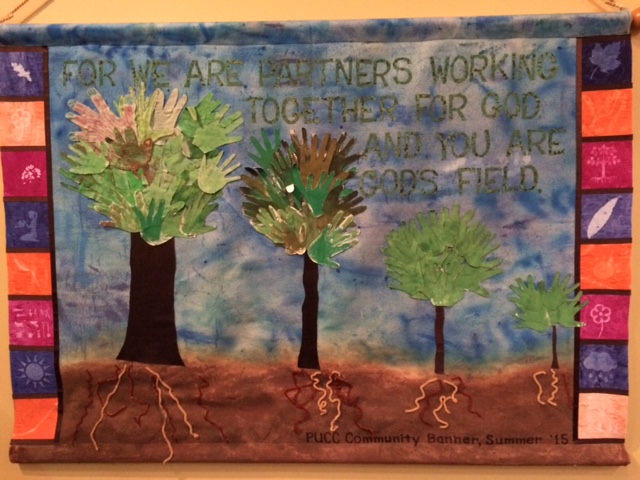
As we sing together our community hymn, four folks are going to give us a “hand” in finishing our beautiful community banner.

In the name of our God, who creates us, redeems us, sustains us, and hopes for our wholeness.  Amen.

Kimberleigh Buchanan  (c) 2015IMG_0239

Posted in Uncategorized | Leave a comment

Sermon: “True Love” (8/16/15)

Let love be genuine; hate what is evil, hold fast to what is good; 10love one another with mutual affection; outdo one another in showing honour.11Do not lag in zeal, be ardent in spirit, serve the Lord. 12Rejoice in hope, be patient in suffering, persevere in prayer.  (Romans 12:9-12)

Anybody tired yet?  That is one long to-do list!  And Paul is just getting started.  The list continues in next week’s passage.  I’d read it to you, but it’d just depress you.  And truth be told, there’s plenty to depress us—or at least exhaust us—in today’s passage.

For those keeping score at home, in today’s 4 short verses, Paul lists 11 things that followers of Jesus should do.  Eleven!  Next week’s passage adds 12 more.  What is Paul getting at here?  Why such a long list?  Are we supposed to do all these things?  Like, simultaneously?  Will we be graded?  Will there be a test?

I was drawn to this Romans 12 passage for the last part of our summer theme—“Growing Deeper into Community”—because it’s one of the quintessential New Testament passages on living in community.  It begins with one of Paul’s riffs on the body of Christ—we all have different gifts and our calling as followers of Jesus is to use those gifts to build up the body of Christ.  Then, like a similar passage in I Corinthians, he starts talking about love.

Sounds good, right?  Every part of the body working together with every other part of the body; all of it grounded in love.  A great way to end our exploration of community!  Then I actually read Romans 12.  (That always messes me up!)  Such a long list!  What’s a preacher to do?  To adequately address each item on the list would require a sermon on each one.  Anybody up for 11 sermons between now and lunch?  Not if we’re going to “hate what is evil and hold fast to what is good!”

But if we don’t consider each item on Paul’s list individually, the other option is to lump them all together.  But if we do that, then each item loses its impact.  Paul must have had some reason for listing the items he listed, right?  Lumping them all together feels reductionistic.

So as I mulled over what to do with these verses—wishing to goodness I’d chosen some different ones—an idea came to me.  I wonder if Paul’s list really has just one item and the rest is commentary.  I wonder if, as he begins his reflections on what it takes to strengthen the body of Christ, Paul comes back to the same thing he came back to in I Corinthians.  What does it take to strengthen the body of Christ?  Love.  And if your love is genuine, then all the other actions Paul lists in today’s verses fall into place.

If your love is genuine, you’ll hate what is evil and hold fast to what is good.  If your love is genuine, you’ll love one another with mutual affection.  If your love is genuine, you’ll outdo one another in showing honor.  If your love is genuine, you won’t lag in zeal, you’ll be ardent in spirit, and you’ll serve God.  If your love is genuine, rejoicing in hope will come naturally to you, as will being patient in suffering and persevering in prayer.

I don’t know if that’s what Paul intended, but doing one thing sounds a whole lot easier than trying to do 11 things.  So, let’s focus on the one thing—love—and see where that gets us.

You’ve probably heard lots of definitions of love.  The one we gravitate to here at Pilgrimage comes from Christian ethicist Beverly Harrison who described love as “the power to act each other into well-being.”  It’s a good description, one that reminds us that love isn’t just something we say or feel.  Love is something we do.

As we’ve explored this theme of growing deeper into community this summer, though, I’ve been wondering if our definition of love might also need to deepen.  Yes, love is the power to act each other into well-being, but how does that work?  How, precisely, do we act each other into well-being?

Maybe it’s like taking soup to a neighbor when they’re sick.  You might remember the piece Rochelle shared with us in a sermon back in June.  It comes from a book called Deepening Community, by Paul Born.  The piece is so good, I’m going to read it again.  J

“Many times over the past 30 years,” Born writes, “I’ve been asked, ‘What is the most important thing people can do to make a difference in the world?’  ‘That’s simple,’ I say.  ‘Bring chicken soup to your neighbor.’  ‘Really?’ is the typical response.

“I say yes, and then add, ‘But remember, I said the answer is simple.  But the act of bringing soup….well, that takes work.’

Think about it.  Taking chicken soup to your neighbor “requires that you know your neighbor.  It requires that you know they are not vegetarian and like soup.  It requires that you know them well enough and communicate regularly enough to know they are sick.

“Once you know they are sick, you must feel compelled to want to help and to make this a priority among the many calls on your time and energy.  Your neighbor must know you well enough to feel comfortable in receiving your help.  And you must have enough of a relationship to know what they prefer when they are sick, whether it is chicken soup, pho, chana masala, or even ice cream.  So, you see, the work takes place long before you perform the act of bringing soup.”  (Kindle, 180-185)

Acting each other into well-being—loving each other—takes a lot of work.  It begins by getting to know each other.  How can we act someone into well-being if we don’t know what will make their being well?  How can we nurture each others’ gifts if we don’t know what those gifts are?  How can we strengthen the body of Christ, if we don’t know the strengths and needs and limits of each part?

At first glance, Paul’s list in Romans 12 feels daunting:  hate evil, cling to good; love each other with mutual affection; outdo one another in showing honor; Do not lag in zeal, be ardent in spirit, serve the Lord. 12Rejoice in hope, be patient in suffering, persevere in prayer.   But if instead of focusing on 11 tasks, we focus on the one task of loving—of getting to know each other well enough that we know what action will contribute to our neighbor’s well-being—then maybe the other stuff will take care of itself.

So, we didn’t have a picnic yesterday.  At the beginning of the summer, we got the idea for a church-wide picnic at Lake Allatoona.  It would be a great way, we thought, of helping us grow deeper into community.  But by Tuesday, there weren’t enough people signed up to make it happen, so we cancelled.

I’m guessing there are many reasons why interest in the event wasn’t higher—school started, Lake Allatoona felt far away, lack of time.  Another reason, perhaps, is that we simply bit off more than we could chew.  In our eagerness to grow deeper into community this summer, we loaded up the calendar…as if all it takes to grow deeper into community is doing more things together.

But sometimes, acting each other into well-being means recognizing when we’ve bitten off more than we can chew and acknowledging that sometimes we simply need to stop.  And breathe.  And be.  Love is the power to act each other into well-being…and sometimes the most loving action we can take is simply to be in each other’s presence.  And rest.

One of my favorite parts of the renovation we did several years ago was turning the sanctuary 90 degrees…because now during 8:30 worship, I can look out and see who’s coming for 10:00 worship.  (…or who’s coming late for 8:30.  J)

Last week toward the end of 8:30 worship, I saw a beautiful thing.  Someone arrived early for 9:30 choir rehearsal.  She sat down at one of the picnic tables and began to read.  After a few minutes, another choir member arrived and sat down across from the first person.  The two struck up what seemed to be a relaxing conversation.  It was so beautiful!

And it embodied everything we’ve been about this summer.  Think about what it took for that 5 minute conversation to happen.  Two people who’ve committed themselves to choir and who, through their involvement in choir have gotten to know each other well enough that they want to spent time chatting; one teenager who dreamed up this idea of building picnic tables so that we can do exactly what those women did last week—visit with each other in the outdoors; several church members who gave up several hours on a Saturday to make said teenager’s dream a reality.

What I saw out those windows last week wasn’t just a 5 minute conversation, it was the fruit of many weeks, months, and years of work, the work of getting to know each other so that, acting each other into well-being has become second nature.  We do it without even thinking.

So, I could have preached 10 more sermons this morning, but I think just one sermon will be sufficient:  “Let your love be genuine.”  If we do that, everything else will fall into place.

In the name of our God, who creates us, redeems us, sustains us, and hopes for our wholeness.  Amen.

Kimberleigh Buchanan ©2015

Posted in Uncategorized | Leave a comment

Sermon: “Overcome Evil with Good” (8/9/15)

Have you grown weary of evil in the world?  Charleston.  Chattanooga.  ISIS.  How can people do such horrific things to each other?  Where is our humanity, indeed.

The presence of evil in the world–that’s what sends many people fleeing from faith.  “How can God let these terrible things happen?” they ask.  “I can’t believe in a God who allows such things to occur.”  One friend recently asked me, “Do you believe in original sin?”  I told him I believe more in original grace.  He told me that when he looks at all the evil in the world, he sees a lot more evidence for original sin than original grace.  “Left to our own devices, humanity always seems to choose evil,” he said.

I ache for that friend.  A thoughtful person, he also used to be a person of deep faith.  But the evil he sees in the world has killed his faith.  I fear it’s also killed his hope.

So, how does the thoughtful person keep faith in a world where nine people attending Bible study can be shot down, a world where Coptic Christians can be beheaded, a world where children are taught to murder, a world where members of our military are murdered just an hour and a half up the road?  Maintaining faith when times are good–that’s well and good.  But maintaining faith in the face of evil?  A faith that can do that can withstand anything.

How do we get that kind of faith?  How can we keep believing in the face of evil?

As I watched coverage of the Charleston shooting, I felt a lot of things–rage, despair, helplessness.  I just couldn’t wrap my mind around such an evil act.  It didn’t compute.

Then I remembered something I heard in the days after 9/11, a quote from Mr. Rogers.  He said that if something terrible happens, look for all the people who are helping in the aftermath.  See all the good they’re doing….then do something to help.  Sometimes, the only way to remember that there is good in the world is to do something good ourselves.

Which is probably where Paul is coming from when he tells the followers of Jesus in Rome:  “If your enemies are hungry, feed them; if they are thirsty, give them something to drink; …Do not be overcome by evil, but overcome evil with good.”

Romans is one of Paul’s later letters.  It was written after persecution of Christians had become a regular practice of the Roman government.  Paul wrote to encourage people who were being mistreated because of their faith, people who increasingly were on the receiving end of evil acts.  “If your enemy is hungry, feed them.  If they’re thirsty, give them a drink.”

Why?  Why treat your enemies, why treat your abusers as human beings when they’re treating you so inhumanely?

After decades of working with Brazilian peasants who were mired in the oppressive realities of poverty and illiteracy, educator Paulo Freire wrote a book called Pedagogy of the Oppressed.  In it, he closely examined the dynamics of oppression.  A key idea for Freire is this:  oppression dehumanizes both the oppressed AND the oppressor.  When we treat others inhumanely, we become less human ourselves.  At the same time, when we treat others humanely, our own humanity is strengthened.

Which might be what Paul is getting at in Romans 12.  When you’re on the receiving end of evil, dehumanizing acts, respond to those acts with humanity.  Yes, treat your enemies, treat your abusers as human beings.  Who knows?  Perhaps if your enemy is treated like a human being, he or she will start acting like one.  However your enemy responds to your humane treatment, though, know that your compassionate action will strengthen your own humanity.

“Overcome evil with good.”  I know.  It’s hard to imagine.  But sometimes, doing good in the face of evil is the only way to survive; it’s the only way for our faith to survive.  If we can’t find any good in the world, sometimes we have to create it ourselves.

Can’t imagine how to do good in the face of evil?  Here are a few examples…

A gunman walks into a Bible study at Mother Emanuel AME Church in Charleston and, after sitting with them for an hour, stands, and shoots and kills nine people.  The families of those who died forgive the shooter.  Those grieving families overcame evil with good.

Another gunman walks into a school for Amish children and kills six girls.  The parents forgive the gunman.  Those Amish parents overcame evil with good.

After decades of Apartheid in South Africa, under the auspices of the Truth and Reconciliation Commission, Black South Africans forgave the whites who had so horrifically abused their people.  Black South Africans overcame evil with good.

It’s important to remember these stories of people overcoming evil with good….because when we are confronted with evil, these stories can guide us into responding humanely to even the most inhuman of acts.

There is one story I’ve been wrestling with that doesn’t seem to move much past acts of evil.  One cool April day in 1913, the body of 13 year old Mary Phagan was found in the basement of the National Pencil Factory in Atlanta.  Reading an account of the trial and eventual lynching of factory manager, Leo Frank, for Mary Phagan’s murder, I didn’t find a whole lot to redeem the story.  At all.  Racism was rampant—against African Americans and Jews.  Sensational journalism didn’t just report on the events, it shaped them.  Witnesses’ stories changed on a whim, based on how much the interviewer paid them.  When, in 1915, many Mariettans—some of them public figures—drove to Milledgeville, broke Frank out of prison, drove him back to Marietta and lynched him, no legal action was ever taken.  To this day, no one has been charged with the unlawful death of Leo Frank.  The lynching of Leo Frank remains a dark stain on Marietta history.

A few people did advocate for Frank throughout the trial and worked to exonerate him after his death.  Overall, though, the story of Leo Frank is sordid; it is rife with evil.

A week from Monday marks the 100th anniversary of the lynching of Leo Frank.  Next Sunday afternoon at 2:00, there will be a memorial service for Leo Frank at Temple Kol Emeth.   The Temple’s rabbis are eager for people of all faiths to attend the service.

I encourage us to attend.  I know.  This event happened a century ago.  What does it have to do with us?  None of us had family in Marietta at the turn of the century.  None of our relatives participated in the trial or lynching of Leo Frank.

We might not be related by blood to participants of those heinous acts a century ago, but we are related by our common humanity.  Martin Luther King, Jr., once said, “Injustice anywhere is a threat to justice everywhere.  We are caught in an inescapable network of mutuality, tied in a single garment of destiny.  Whatever affects one directly, affects all indirectly.” Until all of us are free, none of us is free.

Attending the memorial service next Sunday can be one small way of overcoming evil with good.  Joining together with people of other faiths to affirm the humanity of someone who was treated so inhumanely?  In so doing, we’ll remind ourselves and the world that good does exist.  Good exists in the world because we are working with God to create it.

How do we keep our faith in the face of evil acts?  How do we maintain our humanity when forces and people seek to destroy it?  We tip the scales toward good by doing something good ourselves.

Here’s the story of one young woman who did just that.


Prayers of the People  (8/9/15)

God of all compassion, we know that when any of your children suffer, you are the first to weep.  When people don’t have enough food to eat, when they are oppressed by systems that don’t allow them to live in their full humanity, when basic human rights are denied, you weep, and hope, and pray that we’ll do something.

And so today, we put ourselves at your disposal.

Make us instruments of your peace, Holy One:

Where there is hatred, let us sow love;
where there is injury, pardon;
where there is doubt, faith;
where there is despair, hope;
where there is darkness, light;
where there is sadness, joy;

May we not so much seek to be consoled as to console;
to be understood as to understand;
to be loved as to love.

For it is in giving that we receive;
it is in pardoning that we are pardoned;
and it is in dying that we are born to eternal life.  (St. Francis)

And so this day—and all days—we ask not so much what you can do for us, but what we can do for you.  Show us the way.  GM/HP

In the quiet of this moment, we make ourselves available to hear whatever you might be saying to us.  (Silence)  GM/HP

In the quiet of this moment, we lift into your care all those things that are not yet ready for public speech.  (Silence)  GM/HP

Blessing

Christ has no body now but yours.

No hands, no feet on earth but yours.

Yours are the eyes through which he looks compassion on this world.

Yours are the feet with which he walks to do good.

Yours are the hands through which he blesses all the world.

Yours are the hands, yours are the feet, yours are the eyes, you are his body.

Christ has no body now on earth but yours.   (Teresa of Avila)

Use that body to do something.


Posted in Uncategorized | Leave a comment

Sermon: “Members of One Another” (8/2/15)

Good news!  In this summer of growing deeper into community, we’re also growing in numbers.  Today the Stanley family–Christy, Jeff, and Zach–will be joining Pilgrimage.

Welcoming new members is a joy.  Knowing that folks have been through a discernment process and have decided that this is the place, these are the people with whom they want to continue their faith journey?  An utter joy!

And the tiniest bit confusing.  Because church membership isn’t what it used to be.

When I became your pastor in 2001, most folks who visited found us in the phone book.  Often, they were UCC transplants from the north looking for a familiar church experience in the south, which–let’s face it–was hard to find.  Folks weren’t that interested in Inquirer’s classes because they were lifelong UCCers; they already knew all the answers.  They just wanted to join…because that’s what you did when you moved to a new community–you found the nearest UCC church and you joined… kind of like joining the gym.

Things are different now.  Now, I’d say 95% of folks find us on the web.  The other 5% come because of the messages on our sign.  Very few people are lifelong UCC.  In fact, very few people are UCC at all.  When people attend Inquirer’s classes now, when it’s time to go, they want to keep talking, keep learning about the UCC.  In fact, the interest in the last Inquirer’s class was so intense, I’ve decided to teach a UCC ABC’s class.  It’ll begin August 16.

At the same time that inquirers have become more interested in learning about the UCC, they’ve become less interested in becoming members of the community.  In my reading about this non-joining trend, I’ve learned that folks aren’t joining much of anything anymore–not faith communities, not professional organizations, not anything.  (Except gyms, I guess.  🙂

The place we’ve been wrestling with the not-joining trend here at Pilgrimage is in the deacons.  Do you know how the deacons’ ministry here works?  Drawing on the description of the first deacons in Acts 6, our deacons see to the care of the community’s members.

In this congregation, we do that by divvying up all the families.  Each deacon stays in touch with up to 10 families in the church.  If there is a pastoral need, they work to see if our community can meet that need.  When I can’t make a hospital visit, they do that.  They’ve even received training to take communion to folks who aren’t able to attend worship.  If you have a pastoral need, I am of course always available.  Your deacon also is available to listen, pray, and connect you with more practical care like providing food, respite care, that sort of thing.

Here’s how the changing role of church membership impacts the deacons.   If someone is a member, but they no longer attend, how long do they stay in touch?  How many times does a deacon reach out when the person they’re contacting doesn’t respond?  Is it good stewardship of our deacons’ time and energy to keep reaching out to people who don’t reach back?

On the other side, if someone is very active in the community, should we refrain from assigning them a deacon because they haven’t joined?  Is having a deacon a “perk” of membership, or is it a key part of being community?  And what about name tags?  Are name tags a perk of church membership?  Do you only get a name when you’re officially part of the community?  The answer to that is no!  If you want a name tag, contact Lynne.

So, if church membership isn’t what it used to be, what is it?  What will it mean—for them and for us—when the Stanleys sign the membership book in a few minutes?

Today we begin a four-week exploration of Romans 12, which is a how-to manual on community.  Today’s passage is similar to another of Paul’s reflections on community– I Corinthians 12, the Mr. Potato Head passage….you know—we’re all  part of the body of Christ, we have different functions AND we’re all connected.  If we were all eyes, where would the hearing be?  If we were all mouths, where would the listening be?  That’s why I asked for this encore performance of the The Body drama today.  What a beautiful illustration of just how important EVERY SINGLE PART of the body is….and how important it is for all those parts to work together.  And how necessary diversity is.

The body metaphor also works well as we seek to grow deeper into community.  There’s a tweak in the Romans passage, though, that has stuck with me and won’t let go.  Verses 4-5:  4For as in one body we have many members, and not all the members have the same function, 5so we, who are many, are one body in Christ, and individually we are members one of another.

Members of one another?  What does that mean?  The body drama illustrates it well.  Where would the legs be without the brain?  Where would the bladder be without the lungs?  Where would the big toe be without the stomach?  And where would any of the other parts be without the heart “pumping, pumping, pumping?”

Each part is a member of every other part.  If any part isn’t functioning well, all the others are affected.  If one part is sick or injured or tired, all the other parts have to work harder.  A fully-functioning body requires all the parts to work well together.

And a fully-functioning body of Christ requires that all its members work well together, to actively engage their interconnectedness, to depend on their diversity.  If we remain only members of the body or institution and not members of each other, then our membership can only remain shallow and perfunctory….kind of like becoming a member of the gym and never going to work out.   And we all know how NOT working out affects bodies.

So maybe the changing landscape of church membership isn’t so much puzzling as it is an opportunity…Maybe it’s an opportunity to grow deeper into community by taking seriously how interconnected we are.

How interconnected are we?  As you reflect over this summer of growing deeper into community, how have we been working together?  What are some examples of us becoming members of one another, of depending on our diversity, of working together so that we, as the body of Christ, might act others into well-being?  (Responses from congregants.)

The intent of some sermons is to challenge you to see things in new ways.  This isn’t one of those sermons…because we’ve just heard about many ways in which this community already is working well together as a body.  We have spent time together, talked together, played together, gotten to know each other better, learned about our diverse gifts, and used them not only to strengthen our Pilgrimage community, but also to act others into well-being outside this community.

The landscape of church membership is changing…and personally, I think that might be one of the best things to happen to the body of Christ in a good long while.  This notion that we are members of one another–and not simply of an institution…living as if we are members of one another is ushering us in to a deeper experience Christian community than we’ve ever had.  What good news!

Church membership isn’t what it used to be.  Thanks be to God!

In the name of our God, who creates us, redeems us, sustains us, and hopes for our wholeness.  Amen.

Kimberleigh Buchanan  ©2015

Romans 12:3-8

3 For by the grace given to me I say to everyone among you not to think of yourself more highly than you ought to think, but to think with sober judgement, each according to the measure of faith that God has assigned. 4For as in one body we have many members, and not all the members have the same function, 5so we, who are many, are one body in Christ, and individually we are members one of another. 6We have gifts that differ according to the grace given to us: prophecy, in proportion to faith; 7ministry, in ministering; the teacher, in teaching; 8the exhorter, in exhortation; the giver, in generosity; the leader, in diligence; the compassionate, in cheerfulness.

Posted in Uncategorized | Leave a comment

Sermon: “Killing Koinonia” (7/26/15)

Acts 5:1-11  (NRSV)

But a man named Ananias, with the consent of his wife Sapphira, sold a piece of property; 2with his wife’s knowledge, he kept back some of the proceeds, and brought only a part and laid it at the apostles’ feet. 3‘Ananias,’ Peter asked, ‘why has Satan filled your heart to lie to the Holy Spirit and to keep back part of the proceeds of the land? 4While it remained unsold, did it not remain your own? And after it was sold, were not the proceeds at your disposal? How is it that you have contrived this deed in your heart? You did not lie to us* but to God!’ 5Now when Ananias heard these words, he fell down and died. And great fear seized all who heard of it. 6The young men came and wrapped up his body,* then carried him out and buried him.

7 After an interval of about three hours his wife came in, not knowing what had happened. 8Peter said to her, ‘Tell me whether you and your husband sold the land for such and such a price.’ And she said, ‘Yes, that was the price.’ 9Then Peter said to her, ‘How is it that you have agreed together to put the Spirit of the Lord to the test? Look, the feet of those who have buried your husband are at the door, and they will carry you out.’ 10Immediately she fell down at his feet and died. When the young men came in they found her dead, so they carried her out and buried her beside her husband. 11And great fear seized the whole church and all who heard of these things.

Well, isn’t that a sweet story?  A married couple sells some land and gives the proceeds to the community….well, most of the proceeds.  By agreement, the two decide to give only a portion of the proceeds but say it’s the whole thing. The difference, they keep for themselves.

So, Ananias brings the offering and lays it at the apostles’ feet.  Knowing of the deception, Peter calls Ananias on it.  Ananias’ response to getting caught? He drops dead.  Three hours later, unaware of her husband’s demise, Sapphira appears.  Peter asks if they sold the property for the lower price.  She says yes.  Then, she too drops dead.

What in the world is going on here?  Why is this story in the Bible? Aside from a potentially compelling stewardship illustration J, what good news is there for us in the disturbing story of Ananias and Sapphira?

It might help if we look at the larger context of Acts. It couldn’t hurt, right?

Fifty days after Jesus’ death and resurrection his followers gather in Jerusalem for the high holy days.  After God’s Spirit swoops in and stirs things up, the people…

devote themselves to the apostles’ teaching and fellowship, to the breaking of bread and the prayers…All who believed were together and had all things in common; 45they would sell their possessions and goods and distribute the proceeds* to all, as any had need. (Acts 2:42-44)

Two chapters later, the community is still clicking on all cylinders. Listen:

the whole group of those who believed were of one heart and soul, and no one claimed private ownership of any possessions, but everything they owned was held in common. …There was not a needy person among them, for as many as owned lands or houses sold them and brought the proceeds of what was sold. 35They laid it at the apostles’ feet, and it was distributed to each as any had need.

In fact….

36There was a Levite, a native of Cyprus, Joseph, to whom the apostles gave the name Barnabas (which means ‘son of encouragement’). 37He sold a field that belonged to him, then brought the money, and laid it at the apostles’ feet.

To this point, the believers have acted as one.  Everyone is on the same page.  They really do have all things in common, even their ideas and hopes and motivations.

But it’s a community…which means things aren’t going to go smoothly forever.  There’s going to be a hiccup.  At some point, someone’s going to forget about working for the common good and will put themselves first….and they’ll do it, not because they’re bad people, not because they’re selfish people, but because…

Why do people sometimes put their own needs ahead of the needs of the community?  We hear it over and over in the Bible–work for the common good, love your neighbor as yourself, have all things in common….yet sometimes we keep something back for ourselves; we withhold our gifts–time, talent, authenticity, honesty. We know the community is strengthened when we commit ourselves fully, but sometimes we just don’t.

Do you wonder why Ananias and Sapphira lied about their gift, why they held something back for themselves? The expectations were clear: have all things in common.  They’d just seen Barnabas sell his land and give every cent of the proceeds to the community. But for some reason, they couldn’t do it; they weren’t yet ready to give everything they had to the community.

Luke doesn’t say why Ananias and Sapphira drop dead in the doorway when their lie is found out.  He doesn’t say “God struck them dead.”  He doesn’t say, “the wages of sin is death. See?” He doesn’t say the couple had pre-existing cardiac issues. He just lets us know they lie, then they die.

I wonder how things might have gone differently? What if, when their resolve to give everything to the community wavered, instead of lying they’d gone to Peter and confessed: “We can’t do it.  We sold this property intending to give all the proceeds to the community, like Barnabas did, but we can’t do it.  We’re so sorry, but we just can’t do it.”

And what if Peter had responded: “Giving all to the community is hard; it takes time.  Thank you for being honest about your ability to commit.  Your confession is a step in the right direction.  Being honest about your limits also builds community.  Give what you can now.  Later, as you grow deeper into this community, perhaps you’ll find it easier to give more.”

Maybe Luke included this story of Ananias and Sapphira as a cautionary tale…not so much to warn against holding things back from the community, but to warn against lying about it.  Trying to be someone we’re not, and trying to convince others we’re someone we’re not–that is what kills koinonia.  Inauthenticity kills community. Dishonesty kills community. Being flawed people? That doesn’t kill community. In fact, it is our flaws, our limits that provide fertile ground for growing deeper as a community.

I’ve learned that lesson again in the last year and a half. Raised Southern Baptist and called to pastor, my journey into ministry wasn’t easy. I went to seminary to become a children’s minister– because that’s all I thought women could do in church. But a few professors helped me see that my true calling was to pastoral ministry. Just as I was opening myself up to my call, the fundamentalists took over the seminary. By the time I graduated, I heard every day, “Women can’t preach; women can’t pastor.” In my head, I knew the words weren’t true, but they seeped into my heart anyhow. Seminary is a joyous experience for many. For me and my classmates, it was traumatic.

It’s taken a long time, but I’ve done a lot of healing. You all have been key to that healing process. I’ve never felt like a woman pastor here; I’ve just felt like your pastor. Your acceptance of me has helped me live into my true calling. You have acted me into well-being.

Sometimes, though, even after we’ve healed, something happens and all the old pain rushes back. That happened to me at the Cobb Interfaith Thanksgiving Service in 2013.

A year or so before the service, the Cobb Interfaith Spiritual Leaders group had begun meeting. Some folks floated in and out of the group, but six of us formed a core—five men and me. Over the course of the year, the six of us had become good friends.

I went to the Thanksgiving service joyful and eager to support interfaith work in our community. But when the procession of clergy began, and I saw that there were just two women and that among the large group of men were my five good friends from the Cobb Interfaith group—all the exclusion I ever had felt because of my gender came flooding back. Feeling excluded again—and betrayed by my friends—I walked out.

As I reflected, prayed, and processed the experience with others, I struggled with how to respond. In my head, I knew those men never would have excluded me intentionally. But still. I hadn’t been included when they had. The two token women had been enlisted; there was room for no others. Yet the platform had plenty of room for all those men. I knew my friends only wished me well, but—because of the old hurts—the group no longer felt safe for me. I sent them an email letting them know what had happened and that I was taking a break from the group. To a man, they responded with great compassion.

I stayed away for a long time—over a year. I had all but decided not to return to the group when I was invited to participate in an interfaith prayer vigil for marriage equality last April. Participating in that service was a homecoming. It was good to reunite with my friends.

The experience was good enough that I went to our group’s meeting in May. All through the meeting I debated, “Do I tell them about my journey in the last year or not? Do I explain why I came back, or just go on as if nothing happened?”

I opted to tell my story. Those men—my friends—listened with their full attention and again with deep compassion. The first person who spoke said, “We’ve been waiting for you to tell us your story, Kim. We’re so glad you’re back.”

IMG_0216

The photo on your bulletins was taken this past Thursday. For the first time, I hosted the Cobb Interfaith gathering. Ten of us—women and men—gathered around the table, broke bread, and talked about how people of all faiths might work together on healing racism in our country. Then I led us out to the peace pole and got Lynne to take our picture. A couple of the faces in this picture you’ll see again Saturday night at our musical celebration.

Why tell you this story? I tell it because it demonstrates just how hard community can be sometimes…and how much stronger community becomes when we’re honest with each other. Had I not shared my Thanksgiving service experience with my friends, it wouldn’t have been as dramatic as what happened to Ananias and Sapphira, but it would have amounted, essentially, to the same thing—I would have been dead to that community. Instead, because I confessed my limitations, it gave them the opportunity to be supportive of me, which gave me the opportunity to receive their care for me, and to feel included.

As we sat around the table Thursday, I realized we had come a long way.  I had come a long way.  What good friends we are! What a strong community we are becoming. I know there will be other hiccups along the way, and I know that the next time we hit turbulent waters, we’ll be able to navigate them with greater skill…because, look! We’ve already done it once.

When we started on this journey of growing deeper into community here at Pilgrimage this summer, I didn’t realize just how hard the work of deepening community can be. But, as I’ve learned with my Cobb Interfaith friends, that hard work strengthens community as nothing else can.

I just wish someone had told Ananias and Sapphira.

In the name of our God, who creates us, redeems us, sustains us, and hopes for our wholeness. Amen.

Kimberleigh Buchanan ©2015

Posted in Uncategorized | Leave a comment

Sermon: Mission: Koinonia! (7/12/2015)

Allen and I just got back from a week at the monastery.  (Isn’t that where you spend your vacations?) J  It might seem strange to spend vacation in a dorm, with bathrooms down the hall, to eat bland food, and go to prayer three times a day, but, for Allen and me, it’s one of the most restful things we do—relaxing into the rhythm of prayer, receiving the gifts of Benedictine hospitality, getting loved on by nuns who’ve become our friends. We go to the monastery because we have learned that resting in God is the deepest, most renewing rest there is.

And yet…every time I visit Our Lady of Grace, I can’t help wondering why.  Why commit yourself to a lifetime—which can last well into your 10th or even 11th decade–why commit yourself to a lifetime of dorm-living, bland food, and praying three times a day with the same group of people, some of whom annoy you mightily?

Every sister I talk to assures me that living in community is a special calling. If you try to live in community when you’re not called to it, you don’t last long.  But those who are called?  It works for them.  Still.  Call me spoiled, but I like having my own bathroom.

But then I read something like today’s lesson from Acts 2, and suddenly my commitment to my own private bathroom seems a little selfish, a little worldly, decidedly un-spiritual.

The story thus far….Jesus has lived, died, risen from the dead, and ascended into heaven.  Then the Spirit swoops in and stirs things up.  Miracles happen. A spirit of peace and joy breaks out. The place is rife with celebration.

Caught up in the Spirit, Peter preaches:  “In the last days, God declares, I will pour out my Spirit upon all flesh, and your sons and your daughters shall prophesy, your young people shall see visions, and your old folks shall dream dreams.”

How do folks respond to the outpouring of God’s Spirit?  First, they’re baptized then…

42They devoted themselves to the apostles’ teaching and fellowship, to the breaking of bread and the prayers.  43 Awe came upon everyone, because many wonders and signs were being done by the apostles. 44All who believed were together and had all things in common; 45they would sell their possessions and goods and distribute the proceeds to all, as any had need. 46Day by day, as they spent much time together in the temple, they broke bread at home and ate their food with glad and generous hearts, 47praising God and having the goodwill of all the people. And day by day the Lord added to their number those who were being saved.

So, Jesus lives, dies, lives again, ascends, then God’s Spirit swoops in. How does the community respond? They respond by choosing to live together.  To eat, pray, study, and fellowship together.  Again, I ask: Why?  What IS the big deal about community?

Think about your own life. We don’t live in community here, but we do gather regularly for worship, prayer, shared meals, study, and service. What happens to your spiritual life when you’re away from this community? Do you pray as much? Reflect on God’s love as much? Serve others as much? It’s true that there are some folks—hermits, we call them—who do have consistent, profound spiritual experiences outside of community. For most of us, though, staying spiritually connected is a whole lot easier when we do it with others. I suspect that’s why those new believers chose to live together in those first heady days after Pentecost.

I also suspect that conflicts soon arose—those communities were, after all, peopled by people. A quick survey of Paul’s epistles reveals LOTS of conflicts in the early days. Paul wrote to help communities navigate the life of faith…even when folks weren’t getting along.

So, maybe those first century Christians chose community-life because, though it isn’t always easy, it is the easiest way to really live one’s faith.  All those other folks remind us–simply by their presence–that everything we do–eating, sleeping, working, praying, serving…. everything we do is an opportunity to experience God’s presence and to share God’s love.

These verses from Acts inspired Baptist pastor Clarence Jordan to start an intentional Christian community in southwest Georgia.  He called it Koinonia, the Greek word for community used in Acts to describe what believers created the first days after Pentecost.

Seeing in these verses a picture of what God’s kin-dom looks like, Clarence and a few others set out to establish just that kind of community at Koinonia Farm.  They called it a “demonstration plot” for the kin-dom of God.  They held all things in common.  They shared equally in the farm work.  They lived together in a small enclave.  They shared meals together.

Did I mention that Koinonia was intentionally interracial…and that it started in 1942?  In southwest Georgia?  Community life wasn’t always easy in those first couple of decades.

Tuesday, I travel with our youth to that same Koinonia Farm.  It’s still an intentional community trying to live into their vision of the kin-dom of God–a place where people live, work, and pray together, a place where no one experiences need because they have “all things in common,” a place where peace and goodwill are maintained by doing the hard work of living, working, and praying together with folks you might not always get along with.

So, in this summer of “Growing Deeper into Community” our youth are going to a place called Koinonia–the New Testament word for community.  They’ll share in work, prayer, meals, and fellowship with folks who really have committed themselves to community.   So, here’s what I’m thinking. Why don’t we send our teenagers to Koinonia as reporters, or detectives, (or spies!) to learn as much as they can about community, then report back to us next week?

I don’t make this suggestion lightly. Because of their age and inherent idealism, teenagers see, hear, and understand things we adults never would be able to see, hear, or understand. If we want to create a more hopeful future, who better to lead us than the inhabitants of that future? Peter understood the vital importance of young people to keeping faith communities vital and relevant. That’s why he quoted the prophet Joel in his Pentecost sermon: “Your young people shall see visions, and your old folks shall dream dreams.”

In the bookstore at Synod, I met an author who was signing an advance copy of her book, Ferguson and Faith: Sparking Leadership and Awakening Community.  Leah Gunning Francis teaches Christian Ed at UCC-affiliated Eden Theological Seminary in St. Louis.  Chalice Press invited Leah to interview participants from faith communities who have been involved with all that’s been happening in Ferguson since last August.

In retirement, when I look back on my ministry, I think I will see reading this book as a before-and-after event.  It’s challenging me to see ministry and the work of the church in completely new ways.  It’s opened my eyes to the vital importance of hearing, really hearing, the voices of young people… and letting them lead us into a more just, loving, and generous world.

I look forward in the future to sharing with you some of the creative things faith communities and faith leaders have been doing in Ferguson.

Today, though, I want to share the most striking thing to me about the interviews with religious leaders.  When these clergy people went to offer guidance and leadership to the protesters, they quickly learned that what they had to say, what had worked in similar situations in the past, wasn’t relevant to what the young people were experiencing.  In fact, spouting old truisms only angered the young protesters.  The religious leaders soon realized that their task in this instance wasn’t to speak to–or for–the protesters; their calling in Ferguson was to support the young leaders, to offer food and places to gather–and rest–in their places of worship, and on occasion to be a bridge between protesters and law enforcement.

Communities in and around Ferguson are still finding their way, but strides are being made.  That’s due in large part to community and religious leaders listening to the young people.  If you think about it, most positive social movements have been started by young people. It was largely young people who moved the civil rights movement.

And I’ve heard a couple of stories about the Supreme Court’s marriage equality decision.  In many cases, parents have tried to explain the decision to their children and assumed they’d have to wait actually to get married until their kids got used to the idea.  From what I’m hearing, though, the kids already are ready…have been for a long time.  In so many circumstances, we see roadblocks where our children see only open road.

All of this is to say that we need to listen to young people.  They haven’t been around long enough yet to get jaded.  They haven’t contributed to creating the status quo, so they have little investment in it.  That’s probably why the prophet said the young people will prophesy–because they’re the ones who can see a more hopeful future.  Those of us who’ve been around a while have seen all the things that can go wrong…and have.  We see problems; young people see possibilities.

So, when I suggest that we send our youth on a fact-finding mission to Koinonia to learn what they can about community and report back to us, I’m not just making a cutesy connection between what they’re doing and our summer theme.  I’m suggesting it because these four teenagers are going to see things and hear things and imagine things that those of us no longer quite so young can see.  We can dream dreams—indeed we have a responsibility to; but it is the young people who will lead us into making those dreams come true.

So, let’s get our emissaries commissioned!

(8:30 In the next service, we’ll commission the youth for their trip to Koinonia. As David plays, I’d like to invite you all to write your own blessings/hopes for the kids on the cards provided. I will take those cards with me and read them during our prayer times during the week.)


In the name of our God, who creates us, redeems us, sustains us, and hopes for our wholeness. Amen.

Blessing of the Youth for their Trip to Koinonia Farm (7/12/15)


Devin, Zach, Danielle, and Emma, as your faith community, we have watched you grow. We’ve worked hard at nurturing you into the Christian faith. We are proud of who you are becoming!

As we explore what it means to grow deeper into community this summer, we send you forth to Koinonia on a fact-finding mission. In the next week, learn everything you can about community. What does it take to be a strong and deep community of faith? We’re all going to be here next week to hear what you’ve learned. We’ll be here because we really want to know what you find out. You are going to see things and hear things and understand things we’d never see, hear, and understand. To this point, you’ve been learning from us. Now it’s our turn to learn from you!

And now as you go forth, we’re going to pray and ask God’s blessing on you and all you will experience in the coming week.

Holy One, we thank you for each of these youth—and chaperones. We ask your blessing on each of them. Keep their minds and hearts open to learning everything they can from you and their experiences. Keep our minds and hearts open to learning everything we can from them when they return. Bless the people these young people are becoming—and the community they will be building this week. In Jesus’ name we pray—Amen.

Posted in Uncategorized | Leave a comment

Doing about racial reconciliation…

Like everyone else in the country, I was stunned by the shooting at Mother Emanuel AME Church in Charleston last week.  Having grown up in the South, race relations always have been front and center in my thinking and feeling.  Serving as a pastor in the United Church of Christ, I also am firmly committed to working for justice.

I confess that with events in Ferguson last year, and Baltimore this year, I’ve felt paralyzed.  The problems seem so big; I feel so small.  Wanting desperately to do something, I’ve done very little.  Nothing, really.  Oh, I’ve felt plenty guilty, but not enough to take action.

Then–last week’s massacre of nine people attending Bible study at their church….

My complacency evaporated and I looked for something to do.  When the call came on Friday to attend a meeting in preparation for an interfaith, interracial prayer service in Atlanta, I hopped in the car and went.  I spoke at the press conference held after the meeting.  I went back to Atlanta the next day for the prayer service at Peachtree Christian Church.  Sunday at Pilgrimage, we prayed for the people affected by the shooting and for guidance in how we might work to heal the racial divide in our country.

Then last night, I attended a prayer service at Bethel AME Church in Acworth.  I had met Pastor Leela Waller at the prayer service in Atlanta.  I had thought perhaps her church and ours could begin partnering, get to know each other, build a bridge between a predominantly African American congregation and a white congregation.

The service was led by Freedom Church in Acworth.  It was that congregation’s gift to the Bethel AME congregation to let them know they are supporting them…and will continue to do so.

Here’s the thing….last night’s service happened because the two congregations already had a relationship.  As soon as he learned about the shooting, the pastor of Freedom Church–who was on vacation–called the pastor of Bethel AME because they already were friends.  They didn’t get together simply because of the shooting.  They got together because the shooting affected people they already loved.

I left the service convicted…and convinced that the only way to work toward racial reconciliation is to BEGIN working toward racial reconciliation.  And the best way to begin working toward racial reconciliation is to build and strengthen relationships with people of other races.  As long as those who are different from us remain “them,” the task always will feel daunting.  But when “they” become “our friends,” then we’ll know exactly what to do.

After church on Sunday, a white congregant told me that one of their children had adopted an African American child.  This person said, “I used to say, ‘Oh, look what’s happening to those people.’  Now I say, ‘Oh, look what’s happening to US.'”  When we make friends, when we work hard at building relationships, then when tragedy strikes, we realize it’s happening to all of us.  And if it’s happening to US, we will know what to do…and do it.

Posted in Uncategorized | Leave a comment

Barbara Kingsolver on Community

Got this quote from a church member’s Chipotle cup:

“The ancient human social construct that once was common in this land was called community.  We lived among our villagers, depending on them for what we needed.  If we had a problem, we did not discuss it over the phone with someone in Mumbai.  We went to a neighbor.  We acquired food from farmers.  We listened to music in groups, in churches or on front porches.  We danced.  We participated.  Even when there was no money in it.  Community is our native state.  You play hardest for a hometown crowd.  You become your best self.  You know joy.  This is not a guess; there is evidence.  The scholars who study social well-being can put it on charts and graphs.  In the last 30 years our material wealth has increased in this country, but our self-described happiness has steadily declined.  Elsewhere, the people who consider themselves very happy are not in the very poorest nations, as you might guess, nor in the very richest.  The winners are Mexico, Ireland, Puerto Rico–the kinds of places we identify with extended family, noisy villages, a lot of dancing.  The happiest people are the ones with the most community.”

Amen, Barbara!

Posted in Uncategorized | Leave a comment

Sermon: “Sow What?” (6/7/15)

Author Marjorie Kinnan Rawlings was raised in the northeast, but on a trip to north Florida in her 30s, she fell in love with the backwoods area known as Cross Creek.  She bought several acres and set up a homestead there.  It’s in the house on the property that she wrote several of her books, including The Yearling and Cross Creek.

            Having grown up in the same county as Cross Creek, I’ve always been drawn to Rawlings’ writings.  The last paragraph of her memoir Cross Creek is one of her best:

“Who owns Cross Creek?  The red-birds, I think, more than I, for they will have their nests even in the face of delinquent mortgages…It seems to me that the earth may be borrowed, but not bought.  It may be used, but not owned.  It gives itself in response to love and tending, offers its seasonal flowering and fruiting.  But we are tenants and not possessors, lovers, and not masters.  Cross Creek belongs to the wind and the rain, to the sun and the seasons, to the cosmic secrecy of seed, and beyond all, to time.”

“The cosmic secrecy of seed”…isn’t that a great line?  It resonates with a line in the hymn we just sang:  “From the past will come the future; what it holds, a mystery, unrevealed until its season, something God alone can see.”  (In the Bulb There Is a Flower, by Natalie Sleeth.)

What happens inside seeds is–to most of us–a great mystery.  Whether we call it Cosmos or God, something happens when seeds and earth interact.  Every time one sprouts, it does kind of feel like a miracle, doesn’t it?  Maybe that’s why so many people find God in their gardens.

The cosmic secrecy of seed—a miracle, yes, but after eons of agricultural progress, some things are less secret, less mysterious….like the kind of soil that produces good crops.

Today we hear Jesus’ first parable in the Gospel of Mark, the parable of the sower.  It’s a story to which the rural hearers of the parable would have related.

Once upon a time, a sower sowed some seed. Some landed on the path and never took root. Some landed on rocky ground; it sprang up quickly, but, having no depth of soil in which to grow roots, it withered. Some seed landed among thorns, which choked the seed. Finally, other seed fell into good soil and brought forth grain. It grew and yielded 30, 60, and 100 fold. Jesus ends the parable by saying, “Let anyone with ears to hear listen!”

On the face of it, it’s a straightforward story.  If you’re scattering seed, the seed that lands in good soil is going to have the best chance of revealing all its “cosmic secrets.”  Seed that lands on the path or among rocks and thorns is–literally–going to have a hard row to hoe.

But Jesus isn’t a county agent dropping by to tell farmers how to improve crop yield.  Jesus is a spiritual teacher.  So, what’s the deeper meaning of the story?

When Jesus’ disciples ask him to explain the parable, here’s what he says:  14The sower sows the word. The word—Jesus’ teaching—is sown…and receives a variety of responses.

The first group are the ones on the path where the word is sown: when they hear Jesus’ teaching, Satan immediately comes and takes away the word that is sown in them.  Basically, these are the folks who weren’t really listening in the first place.  They had their earbuds in or were updating their Facebook status and just weren’t paying attention.

The next group are the ones sown on rocky ground: when they hear the word, they immediately receive it with joy. 17But they have no root, and endure only for a while; then, when trouble or persecution arises on account of the word, immediately they fall away. We’ve all seen that. People join the church all gung ho, then their interest wanes, and boom.  They’re gone.

The third group are those sown among the thorns: these are the ones who hear the word, 19but the cares of the world, and the lure of wealth, and the desire for other things come in and choke the word, and it yields nothing. They WANT to grow deeper, really they do, but growing deeper into faith or spirituality or community isn’t yet a priority for them.  So, though they WANT to grow deeper, they don’t yet want it more than they want other things.  

The last group are the ones sown on the good soil: they hear the word and accept it and bear fruit, thirty and sixty and a hundredfold.”

I won’t ask for a show of hands, but did any of you name names with each set of seeds?  Oh, yes.  That seed describes so-and-so.  Mm hmm…Jesus was thinking of that person when he talked about the seeds that landed on rocky ground.  And I’ve lost count of all the people who seem happily plagued with thorns!  It’s okay.  Sometimes I name names, too.  J

The trouble with naming names, though, and maybe this is just me, but when I start identifying each seed group in the parable with individual people or groups based on my assessment of their relationship with God, I always find my own name in the last list–the seed sown in good soil.  Have you ever done that?  Well, of course, I’m sown in good soil!  I’ve accepted the good news and look at all the fruit I’m bearing!

We might be able to hold that interpretation—the one that shows us in a good light—if it weren’t for those twelve disciples. These were the twelve people Jesus had personally called to join him, the ones who had given up jobs and homes to follow someone they felt to be a deeply spiritual teacher. If anybody made it onto the “good soil” list, it should have been those guys.

When they come and ask Jesus to explain the parable, it sounds like that’s exactly what he’s saying. “To you has been given the secret of the kingdom of God, but for those outside, everything comes in parables; 12in order that ‘they may indeed look, but not perceive, and may indeed listen, but not understand.”  For you “good soil” folks, Jesus says, everything is clear, but to the pathway, rocky ground, and thorny folk, everything will remain a mystery.

Except…Well, this is embarrassing…The parable is still a mystery to you disciples, too, isn’t it? Even though I chose you and called you and you left your jobs and homes to follow me, even though you are committed to living the spiritual life more deeply…maybe you all aren’t the good soil I imagined. Or maybe even good soil has a few rocks and thorns…

And if the good soil has a few rocks and thorns…maybe the pathway, rocky ground, and briar patches hold some good soil. Have you ever wondered why the sower scatters seed so blindly? If the farmer knows that seeds have the best chance of revealing their “cosmic secrets” when planted in good soil, why doesn’t the sower clear out some land and plant the seeds properly in a well-tended garden? Seems like she’d save herself a lot of trouble—and seed money—if she got more organized about the enterprise.

Maybe the sower scatters the seed over all kinds of terrain because she’s not exactly sure where it might take root. Sure, the seed is most likely to take root in good soil, but that doesn’t mean good soil is the only place it’ll take root. What better way to discover other patches of good soil than to cast your seed widely? Then, when flowers and vegetables and fruit and trees begin appearing on the path, on the rocky ground, and in the thorns—you’ve got a whole new area to cultivate, a whole new patch of ground in which to sow the word.

In Erskine Caldwell’s 1933 novel, God’s Little Acre, Ty Ty Walden is a God-fearing man, who sets aside one acre of his property and promises to donate to the church any profits generated by that acre.  Ty Ty also is obsessed with finding gold on his land….to the end that he spends all his time digging holes at various locations on the farm, looking for gold.  Terrified, though, that gold will be found on “God’s acre,” Ty Ty keeps moving it—to back behind the house, to the front of the house, out by the barn, in the back field.

We could have a “field” day trying to identify Ty Ty with one of the seeds in today’s parable, but I invite us to do something else with it.  We wouldn’t want to emulate Ty Ty’s motives, but I wonder if we might make use of this idea of moving God’s acre around.

Here’s what I mean.  Let’s say the 12 disciples are God’s acre—that is, the place that contains the best soil, the place most likely to produce good fruit for God’s kin-dom.  It’s a good assumption to make— they were the ones who gave up everything to follow him.  They were religious folk, they spent lots of time with Jesus.  And yet, they turned out to be not so productive for God’s kin-dom.  They were as puzzled by the parable as everyone else.  Their confusion revealed the presence of rocks and thorns in their God-ly acre.

So, maybe in telling this parable, Jesus is suggesting that God’s acre sometimes moves.  Sometimes the sweetest fruit, the most productive trees, the most faithful disciples don’t grow in the designated “good soil” zone, the garden or field.  Or church.  Sometimes, when the word is sown, it takes root in odd places, places where there’s no logical reason for it to take root…and yet, it does.

Maybe God’s acre sometimes is home to faith leaders or faith communities…but other times to children or animals or business executives; maybe God’s acre sometimes holds churches and synagogues and mosques and seminaries….but other times bars or psychiatric hospitals or rock concerts or city buses.  Maybe as we seek to grow deeper into community this summer, even as we continue cultivating and caring for God’s acre on our hill, we’ll also do well to seek God’s other acres outside these walls and down the hill.

A sower went out to sow…

The one who has ears to hear…

In the name of our God, who creates us, redeems us, sustains us, and hopes for our wholeness.  Amen.

Kimberleigh Buchanan  © 2015

Scripture:  Mark 4:1-20

Posted in Uncategorized | Leave a comment