Trump-ing Women’s Dignity (Take 2)

First, I need to say that, though I’m writing about the President of the United States, this is not a political post.  I know many people who voted for our current president.  I did not.  I love the friends and family who did vote for him and respect their right to vote for whomever they choose.  Freedom to choose our leaders is at the heart of our democracy.  If I don’t like policies implemented by an administration or Congress, it’s my responsibility as a citizen to work to change those policies.  Part of what it means to live in a democracy is occasionally getting a leader who sees government very differently from you.  This I accept.

What I’m finding it hard to accept is the fact that the American people elected an admitted sexual abuser to be president.  Initially dumbfounded that such a thing could happen in 21st century America, I thought I would come to adjust to the reality…then work to elect someone else.

I’ve now come to realize that, try though I might, I can’t file away the president’s abhorrent treatment of women in some back corner of my brain and forget about it.  Every day I wake up the citizen of a country whose leader sees half our country’s population as less than fully human is a day I feel less than human.  Bit by bit, I feel my human dignity being whittled away.

I am blessed beyond measure to be married to a man who proudly calls himself a feminist and who admits that he’s still growing into what that means.  There are times when he supports me more than I support myself.  I have been able to grow into the strong woman I am because of his love, support, and–on occasion–challenge.

I’m also blessed to have male friends who get at least a little of what it means to be a woman in the United States today.  Their presence and support–and their willingness to deal with their own male privilege– gives me hope.

Outside of these loving and supportive men, I confess that I’m apprehensive.  Is the reason a sexual predator was elected president because people in our country really do see women as less than men?  When people look at me, do they see someone who’s less than a man?  

I suspect the vast majority of people with whom I come in contact do see me as equal to men…but I don’t know that.  I don’t know for sure that when someone looks at me they see a fully capable human being who just happens to be a woman.

I recently watched the OJ Simpson movie on Netflix.  The most painful episode for me was titled “Marcia, Marcia, Marcia.”  The episode dealt with the blatant sexism Marcia Clark had to deal with every second of every day of the trial….from comments about her clothes and hair, to belittling her need to care for her children, to accusations of “bitchiness”–and all of it done through the national media.  (I just googled “pictures Marcia Clark.”  Eight of the first nine entries referred to “nude” or “topless” photos of Clark.)

Image result for pictures marcia clark

No one commented on Robert Shapiro’s smugness, or Bob Kardashian’s bad haircut, or any of the clothing worn by any of the defense attorneys.  The men’s suits and haircuts would had to have been truly atrocious for anyone to notice.  And smugness or aggressiveness–had it been noticed at all–would simply have been called characteristics of a good attorney had they been observed in the men.

Hear me well.  I am not in this post, speaking for all women.  I am only speaking my own truth, and it is this:  Each day our president is not held accountable for his abuse of women is a day that I have to work harder at believing in my own true worth.  I do believe in my own dignity.  I’ve done too much healing work in my life not to.  All I’m saying is that it’s taking a lot more work these days to believe that being a woman is a good thing.

Posted in Uncategorized | Leave a comment

Trump-ing Women’s Dignity

First, I need to say that, though I’m writing about the President of the United States, this is not a political post.  I know many people who voted for our current president.  I did not.  I love the friends and family who did vote for him and respect their right to vote for whomever they choose.  Freedom to choose our leaders is at the heart of our democracy.  If I don’t like policies implemented by an administration or Congress, it’s my responsibility as a citizen to work to change those policies.  Part of what it means to live in a democracy is occasionally getting a leader who sees government very differently from you.  This I accept.


What I’m finding it hard to accept is the fact that the American people elected an admitted sexual abuser to be president.  Initially dumbfounded that such a thing could happen in 21st century America, I thought I would come to adjust to the reality…then work to elect someone else.


I’ve now come to realize that, try though I might, I can’t file away the president’s abhorrent treatment of women in some back corner of my brain and forget about it.  Every day I wake up the citizen of a country whose leader sees half our country’s population as less than fully human is a day I feel less than human.  Bit by bit, I feel my human dignity being whittled away.


I am blessed beyond measure to be married to a man who proudly calls himself a feminist and who admits that he’s still growing into what that means.  There are times when he supports me more than I support myself.  I have been able to grow into the strong woman I am because of his love, support, and–on occasion–challenge.


I’m also blessed to have male friends who get at least a little of what it means to be a woman in the United States today.  Their presence and support–and their willingness to deal with their own male privilege– gives me hope.


Outside of these loving and supportive men, I confess that I’m apprehensive.  Is the reason a sexual predator was elected president because people in our country really do see women as less than men?  When people look at me, do they see someone who’s less than a man?  


I suspect the vast majority of people with whom I come in contact do see me as equal to men…but I don’t know that.  I don’t know for sure that when someone looks at me they see a fully capable human being who just happens to be a woman.


I recently watched the OJ Simpson movie on Netflix.  The most painful episode for me was titled “Marcia, Marcia, Marcia.”  The episode dealt with the blatant sexism Marcia Clark had to deal with every second of every day of the trial….from comments about her clothes and hair, to belittling her need to care for her children, to accusations of “bitchiness”–and all of it done through the national media.  (I just googled “pictures Marcia Clark.”  Eight of the first nine entries referred to “nude” or “topless” photos of Clark.)

Image result for pictures marcia clark


No one commented on Robert Shapiro’s smugness, or Bob Kardashian’s bad haircut, or any of the clothing worn by any of the defense attorneys.  The men’s suits and haircuts would had to have been truly atrocious for anyone to notice.  And smugness or aggressiveness–had it been noticed at all–would simply have been called characteristics of a good attorney had they been observed in the men.


Hear me well.  I am not in this post, speaking for all women.  I am only speaking my own truth, and it is this:  Each day our president is not held accountable for his abuse of women is a day that I have to work harder at believing in my own true worth.  I do believe in my own dignity.  I’ve done too much healing work in my life not to.  All I’m saying is that it’s taking a lot more work these days to believe that being a woman is a good thing.


Posted in Uncategorized | Leave a comment

Sermon: “The Rocks Are Crying Out” (Rom. 8:18-22; Lk. 19:36-40) [2/26/17]


Didn’t we have some beautiful weather this week?  Sunlight gleaming, air refreshing, flowers blossoming, thermometer flirting with 80 degrees…in February.

There’s been a lot in the news lately about folks who accept the scientific fact of climate change and those who don’t.  With 97% of scientists agreeing that, largely due to human activity, the climate is changing, I don’t know that those of us in this room would debate those facts.

Even if we did want to debate the facts of climate change, worship isn’t really the time or place to do it…or even to strategize a plan for addressing it.  If you’re interested in working for climate change mitigation, I invite you to meet with Hugh Lowrey and me after 10:00 worship next Sunday.  For those who don’t know, Hugh is a scientist, a chemist who owns a couple of patents.  Deeply concerned about shifts in climate—and the devastating, life-as-we-know-it changes to which those shifts lead—Hugh has done some research and has found practical suggestions about how actively to engage in working to mitigate climate change.

So, if our task in this worship service isn’t to debate climate change or to strategize how to address it, what is our task?  In the context of worship, this space and time in which we open ourselves as fully as we know how to the God who has loved us, loves us now, and will always love us, how might we frame our concerns about climate change?

In an essay titled, “Teaching a Stone to Talk,” author Annie Dillard says, “God used to rage at the Israelites for frequenting sacred groves.  I wish I could find one” (87).  That’s her playful way saying that millennia ago, our human ancestors interacted with nature as if it were sacred.  Of contemporary faith expressions, paganism comes closest to retaining that strong spiritual connection to creation.  When Dillard says she’d like to find a sacred grove, she’s saying she’d like to reconnect with creation in such a way that its holiness becomes real to her.

Image result for picture teaching a stone to talk      Image result for picture stacked stone altar

The essay’s title describes the practice of an acquaintance of Dillard’s in the small village in which she lives.  Thirty-something Larry is trying to teach a stone to talk.  Each day, he takes the stone down from its perch and begins the lesson.  Other villagers chuckle when speaking of Larry’s pedagogical folly.  “Teach a stone to talk?  Bless his heart!”

I wonder, though.  Are Larry’s lessons folly?  Or are they a deep form of wisdom?

Think about it.  (Pull out stone.)  Each day at the appointed time, Larry pulls the stone down from its appointed place, sets it in front of him, and begins the lesson.  What do the lessons entail?  Only Larry knows for sure.  And the stone.

Related image

I’ve been thinking about what I would do to teach this stone to talk.  The first thing I notice is that the stone has no mouth.  That’s going to be a problem.  How can the stone speak without a mouth?  I could certainly carve a mouth in the stone, but even if I were to do that, there aren’t any vocal chords…neither is there breath to set the chords vibrating.

So the first thing I realize is that if I am to teach this stone to talk, I’m going to have to figure out how it might speak.  The first few lessons, then, I’d pull the stone off the shelf, set it in front of me, observe it, and contemplate how this stone, in light of its unique physical properties, might speak.

I wonder what might happen after several days of sitting with the stone…Might I get frustrated?  Might I grow despondent?  Might I pick that stone up and hurl it out the window?

Or…might I discover that the stone has been speaking all along?  That it has no need to learn from me how to communicate…that it’s been “crying out” for eons?  And with that realization, might I—finally—begin to listen?  Might I learn that it’s not so much a matter of teaching the stone to talk, but of learning from the stone how to listen?

Today’s Scripture lessons are mostly about things other than creation.  Each text, though, uses nature as a metaphor, an image through which to understand faith better.

In Romans, the author describes creation as groaning and likens it to the groaning of people of faith…not the groaning that happens when the pastor tells a punny joke.  Again.  The kind of groaning that comes from waiting…like the groaning that accompanies childbirth.  Intense pain, yes…but pain that leads to new birth.  As people of faith, we sometimes feel intense pain, we ask “Is this all there is?”  “What are we doing here?”  “Is there a God?”

In these verses, the author seeks to reassure people of faith who feel stuck, or disheartened, or who, in the author’s historical context, are being persecuted.  Despite the intensity of the current pain, if we don’t shy away from it, if we tend to it with all the love we have, like pains that accompany labor, inevitably, eventually, the pain will lead to new birth.

The author in Romans 8 wasn’t talking about climate change–the use of fossil fuels that would lead to the devastating effects of greenhouse emissions lay many centuries in the future.  The image of creation groaning, though, is an apt image for where creation is in the 21st century.  If we listen, I suspect we’ll hear creation groaning.  (Is anyone else thinking about fracking…and the earthquakes it causes?)  If we listen, I suspect we’ll hear creation writhing in pain.  (Anyone hearing the rush of flood waters in California?)  There’s little doubt that creation is groaning and writhing in pain.  What isn’t clear at this point is whether this intense pain will lead to new birth.

The passage from Luke is part of the Palm Sunday narrative.  Jesus is riding into town on a donkey when the large crowd of his followers begins praising him:  “Blessed is the one who comes in the name of the Lord!”  Some Pharisees in the crowd order Jesus to order the people to keep quiet.  Jesus responds:  “I tell you, if these were silent, the stones would shout out.”

Certainly, this is hyperbole.  Jesus often used exaggeration to make his point.  Stones don’t shout…they don’t have mouths, remember?  If the crowds kept quiet, the only sound would be the sound of silence (or the Pharisees’ grumbling)…but by using this image, Jesus is suggesting that everything he was about extended to all creation.  He didn’t mean the stones literally would start shouting, but he did suggest that even the stones had a vested interest in what was happening.  The God-through-Jesus thing wasn’t just for people.  It was for all creation.

So.  What would Jesus do about climate change?  Because science and religious belief were at such different places 2,000 years ago, we can’t know for sure…but this bit about the stones crying out might give us a clue….

Why might creation have a vested interest in the God-through-Jesus thing?  Because we’re kin.  God created all of us, every single living thing.  Because all of us—people, trees, plants, seas, animals, dirt, sky…all of it—all of us—are created by God.  We are in relationship with everything else God created.  And just as we look for and see God in our fellow human beings, when we look for God in creation, we will find God.

So the first step for us as people of faith in working for climate change mitigation is to remember that creation was created by God…and by virtue of its having been created by God, it is, like human beings are, holy.  Creation is holy.  Creation bears the image of God.  Whatever we do to the planet, we do to God.

As we decide how to respond to climate change, we’ll do well to reconnect with the sacredness of created things.  Science is important.  Earth-affirming legislation from all the world’s countries is vital.  But until we relate to creation as a living, breathing relative, until we open ourselves to its pain, until we look for and find that of the divine within it, until we listen to creation, all our efforts will be for naught.

In a recent article titled, “This Is the Most Dangerous Time for Our Planet,” physicist Stephen Hawking notes that inhabitants of planet earth “have the means to destroy our world but not to escape it.”  Which means, we need to take care of it.  We can’t just use this planet up and go somewhere else.  We haven’t figured out how to do that yet.  https://www.theguardian.com/commentisfree/2016/dec/01/stephen-hawking-dangerous-time-planet-inequality

In unrelated news, NASA announced this week that it’s found not just one, but seven earth-like and habitable planets in a solar system just 40 light years away—an intergalactic hop, skip, and jump.  Those planets have water and everything!  Does anyone have Mr. Hawking’s email?  I’m sure he’d like to know about this.  J

Image result for seven new planets

So.  What if it was possible for us to colonize other planets…to throw up our hands and say, we’ve done too much damage to Planet Earth, let’s just give up, move away, and start over?  If we could move to another planet, as people of faith should we?

I think not.  Even if it were possible to use this planet up and toss it in the trash, I can’t see how that would be the faithful thing to do.  Creation bears the image of God!  We’re kin!  Creation was never meant to be used up and discarded.  Creation was meant to be loved.  We are called to love creation.  We are called to act creation into wellbeing.

Dave Isay has called listening an act of love.  I invite us this morning to love creation by listening to her.  Is she groaning?  Is she writhing in pain?  Is she crying out to us?  As the labor pains bear down, the question comes:  What kind of midwives will we be?  Will we stay with our patient, doing everything in our power to ensure that new life emerges healthy and whole?  Or will we simply sit in the corner and let the patient take care of things herself?  The rocks are crying out.  What are they saying?  How will we respond?

Related image

In the name of our God, who creates us, redeems us, sustains us, and hopes for our wholeness.  Amen.

Kimberleigh Buchanan  © 2017

Posted in Uncategorized | Leave a comment

Sinful Policies

I’ve tried to stay positive.  I’ve clung to hope that things wouldn’t get as bad as I’d imagined.  My hope is waning.  

Current policies whittling away at my hopefulness:


*removal of federal protections from transgender students  

*broadening of deportation enforcement rules

Image result for pictures deportation

*ignoring the concerns of Native Americans at Standing Rock (It’s little wonder that a portrait of Andrew Jackson, architect of policies that led to the Trail of Tears, hangs in the Oval Office.)

Image result for pictures of standing rock indian reservation

*proposal of a bill in the House of Representatives (co-sponsored by my representative, Barry Loudermilk) that states in full:   “The Environmental Protection Agency shall terminate on December 31, 2018.”

Image result for pictures of epa


As I reflect on most of the policy decisions being made by the current administration, they seem to grow from a single belief:  that some lives have more inherent value than others.  That is a description of sin.  


*Yesterday’s decision about transgender students is humiliating, not to mention permission-giving for bullying and discrimination.  It is sin.


*Millions of people in our country right now are terrified of being deported.  In the elementary school where a friend teaches, so many children have parents who have been deported, they’ve created a support group for them.  Tearing families apart and traumatizing children–It is sin.


*Our nation’s treatment of native peoples continues to diminish them.  One might even question that drawing up treaties with Native Americans was itself an injustice–not because covenants aren’t good, but because the land was theirs in the first place.  How good, though, that treaties were drawn up.  They didn’t negate all the damage that already had been done to Native peoples, but they did lay out a way forward that would be more mutual, if not equitable.  To arbitrarily ignore the spirit of these treaties is demeaning to Native Americans.  It is sin.


*A one-sentence bill providing for the termination of the Environmental Protection Agency by the end of 2018.  Sigh.  We have one planet.  Through our greed, we have done great harm to Earth.  Why would we not want to protect our one planetary home?  Ignoring our call to stewardship of creation–It is sin.


Here’s the thing.  Part of what it means to be human is to recognize the humanity in others.  If we are unable to recognize the humanity in others, our own humanity is diminished.  Based on policies enacted by the current administration, much of our current national leadership is not accessing their full humanity.  Indeed, these policies are inhumane.  Seen through a theological lens, they are sinful.


The good news from my Christian faith, though, is the gift of redemption through repentance.  In the tiny flame of hope still flickering deep inside me, I pray for repentance.  And redemption.  And restoration.


Please, God.  Please….


Posted in Uncategorized | Leave a comment

Sermon: “Following Jesus by Loving Our Enemies” (Mt. 5:38-48) [2/19/17]


Yeah.  So, this is one of those passages we’re supposed to read metaphorically, right?   Jesus didn’t really mean to turn the other cheek when someone strikes us, did he?  He didn’t mean that when someone takes our coat we should actually hand over our cloak, too, did he?  He didn’t mean actually to go two miles when compelled to go just one, did he?  And surely, surely, he didn’t mean to love our enemies, like, our real enemies, like, out-and-out, dyed-in-the-wool bad guys…did he?

Over the centuries some commentators have tried to make this text easier to digest…like, saying that “turning the other cheek” would make the person hit you in a way that would be demeaning for him; or giving someone who wants your coat your cloak, too, as a way to embarrass him; or walking two miles when you’re only forced to go one, as a way to get a Roman soldier in trouble.

I get where people are going with all those exegetical gymnastics…they’re wanting to downplay what they see as a weak response to bullying and violence.  No one wants to be a doormat.  Everyone wants to feel strong.  But what if Jesus meant exactly what he said?  What if he really is calling us to a life of intentional non-violence?

A few weeks ago, I shared a passage out of the comic book memoir of John Lewis describing the training he’d received in non-violence, a training based directly on today’s Gospel Lesson.  “The hardest part to learn,” Lewis writes, “the hardest part to truly understand, deep in your heart, was how to find love for your attacker.”  “Do not let them shake your faith in nonviolence,” they were told.  “Love them!”  (March, 29)  Love your enemies.

Image result for rep john lewis pictures

Love.  Your enemies.  Act your enemies into wellbeing.  So what if you love your friends and family, those people who love you back? Jesus says.  What more have you added to the world by doing that?  In The Cost of Discipleship, Dietrich Bonhoeffer says it this way:  “We can love our kith and kin, our fellow citizens and our friends, whether we are Christians or not; there is no need for Jesus to teach us that.  He takes that kind of love for granted.”  (152)

Bonhoeffer goes on to remind us that, by its very nature, discipleship calls us to go beyond what is expected.  If we only do what is expected, nothing changes.  The world remains exactly the same.  If the world is to change, if we are to build God’s kindom on earth, if we are to make God’s dreams for the world come true, we have to go beyond what the world expects…

…which is the invitation the Sermon on the Mount extends with every verse.  Every sentence, every phrase invites us to go beyond the expected.  “You have heard that it was said (the expected)…but I say to you (the beyond)…”  Go beyond the letter of the law, Jesus says at every turn…because the good stuff of faith, the meat of it lies beyond what’s expected.

But what does that mean in terms of loving?  For Jesus, a love that goes beyond what’s expected is a love that extends to the person who doesn’t love you back—your enemy.  Loving those who love you back, that’s nice, that’s important, but it isn’t the kind of love that characterizes discipleship.  True discipleship calls us to an even more profound love, a love that reaches out to the one mired in hatred.

But why?  Why love those mired in hatred, especially when that hatred is directed at us?

When six year old Ruby Bridges integrated William Frantz Elementary School in New Orleans in 1960, parents of all the other children kept their children home.  Every day, federal marshals escorted little Ruby to her classroom, protecting her from the large, angry mob assembled each day at the school’s entrance.

Image result for Ruby Bridges pictures

            One morning, Ruby stopped and faced the screeching crowd.  Watching from the window, Ruby’s teacher thought she saw her speak to the crowd.  When asked later what she said to them, Ruby said, “I was praying for them.”  When asked why she was praying for people who were saying such mean things, Ruby said, “Well, don’t you think they need praying for?”

Even at the tender age of six, Ruby Bridges got what Jesus was trying to teach his disciples about loving our enemies and praying for those who persecute us.  We love our enemies because they need our love.  Folks who are mired in hatred don’t have access to their full humanity.  Part of what it means to be human is to recognize the humanity in others.  If we are unable to recognize the humanity in others, our own humanity is diminished.

So, when Jesus calls us to love our enemies, he’s calling us to act them into wellbeing and thus to affirm their humanity.  And what happens when we affirm the humanity of our enemy?  Our own humanity is strengthened.

I need to offer a caveat.  Loving the enemy doesn’t mean to put our lives at risk.  The call to “turn the other cheek” has been used way too often to encourage people—especially women—to stay in abusive relationships.  Sometimes the best way to love our enemy, the best way to act them—and ourselves—into wellbeing, is to remove ourselves from the situation.  Following the way of non-violence only comes after making a conscious choice to engage it, not because we don’t feel like we have a choice.

So, Jesus said a lot of annoying things during his three short years of ministry…This might be the most annoying of all.  Love our enemies?  But if, as Bonhoeffer suggests, the Sermon on the Mount can be summed up in the single word of love, then perhaps the kind of love Jesus is talking about, the kind of love that comes from God, the kind of love that’s unique to God, is the love that is capable of extending to enemies.

            Which begs the question:  Can we truly know the love about which Jesus speaks without loving our enemies?  When that question came to me this week, it jarred me to my core.  I’d always assumed that loving my enemies was a nice thing to do on occasion, an add-on to the very good discipleship work I was already doing .  But if the love God offers, the love Jesus showed us is characterized by loving our enemies, then it follows that I can’t know fully God’s love until I love my enemies.

But what if I can’t?  What if it’s just too hard to love my enemies?  Clarence Jordan offered a great way of understanding this.  He saw loving our enemies as the final stage of the process of spiritual growth.  The first stage is unlimited retaliation (“You hurt me, I’ll crush you…just because I can.”).  The second is limited retaliation (“an eye for an eye”).  The third is limited love (“Love your neighbor [that is, people like us] and hate your enemy.”).  The last stage is unlimited love (“Love your enemies and pray for those who persecute you.”)

Our affinity for any given stage in the development of retaliation/love identifies our level of spiritual maturity.  Jordan explains:  “To talk about unlimited retaliation is babyish; to speak of limited retaliation is childish; to advocate limited love is adolescent; to practice unlimited love is evidence of maturity.”  (Sermon on the Mount)

If loving our enemies is something we’re growing toward, then—Whew!—it’s not a deal-breaker if we can’t love all our enemies right this very minute.  Jesus isn’t going to kick us out of the disciples club if we’re still working on it.  J

Dietrich Bonhoeffer was still working on it his first trip to the United States in 1930-31.  Among his close friends at Union Seminary in New York was a student from France named Jean Lasserre.

Related image

In 1931, the two friends went to see the movie, All Quiet on the Western Front.  Bonhoeffer biographer, Eric Metaxas, calls the film a “searing indictment” of World War I, the war in which the friends’ home countries, Germany and France, were bitter enemies.

In one moving scene, a young German soldier, left alone in a trench, brutally stabs a French soldier who crawls into the trench with him.  Overcome by the horror of what he’s done, the young German “caresses the dying man’s face, trying to comfort him, offering him water for his parched lips.”  ‘I want to help,’ he says.  ‘I want to help.’  “After the Frenchman dies, the German lies at the corpse’s feet and begs his forgiveness.  He vows to write to the man’s family, and then he finds and opens the man’s wallet.  He sees the man’s name and a picture of his wife and daughter.”

Image result for all quiet on the western front pictures

“The sadness of the violence and suffering on the screen brought Bonhoeffer and Lasserre to tears, but even worse to them was the reaction in the theater.  Lasserre remembered American children in the audience laughing and cheering when the Germans, from whose point of view the story was told, were killing the French.  For Bonhoeffer, it was unbearable.  Lasserre later said he could barely console Bonhoeffer afterward.”

“Lasserre spoke often about the Sermon on the Mount and how it informed his theology.  From that point forward it became a central part of Bonhoeffer’s life and theology, too, which eventually led him to write The Cost of Discipleship.”  (2302)

Love your enemies.  Love.  Your enemies.  Act your enemies into wellbeing.  Annoying?  Yes.  Difficult?  Oh, yes.  Mind-boggling and gut-wrenching?  Yes. And Yes.  Necessary for fully grasping what it means to be a follower of Jesus?  (Sigh.)  Yes.  Yes.

Image result for love your enemies pictures


In the name of our God, who creates us, redeems us, sustains us, and hopes for our wholeness.  Amen.

Kimberleigh Buchanan  © 2017


Posted in Uncategorized | Leave a comment

Sermon: “Following Jesus by Building God’s Kindom Together” (I Cor. 3:1-9; Mt. 5:21-24, 37) [2/12/17]

This week, Jeff Stanley posted a picture on Facebook of a fully-functioning Yugo he’d seen on I-75.  Traffic had stopped, and there it was.  He took the picture and posted it.  My response was simply to state the obvious.  “This is the age of miracles,”  J

Image may contain: sky, car and outdoor

Not really.  With regular maintenance and a little TLC, even a Yugo can remain on the road.  You know what is a miracle?  What we’re doing right now.

Take a minute and take in your surroundings….the space–so aptly called a sanctuary… the light, the colors….the people.  Think of all the things we hear in this space during worship… music, children, the tentative voice of one sharing a concern during prayer time.  Think about what will happen in a moment when we’ll join hands and sing “Let There Be Peace on Earth”…

What happens here every week is a miracle.  Where else in 21st century life do people gather across generations and sing together, pray together, support each other, and work with each other to act the world into wellbeing?  Nowhere….which is not to say faith communities get it right all the time.  Church might be a miracle, but it’s not perfect.  Maybe if it didn’t have, oh you know, people in it.  Doing community well takes work.  A lot of hard work.

That’s what Paul said to the church at Corinth.  Several times.

As sometimes happens in faith communities, members of the Corinthian church had begun to sort themselves into cliques.  One group pledged allegiance to Paul, another to Apollos.  Based on what Paul writes, it sounds like the various groups had dug in their heels, brought out the heavy artillery, and aimed it at each other.  Now they were spending all their time dealing with dissension instead of doing the work to which they were called– building God’s kindom, working together to make God’s dreams come true.

If doing community is so hard, if slipping into non-productive and contentious patterns of behavior is so easy, why bother?  Why didn’t Paul just tell the Corinthians to hang it up, to do the God-thing without community, to follow Jesus by flying solo?  Paul kept calling the Corinthians back to community because he knew what Dietrich Bonhoeffer would come to know centuries later:  disciples aren’t meant to fly solo.  Discipleship and community go hand-in-hand.   Following Jesus isn’t so much “following the leader” single-file or sitting the game out altogether, as it is moving haphazardly down the road in the midst of a slightly chaotic mob.

Though Bonhoeffer engaged in many solitary activities—praying, writing, in prison—he also really loved being with people.  He grew up in a large family that valued work, play, and the arts—especially music.  Until he left home, family and friends would gather at the Bonhoeffers every Friday for an evening of music…at the center of it all was Dietrich, an accomplished pianist.  He also loved pastoring and took great delight in teaching confirmation.

Perhaps the most joyful time of Dietrich’s short life, was the two years he spent leading an underground seminary.  By teaching theology to ministry students with whom he lived in community, the experience hit all Dietrich’s sweet spots.

“The physical presence of other Christians is a source of incomparable joy and strength to the believer,” Bonhoeffer wrote in Life Together.  When we become uncertain and discouraged, when our hearts begin to falter, the word of another member of the community strengthens us.

One of the joys of my job is hearing about new folks’ “pilgrimages to Pilgrimage.”  So many people come here as a last-ditch effort.  After an intense search or after a long hiatus, people decide to give church one last try.  One person I talked with this week said, “I began to wonder, what if there’s a church out there that isn’t judgmental and hypocritical?”  He googled “open-minded church” and eventually found us.

I had a lot of conversations about our community this week.  Two words kept coming up in these conversations:  authentic and deep.  That, I think, is what’s so important about what we do here–we seek to speak a truth that goes beyond the superficial and touches the deepest places inside us.  That deep word of truth is what so many people are hungry for these days.

But still…while we seek to speak truth to the deeper places, we don’t always succeed.  What happens when we don’t live up to the ideal of Christian community?

In his letter to the Corinthians, Paul reminds the church that each person makes his or her own unique contribution to the life of the community.   “I planted, Apollos watered, but God gave the growth.  So neither the one who plants nor the one who waters is anything, but only God who gives the growth.”  It’s wonderful that so many people offer their gifts to the community…but Paul reminds us that those gifts are not the point.  So what, if I planted?  So what, if Apollos watered?  All the matters is that we are one in Christ.  “The one who plants and the one who waters have a common purpose…For we are God’s servants, working together.

In Life Together, Bonhoeffer also talks about what happens when we become disillusioned by Christian community.  Ironically, the moment we become disillusioned is the moment church begins living up to its potential.  It’s only when we face our disillusionment squarely, “with all its unhappy and ugly aspects,” that the community “begins to be what it should be in God’s sight…The sooner this shock of disillusionment comes to an individual and to a community, the better for both.  A community that cannot bear or survive such a crisis, that insists on keeping its illusion when it should be shattered, permanently loses in that moment the promise of Christian community.  Sooner or later it will collapse…the one who loves the dream of community more than the Christian community itself destroys it.”

Image result for life together bonhoeffer picture

Kind of wild, isn’t it?  That Christian community becomes most real and most effective when we become disillusioned with it.  Lutheran pastor Nadia Bolz-Weber warns new members to the church she serves in Colorado about the disappointments that come from Christian community.  “It’s my practice,” she writes, “to welcome new people by making sure they know that House for All Sinners and Saints will, at some point, let them down.  That I will say or do something stupid and disappoint them.  Then I encourage them to decide before that happens if they will stick around after it happens.  If they leave, I tell them, they will miss the way that God’s grace comes in and fills in the cracks left behind by our brokenness.  And that’s too beautiful to miss.”   (Accidental Saints)

Reflecting on what it means to follow Jesus these past few weeks has reminded me of the moment in my life when I decided to give myself as fully as I could to that way of life.  It was my first year at Emory, 1993.  The fundamentalists had taken over the seminary I attended in 1990.  By the time I left seminary, I was hearing every day, “Women can’t preach; women can’t pastor.”  Though feeling called to pastor, the denomination was in such disarray there was no way I was going to be called to a church.  Instead, I went to Emory to do a PhD.

On the day in question, I was walking a path on campus that took me under the chapel.  When I reached dead center under the chapel, I stopped.  As I stood there, the thought came to me:  “You know, you don’t have to do this.  Church is so messed up.  There are lots of folks who are post-church, post-Christian, even, who are leading very happy lives.  You don’t have to stay in the church.”  I thought about it long and hard.  So much would be easier if I left the church, left my faith.

But then I thought about Jesus.  I thought about everything he tried to teach us while he lived among us.  And I thought about how—even after 2,000 years—we haven’t even begun to scratch the surface of what he was trying to teach us.

Then I began to wonder… What if a church, just one church, tried to follow Jesus…like really follow Jesus in the radical way he intended us to follow?  What if, instead of getting caught up in religious laws and church politics, of deciding who’s in the kindom and who’s not, what if we really tried to follow Jesus?  What might happen?  In that moment beneath the chapel, I decided that if just one community of Jesus’ followers tried to follow Jesus…they didn’t even have to get it right…but if one community of Jesus’ followers tried to follow Jesus, I decided it would change the world.  In that moment I answered the call I was feeling to lead that kind of community…

And here we are…wrestling together as a Christian community with how to follow Jesus in 2017.  We don’t always get it right.  But we are trying to follow Jesus.  And it is changing the world….maybe not in a tidal wave kind of way…more like a gentle, steady trickle.  But that trickle led a child who grew up in this church to write an essay for college on how this church shaped who she’s become…that trickle led to us hosting Family Promise…that trickle led us to begin building a relationship with our friends at Ahmadiyya Muslim community…that trickle is leading some of our members to ramp up their involvement in justice work…that trickle is seeping into the process of deciding what to do about the Next Generation House…

Does the idea of following Jesus overwhelm you, like, how in the world can you do that?  There’s so much that needs to be done.  Here’s today’s good news:  we don’t have to do it alone.  In fact, Jesus calls us to follow him in community.  So, how will we—together—follow Jesus today?  And tomorrow?  And the next day?  I can’t wait to find out.  Can you?

In the name of our God, who creates us, redeems us, sustains us, and hopes for our wholeness.  Amen.

Kimberleigh Buchanan  ©2017

Posted in Uncategorized | Leave a comment

Sermon: “Salty Christians” (Mt. 5:13-20 and Is. 58:1-12) [2/5/17]

When we baptized Devon a minute ago, we promised to love Devon and to help his dads nurture him into the Christian faith until he’s able to claim that faith for his own.  What will that nurture look like?  Yes, yes.  I know.  Holding him.  Every chance we get we’ll teach him about God’s love by holding him.

Image may contain: 4 people, people standing and suit

How else?  How will we teach Devon how to live as an authentic and faithful follower of Jesus in today’s world?  A good place to begin—of course—is the Sermon on the Mount.  Today we pick up where we left off last week, just after the Beatitudes.  Now, Jesus says:

You are the light of the world!  //  You are the light of the world!
But if that light is under a bushel, //  Brrr, it’s lost something kind of crucial
You got to stay bright to be the light of the world
You are the salt of the earth  //  You are the salt of the earth
But if that salt has lost its flavor  //  It ain’t got much in its favor

You can’t have that fault and be the salt of the earth!

So, salt is salt and light is light.  If salt doesn’t flavor, it’s not salt.  If light doesn’t shine, it’s not light.  The same is true of Jesus’ disciples:  like salt and light each have only one purpose— to salt and to shine—so do Jesus’ disciples have only one purpose.  And that purpose is… what?  It is to enter, which is to say create, the kindom of heaven.  Our one job as disciples is to make God’s dreams for the world come true.

How do we do that?  After talking about salt and light, Jesus says he didn’t come to abolish the law and the prophets, but to fulfill them, that fulfilling the law and the prophets is the means by which we enter the kindom of heaven.  But which part of the law and the prophets?

Perhaps a part like today’s lesson from Isaiah.  Listen.

Announce to my people their rebellion, to the house of Jacob their sins.  Day after day they seek me and delight (I imagine the prophet using “air commas” here) to know my ways, as if they were a nation that practiced righteousness and did not forsake the ordinance of their God;  they ask of me righteous judgements, they “delight” to draw near to God. ‘Why do we fast, but you do not see?  Why humble ourselves, but you do not notice?’

Look, God says, you serve your own interest on your fast-day, and oppress all your workers.  You fast only to quarrel and to fight and to strike with a wicked fist.  Such fasting as you do today will not make your voice heard on high.   Is such the fast I choose, a day to humble oneself?  Is it to bow down the head like a bulrush, and to lie in sackcloth and ashes?  Will you call this a fast, a day acceptable to the Lord?

It seems the people were diligently engaging in religious rituals—in this case fasting—but had forgotten why they were engaging in them.  The point of fasting isn’t going without food or trying to get God’s attention, God says.  The point of fasting is to sharpen our spiritual vision so that we can see with greater clarity the work to which we are called in the world.  God describes that work in these next verses.

Is not this the fast that I choose:  to loose the bonds of injustice, to undo the thongs of the yoke, to let the oppressed go free, and to break every yoke?  Is it not to share your bread with the hungry, and bring the homeless poor into your house; when you see the naked, to cover them,

and not to hide yourself from your own kin?  Then your light shall break forth like the dawn, 

You have to wonder if this Psalm was rolling around in Jesus’ head while he was talking to his disciples about “letting their light shine”…

Then your light shall break forth like the dawn and your healing shall spring up quickly; Then you shall call, and God will answer; you shall cry for help, and God will say, Here I am.

So, our own healing happens when we help to heal others.  As we act others into wellbeing, we act ourselves into wellbeing.

If you remove the yoke from among you, the pointing of the finger, the speaking of evil,

10 if you offer your food to the hungry and satisfy the needs of the afflicted, then your light shall rise in the darkness and your gloom be like the noonday.  God will guide you continually,

and satisfy your needs in parched places, and make your bones strong; and you shall be like a watered garden, like a spring of water, whose waters never fail.  Your ancient ruins shall be rebuilt; you shall raise up the foundations of many generations; you shall be called the repairer of the breach, the restorer of streets to live in.

What one thing are followers of Jesus to do?  We do whatever we can to make God’s dreams for the world come true.  What does God dream for the world?  God dreams of a world where no one is oppressed, where all people have enough food to eat, a roof over their head, and everything they need to live fully as the beautiful creatures God has created them to be.

And so, it is in serving others that we are healed.  It is in loosing the bonds of injustice that we are salt and light in the world.  It is by serving others and working for justice that others will know we’re followers of Jesus.  They’ll know we are Christians by our love, right?

Mahatma Gandhi was not a Christian, but he did read the Sermon on the Mount every day.  He said it almost convinced him to become a Christian…but then he met some Christians.

Just to be clear, he wasn’t talking about rank and file Christians who try to follow Jesus in caring for the least of these.  Most of the Christians Gandhi encountered were part of the British colonial government, which had oppressed the Indian people for well over a century.

In 1757—a little more than 100 years before Gandhi was born in 1869—India became a colony of the British.  More specifically, it came under the rule of a business, the British East India Company.  After a century of exploitation, British coffers were overflowing, while the people of India were starving.  “By British figures, 400,000 Indians died of starvation in the second quarter of the 19th century, 5 million in the third quarter, and an appalling 15 million between 1875 and 1900, the years in which Gandhi was coming of age.”  (Eknath Easwaran in The Essential Gandhi)

Indians had from time to time attempted to re-gain their independence, but those efforts had been disorganized and, in some cases, violent.

Gandhi’s approach—largely in conversation with the Sermon on the Mount—was unique in its insistence on nonviolent resistance.  He also called on the people of India to pull together to resist the oppressive colonial power.  Pulling together, though, required Indians to reach across lines of class set by their rigid caste system.

Gandhi understood that India had been susceptible to colonization by an oppressive regime because Indians had been oppressing their own citizens.  A person who lived through the times wrote:  “By linking independence with the way we treated one another, Gandhi shook the country from top to bottom…He told us that all of us were one and that we would never have the unity to throw off foreign rule, or even be worthy of self-government, until we ceased exploiting our own people.”  (Easwaran)

In 1930, a single event unified the people and set them on the course that eventually led to India’s independence—the Salt March.

“Britain’s Salt Acts prohibited Indians from collecting or selling salt, a staple in the Indian diet.  Citizens were forced to buy [it] from the British, who, in addition to exercising a monopoly over the manufacture and sale of salt, also exerted a heavy salt tax….Defying the Salt Acts, Gandhi reasoned, would be a simple way to break a British law nonviolently.”  (http://www.history.com/topics/salt-march)

On March 12, 1930, Gandhi set out from his ashram with several dozen followers on a journey of 240 miles to the coastal town of Dandi on the Arabian Sea.

Image result for gandhi salt march picture

They planned to defy British policy by making salt from seawater.  Along the way, Gandhi spoke to large crowds about what they were doing.  Each day more and more people joined the march.  By the time they reached Dandi on April 5th, the crowd numbered tens of thousands.

Image result for gandhi salt march picture

The morning of April 6th, Gandhi walked down to the sea, reached down and picked up a small lump of natural salt out of the mud, and in that simple act, defied British law.  His action inspired tens of thousands of others across the country to do the same.  When all was said and done, 60,000 Indians had been arrested.  It took another 17 years, but the Salt March was the event that initiated the movement that eventually led to India’s gaining its independence.

Related image

Someone asked me this week about the relationship between the Sovereignty of God and our responsibility to take action in the world.  Some will say that, if God is in control, we don’t have to do anything, just trust that God will make things right.  Can you imagine what the world would be like if people of faith just sat back and watched things happen?  We’d still have slavery.  Women couldn’t vote.  Michael and Matthew’s moms wouldn’t be married.  And, as a woman, I wouldn’t be your pastor.

Reading the Gospels, I don’t see Jesus saying anywhere to sit back, get yourself some popcorn, and watch God work.  Jesus calls all his disciples to get out there and live God’s love in the world.  God’s will isn’t going to happen on earth as it is in heaven unless we work with God and each other to make it happen.  As the song says, “I shook my fist at God and said, ‘Why don’t you do something?’  God said, ‘I did.  I created you.’”

We are the light of the world.  We are the salt of the earth.  We are followers of Jesus.  So, let’s get out there and do something…and in our doing, let us show Michael and Matthew and Devon and Maddy and all our children how to follow Jesus with faith and integrity.  Let us all work together to make God’s dreams come true.

In the name of our God, who creates us, redeems us sustains us, and hopes for our wholeness.  Amen.

Kimberleigh Buchanan ©2017

Posted in Uncategorized | Leave a comment

Love Wins?

As a follower of Jesus, I’m all for love.  I believe God so loved the world.  I believe in loving my neighbor and my enemies.  I believe love bears all things, believes all things, hopes all things, endures all things.  I believe love never ends.  I believe that, while hope, faith, and love abide, the greatest of these is love.  I believe Jesus loves all the little children, including me.

What I don’t believe is that love wins.

To say that love wins is to turn loving into a zero-sum game.  When winners are declared, losers are named.  If lovers label haters as losers, has love won anything besides bragging rights to having won?

Christian ethicist Beverly Harrison described love as “the power to act each other into wellbeing.”  When we talk about love at the church I pastor, that’s how we describe it.  It reminds us that love isn’t just a nice word that makes us feel all warm and gooey inside.  Rather, love is best grasped in action, in action single-mindedly focused on the wellbeing of the beloved.

I’m having trouble seeing how making losers of haters contributes to their wellbeing.  If love actively engages in diminishing another, can it be said to have won?  Can it even be said to be love?

I get where the “Love Wins” and “Love Trumps Hate” folks are coming from.  It’s a call to remember what Abraham Lincoln called our “better angels.”  The protest signs, no doubt, are birthed out of a desire to reduce hateful speech and actions and to “speak truth to power.”

I wonder, though, if their (our) aim might be better advanced by changing the phrase to “Love transforms.”  “Love transforms hate.”

If love seeks to transform hate, might not that come closer to reducing the amount of hatred in the world?  If lovers seek to act haters into wellbeing, might not that simultaneously reduce the number of haters and increase the number of lovers in the world?  Might not the best way to reduce the hatred of haters be for lovers to love everyone always?

Image result for love transforms pictures

Posted in Uncategorized | Leave a comment

Sermon: Following Jesus Handbook–Sermon on the Mount (Mt. 5:1-12) [1/29/17]

So.  Some things happened this week.  Lots of things.  Are you wondering how to follow Jesus in the new circumstances in which we find ourselves in our country?  I sure am.

Some folks throughout history have found the Sermon on the Mount to be a helpful handbook for following Jesus in troubling times.  Mahatma Gandhi read it every day.  Dietrich Bonhoeffer’s best-known book, The Cost of Discipleship, is an extended essay on it.  It guided Martin Luther King, Jr., as well.  If the Sermon on the Mount guided Gandhi in addressing the injustices caused by colonialization, Bonhoeffer in confronting the Nazi regime in World War II, and Martin Luther King, Jr., in transforming the Jim Crow South, perhaps it also can guide us as we seek to follow Jesus in the new reality in which we find ourselves.

To figure out what the Sermon on the Mount means for our 21st century context, it might help to look at the 1st century context into which Jesus first uttered the words.

First century Palestine was occupied by an oppressive Roman regime.  Race prejudice was prevalent.  The steep taxes paid to the occupying government were so high, many people struggled to buy food and basic necessities.  The gap between rich and poor had widened to the point that there was no middle class.  For those living on the margins, life was grim.

What were they to do?  Some said the best way to survive was simply to go along and not complain.  Others–the Zealots–advocated overthrowing the government.  Religious leaders, like the Saducees, compromised.  If you can’t change things, they figured, use the system to your advantage.  The Pharisees cast their lot with God.  They thought that if you just followed God’s law, God would reward you.  (Clarence Jordan, The Sermon on the Mount)

Jesus offered a different way, a way summed up in a one-line sermon:  “Repent, for the kindom of heaven has come near.”

Repent.  Now, there’s a scary word.  Clarence Jordan, founder of Koinonia, says in his commentary on the Sermon on the Mount that when Jesus “called on people to repent, he demanded that they change their way of thinking, abandon their false concepts, forsake their wrong methods, and enter upon a new way of life.”  “Forsaking the wrong way,” he said, “is only half of repentance; accepting the right way is the other half.”  (13)

What is the right way?  The right way is whatever leads to the kindom of heaven…which, for the longest time, I assumed was where you go after you die…pearly gates, streets of gold, harp-playing angels, and all that…

But as we spend time with the Sermon on the Mount this year, you’ll see that Jesus wasn’t nearly as concerned about what happens after death as he was with what happens before it.  Jesus cared deeply about the circumstances in which people were living.

For Jesus, the kindom of heaven is in the here and now, at least to the extent to which we work with God to create it.  In fact, that’s the whole point of following Jesus—doing what we can to help create the world God envisions.  “Thy kindom come, thy will be done on earth as it is in heaven,” right?

How do we repent and create the kindom of heaven?  What will inspire us to “change our thinking, abandon false concepts, forsake wrong methods, and enter upon a new way of life?”

Jesus’ method was to turn everything on its head.  Reading the Gospels is like taking a stroll through Opposite Land.  Jesus seems intent every step of the way on upending assumptions about how to get along in the world.  He preached mainly to the poor—society’s least powerful people—and called on them to turn the world upside down.  No wonder he got killed.

“Repent, for the kindom of heaven has come near!”  Man, I’d love to preach one sentence sermons…but I’m not sure I could.  And if I did, I’m not sure anybody would understand them.

I suspect the same was true for Jesus.  He probably had all kinds of folks asking after hearing his one-line sermon asking, “Um, Jesus?  I don’t get it.”  His response is the Sermon on the Mount, an extended explanation of “Repent, for the kindom of heaven has come near.”

So, if you’re preaching a sermon that’s going to inspire people to turn the world upside down, you’ll need to start with something that will grab their attention, something catchy, something shocking.  That’s why Jesus starts the Sermon on the Mount with the Beatitudes.

In 1991, author Phillip Yancey was preparing to teach a Sunday school lesson on the Beatitudes.  His prep work involved searching for film clips of Jesus speaking the Beatitudes.

This was in ancient times, before Netflix streaming—so, Yancey was searching for scenes on VCR tapes.  While fast-forwarding or rewinding, he’d flip to CNN.  It was January 1991 and in a press conference, General Norman Schwartzkopf was explaining how the American military had defeated the Iraqi forces in the first Gulf War in just five short days.

Yancey flipped back and forth between Jesus movies and the news conference until he abandoned the VCR altogether– “Stormin’ Norman proved entirely too engaging,” Yancey said.  “He told of the ” end run” around Iraq’ s elite Republican Guard, of a decoy invasion by sea, of the allied capability of marching all the way to Baghdad unopposed… Confident in his mission and proud of the soldiers who had carried it out, Schwarzkopf gave a bravura performance.”  Yancey remembers thinking, “That’s exactly the person you want to lead a war.”

When the briefing ended, Yancey went back to the Jesus movies.  As he watched Max von Sydow’s Jesus slowly recite the Sermon on the Mount in The Greatest Story Ever Told, then compared it to General Schwarzkopf’s briefing, he was struck by the irony that, in Stormin’ Norman’s briefing, he’d been watching the Beatitudes in reverse.

“Blessed are the strong, was the general’s message.  Blessed are the triumphant.  Blessed are the armies wealthy enough to possess smart bombs and Patriot missiles.  Blessed are the liberators, the conquering soldiers.”

“The bizarre juxtaposition of the two speeches gave Yancey a feeling for the shock waves the Sermon on the Mount must have caused among its original audience, Jews in first-century Palestine.  Instead of General Schwarzkopf, they had Jesus, and to a downtrodden people yearning for emancipation from Roman rule, Jesus gave startling and unwelcome advice.  If an enemy soldier slaps you, turn the other cheek.  Rejoice in persecution.  Be grateful for your poverty.  The Iraqis, chastened on the battlefield, got revenge by setting fire to Kuwait’s oil fields; Jesus enjoined not revenge but love for one’s enemies.  How long could a kingdom founded on such principles survive against Rome?”  (The Jesus I Never Knew)

Last week, one of our young people told us what a thrill it was to shake the hand of U.S. Representative John Lewis.  I’ve just finished reading the first volume of the comic book version of Lewis’ life called March.  In it, he says that from the age of 4, he felt called to preach.  Though his life took a different turn, his love for his Christian faith and commitment to living that faith in public still guides everything he does.

One of the things Lewis talks about in March is his love of chickens.  At home on the farm in Alabama, it was Lewis’ job to care for the chickens.  He fed them, tended them…and preached to them.  Nearly every night, he’d gather the chickens into the henhouse, settle them on their roosts, and “lay” a sermon on them.  “They would sit quietly,” he said. “They would bow their heads.  They would shake their heads.  But they would never quite say ‘Amen.’”

In the book, amid pictures of chickens on their roosts, conversation bubbles contain one of Lewis’ sermons:  The Beatitudes.  “Blessed are the meek, the merciful, the pure in heart.”

When I read the last two bubbles:  “Blessed are they who are persecuted for righteousness’ sake, for theirs is the kindom of heaven,” another picture flashed in my mind — a picture of Lewis lying on the ground near the Edmund Pettis Bridge in Selma, Alabama.  It was March 7, 1965, the day the people’s march to Montgomery for voting rights was stopped nearly before it began.  In the ensuing chaos, Lewis’ skull was fractured in a beating.
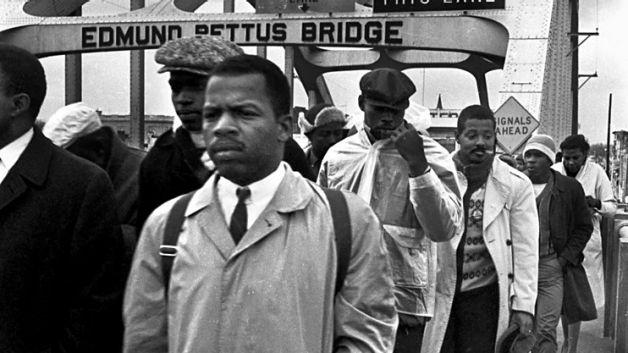
Image result for rep john lewis picture

In another section of the book, Lewis talks about the extensive training in nonviolent resistance he and many others received.  In the sessions, they’d role-play scenes, like enduring abuse while sitting at lunch counters.  A key part of the training was that everyone would play every role…which meant that every person played protester, witness, and attacker.

The most difficult role for any of them to play was attacker.  Can you imagine being a person committed to love and justice having to spew hatred at people who were your friends…to shove them and spit at them and pour things on them?  Some people couldn’t take it and left.

The training sessions helped the protesters learn how to protect themselves, how to disarm their attackers by connecting with their humanity, how to protect each other, how to survive.  “But the hardest part to learn,” Lewis writes, “the hardest part to truly understand, deep in your heart, was how to find love for your attacker.”  “Do not let them shake your faith in nonviolence,” they were told.  “Love them!”

“Blessed are they who are persecuted for righteousness’ sake, for theirs is the kindom of heaven.”  John Lewis found it, he found the kindom of heaven.  He found it by putting his body on the line for the sake of justice.  He did it by standing up for what is morally right in the face of laws that were morally wrong.   He did it by becoming a part of the solution.  And he did it all, every last bit of it, as a disciple of Jesus.

So…how will you follow Jesus?  As the country and the world change, how will you work with God and others to create the kindom of heaven here on earth?  How will we all, working together, act the world into wellbeing?  How will we, we who want to follow Jesus, help create the world of God’s dreams?

In the name of our God, who creates us, redeems us, sustains us, and hopes for our wholeness.  Amen.

Kimberleigh Buchanan  © 2017


Posted in Uncategorized | Leave a comment

Who Do YOU Say that I Am?

Image result for who do you say that I am picture

Until 15 years ago, I was a Baptist.  A progressive Baptist…which isn’t an oxymoron, as many would suppose.  In truth, the phrase is redundant.


True Baptist values are best described in terms of freedom–freedom for the individual to interpret Scripture for him or herself, freedom of conscience, freedom for congregations to govern themselves, and religious freedom (manifest in a strong commitment to the separation of church and state).  It was and is my belief that any exclusive or coercive policies or beliefs espoused by Baptists or their institutions is a departure from true historic Baptist principles.


In the last decade before I joined the United Church of Christ, I found myself frequently responding to folks who were surprised to learn I was Baptist.  “I’m not that kind of Baptist,” I would assure them.  


A lot of what I’m reading from progressive Christians these days feels familiar.  “I’m not that kind of Christian,” they say.  I get where they’re coming from.  Statements some folks who call themselves Christians make–especially those that belittle or demean others–leave me in a constant state of rage.  But is telling the world what kind of Christian I am not going to help the world to heal?


Jesus once asked his disciples, “Who do people say that I am?”  They said, “Some say John the Baptist, but others Elijah, and still others Jeremiah or one of the prophets.”  But that question was just a set-up for his real question:  “Who do you say I am?”  In one of his better moments, Simon gets it right when he says: “You are the Messiah, the Son of the living God.”


Ding!  Ding!  Ding!  Ding!  Jesus says.  (That’s a rough translation.) “Blessed are you, Simon son of Jonah! For flesh and blood has not revealed this to you, but God in heaven. And I tell you, you are Peter, and on this rock I will build my church, and the gates of Hades will not prevail against it. I will give you the keys of the kingdom of heaven, and whatever you bind on earth will be bound in heaven, and whatever you loose on earth will be loosed in heaven.”


It wasn’t in describing what the other people said of Jesus that Peter became the rock upon which the church was built.  It was in describing his own personal understanding of who Jesus was.  Peter was named only as he named Jesus for himself.


I know it’s frustrating to hear the hate-filled rhetoric and see the terrifying patterns of behavior of those who call themselves Christians.  Even so, I suspect the question that still most interests Jesus is not, “Who do people say that I am?” but “Who do you say I am?”


So, who is Jesus to you?


Posted in Uncategorized | Leave a comment