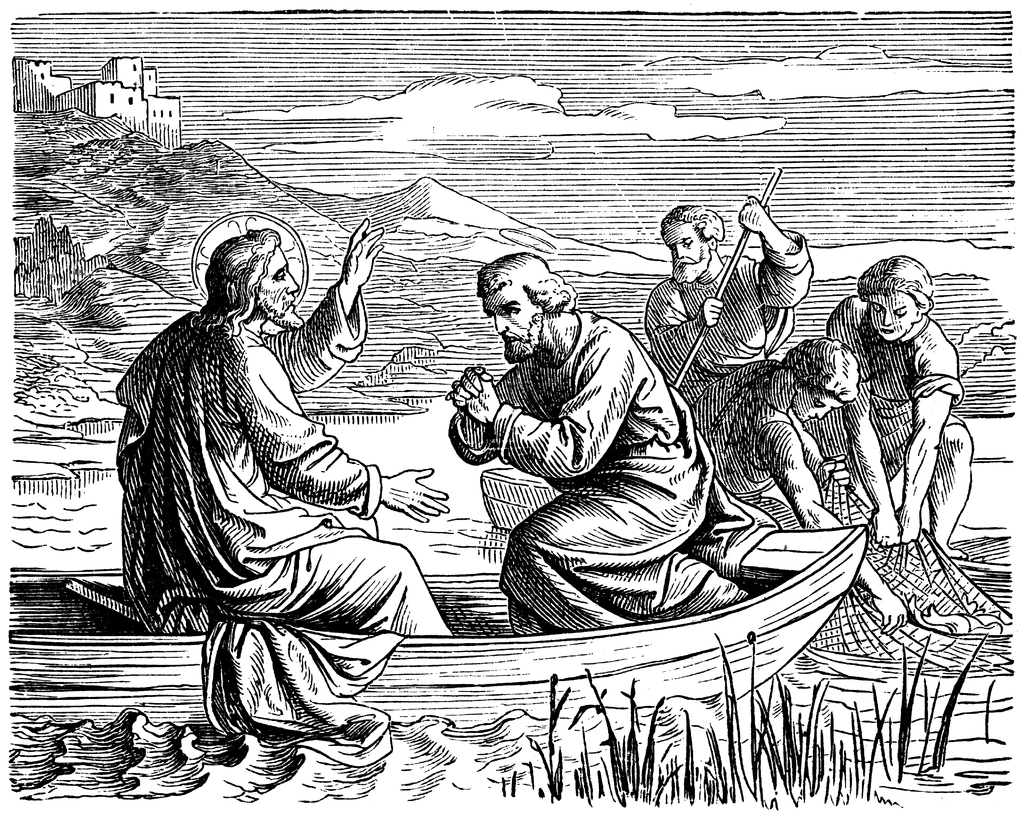
Sermon: “On Loving All God’s Children” (Luke 15:11-32) [3/31/19]

Have you ever been lost?  The first year at my last church, I pretty much stayed lost.  Atlanta is not kind to the directionally-challenged.

Thanks to the little lady in my phone, I’m doing better–not perfect, but better–here in Asheville.  Switchbacks and swift elevation changes do stymie her from time to time, but overall, I get where I need to go when I need to be there.  Praise be to the little lady in my phone!

In Luke 15, Jesus tells three stories about the lost—the lost sheep, the lost coin, the lost child.  The stories come late in Luke’s narrative.  One wonders whether Jesus latched onto the metaphor of lost-ness because he, too, was directionally-challenged.  Maybe…maybe…

Or maybe the idea of lost-ness emerges from the people he sees in front of him…people rejected by the religious establishment, like tax collectors and sinners…as well as representatives from that religious establishment, Pharisees and scribes.

Perhaps as Jesus looked over the crowd—the sinners raptly listening to his every word, the scribes grumbling—maybe when Jesus looked into the faces of those desperate and grumbling people, maybe he thought to himself, Lost.  They seem so lost.

So, he tells three stories about the lost.  In the first, one sheep from a flock of 100 gets lost.  The shepherd secures the 99, then searches for and finds the lost sheep.  Jesus says:  “There will be more joy in heaven over one sinner who repents than over 99 righteous people who need no repentance.”

Next, Jesus tells the story of the poor widow’s lost coin.  She tears up the house looking for it.  When she finds it, she throws a party, so happy is she to have found what was lost.

It seems pretty clear where Jesus is headed with these stories.  He’s reminding both the so-called “lost ones” (the sinners and tax collectors) and the righteous people (the Pharisees and scribes) that God loves the lost…that no matter where they’ve gone or who they are or what they’ve done, they are included in God’s kindom.

Good stories.  Great message: welcome everyone because God welcomes them.  Terrific!

But Jesus isn’t done yet.  He has yet one more story to tell—the story of the lost child.

A man has two sons.  The younger asks for his inheritance so he can go make his way in the world. The elder brother hears the exchange and mutters, “Of course you do.”  The younger brother goes out into the world…and parties heartily, parties every bit of his inheritance away.

With no money–no nothing–he is truly lost.  When he finds himself again—in a pen, slopping hogs and wishing for some of that slop for his own supper—this thought comes to him: “If I were a servant in my parent’s house, I’d be eating much better than this.  I’d have clothes, a meaningful job…  Let me go back to my father’s house.”  And so, he goes.

Can you imagine?  Coming home after squandering your inheritance, after living a life of debauchery, after losing absolutely everything…can you imagine coming home after that?  The prodigal must have been terrified.

But he needn’t have been, because his father, seeing him in the distance, runs to meet him and embraces his son who’d been lost but now is found.  Then the father calls for a BIG party to celebrate the return of son who’d been lost…

This is where the third story of the lost takes an unexpected turn.  Now the spotlight turns to the older brother, the one who’d been at home all along.  When the father announces the party, in resentment the older son says, “For all these years I’ve been working like a slave for you, and I’ve never disobeyed your command; yet you have never given me even a young goat so that I might celebrate with my friends.  But when this son of yours came back, who has devoured your property with prostitutes, you killed the fatted calf for him!”

Ah.  So now we know that it’s not just the younger son who’s been lost.  The son who stayed home was lost, too.  It’s not just the tax collectors and sinners who are lost.  The Pharisees and scribes are lost, too.

We’re all lost, aren’t we?  We all want to feel loved, to feel at home, to feel special.  Sometimes, like the Pharisees and scribes, we get the idea that it’s our status or our proximity to holy things or holy people that makes us special.  What we learn in this final parable of the lost is that it isn’t our status or anything we’ve done that makes us special.  What makes every person special is God’s unconditional love.  When we realize that we’re all lost, that we’re all desperate for home, that we all just want to feel loved…when we realize that all of us together are trying to find our way home…That is when we begin to get a glimpse of God’s kindom.

Several of us drove to the Swannanoa Corrections Center on Wednesday to hold a prayer vigil.  Sitting on the lawn by the entrance, peering through the chain link fence… It looked like young women walking between classes on a college campus.  It felt like we were the ones on the outside looking in, like the chain link fence wasn’t there to keep them in, but to keep us out.

That’s when it hit me–we’re all the same.  We all want to be loved.  We all want to be connected.  We all do beautiful things.  And we all mess up.  Learning what we have in the Just Mercy class about the stunning inequities in the criminal justice system, what puts some people in prison and keeps others out isn’t so much that the people inside are bad and the people outside good…the system is more arbitrary than that.  Looking through that chain link fence, I realized that we’re all the same.  As I watched a young woman working in a greenhouse, I meditated on Bryan Stevenson’s observation that none of us is as bad as the worst thing we’ve ever done.  That gardener–she isn’t defined by whatever she did to put her in prison.

It’s like Chaplain Dalton said at the choir concert here in this room Friday night.  Present were four women who’d served time in the Swannanoa Corrections Center….but none of us knew who they were….because, we’re all the same.

Joyce Rupp captured our sameness in a poem called Prisoners.


They walk in with their tan uniforms,

while the five of us “visitors”

walk in with our identity badges.


I look around the group

and think to myself:

“If we left our badges and uniforms

outside the door,

no one would ever know who is who.”


Ethnic heritage, life situations,

personality patterns, clouded dreams,

choices and decisions made wrongly,

who can say just what it was

that brought these women here.


I feel compassion in a new way,

one among them, not apart,

at home with them,

and unafraid,

knowing them to be my sisters,

not just “prisoners of the state.”


We’re all the same.  We’re all beautiful.  We’re all broken.  We all do good things.  We all mess up.  We’re all lost and long to be found.  And we’re all loved deeply, unconditionally, fiercely by God.
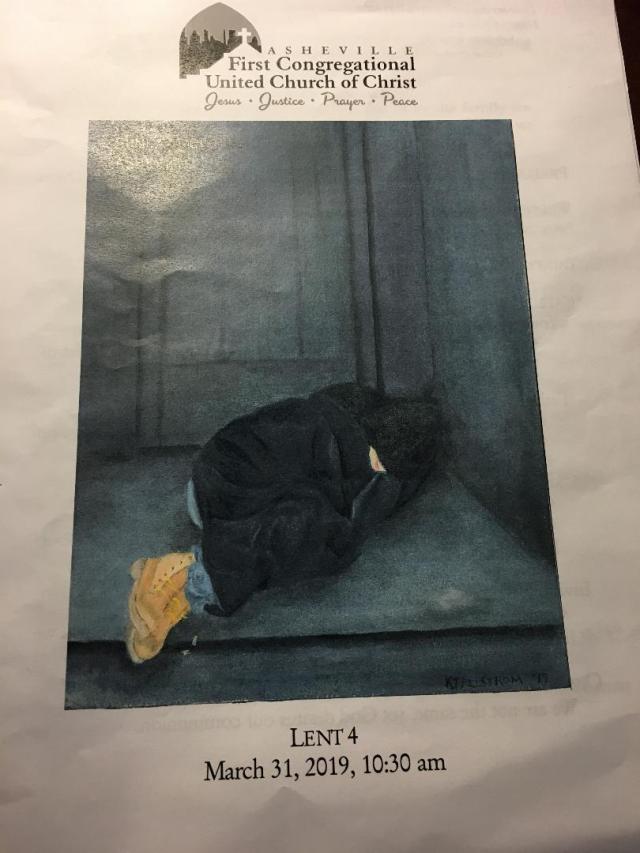
thumbnail

Today’s artwork was created by Mandy Kjellstrom.  I asked Mandy to share the story behind the painting.  Here’s what she wrote:

On a Sunday morning in February I walked to church taking the same route I always take and passed this doorway where the young man or older boy (impossible to tell) was sleeping.  Frequently on Sunday mornings there is someone sleeping in this doorway on Broadway near the intersection with Woodfin in downtown Asheville.  It always gives me pause to reflect on my life and the person’s sleeping in the doorway.  After all, I am walking to church wearing nice clothes having slept in a warm house and comfortable bed and eaten a healthy breakfast.  Usually the person in the doorway is poorly dressed and looking pretty uncomfortable and will most likely wake up very sore and very hungry.  So I am smack dab in the middle of a tension of the opposites.  And so are we all.  How is it that in this country we can have these opposite extremes?  What is the solution?  We have to be creative in solving it and we  have the capacity to solve it, right here, in our little city, if we put our minds and hearts into it.  

But about this particular person in the doorway.  As I said, I snapped the photo about 6 weeks ago, but I’ve kept going back and looking at it and thinking about this particular person.  He has stayed on my mind and in my heart. And what comes to me so clearly is: This is someone’s child.  He looks so young to me.  What could his story possibly be?  Does he have a mother who loves him and is worried sick about him?  I hope so.  Or does he have a mother who has hurt him deeply and from whom he’s running away?  Does he even have a mother?  Maybe he is just traveling.  It is impossible to know.  I have never seen him again in that doorway.  But I do know, without his knowing it, he touched my life. 

Sometimes creating a painting can be a very sacred time.  Not always, just sometimes.  Reflecting on this young man while painting him was one of those times.   

In a subsequent email, Mandy shared the name of the painting:  “Our Child.”  Our child.   That young man is our child…because we belong to each other.  All of us are part of the same family.  All of us are loved unconditionally by the creator of the universe.

I wonder how the world might change if we really believed that?  I wonder how the world might change if we lived it?

In the name of our God, who creates us, redeems us, sustains us, and hopes for our wholeness.  Amen.

Kimberleigh Buchanan  © 2019


Posted in Uncategorized | Leave a comment

Sermon: “Thirsting for God” (Ps. 63:1-8, Lent 3) [3/24/19]

On a cold, gray morning in 1982, a small group of Anglican clergy gathered at the home of the Dean of Saint Paul’s Cathedral for a simple service of Holy Communion.  The celebrant was Elizabeth Canham, who I just learned lives in Black Mountain.  A native Brit, Elizabeth had moved to the States for the purpose of becoming an ordained Episcopal priest.  The Church of England wasn’t yet ordaining women.

The months prior to Canham’s return home had been joyous…and feverish–preparations for ordination, receiving friends who’d crossed the Atlantic to share the occasion, dealing with media representatives who treated her ordination as a cause celebre.  Canham writes of the experience, “It had been a breathless time of excitement, hope, and fulfillment.”  She had returned to England, she said, for what she thought would be a rest.  Instead, she’d been inundated with invitations, requests, meetings, and interviews.

Of the gathering at the Dean’s home that gray morning, Elizabeth writes:  “The clergymen offered me affirmation and hope for a more inclusive Church of England…Then one of them, rector of a nearby parish, asked if I had some time to spare following the service.  Anxious to respond to the needs of others and to further the ‘cause,’ I said yes.

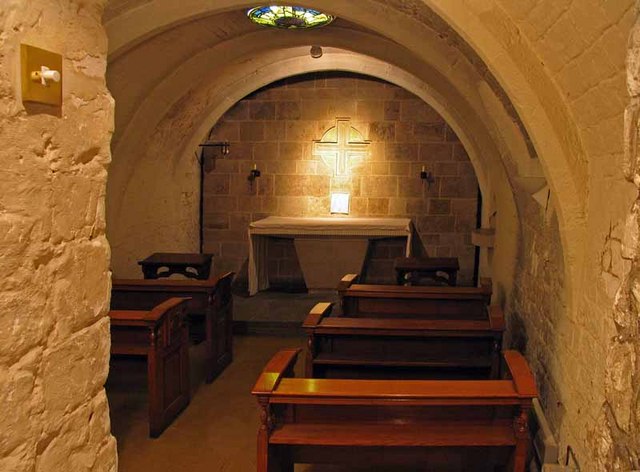
“Later that morning we walked through the London streets and into the crypt of his centuries-old church.  We passed through to a small, sparsely furnished worship space.  A plain altar, cross, and muted light drew me into a quiet space, and my friend sat down beside me.

“Expecting my friend to ask for something I waited, tense, ready to respond.  Instead the silence grew, and I began to sense a loving, prayerful presence as this priest wordlessly invited me into a resting place.  When I realized that he was not asking me to provide something but to receive a gift, tears began to flow.  In this period of intense activity I had forgotten to stop, to wait, and to be open to the renewing power of restful presence, the Sabbath time with which the Creator gifted humankind at the beginning of all things.”  (Heart Whispers, 99-100.)

Image result for picture crypt chapel London

Sabbath rest.  Stopping…to be still, to be present to ourselves, to be present with each other, to breathe in God’s love, to be.

Sometimes, we forget, don’t we?  So immersed are we in doing the crucial work of acting the world into wellbeing–righting wrongs, protesting injustices, dismantling oppressive social systems–so immersed are we in doing the crucial work of acting the world into wellbeing, of, in Elizabeth’s words, “furthering the ‘cause,’” we often forget to rest.  And sometimes, it’s not that we forget to rest; it’s that we downplay the importance of resting.  We sometimes see resting as a weakness, or even as a sign of disloyalty to the movement.

It’s like the first session of the “Just Mercy” class week before last.  In the class we’re looking at mass incarceration, which is among the gravest manifestations of racism in our country.  As each of us in the class named why we had come to the class, one person said, “I’m looking for hope.”  To which I responded, “No!  We’ve got to face the facts of racism and the injustice of our criminal justice system.  Until we face the facts, nothing will be helped, nothing will be healed, there will be no hope!”  Okay.  It wasn’t my most pastoral moment ever.  :-/

There’s just so much that feels broken these days, isn’t there?  And the rate at which things break in the world seems to have sped up exponentially.  The massacre of Muslims in New Zealand.  The inland oceans created by flooding in Mozambique and our own country’s Midwest.  The rampant corruption afoot among some politicians.  Parents trying to buy their kids admission into Ivy League schools, the ongoing gentrification in our own city… Our go-to response for all of this is to get out there and DO something!  To write letters, to march, to protest, to advocate.  We’re activists!  That’s what following Jesus is all about!

Yes, that’s true.  But what else did Jesus do?  He regularly stepped away for rest and prayer.  Jesus practiced contemplative action…action grounded  in and sustained by prayer.

We’ve done a pretty good job on Wednesdays this Lent, of breathing in God’s love in a brief time of quiet prayer at noon, then going out on the Mercy Walks.

In worship, though, we haven’t been quite as balanced.  In worship, things have been intense…looking at the injustice of exclusion of LGBTQ people from churches 3 weeks ago, and delving into the injustices of white privilege and racism the last two Sundays.  Y’all, that’s some heavy stuff.  And, like the pastor said, It’s vital that people of faith face these hard facts…

But it’s equally important on occasion to take a break, to allow ourselves to rest in the loving embrace of God, to laugh and sing and enjoy each other’s company.  Saving the world is important, but if we forget what we’re saving it for, what have we gained?

So, today, I offer not a word of challenge, but one of grace…an invitation simply to be in each other’s company…an invitation to rest in God’s love, to breathe in everything that will heal you, that will heal us as a community.  The invitation is to pause and reconnect with the delight of being human and the delight of being part of this community of humans.

To help in this process of simply being and delighting in that being, I’m going to give you two gifts today.  The first is a shorter sermon.  You’re welcome.  🙂  The second is a second reading of today’s Psalm.  We’re going to hear the Psalm in a process called lectio divina, divine reading.  Ellenor will read the Psalm 3 times with brief pauses between each reading.  The invitation is simply to let the words wash over you.  If a word catches your imagination, sit with it, see what it might be saying to you.  Or don’t listen at all.  Simply be in this space, with these people.  Simply be.  Ellenor?

O God, you are my God, I seek you, my soul thirsts for you;

My flesh faints for you, as in a dry and weary land where there is no water.


So I have looked upon you in the sanctuary, beholding your power and glory.

Because your steadfast love is better than life, my lips will praise you.


So I will bless you as long as I live; I will lift up my hands and call on your name.


My soul is satisfied as with a rich feast, and my mouth praises you with joyful lips

when I think of you on my bed, and meditate on you in the watches of the night;

for you have been my help, and in the shadow of your wings I sing for joy.


My soul clings to you; your right hand upholds me.


Sing:  “There Is a Balm in Gilead”


Posted in Uncategorized | Leave a comment

Sermon: “Keeping God’s Promises” (Gen. 15:1-6) [Lent 2, 3/17/19]

How many nonagenarians do we have in the house today?  Octagenarians?  Any young whippersnapper septuagenarians?  Here’s the good news–or maybe it’s bad news.  Here’s the news proclaimed from Scripture today: if you’re younger than 99, you’re only getting started.  Abram was 99, his bride Sarai, slightly younger, when God called them to “go to a land God would show them.”  Yeah.  Don’t try to plug that into your GPS.

In addition to the call, God made a promise:  more descendants than stars in the night sky.  Which sounded great.  But when Abram and Sarai started thinking through the logistics, questions arose.  How were two nonagenarians going to create a nation?

I wish I could tell you that God’s decision to entrust God’s promise to the two least likely candidates on the planet was an aberration, but, alas, throughout Scripture, our Sovereign consistently selects the least qualified people to help fulfill divine promises.  God doesn’t excel in the HR department…which might be God’s very point.  Maybe God is trying to tell us that God’s promises will be fulfilled…no matter who is entrusted to fulfill them.

God’s promises.  Does it ever seem like God’s promises get fulfilled more often for some people than for others?

Ty’s testimony this morning was very brave.  It’s painful to acknowledge our privilege… to admit that only part of our success is due to our hard work, that much of it is inherited from our ancestors, or can be attributed to our gender, skin color, or sexual orientation.

I was at a gathering this week where Black mothers were processing the big college admissions scandal, women whose children’s hard-earned places in universities have been questioned at every turn…while rich white parents are buying their already-privileged children admittance to ivy-league schools.

At this same gathering, a Black mother told us that on her way to the meeting, she’d received a text from her college-age son, “Mom, I need to talk to you in 10 minutes.”  Her first thought was, What has happened to my Black son in the state of Kentucky?  His question turned out to be about health insurance, but for 10 minutes, this mother was terrified.  By the time she arrived at the meeting, she was so upset, she told us, she had what she called a “runny tummy.”  NOT having to live with the constant worry of what the world might do to your child because of the color of that child’s skin?  That is white privilege.

Waking up to white privilege is hard.  Consciousness of whiteness often leads to guilt.  Then shame.  Sometimes we respond to shame by doing nothing.  Aware of the trauma caused by social systems that benefit us, we begin to think the biggest gift we can offer in the work of racial justice is to sit it out, to leave the work to those who are directly affected by racism.

Other times, shame leads us to overcompensate.  We charge in and try to save the day for our black and brown bodied friends…which only reinforces the idea of white saviorhood.

As your pastor, I know I’m supposed to have all the answers, but when it comes to knowing how we can and should work for racial justice?  I’m not sure.  Doing nothing doesn’t feel right.  Neither does swooping in to save the day.

For all I haven’t figured out, this I do know:  for those of us who are white, our number one task in the work of racial justice is waking up to our whiteness.

I’ve worked through a lot of things in my life, but I think waking up to my whiteness is by far the hardest.  I’ve faced exclusion because of my gender.  As a Southern Baptist, I had to work very hard, first, to believe I had a right to be in the pulpit, then, to pursue a path that would lead me to the pulpit.  It’s still not uncommon for people to refer to me not as a pastor, but as a woman pastor.  I, like many of you, have dealt with all kinds of bias.

But despite all the gender-based bias I have experienced, I must also acknowledge that a lot of what I’ve received in my life has come not through my own effort, but because of the color of my skin.  That is hard to admit.  If I had a son whose skin was the same color as mine, I wouldn’t give it a second though if he texted to say he needed to talk with me in ten minutes.

The other part of facing my whiteness is the recognition that, though in the interest of justice and in the interest of becoming my best self I must face my whiteness, I will never arrive at some fully enlightened place.  I will always be white.  I will never know what it means not to be white.  I will always carry with me in my melatonin-less skin cells the burden of what my people have done to other people, what my family members have done to other people.

Even amid the difficulty of facing my whiteness, I do have hope for myself and other white people working for racial justice.  Remember Abram and Sarai?  God seems always to entrust the promise to folks who seem least likely to fulfill it.  If God can create a nation out of two nonagenarians, then maybe God can use us white people in the work for racial justice.

The most important racial justice work for white people is waking up to our whiteness.  That said, there are some actions we can take that can help in this work.  Consider what happened one summer day in 1965 in Forrest City, Arkansas.

Shortly after passage of the Voting Rights Act of 1965, the Student Nonviolent Coordinating Committee began registering voters.  They’d visit folks in Black neighborhoods, tell them about the new law, then get them to the elections office to sign up.

One day, SNCC volunteer, Si Kahn, approached a front porch where an ancient-looking woman rocked.  “‘Good afternoon, Ma’am,” he said.  The woman nodded and kept rocking.

“I’m from the Freedom Center,” Si went on.  “I wonder if I could talk with you for a minute?”  She nodded again and gestured towards a straight-backed chair opposite her.  Si sat down.  He really wanted to ask how old she was, but it didn’t seem the polite thing to do.  The woman must have guessed his question.  ‘You know,’ she said, ‘I was born a slave…I was 4 years old when we got freed,” the woman said.  Then the woman who had been born a slave reached out to Si.  “How can I help you?”

“‘Ma’am, the president of the United States has signed a law saying that everyone has the right to vote.”  The woman cut Si off, gently.  “I read the papers.  Every day.  I know.”  Si said, “I was hoping you’d go with me to the courthouse to register to vote.”  She stopped rocking and leaned forward.  “Son,” she said, “I’m 106 years old.  I don’t leave my rocking chair.”

Si “was caught between figuring out what year that meant she’d been born and trying to frame a response.  All he could come up with was, ‘If you didn’t have to leave your rocking chair, would you register to vote?”  It was half a nervous joke; he didn’t know what else to say.

“I would,” she said.  “But I don’t ever leave my rocking chair.”

“Si went back to the Forrest City Freedom Center, where he found a number of young Black men.  Still in awe at having sat and talked with someone who had been born a slave, Si told them what he’d just seen and heard.”

The Center had recently received a gift of a “brand-new bright yellow four-on-the-floor three-quarter-ton Dodge pickup.  One of the young men took the keys from where they hung on a nail by the front door and slid into the cab.  Others piled into the back of the truck.

“They drove to the woman’s house and stepped onto the porch. They lifted her, still in her rocking chair, carried her outside, and placed her, chair and all, in the back of the truck.

“With the young men kneeling next to her, each with a hand on the chair to steady it, they drove as slowly as they could, weaving their way through the Black community, up one street and down another: past the churches and the adjacent graveyards, the segregated elementary school and high school, the little grocery stores, Clay’s Funeral Home, and the Freedom Center.

“As word spread, people poured onto their porches, into their yards, to watch as she passed, sitting straight and proud in her chair, in the back of the bright yellow pickup they all recognized on sight.  Everyone knew who she was, the eldest member of their community, the woman who had been born a slave–and they knew where she was going.

“When there was no street untraveled, no place in the Black community left to trumpet the news, the young men turned towards the courthouse, parking directly in front of the entrance, where everyone passing by could see them. Then they carried her in that throne up the courthouse steps and into the registrar’s office, so she could register to vote.” (Kahn, Si.  Creative Community Organizing, 22-24)

We could talk all day about elections fraud—about Georgia’s Secretary of State overseeing his own election as Governor, about arbitrary voter ID restrictions, about the Senate Majority Leader publicly declaring that he didn’t want more people coming to the polls, about the obscenity of vote harvesting in North Carolina’s 9th Congressional district.  Congress’ failure four years ago to renew the Voting Rights Act, as we are seeing, is wreaking havoc on our elections process.  The freedom of our fellow country people to vote is dwindling.

We talked last week about how, though we all walk the same streets and traverse the same geography, we inhabit different planets.  A lot of what sends us to different planets is legislation.  Ensuring life-giving legislation for all our fellow citizens begins with everyone having an equal say in who writes the laws.  Until everyone has equal access to the ballot box, we will continue to inhabit different planets.

So…perhaps we have arrived at something even the unlikeliest of candidates for fulfilling God’s promise for racial justice in the world can do: work for free and fair elections.  What will that work look like?  Join us for Wednesday’s Mercy Walk to the Elections Office.  We’ll pray and open our minds and hearts to how God might be leading us in this important work.

Another thing those of us who are waking up to our whiteness can do is imagine what life might be like in someone else’s skin.  One of the assignments at a songwriting camp I attended a few years back invited us to do just that.  We were to write a song from another person’s perspective.  At the time, I was mulling over a quote I recently had read by someone who marched from Selma to Montgomery in March 1965 in support of voting rights.  This was two weeks after the first attempt to march ended in violence on the Edmund Pettis Bridge.

Image result for pictures of selma to montgomery march

Bruce Hartford relates an experience on the last day of the march.  “On the right side of the road, all lined up, were these tourist motels.  In the lobbies were the black maids, janitors, in their uniforms, and they were just looking.  You could see, you could just know, what was going on in their minds—they wanted to come out and join the march, and they were afraid of losing their jobs.  Wanted to join, afraid to come out.  Suddenly, in one swoop, one rush, they just ran out and joined us.  They were liberated.  We were all liberated.  To me that was the high point.  I’ll never forget that—it symbolized everything that was happening.” (Everybody Says Freedom, 201)

For the assignment, I tried to imagine what it felt like to be one of those maids in one of those tourist motels.  This is the song that emerged.  “Selma”

[Selma]


Posted in Uncategorized | Leave a comment

Sermon: “Our Brokenness Unites Us” (Dt. 26:1-11; Lk 4:1-13) [3/10/19]


Last Wednesday, we took our first Mercy Walk.  We talk a lot here at FCUCC about breathing in God’s love in worship, then breathing out God’s love in the world.  For Lent, Mercy Walks will help us shorten the feedback loop.  We’ll pray, then immediately go out into the world.  The invitation is to walk prayerfully—mercifully—into the world and reflect on what it means truly to be Christ’s body in the world.

The first Mercy Walk was…instructive.  After a time of prayer and reflection, Sandy Clark and I set out for the Vance Monument.  The initial plan had been to offer ashes at AHope.  When I spoke with the folks at AHope, they thanked us for the offer, but said that because so many of the people who come to AHope have been wounded by church, our being there to impose– yes, impose–ashes…likely wouldn’t have been well-received.

When I heard the explanation, it made sense.  Though I had hoped to offer folks at AHope a religious ritual that has deep meaning for me, I wasn’t being very empathetic about it.  I had been assuming a similarity of context that doesn’t exist.

How many of our well-intentioned acts of service are based on similar faulty premises?  How often do we “impose” gifts on people they do not wish to receive?

So…Plan B—the Vance Monument.  Once Sandy and I arrived, we imposed ashes on each other.  Great!  Now what?  We waited.  And waited.  I began to wonder what in the world we were doing there.  What?  Did I imagine people streaming to the monument to receive ashes?  “Finally!  Someone’s imposing ashes in downtown Asheville!”  (It is called Asheville, after all.)  We didn’t have a sign; I doubt people even knew what we were doing.  I thought about shouting an invitation, but decided, “Hey!  Come over here so I can remind you you’re going to die!” probably wouldn’t be very inviting.

So, we stood.  We talked.  We took pictures of the pigs and turkeys.  Rick Johnson joined us.  We imposed ashes on him, too.

Then we read the plaque on the monument just in front of the Vance monument.  That plaque reads:  “Erected and dedicated by the Daughters of the Confederacy and friends in loving memory of Robert E. Lee and to mark the route of the Dixie Highway.”  Want to guess when that monument was installed?  1926.  Over 60 years after the end of the Civil War.  What point could they have been making except reasserting white supremacy?

The Vance Monument was dedicated in 1898, just four years after Vance’s death.  Do you know anything about Zebulon Baird Vance?  He was a slave owner.  He fought in the Civil War until 1862.  From 1862 – 1865, then again, 1877-1879, he served as Governor of North Carolina.  From 1879 until his death in 1894, he served in the US Senate.

By the beginning of this century, the monument had fallen into disrepair.  In 2012, a Civil War re-enactment group formed a partnership with the Department of Cultural Arts of the city of Asheville to restore the Vance Monument.”  https://docsouth.unc.edu/commland/monument/205/

Renovation of the monument was completed in 2015.  June 17th of that year, gunman Dylan Roof assassinated 9 worshipers at a Wednesday night Bible study at Mother Emmaunel AME Church in Charleston, South Carolina.  The Vance Monument became a flash point of outrage in response to the shooting.

So, as we stood there Wednesday, ashes on our foreheads, shivering in our shoes, I reflected on what it meant to receive the ashes at the Vance monument–What did it mean for me, a white, middle class daughter of the south, descendant of slave owners?  What did it mean to receive the ashes–sign of flawed humanity—at a memorial to someone who was…a lot like me?

We have two Scripture texts today.  The first contains a ritual of thanksgiving offered by the Israelites for having broken free of slavery. The second recounts Jesus’ journey into the wilderness for a time of reflection and temptation after his baptism.

The story of the Exodus is pivotal for many African American Christians.  The parallels between their and the Israelite’s stories are clear–enslaved, abused, crying out for freedom, then finally receiving it.  The Israelites do have to wander around the wilderness for a few decades, but after that, they move into their new land, a land flowing with milk and honey.  They settle there, create their own farms, produce their own crops.  This bit from Deuteronomy enjoins them to offer their first fruits as a thank you for having arrived.

Great story.  Great songs.  A hopeful story for an enslaved people longing to be free…

…unless the people in the story with whom you most identify are the Canaanites.  Who are the Canaanites?  They’re the folks the Israelites push off their land so they, the Israelites, would have a place to live.  The Israelites had gotten this idea that, because they were God’s chosen people, they had a right to the land, regardless of who was already there.  In one telling of the story, the Israelites overpowered the natives and stole their land.

In an article titled, “Canaanites, Cowboys, and Indians,” Robert Warrior interprets the story of the exodus from the perspective of Native Americans.  Because of his experience as one whose land was stolen by settlers who also thought they had a God-given right to land belonging to others, he doesn’t identify with the Israelites so much as with the Canaanites.

I thought about the Warrior article Wednesday at the Vance and Lee monuments.  Both monuments were built in a context of white supremacy.  I suspect there are still folks around who consider Vance and Lee “beloved.”  For folks with histories similar to mine, the monuments have another context—the context of trying to atone for our country’s original sin of racism.

On Wednesday, an African American man in dreadlocks walked quickly past us with his head down.  I would love to have talked with him about the context in which he understands the monuments.  And I wonder through what lens the people who spray painted the monument with “Black Lives Matter” after the Charleston church shooting see it?


Image result for picture vance monument black lives matter


Key to authentic and effective social justice work is recognizing that we’re all navigating different contexts.  We traverse the same streets, the same geography, but our journeys differ vastly depending on our social contexts.  Skillfully navigating among the various contexts is vital to our work of acting the world into wellbeing.  Had I navigated more skillfully the differing social contexts between me and folks at AHope, I might have thought twice about going there to *impose* a ritual they might not want.

The three temptations Jesus faces during his wilderness sojourn are questions about context. Each temptation asks: Will you act out of a context of power and privilege?  Or will you act from a context of solidarity and empathy?  Each time, Jesus rejects power and privilege. Each rejection strengthens him.  He leaves the wilderness ready to engage in the work before him.

Those of us who are white and middle-class face the same temptations.  Because of our skin color, and because of all the power and privilege accrued by our ancestors for generations because of their skin color, we have significant power and privilege, power and privilege people who don’t share our shade don’t have.

The call for us–this Lent and always–is to follow Jesus’ example.  We too are called to reject the temptation to use our power and privilege to maintain unjust systems.  We too are called to reject the temptation to use our power and privilege to overpower the underprivileged.  We too are called to reject the temptation to use our power and privilege to enrich and draw attention to ourselves rather than acting others into wellbeing.

If you haven’t taken on a Lenten practice yet, here’s a possibility:  take on the practice of reflecting on context.  How does your social context differ from the contexts of others?  How might an understanding of differing social contexts inform how we act the world into wellbeing?

The next time you visit the Vance Monument, consider your own familial and social contexts.  Are you, like me, descended from white Southerners?  What does the monument mean in that context?  Are you a pacifist, descended from pacifists?  What does that mean to you?  Are you African American?  What does it mean for you to visit—or not—the Vance monument?

There is so much that divides us.  Inhabiting different social contexts means we inhabit different worlds.  In light of this great divide, what hope is there for us to act the world into wellbeing?   Is there no common ground?  Is there nothing that connects us?

Toward the end of Just Mercy, Bryan Stevenson suggests there is one thing that does unite us.  One thing connects all human beings:  our brokenness.  He writes:

“We are all broken by something. We have all hurt someone and have been hurt. We all share the condition of brokenness even if our brokenness is not equivalent. I desperately wanted mercy for Jimmy Dill (a prisoner Stevenson represented) and would have done anything to create justice for him, but I couldn’t pretend that his struggle was disconnected from my own. The ways in which I have been hurt—and have hurt others—are different from the ways Jimmy Dill suffered and caused suffering.  But our shared brokenness connected us.”    Just Mercy

Our shared brokenness connects us.  As Jean Vanier, founder of the L’Arche communities said, “People come to L’Arche because they want to serve the poor.  They only stay once they realize they are the poor.”  If our shared brokenness connects us, perhaps it is our mutually caring for each other that will heal us and, ultimately, the world.

In the name of our God, who creates us, redeems us, sustains us, and hopes for our wholeness.  Amen.

Kimberleigh Buchanan ©2019

Posted in Uncategorized | Leave a comment

Sermon: “Doubling Down on Love” (Luke 9:28-43a) [3/3/19]

            Here’s what bugs me about this story.  It’s not the odd appearance of Moses and Elijah  with Jesus on the mountain.  And I’m not bugged by Peter’s ebullient outburst; that’s just who Peter was.  I’m not bugged by the reprise of Jesus’ baptism blessing: “This is my child, the beloved, with him I am well-pleased.”  And I like the addition of “Listen to him!”

What bugs me about this story is what happens after Jesus, Peter, James, and John come down from the mountain. When they reach the bottom, they’re met by a man who implores Jesus to heal the man’s only son, who is beset by seizures.  “I begged your disciples to cast out the demon, but they could not.”

What bugs me is how Jesus responds to the man’s request.  “You faithless and perverse generation, how much longer must I be with you and bear with you?”  I’m going to go out on a limb here and say that’s probably not what God had in mind when God told Peter, James, and John to, “Listen to him!”  I know he’s Jesus and all, but man!  That’s cold!  Seems like when you’ve experienced the mountaintop, when you’ve had visions and have heard God speak… I don’t know.  Seems like you’d be in a better mood, doesn’t it?  Why is Jesus so grumpy?

Maybe it will help to look at what’s happened leading up to this moment.

After preaching his first sermon in his hometown—He didn’t get killed, so we’re going to call it a win.  After that, Jesus starts collecting disciples.  They go out teaching and preaching and healing.  There’s an encounter here or there with the religious authorities that foreshadows what’s to come (cue ominous music), but mostly it’s typical Messiah stuff.

By the time we get to chapter 9, Jesus’ ministry is going so well, he sends the twelve out on their own to cast out demons, cure diseases, and preach the kindom of God.

In the meantime (cue ominous music) Herod, the Jewish tetrarch, starts getting nervous.  With all the teaching, preaching, and healing he and his disciples have been doing, Jesus has amassed quite a following…and by “quite,” I mean bigger than Herod’s.

After the disciples return from their outing and report their success, they and Jesus try to retreat to a small village, but the crowds find them.  So, Jesus teaches.  He goes on so long, the people get hungry.  In true Messiah fashion, Jesus feeds all of them.  And has leftovers.

After that, Jesus does some reflecting.  He asks his disciples who people say he is.  “John the Baptist!” someone says.  “Elijah!” says another.  Then Jesus asks them who they say he is.  Peter ebulliently says, “The Messiah of God.” Ding!  Ding!  Ding!  Ding!  Correct answer, Peter!

In response to Peter’s declaration, Jesus predicts his own death.  “The One of Humanity must undergo great suffering, and be rejected by the elders, chief priests, and scribes, and be killed, on the third day be raised.”  (Cue ominous music.)

It’s after this that Jesus takes Peter, James, and John up the mountain.  Then all the lights, visions, and voices happen.  Then they come back down the mountain.  That’s when Jesus turns into a grump, when he calls his disciples a “faithless and perverse generation,” when he wonders aloud how much longer he must be with them and bear with them.

So…maybe Jesus is getting worried about what he senses will happen soon…by which I mean getting killed.  That’d make anybody grumpy.  Or maybe he was full of all that glory from his mountaintop experience and was annoyed that he had to quit basking and get back to work.

Or…maybe Jesus was getting nervous about whether or not the disciples would be able to keep on with the work of the kindom after he was gone. A short time before when he’d sent them out, the disciples had healed, cured, and preached to beat the band!  Maybe Jesus had interpreted their success to mean his work with them was done, that they’d learned all their lessons, that they now were ready to continue sharing the message of God’s love after Jesus’ departure.  But now?  Sigh.  It was back to the drawing board.

So what happened?  How did the disciples lose their Gospel mojo?

Here’s what I wonder–and y’all, don’t look for this interpretation in any commentary.  This is just me.  But I wonder if the disciples lost their momentum, if they lost their Gospel mojo because Jesus didn’t take all of them up the mountain.  Maybe the disciples down below lost confidence when they’d been excluded from the inner circle.  And maybe the three Jesus had taken up the mountain started thinking they were all that, that they were better than the “less worthy” people who’d been left down below.

So, maybe Jesus is grumpy because the disciples have forgotten how to be disciples.  But maybe the disciples had forgotten how to be disciples because the going up the mountain thing had created insiders and outsiders.  Maybe the disciples lost touch with their mission as disciples because everyone didn’t have equal access to Jesus.

In a class I TA’d at Candler School of Theology in the 90s, a student led a Bible lesson on righteousness.  She had outlined three concentric circles on the floor in masking tape and placed a lit candle in the center.  Then she invited us to arrange ourselves on the circles based on how righteous we were feeling that day.  The righteous-feeling people stood on the tape closest to the center.  The sort-of righteous feeling stood on the middle circle.  Even before she said it, I headed to the outermost circle.  A couple more brave unrighteous souls joined me.

As you might guess, the inner circle was crowded.  The middle circle also had a lot.  The couple of us on the outside…felt like we were on the outside.  After we’d settled in, one of my fellow unrighteous folks said, “I can’t see the light for all those righteous people!”  We, who most needed to see the light that day, couldn’t see it for all those righteous people.

Image result for methodists lgbt pictures

Have you figured out that I’m talking about the Methodists?  The United Methodists’ decision this week to double down on restrictions to folks who are LGBTQ has hit many of us in the gut.  Some of you are former Methodists.  Even if your membership is in this UCC congregation, I know that many of you are still Methodist in your hearts.  I experienced exclusion in my life as a Southern Baptist, but the deepest part of my heart is still Baptist.  It’s hard to explain.  The fact that denominations exclude doesn’t instantly erase all the ways those denominations have loved us and formed us…

Which is part of what makes this so hard.  How can the church that taught us how to love act in such un-loving ways?  How can the church that taught us to appreciate diversity within the body of Christ make such a sharp turn to conformity?  If Jesus loves all the little children of the world, who is the church to exclude even one of them?

The short answer to these questions is a logistical one.  Many delegates to last week’s conference come from countries where homosexuality is a crime.  In some countries it’s a capital crime.  As clergy who have to return to those countries, it could be that some of those delegates felt they had no choice but to double down on exclusion.  There is speculation that if the vote had been taken with just American churches, the church’s doors would have been opened both to gay weddings and to ordination of LGBTQ clergy.

But that’s not what happened.  And now people are hurting, people are angry, and a church, likely, is splitting.  I don’t know about you, but my heart is breaking.

But here’s what I want to say today—broken hearts heal.  Twenty years ago, the church on whose staff Allen and I served, was disfellowshipped by the Georgia Baptist Convention for welcoming people of all sexualities.  I can honestly say I’ve never been as frightened for my physical safety as I was that day in Macon’s convention center.  Mob mentality is ugly.  And terrifying.  We were devastated by the experience.

But working through the pain and trauma of it has taught me a lot.  Perhaps the most important lesson I’ve learned is that institutional church isn’t the same thing as the body of Christ.  All human institutions are flawed.  The ideal of community among Jesus’ followers, the power of community to act the world into wellbeing, the unshakable reality of God’s radically inclusive love….denominations may come and go, but the good news of God’s love remains.  As long as we continue living what Jesus taught, God’s hopes for the world will come true.  The disciples might have gotten it wrong that one day, but they must have gotten something right eventually, right?  We’re here, aren’t we?

Don’t get me wrong.  I am deeply grateful for our beloved UCC and am honored to call myself UCC clergy…but the world won’t be saved by the UCC.  The world will be saved when followers of Jesus start acting like Jesus.  The world will be saved when followers of Jesus become Christ’s hands and feet, Christ’s body in the world.  The world will be saved when people of faith quit doubling down on exclusion and start doubling down on love.

What should we do, church?  Double down on love!  When bad interpretation of Scripture is used to exclude, what should we do, Church?  Double down on love!  When bad politics supplants good theology, what should we do, Church?  Double down on love!  When the least of these are crushed by corrupt and unjust social systems, what should we do, Church?  Double down on love!  When heterosexism prevents church leaders from celebrating the beautiful diversity of Christ’s body, what should we do, Church?  Double down on love!  When institutions double down on exclusion, what should we do, Church?  Double down on love!  What should we do?  Double down on love!  What should we do?  Double down on love!

In the name of our God, who creates us, redeems us, sustains us, and hopes for our wholeness.  Amen.

Kimberleigh Buchanan  © 2019

Posted in Uncategorized | 2 Comments

Clergy Sexual Abuse: A Theological Problem

I was saddened–but not surprised–by reports from the Houston Chronicle that 380 clergy and other staff in Southern Baptist churches sexually abused 700 children and adults in the last 20 years.  


Many people have faulted the congregational polity of Southern Baptists–which says that each congregation governs itself–for creating the circumstances in which this sexual abuse could flourish.  That argument falls flat, though, when you consider the sexual abuse scandals in the Roman Catholic Church. As, by far, the most hierarchical structure of any religious group, that oversight didn’t help prevent abuse.  To the contrary, the hierarchical structure enabled the abuse to continue for decades.


Laying the blame for insidious patterns of sexual abuse on church structure–either hierarchical or congregational–is too easy an answer.  Any institutional structure can be manipulated by abusers if the structure becomes unhealthy. I suspect at the root of the sexual abuse crisis in the Southern Baptist Convention and the Roman Catholic Church lies in a theology that values men over women.   


I went to seminary in the 1980s to become a children’s minister.  Feeling drawn to church work, I pursued the only job I’d seen women do in churches.  Thanks to two professors–Molly Marshall, who called me a theologian, and, Chuck Bugg, who invited me to take a preaching class–I was able to discern my true calling to pastoral ministry.


I remain grateful to these two professors who saw something deeper in me than I could see in myself at that point, and who gently accompanied me as I connected with my true calling.  Because of their mentoring, I am now in a profession and job that are deeply satisfying.

Image may contain: Kim Buchanan, indoor


Sadly, my theology and preaching professors were not my only teachers at seminary.  Halfway through my degree, fundamentalists took over the school. The issue on which these particular fundamentalists focused was women in ministry.  By the time I graduated, I heard literally every day, “Women can’t preach. Women can’t pastor.”


Just opening up to my call to preach and to pastor, I knew in my head the fundamentalists’ words weren’t true.  But deep inside, their words took root.


A couple of years later, my husband and I watched a documentary that told the story of the seminary’s take-over, “Battle for the Minds.”  After the film was over, we didn’t say a word. We simply turned off the TV and went to sleep.


A couple of hours later, a poem woke me up.  At the desk in my study, words poured unbidden onto the pages of my journal.  The imagery that emerged? Rape.


The next morning, when I read my midnight scribbles, the image shocked me.  Rape? Is that really what seminary had felt like to me? The longer I sat with the image, though, the more accurate it seemed.  With their words, those men had whittled away at my personhood and that of other women. They had sought to negate God’s call to me and to other women.  Proving Mary Daly’s assertion that “when God is male, males are God,” the fundamentalists who took over the seminary had sought to supplant the divine role.  I left seminary deeply wounded. Violated.


Though my experience of seminary was traumatizing, I was fortunate to have had professors who believed in me and who taught me to think critically and theologically about what was happening in the denomination and in my life.  I also have been blessed with some good therapists who have accompanied me on my healing journey and with a husband who honors me as a woman and who profoundly respects my pastoral authority.


As I list these resources, I recognize just how privileged I am.  It took a long time to heal from seminary, but because of the resources at my disposal, I have been able to do the healing that was needed.


Young people, teenagers, children… A three year old child doesn’t have access to those resources.  A three year old child only knows that church is a good place, a safe place. A three year old child only knows that church is where God lives.  And who does she see at church? The pastor. Who is a man.


While the Southern Baptist Convention and the Roman Catholic Church are opposite in structure, they are alike in this: both have exclusively male clergy.  I appreciate the strides the Catholic Church–finally–is taking to address the epidemic of clergy sexual abuse. For the Pope to be hosting a conference on the topic this week in Rome is an important step.  And I appreciate the formation of a Southern Baptist study group tasked with addressing the sexual abuse crisis in its churches. I’m especially heartened that at least three members of that group are women.


I suspect, though, that as long as ordination belongs only to men, efforts at reform in the Southern Baptist Convention and the Roman Catholic Church will remain superficial.  As long as God is male, as long as only men are clergy, men will be more God-like than women or teenagers or children. At the heart of the sexual abuse crisis–particularly in the practice of covering it up–is the valuing of one group of human beings over others.  As long as that inequality continues, true reform will not be possible.


Posted in Uncategorized | Leave a comment

Sermon: “A Plea for Empathy” (Luke 6:27-38) [2/24/19]

A sermon a few weeks ago invited us to hear I Corinthians 13–the love chapter–in the context of a current-day situation.  Later, during Friendship Time, I encountered someone who wasn’t smiling.  When I asked about the lack of joy, the person told me, “I tried what you said.  I imagined the president.  It didn’t work.”

I share this story not to poke fun at the president but to acknowledge how difficult it can be love people with whom we don’t agree or who do things we deem misguided or, in some cases, inhumane.  For many in this room, our president represents “the enemy.”  For others of us, our enemies have different names.

In Jesus’ day, the enemies for the Jewish community were clear–Caesar, the Roman government, Herod, the Jewish tetrarch…sometimes, even, the religious authorities.  For decades, the policies of these enemies had oppressed the poor, the religious minorities, the outcasts.

It is to these oppressed, poor people to whom Jesus says, “Love your enemies; do good to those who hate you,” and all the rest.

Why?  Why does Jesus tell people at the bottom of the social ladder, people who’d been abused and mistreated, to love their enemies?  It sounds a lot like pastors telling abused women to return home and try to make things work.  Is that really what Jesus means?  Whatever happened to “speaking truth to power”…or advocating for the poor…or doing justice?

Like some of you, I was disappointed with the 2016 election…but not for the reason you might think.  My disappointment began in the year leading up to the election.

Having initially come from a conservative denomination and living in a region that was, until recently, rabidly conservative, I think I’d come to idealize those who were more liberal theologically and politically.  In my mind, liberals were above reproach.  As those who actively advocated for the least of these, liberals were very good people.

Then I started reading my Facebook feed.  Holy moly!  The venom I read in some of the posts of my friends sounded a lot like the venom I’d heard spewed from the other side.  I certainly agreed with most of what was said, but the way it was said?  That made me very uncomfortable.  I guess that’s when I realized that, liberal or conservative, we’re all just human beings who are passionate about what we believe.  Sometimes that passion overtakes our ability to see each other–to see all people–as human beings equally loved by God.  As flawed human beings, sometimes we lose touch with our capacity for empathy.

…which is why passages like today’s words of Jesus are so crucial.  “Do unto others as you would have them do unto you.”  Empathize, Jesus says.  Is it hard?  Yes.  Is it more satisfying to stay rooted in righteous indignation?  You betcha!  Is empathy necessary to creating the world of which God dreams?  I’m afraid so.

Simon Wiesenthal was a Polish architect who was sent to a concentration camp in his native Poland in 1942.  One day, the men from Simon’s hut were marched to a nearby hospital to work.  As Simon toiled at removing piles of putrid bandages, a nurse approached him.  “Are you a Jew?”  Simon stood there.  The nurse said, “Come with me.”

Terrified, Simon followed.  The nurse took him up three flights of stairs to a room with just one patient.  The patient’s body—including his face—almost completely wrapped in bandages, Simon knew the man was near death.  As the nurse slipped out, Simon again wondered why she had brought him to this dying man’s room.  He stood beside the bed waiting.

The man thanked Simon for coming…then began telling his story.  He was from Stuttgart, Germany, and had been raised a faithful Catholic in a loving family.  At 16, Simon had joined the Hitler Youth.  Later, he joined the SS.

As Simon listened to the man’s story, he could not fathom why he’d been summoned.  The man went on.  He described some of the campaigns he’d been on, some of the things the Nazis had asked him and his fellow SS members to do.

After hours of talking, the depleted soldier arrived at his point.  He related an incident that happened shortly before the injury that sent him to the hospital.

In a Polish village, the SS were rounding up Jews still living in the city.  Many of the Jews ran to a single, three story house for cover.  Once the house was filled, another 100 people streamed in.  The SS surrounded the house with orders to shoot anyone who tried to escape.  As Karl held his position, he looked up at a second floor window.  Framed in the window, he saw the face of a young child with his mother and father.

When the grenades Karl and the rest of the SS threw into the house exploded, Karl saw the mother, father, and child jump from the window.  Once on the ground, they were shot.

The image of that family had haunted Karl since it had happened.  Before Karl died, he wanted to confess.  He also wanted a Jew to forgive him.

Now, Simon knew why he was there–this young SS member wanted him, a Jew, to forgive him for committing a heinous crime against Jews.

Simon left the room without saying anything.

For the rest of his life, Simon wrestled with what he should have done.  Should he have forgiven the obviously repentant man?  But who was he to absolve sins that had been committed against someone else?

Simon talked with his friends about what he should have done.  A book called, The Sunflower, contains essays by contemporary people who wrestled with the question as well.  Sven Alkalaj, a Bosnian Jew.  Desmond Tutu from South Africa.  The Dalai Lama, who’s spent the last half century in exile.

The Sunflower: On the Possibilities and Limits of Forgiveness by [Wiesenthal, Simon]

What would you have done?  Would you have forgiven the man?  Would you have withheld forgiveness?

Much of what we hear about these days seems rooted in a lack of empathy.  Sexual abuse crises in the Roman Catholic Church and the Southern Baptist Convention.  Family separation policies at the border.  The debate Methodists are having over inclusion of LGBTQ people.  Voter fraud in our own state, both in terms of gerrymandering and overt criminal activity.  If people, especially people in power, had been able to empathize, that is, to see things from someone else’s perspective, might it have prevented some of this bad news from happening?  Might innocent people, children, have been spared trauma?  If as a species we were more adept at empathy, might we be closer to making God’s dreams for the world come true?

Okay, everybody.  On three, let’s do a deep sigh.  1. 2. 3.   Sigh.  One commentator has likened serving up today’s Gospel lesson to serving his children cooked spinach for supper.  “No matter how much I explain the nutritional value,” he says, “no one around the table really wants to dig in.”  (Feasting on the Word, 12577)

But dig in we must.  Empathizing with people means seeing them as the holy, flawed human beings they are.  It also means seeing ourselves as holy and flawed.  I know.  When others are being un-empathetic, the temptation is to stoop to the same level.  When our enemies dehumanize, our gut-reaction is to dehumanize our enemies.

It’s a temptation we must resist.  Because, if we are to fulfill God’s dreams for the world, if we are to create God’s realm here on earth, if we are to have any hope of acting the world into wellbeing, we are going to have to see and treat every person–every person–as a person, as a wholly holy human being, as a beloved child of God.

In the process of wrestling with the rightness or wrongness of forgiving Karl, a couple of years after the war, Simon decided to visit Karl’s parents.  He took the train to Stuttgart.  He found a city in shambles.

When he arrived at the address of Karl’s family home, he saw that the top half had been bombed away.  Yet, when he knocked on the door, a frail-looking woman answered.  Karl learned that the woman’s husband had died.  She invited Simon in.

When the woman told Simon her son had died in the war, Simon told her he knew.  That he had met Karl while working on the railroad.  That was the point at which Simon decided not to reveal to the grieving wife and mother how he had met Karl.

In their conversation, several times Karl’s mother referred to Karl as a good boy.  “He was such a good boy.”  At one point, Simon wandered to the wall where a picture of Karl hung.  It was the first time he’d seen Karl’s face.  To Simon, Karl looked like a good boy.

Though Simon never resolved whether he should have forgiven Karl, he did decide in the visit with Karl’s mother not to reveal all he knew about her son.  What would have been the point?  The woman lived alone in a bombed out house with only memories of her husband and son.  Learning the whole truth would have devastated her.  Hadn’t there been enough trauma?

Simon’s visit to Karl’s mother after the war was an exercise in empathy.  It was the desire to know more about Karl, to understand better where the young man was coming from, that sent Simon to Stuttgart.  Simon’s empathy didn’t change the horror of the crime Karl committed, but it did help him to see how Karl–a basically good person–had gotten pulled into a corrupt system that had transformed him into a murderer.

“Love your enemies.  Do good to those who hate you.  Do unto others as you would have them do unto you.”  Eat your spinach!  Spinach made Popeye stronger.  Maybe this “spinach” will make us followers of Jesus stronger, too.


In the name of our God, who creates us, redeems us, sustains us, and hopes for our wholeness.  Amen.


Kimberleigh Buchanan  © 2019


Posted in Uncategorized | Leave a comment

Sermon: “Woe Is Me?” (Luke 6:17-26) [2/17/19]


A few years ago a clergy friend from Rochester, New York, had a medical crisis in the Atlanta airport.  She was rushed to the hospital, where she stayed for a week until she stabilized and was able to return home.

When my friend related the experience, she commented on the deep faith of those who cared for her in the hospital, particularly the LPNs.  “Every day,” she said, “those people would tell me to ‘Have a blessed day!’  And they meant it!”

As someone who grew up in the deep south, I’ve heard ‘Have a blessed day’ all my life. The strong and tender piety that births such statements is familiar to me.  For my friend, though– a native Scot and long-time resident of the northeast–the unabashed expressions of faith were new.  In those circumstances, sick, far from home, she welcomed the blessings of those who were caring for her.

Blessing.  What does it mean to be blessed?

In today’s Gospel lesson, we encounter Luke’s version of the beatitudes.  You might have picked up on that in the reading.  You also might have found the reading to be slightly off.  Isn’t it supposed to be “Blessed are the poor in spirit?” and “Blessed are those who hunger and thirst for righteousness?”  And where in the heck did all those “woes” come from?

If you had any of those questions, you’re in good company.  The more popular version of the beatitudes comes from the Gospel of Matthew.  That’s the version today’s anthem is based on.  In Matthew–which likely drew from the source that Luke used–we see evidence of an editor….an editor who, no doubt, found the original version of the beatitudes uncomfortable.  “Blessed are the poor”….that’s an idea it’s hard to wrap your head around.  “Woe to you who are rich…”  Yeah.  That’s downright awkward if you’re rich.

Matthew spiritualizes the Beatitudes.  And that’s fine.  Nothing wrong with that.  Matthew wrote in a way that would appeal to the Jewish community he was addressing.  Matthew places Jesus on a mountain to preach—an allusion to Moses on Mt. Sinai.  The Sermon on the Mount’s 107 verses are clearly divided into five sections–a parallel to the five books of the Torah.  Written for Jews, Matthew’s writer introduces Jesus as a new Moses.  Writing to religious people, the author uses religious language–hence, the spiritualizing of the beatitudes.

Luke writes to Gentiles.  Allusions to Sinai and the Torah would have been lost on them.

And so, in Luke, Jesus comes down to a “level place” and preaches a sermon that clocks in at a mere 32 verses.  Not only is the sermon preached on a plain, but in Luke’s Gospel, Jesus’ sermon also is plain, as in plain-spoken.  Luke pulls no punches; he softens nothing.

Luke’s Jesus calls the poor blessed–not the poor in spirit…and the hungry–not those who hunger for righteousness…  And to make his point even plainer, Luke’s Jesus pairs the blessings with woes–woe to the rich and those who are full, those who laugh and who are well spoken of.

So, what is the blessing of poverty and hunger?  What’s the woe of wealth and good standing in society?  Because, when you think about it, we have a lot more in common with the woeful of whom Jesus speaks than the blessed.  We certainly serve the poor and hungry, but we aren’t ourselves poor or hungry.  And compared to the vast majority of the world, we have great wealth and good standing in society.

What’s so woeful about our existence?  What do the poor have that we don’t?

Another clergy friend once pastored a church in Baltimore’s inner city.  It was a rough neighborhood.  One time a young man was shot and killed on the sidewalk outside the church.  When I visited the church a decade ago, my friend said something in a sermon that has stuck with me.  She said to her poor congregants, “Things are harder for people in the suburbs than they are for us.  In the suburbs, people don’t know they need each other to survive.  Here in our neighborhood, we know we need each other.”  Several congregants around me nodded their heads and said “Mmm hmm.”

I suspect that’s the place Luke’s Jesus was coming from.  One commentator sums it up this way:  “To be blessed of God is to have nothing but God.”  The one who has little has little power to meet their own needs, especially in our currency-driven social structure.  Those of us who have means have a lot of power to determine what happens to us.  The danger–the woe–of having lots of material resources is that we can gloss over our own neediness, we can cover it up, we can hide from it.  If we ignore our neediness for too long, it’s easy to forget it’s there.  We come to think that we are all powerful, that our fate lies only in our own hands.

The friend who used to pastor in Baltimore’s inner city now pastors a fairly wealthy church in DC.  As she talks to me about it, her job now seems much more arduous.  In DC, she pastors people who are farther removed from their neediness, their need for connection to others and to God.  I pray harder for this friend now than I did when she pastored the other church.

So, is Luke’s Jesus condemning wealth, per se?  Is Luke’s Jesus praising poverty?  Maybe.  But I wonder if Luke’s Jesus is just calling things as he sees them.  The poor have easier access to God because they have little else.  The wealthy have a harder time accessing the divine because they don’t need a god in their lives.  They really can do things for themselves.

So, is there hope for us woeful people?  Is there no path to blessing for us?

Jean Vanier co-founded L’Arche, intentional communities for people with profound developmental and physical disabilities and those who care for them.  Many who come to serve at L’Arche are transformed by the experience; others are not.  Of the difference, Vanier writes:  “People may come to our communities because they want to serve the poor; they will only stay once they have discovered they themselves are the poor.”  (From Brokenness to Community, p.20)

Those who come to serve in L’Arche communities discover their poverty in relationship with the residents.  Vanier writes:  “Those who come close to people in need do so first of all in a generous desire to help them and bring them relief; they often feel like saviors and put themselves on a pedestal. But once in contact with them, once touching them, establishing a loving and trusting relationship with them, the mystery unveils itself. At the heart of the insecurity of people in distress there is a presence of Jesus.  And so they—the helpers—may discover the sacrament of the poor and enter the mystery of compassion.
“People who are poor seem to break down the barriers of powerfulness, of wealth, of ability and of pride; they pierce the armor the human heart builds to protect itself; they reveal Jesus Christ. They reveal to those who have come to ‘help’ them their own poverty and vulnerability. These people also show their ‘helpers’ their capacity for love, the forces of love in their hearts. A poor person has a mysterious power: in his weakness he is able to open hardened hearts and reveal the sources of living water within them. It is the tiny hand of the fearless child which can slip through the bars of the prison of egoism. A child is the one who can open the lock and set free. God hides God-self in the child.”  ― Jean Vanier, Community And Growth

How do we woeful ones find our way to blessing?  We begin by recognizing our own poverty; we begin by recognizing our need of others.  We open our deepest selves to the poor, the hungry, the excluded.  We open our minds and hearts to receive blessings from any place, from any person, from any circumstance from which it might come.


In the name of our God, who creates us, redeems us, sustains us, and hopes for our wholeness.  Amen

Kimberleigh Buchanan ©2019

Posted in Uncategorized | Leave a comment

Sermon: “Called to Follow” (Luke 5:1-11) [2/10/17]

So, you’re on the shore, beside your boat, washing your nets after a disappointing night of fishing.  A large crowd has gathered on the beach and up the hill behind it.  From the crowd emerges a figure, who walks up to your boat and steps right in.  The man asks you to put out a little way from shore.

And here we have the first instance of a biblical boat jacking….not really.  The man, of course, is Jesus.  The crowds have gathered to hear him teach.  Water is a natural conductor of sound…so, basically, Jesus is conscripting Simon into being his sound guy.  (I don’t blame Jesus.  Can you imagine 1,000 people yelling at once, “We can’t hear you!”  I’m not saying I’ve ever had an experience like that or anything…)

After the lesson is finished, Luke’s story takes an unexpected turn.  When he’s done, Jesus tells Simon to put out for deeper water and drop his nets there.  Simon tells Jesus he’d been fishing all night but had caught nothing.  Even so, Simon says, we’ll give it a try.  He does…and the nets fill up so much they start tearing.  He calls his friends James and John to come help.  Overcome with the abundance of the haul, Simon urges Jesus to “go away from me, for I am a sinful man!”  Jesus doesn’t.

Instead, Jesus says, ‘Do not be afraid; from now on you will be catching people.’ Then, the Gospel writer tells us, “they left everything and followed him.”

We spend a lot of time in churches–and rightly so–reading and trying to understand Jesus’ teachings.  For example, next week, we’ll look at Luke’s version of the Beatitudes, “blessed are the poor,” and all that.  In this story, though we’re told Jesus teaches, we aren’t told what he teaches.  In this story, Jesus’ lesson to the crowd isn’t the point.

The point is what happens between Jesus and Simon Peter.  First, Jesus, um, invites Simon to donate his boat to the event.  Jesus invites Simon to use the things at his disposal for Jesus’ purposes.  Which is cool.  I’ve been to the northern edge of the Sea of Genessaret;  I’ve walked on the shore and climbed the gently sloping hill.  I’ve heard the great acoustics.  The science geek in me loves the hows of amplification.  Or maybe I’m just drawn to the fact that Jesus didn’t have to remember to turn on his microphone.  That Jesus was science smart is cool…but it’s not the point of the story.

The point of the story is what happens after the lesson…the part where Jesus asks Simon to head for deep water and drop his nets.  It’s after pulling in the abundant haul that the deeper point of the story is revealed–Jesus invites Simon to follow him.

Each Gospel tells the story of Jesus’ call with a particular slant.  In Mark, Jesus just walks by, says “Follow me!” and Peter, James, and John “immediately” follow him.  Not a lot of commentary.  In John, Andrew hears Jesus, he takes his brother, Simon, to hear Jesus, then they take their friends James and John…and eventually Philip and Nathaneal.  In John, following Jesus grows out of personal encounters.

In Luke’s version of Jesus calling the disciples, the tools of the fishermen’s trade become the means by which they follow Jesus.  Jesus invites the disciples to use the materials at their disposal to “fish for people.”

Image result for picture jesus simon boat

You might have noticed that I often wear a St. Brigid’s cross.  (Show cross.)  It’s a cross made of rushes or straw.  I wear it to remind myself of my love for Ireland and Celtic spirituality, but also because of the story that goes along with it.

As the story is told, there was an old pagan Chieftain who lay delirious on his deathbed in Kildare (some believe this was Brigid’s father).  His servants summoned Brigid to his beside in the hope that the saintly woman might calm his restless spirit. Brigid is said to have sat by his bed, consoling and calming him and it is here that she picked up the rushes from the floor and began weaving them into the distinctive cross pattern. While she weaved, she explained the meaning of the cross to the sick Chieftain and it is thought her calming words brought peace to his soul. He was so enamored by her words that the old Chieftain requested to be baptized as a Christian just before his passing.  https://www.blarney.com/st-brigid_s-cross/

I wear St. Brigid’s cross to remind me to use whatever is at hand to share God’s love with others.

When I think of using the tools of one’s trade to bring healing to the world, the first person who comes to mind is Oskar Schindler.  In World War II, the German factory owner used his business to save 1200 Jews from the Holocaust.  Or journalist Ida B. Wells, who used the tools of her trade to document lynchings throughout the South, starting in the 1870s.

We’ve spoken the past couple of weeks about how each of us has been given gifts to use for the common good.  It’s been heartening to see just how many of you have stepped up to the plate and are beginning to serve the common good here at FCUCC.

How might we do the same thing in the wider community?  How might we use our gifts or the tools of our trade to share the message of love in the world?  How might we use our gifts and tools of our trade to follow Jesus?  How might we use our gifts and tools of our trade to act the world into wellbeing?

This isn’t just a preacher question.  It’s as real a question as our faith asks.  It is the fundamental question of our faith:  How will we use the means at our disposal to follow Jesus in repairing the world?

How will we use what we have to fight the insidiousness of racism?

How will we use what we have to dismantle social systems that enrich the wealthy and overburden the impoverished?

How will we use what we have to address the hopelessness that leads too many to take their own lives?

How will we use what we have to address the crisis of climate change?

How will we use what we have to transform greed and cynicism into generosity and compassion?

How will we use what we have to create lasting peace in the world?

How will we use what we have to nurture the children in our lives?

How will we use what we have to work for gender justice?

How will we use what we have to ease the burdens of illness and mental illness?

How will we use what we have to change the current rancor of civic dialogue into civil conversation?

How will we use what we have to follow Jesus?  How will we use what we have to share the message of love in the world?  How will we use what we have to act the world into wellbeing?

One more story from World War II.  In 1942, the Nazis established a concentration camp at Theresienstadt, Czechoslovakia.  In an attempt to show the world they weren’t all bad, the Nazis sent many artists to Theirenstadt or Terezin.  Many families with children also were sent.

Friedl Dicker-Brandeis, an artist, designer, and teacher, was sent to Terezin in December 1942.  Before she left, Dicker-Brandeis “conceived a mission for herself and brought what art materials she could to the camp.

“Mrs. Dicker-Brandeis saw that the children of Terezin needed a form of artistic expression as a way to moderate the chaos of their lives. Drawing on her art school experience and available supplies—her hoarded materials, office forms, scrap paper, cardboard, wrapping paper—she provided excellent training in art fundamentals, studies of everyday objects, imaginative drawing, and complex still lifes, all the while freeing her students to reveal their feelings through their art.”  (viii)

“They drew their concealed inner worlds, their tortured emotions, which Friedl Dicker-Brandeis was then able to enter and try to heal.  She helped restore a balance to the trembling consciousness of terrified children.”  (xx, Chaim Potok)

“One of her students recalled, “I remember Mrs. Brandeis as a tender, highly intelligent woman, who managed—for some hours every week—to create a fairy world for us in Terezin…a world that made us forget all the surrounding hardships that we were not spared despite our young ages.”  (I Never Saw another Butterfly:  Children’s Drawings and Poems from Terezin Concentration Camp, 1942-1944, Expanded Second Edition, viii-ix.)

Hoarded materials, office forms, scrap paper, cardboard, wrapping paper…using what she had, Friedl Dicker-Brandeis brought healing to traumatized children’s lives.  Using what she had, Friedl acted the world into wellbeing.

What do you have at hand?  How will you use what you have to heal the world?  How will you use what you have to follow Jesus?

In the name of our God, who creates us, redeems us, sustains us, and hopes for our wholeness.  Amen.

Kimberleigh Buchanan ©2019

Posted in Uncategorized | Leave a comment

Sermon: “Standing on the Side of Love” (I Cor. 13) [2/3/19]

Last week, in his first letter to the Corinthians, we encountered Paul’s Mr. Potato Head theology.  There, he writes:  “Now there are varieties of gifts, but the same Spirit…To each is given the manifestation of the Spirit for the common good…The body of Christ does not consist of one member but of many…If the whole body were an eye, where would the hearing be?  If the whole body were hearing, where would the sense of smell be?”  The “still more excellent way” Paul described is found in calling forth each person’s gifts “for the common good.”

You can probably guess why Paul wrote about everyone using their gifts for the common good.  Because the Corinthians WEREN’T using their gifts for the common good, right?  They were fussing and fighting; they were ranking spiritual gifts, saying some were more important than others…which, of course, meant some people in the community were more important than others.  Though the spiritual excitement that had brought the people together was real, after living in community for a while, the Corinthians had gotten off track.  Fissures formed.  Diversity divided.  The common good got lost in contentious competition.

Paul loved the Corinthians; he had, after all, started the church there.  He was their teacher.  He was their pastor.  Paul wanted the church at Corinth to thrive…and he wanted the community to thrive because he believed that it’s in and through the community of believers that God’s hopes for the world are realized.  But if the community was splintered and, functionally, no community at all, how were they going to help transform the world?  The church at Corinth needed a reminder of what they were there for….which is why Paul wrote this letter.

Paul’s use of the “body of Christ” metaphor…it’s not the most artistic bit of writing in the world, but it does make the point.  As the body has a diversity of parts, each with its own function, so does the body of Christ have a diversity of parts or gifts, each with its own function.  The body–physical or spiritual–doesn’t work unless all the parts are working together.

I imagine Paul writing all that, perhaps congratulating himself on devising such a brilliant metaphor.  Then, I imagine him pausing.  And thinking.  And slipping into a prayer for those knuckleheads, I mean, beloved children in faith, at Corinth.  The metaphor was a good one; Paul had to admit that to himself.  But something was missing.

Then I imagine the light bulb clicking on.  Ah!  The brilliant metaphor of the body…it explained the what of diversity, the logistics of it…but it didn’t explain the why—or the ho–of it.  Why celebrate the diversity of gifts within the community?  How to celebrate that diversity?  Love.  All of it was love.  The goal of a fully-functioning body?  Love.  The means of getting all the parts of the body working together?  Love.  The whole point of the God-thing?  Love.  The means of transforming the world into the world God hoped it to be?  Love.  Love, love, love, love.  The Corinthians had gotten so caught up in the flashiness of their spiritual gifts, they’d forgotten the source of those gifts, the point of those gifts, the reason for any of it–love.

So, as a follow-up that brilliant metaphor he’d devised, Paul either wrote or quoted the love poem…I Corinthians 13.  What he’d said about the body and spiritual gifts was important, vital to the healthy functioning of the church.  But even more important than all that was love.  Love trumps spiritual gifts every time.

Florence Foster Jenkins was a woman of means…whose husband gave her syphilis on their wedding night.  The disease caused nerve damage, effectively ending a potential career as a concert pianist.  Her second husband, St. Clair Bayfield, was devoted to his wife…but because of his wife’s disease, sought relationships outside the marriage.

In the early and mid-20th century, life expectancy after a diagnosis of syphilis (or the number of years before one’s mental faculties were lost) was 20 years.  Florence Foster Jenkins lived 50 years past her diagnosis.

What contributed to Florence’s longevity?  Her love of music.  Florence used her significant wealth to underwrite the classical music scene in New York City.  Renowned conductor Arturo Toscanini was among her frequent guests.

Though no longer able to perform on piano, Florence did still enjoy performing.  She sang.  Horribly.  No two ways about it, from an artistic standpoint, listening to Florence Foster Jenkins sing was excruciating.  But for Florence, singing was a source of great joy.

Florence’s husband, St. Clair, knew of his wife’s love of singing, and despite her lack of skill, planned recitals for her whenever she felt the desire to perform.

St. Clair went to great lengths to spare Florence’s feelings around these recitals.  Venues were carefully selected.  Attendees had to come to Florence’s apartment to get tickets, so that St. Clair could vet them.  The tickets were reserved, of course, only for “music lovers,” aka, people who wouldn’t laugh at Florence’s singing.  Music critics for the papers also were screened meticulously.  And sometimes paid for their reviews.

At performances, concert goers would listen quietly then burst into applause at the end of the evening.  Reviews in all the papers the next morning glowed in adulation.

St. Clair and accompanist Cosme McMoon, had the process of performances down to a science…until Florence went out on her own and reserved Carnegie Hall.  Despite all his efforts to cancel the performance, there was nothing St. Clair could do.  The show had to go on…this time without the benefit of St. Clair’s careful control.

Thinking the performance to be a comedy routine, many in the audience laughed.  Loudly.  A critic for the New York Post wrote a scathing review of Florence’s performance.  After the Carnegie performance, all pretenses dropped.  The truth was laid bare.  Florence knew then that people were laughing at her.  She died a month later.

As I watched the movie of Florence’s life, I wondered why in the world all these people, including her husband, would conspire, essentially, to lie to her.  Why would they allow her to make such a spectacle of herself in so public a way?  Were the lies to Florence–and true music lovers everywhere–not cruel?  Why on earth did they do such a thing?

The motives of some, of course, were self-serving—and predictable—they lied to Florence because they didn’t want to lose her patronage.

In the final scenes of a movie about Florence, as she is dying, St. Clair by her side, it all clicks.  He engaged in all the subterfuge, he tried to protect Florence from the truth about her lack of vocal skill, he did it all for one reason–because he loved her.  Her love of music is what kept her alive.  Out of his deep love for her, he would not deprive her of that.

In an odd way, the story of Florence Foster Jenkins beautifully illustrates Paul’s point about spiritual gifts and love.  God gives each of us gifts to use for the common good…each of us is skilled at a different set of gifts than others…there is great joy in using our gifts for the common good…  But in the end, the only thing that matters, even more than excellence of the gift, is the depth of the love with which it is given.  We honor God when we honor love.  Period.

That’s a good thing to remember when we’re following Jesus–inside this community or outside it.  Each of us has good gifts, exceptional gifts to contribute to the common good…but if we don’t offer our gifts in love, if we don’t honor the gifts of others as gifts of love (no matter how skillful those gifts are), then we’ve missed God’s point.  Love trumps gifts.  Every time.  When love and gifts go together?  That’s what transforms the world.

As we close today, I’ll read our text one more time.  Before I do, I invite you to think of a particular issue or context.  Perhaps it’s something going on at home or work right now.  Maybe it’s a new diagnosis or a sudden grief.  Maybe it’s an issue of injustice in the world that keeps you angry or worried.  Maybe it’s something going on here at the church right now.  Take a minute and call to mind one particular situation.  (Pause)

Now, as you hold this situation in your mind and heart, listen as I read 1 Corinthians 13 once more.  What does this ancient poem about love say to your current situation?

If I speak in the tongues of mortals and of angels, but do not have love, I am a noisy gong or a clanging cymbal. And if I have prophetic powers, and understand all mysteries and all knowledge, and if I have all faith, so as to remove mountains, but do not have love, I am nothing. If I give away all my possessions, and if I hand over my body so that I may boast, but do not have love, I gain nothing.


Love is patient; love is kind; love is not envious or boastful or arrogant or rude. It does not insist on its own way; it is not irritable or resentful; it does not rejoice in wrongdoing, but rejoices in the truth. It bears all things, believes all things, hopes all things, endures all things.


Love never ends. But as for prophecies, they will come to an end; as for tongues, they will cease; as for knowledge, it will come to an end. For we know only in part, and we prophesy only in part; but when the complete comes, the partial will come to an end. When I was a child, I spoke like a child, I thought like a child, I reasoned like a child; when I became an adult, I put an end to childish ways. For now we see in a mirror, dimly, but then we will see face to face. Now I know only in part; then I will know fully, even as I have been fully known. And now faith, hope, and love abide, these three; and the greatest of these is love.

Related image


Song                           Love, Love                                                                                       Traditional

The song will be sung in a round. The choir will begin. When Kim indicates, the pulpit side of the congregation will sing. When Ty indicates, the organ side of the congregation will sing.

Love, love, love, love.  //  The gospel in a word is love!

Love our neighbor, love each other.  //  Love, love, love.


In the name of our God, who creates us, redeems us, sustains us, and hopes for our wholeness.  Amen.

Kimberleigh Buchanan  © 2019

Posted in Uncategorized | Leave a comment