Sermon: “Hospites Mundi” (Earth Day, 4/22/18) [Psalm 104; Genesis 28:16]

So, here’s a thing I saw this week.  Monday night, just as it started snowing, my neighbor started mowing.  Mowing while it’s snowing?  Toto, we’re not in Georgia anymore!

In Georgia, if it starts snowing, you rush to Lowe’s and buy salt, a snow shovel, and a generator, swing by the gas station for some fuel, then make one last stop at the grocery store for milk and bread.  (I always have this vision of families ensconced in their snowbound homes dining on French toast by candlelight.)   In Georgia, when snow is rumored, you begin preparing for the apocalypse.  In Georgia, when it starts snowing, you don’t start mowing!  In North Carolina, apparently, that’s just a thing you do.

I was born in east central Alabama and grew up in north Florida.  Then I moved to Oklahoma to attend college.  “Oklahoma, where the wind comes sweeping down the plain!”  And does it!  Every moment of the day and night.  Constant wind.  For the five years I lived in Oklahoma, I didn’t brush my hair.  What was the point?

And the trees.  There aren’t any.  Maybe the wind blew them all away, I don’t know.  Once, when our glee club toured southeast Texas, I heard someone on the bus—an Oklahoma native—say, “All these trees make me nervous!”  Those trees didn’t make me nervous; they brought me comfort.  They reminded me of home.

For those of us who grew up in a single region, the environment of that region shapes us.  Poet Kathleen Norris’ return home to North Dakota inspired her to write a book about how the landscape of the northern plains shaped–and continues to shape–her spirituality.  A woman in my last church talked about moving back to Wisconsin the whole time I was her pastor…from 2001 until she moved last year.  I’ve been to Wisconsin.  I don’t get it.  For her, though, Wisconsin is home.  That is the landscape that nurtures her.

What landscape nurtures you?  I’m guessing we all love these mountains.  What’s not to love, right?  But are there other landscapes that nurture you?  I invite you to take a minute to return in your mind to one of those landscapes.  What is the terrain like?  The weather?  What plants, flowers, and trees do you see?  What animals and insects inhabit the area?  What makes the place beautiful?  What ecological threats challenge the place?

This year’s Earth Day theme for churches is “A Sense of Place.”  It reminds us that a key part of our Christian faith involves being in relationship with the place we inhabit.  As theologian Munther Isaac says, “A church in a particular land exists for the sake of that land and takes [its] mission from it. The church, in other words, derives much of its purpose from its locale.”

So, Church, how is our purpose derived from our locale?  If the reading of Psalm 104 seemed a little different today, that’s because it was.  Psalm 104 is the quintessential “praising creation” psalm…which is great, but the composer of the psalm names creatures from their home region—the Middle East.  As a way of bringing Psalm 104—literally—home for us, Alice replaced Middle Eastern flora and fauna with flora and fauna from here in Western North Carolina.  It reminds us that God is in THIS place, too, in this terrain, this weather, these plants, animals, and trees…this place, with all its beauty and all its ecological challenges.

So, Church, how will we live our faith in this place?

Asheville picture in Asheville, NC

I confess that over the years I’ve preached a lot of angry sermons about earth care.  The stridency, I’m sure, came from abject terror.  We consume so many of Earth’s precious resources without a thought–fossil fuels, water, trees.  Trees!  Our planet’s lungs.  I think I always assumed that if people understood what we’re doing to Earth, they’d change their behavior immediately and begin doing things that would act Earth into wellbeing.

But it’s not that simple, is it?  It’s not that simple because the steps that truly will act Earth into wellbeing must be taken by nations.  Reducing our individual carbon footprints is important, but in truth, what we do individually isn’t even a drop in the bucket when it comes to mitigating the devastating effects of climate change.  The actions that will have any hope of slowing climate change will be taken by national governments.

I could go off here on the giant steps backward our own government has taken in the last 18 months, but why spend time talking about what we already know needs to be done?  Write your legislators.  March every chance you get.  And work for the election of legislators who will use their power to act Earth into wellbeing.

Sometimes I’m afraid that our collective abject terror about Earth’s health prevents us from nurturing our relationship with Earth.  Sometimes, out of our fear our activism can be a bit heavy-handed.  Don’t get me wrong, activism is important, vital, crucial.  But so is nurturing our relationship with Earth….with our piece of Earth, or the part we’re inhabiting.

In Celtic spirituality, there’s a long tradition of pilgrimage.  Pilgrims often would set out with no plan other than simply to go where they felt God leading them.  St. Columba, of Iona, called these pilgrims, hospites mundi, guests of the world.  Wherever their paths led them, they always were to go as guests of the world.  Being a guest is a frame of mind, isn’t it?  It’s taking care with every little thing.  It’s asking permission for the big things.  It’s enjoying the hospitality that’s extended.  It’s leaving things better than they were when you arrived.

As people of faith, we, too, are guests of the world, of this particular part of the world.  How will we take care with every little thing in this place?  How might we ask permission of Earth before doing things that will impact her?  How might we enjoy the hospitality Earth extends to us?  How might we ensure that this spot on Earth is better when we leave it than it was when we arrived?

The best way to become a good and thoughtful guest is to get to know your host.  As an almost 3-month resident of Asheville, I haven’t done much more than shake hands and say hello to my new region.  Some of you are intimately acquainted with this place.  How might all of us together become better acquainted with this bit of God’s creation we’re visiting?

After my experiences the past couple of weeks with my mom, I’ve decided that the hardest thing in the world is watching someone you love suffer.  When someone you love suffers, you’ll do anything to relieve their suffering.

Do I need to say that Earth is suffering?  Surely, that’s something we all understand.  I’m not here to tell us what to do to relieve that suffering.  What I am suggesting is that when we know our beloved intimately, we will know better how to relieve the beloved’s suffering.  As we become better-acquainted with Earth, we’ll get clearer about how to act Earth into wellbeing.

I grew up in north central Florida.  I hated every minute of it.  It was flat.  It was hot.  It was humid.  Ugly Spanish moss covered everything.  Mosquitos, bugs.  Possums.  The whole time I was growing up, I dreamed of moving to live in—wait for it!—the mountains.

I first started loving my “region of origin” several years back when I read Marjorie Kinnan Rawlings’ Cross Creek.  Cross Creek is on the other side of Alachua County, Florida, from Newberry, where I grew up.  Gainesville splits the difference between the two.

View of salt Springs in Marion County, Florida (1941)

Rawlings grew up in the northeast, but fell in love with Cross Creek the first time she visited in 1928.  She bought an orange grove, worked it, and wrote about her adopted home.  It was in reading those clear descriptions of the area where I grew up that I began to see how those trees, that moss, those critters, that humidity had shaped me.  It was the first time I connected with that part of me that is most at home in north central Florida, the part that is most comforted by the lush vegetation and trees and even the Spanish moss, heat, and humidity of that place.

Cross Creek ends with a paragraph for which Marjorie Kinnan Rawlings is best known.  Hear in these words her profound love for Cross Creek…and her profound respect for creation’s life apart from human beings.  Marjorie seems to have understood herself to be a guest of Cross Creek.  Julie’s going to read the quote, then I’ll sing it.

“Who owns Cross Creek?  The red-birds, I think, more than I, for they will have their nests even in the face of delinquent mortgages.  And after I am dead, who am childless, the human ownership of grove and field and hammock is hypothetical.  But a long line of red-birds and whippoorwills and blue-jays and ground doves will descend from the present owners of nests in the orange trees, and their claim will be less subject to dispute that that of any human heirs.  Houses are individual and can be owned, like nests, and fought for.  But what of the land?  It seems to me that the earth may be borrowed but not bought.  It may be used, but not owned.  It gives itself in response to love and tending, offers its seasonal flowering and fruiting.  But we are tenants and not possessors, lovers and not masters.  Cross Creek belongs to the wind and the rain, to the sun and the seasons, to the cosmic secrecy of seek, and beyond all, to time.”  (Cross Creek, 380)

[Sing:  “Who Owns the Creek?”]

In the name of our God, who creates us, redeems us, sustains us, and hopes for our wholeness.  Amen.

Kimberleigh Buchanan ©2018


Posted in Uncategorized | Leave a comment

Sermon: “Finding the Place of Our Resurrection” (EASTER –Mark 16) [April 1, 2018]


A reading from Mark:  When the Sabbath was over, Mary of Magdala, Mary the mother of James, and Salome bought perfumed oils so that they could anoint Jesus.  Very early, just after sunrise on the first day of the week, they came to the tomb.

            They were saying to one another, ‘Who will roll back the stone for us from the entrance to the tomb?”  When they looked, they found that the huge stone had been rolled back.

            On entering the tomb, they saw a young person sitting at the right, dressed in a white robe.  They were very frightened, but the youth reassured them:  “Do not be amazed!  You are looking for Jesus of Nazareth, the One who was crucified.  He has risen; he is not here.  See the place where they laid him.  Now go and tell the disciples and Peter, ‘Jesus is going ahead of you to Galilee, where you will see him just as he told you.’”

            They made their way out and fled from the tomb bewildered and trembling; they said nothing to anyone, because they were so afraid.  If you respond to these words, then for you they have become the word of the living God.


April Fool!  Here’s the ending that was added later:


            And immediately they reported all these instructions to Peter and his companions.  After this, through them, Jesus sent forth the holy and imperishable proclamation of eternal salvation.  If you respond to these words…


April Fool!  Here’s another ending that was added even later:


            Jesus rose from the dead early on the first day of the week, appearing first to Mary of Magdala, out of whom the savior had cast seven devils.  She went and reported it to Jesus’ companions, who were grieving and weeping.  But when they heard that Jesus was alive and had been seen by her, they refused to believe it.

            Later on, as two of them were walking along on their way to the country, Jesus appeared to them in a different form.  These two went back and told the others, who did not believe them either.

            Finally, the risen Christ appeared to the Eleven themselves while they were at table, and scolded them for their disbelief and their stubbornness, since they had put no faith in those who had seen Jesus after the resurrection.

            Then Jesus told them, ‘Go into the whole world and proclaim the Good News to all creation.  The one who believes it and is baptized will be saved; the one who refuses to believe it will be condemned.  Signs such as these will accompany those who have professed their faith:  in my name they will expel demons; they will speak in new tongues; they will be able to handle poisonous snakes; if they drink anything deadly, it will not harm them; and the sick upon whom they lay their hands will recover.”

            Then, after speaking to them, the savior was taken up into heaven and was seated at God’s right hand.  The disciples went forth and preached everywhere.  Christ worked with them and confirmed their message through the signs which accompanied them.  If you respond to these words, then for you they have become the word of the living God.  Thanks be to God!

Don’t you love that whoever compiled the Gospel of Mark couldn’t decide on an ending?  Don’t you love even more that Mark’s version of the Easter story is the one we get the year Easter falls on April Fools?  Man.  You can’t make this stuff up.  J

So, why three endings?  Which one is right?  I mean, this is the most important story of our faith!  Surely, there’s got to be one right answer, right?

As you might guess, scholars don’t agree about why Mark has so many endings and why the editors let all those endings stay in the final version.  Some suspect the original ending got lopped off somewhere along the way.  Others think it’s fine like it is.

But, let’s face it.  They fled from the tomb bewildered and trembling, saying nothing to anyone, because they were so afraid” isn’t an ending that fills you with confidence.  Neither does it seem likely to start a world-wide religious movement.

Mark is the earliest of the Gospels; it was written in the 50s, the time closest to the events described.  In the two alternate endings, we hear echoes from the endings of the other three Gospels…Jesus’ appearance to the disciples; their commissioning; Jesus’ ascension.  Snake-handling.  Maybe later editors were embarrassed by the original “meh” ending and decided to spiffy it up with other accounts about Jesus’ appearances after the resurrection.

As interesting as all of this is, I do have one question:  Does it really matter?  Does knowing precisely what happened three days after Jesus’ death nearly 2,000 years ago really make a difference for how we live our faith now?

I kind of like that editors left in all three endings of Mark.  Wait a minute!  Maybe once there were even more endings but the editors whittled them down to just three.  Now that would be interesting…say, if there originally were 10 endings, or 100!  Then each of us could choose our own interpretation of the story of Jesus’ resurrection and go on our merry ways.

In recounting the journeys of early Celtic pilgrims, Welsh spiritual writer, Esther de Waal, describes the goal of those journeys as “finding the place of one’s resurrection.”  When pilgrims set out, they didn’t have a destination in mind.  Their intent was to stay open to God’s leading as they journeyed and–along the way– to find their “place of resurrection.”

One means of transportation for these pilgrimages was the coracle, a small boat made of willow branches and skins.  A board across the center of the boat served as the seat.  Attached to that board was a strap that made transporting the boat on land easier–the boater simply threw the coracle over the shoulder and carried it along.  Coracles were navigated using a single oar.  Some pilgrims—so set were they on relinquishing control and going wherever God might lead them–went oar-less.  Tiny one-seater boat, Atlantic Ocean, no oar…Sometimes it worked out.

Image result for coracle picture

The idea of allowing ourselves to navigate our worlds, completely open to wherever the journey leads, seeking in every step, in every lap of water on the skin of our coracle, the presence and intention of God, seeking the place of our resurrection–the place at which we come fully alive, the place where we “get” Jesus’ resurrection, where God’s presence becomes most palpably real…it’s a helpful image on this Easter Sunday in 2018.

Imagine with me all of us in our tiny coracles sailing through the final chapter of Mark’s Gospel… Let’s paddle up to that first ending where the women are terrified… Some of us might linger there.  Perhaps we’ll find in the awkwardness of that ending the place of our resurrection.

Others of us might feel called to paddle past the first ending, drawn to the simplicity and finality of the second ending.  If that’s your place of resurrection, feel free to linger.  The rest of us might feel drawn to the third ending, the one that adds other resurrection stories we’ve heard.  And snake-handling.  Once arriving there, you might like to settle in and make that the place of your resurrection.

Of course, this being First Congregational, I feel certain some of us would sail on past that last ending to some other ending none of us have heard of yet.  Who am I kidding?  That’s probably where we’d all be…an entire flotilla of coracles sailing past everything we’ve previously understood about the story of Jesus’ resurrection.  Some of you probably already have attached an outboard motor to your coracle.  Vroom!  Vroom!  J

As intriguing as it might be to speculate on various possible endings to the story of Jesus’ resurrection, I invite us to turn our coracles around—it might take a minute.  That’s fine.  Take your time.  We’ll wait.  If you’ve attached an outboard motor, turn it off for now.  Let’s go back to that first original ending and see if we might find there a place for our resurrection.

Let’s hear it one more time.  Carla?

A reading from Mark.  When the Sabbath was over, Mary of Magdala, Mary the mother of James, and Salome bought perfumed oils so they could anoint Jesus.  Very early, just after sunrise on the first day of the week, they came to the tomb.

            They were saying to one another, ‘Who will roll back the stone for us from the entrance to the tomb?”  When they looked, they found that the huge stone had been rolled back.

            On entering the tomb, they saw a young person sitting at the right, dressed in a white robe.  (Wait a minute!  Read that sentence again.)  On entering the tomb, they saw a young person sitting at the right, dressed in a white robe.  (A young person?  Carla:  Yes, Kim.  A young person.  May I continue?)  The women were very frightened, but the youth reassured them:  (The YOUTH reassured them?  Carla:  Yes, Kim.  The YOUTH reassured them.  May I?)  They were very frightened, but the youth reassured them:  “Do not be amazed!  You are looking for Jesus of Nazareth, the One who was crucified.  He has risen; he is not here.  See the place where they laid him.  Now go and tell the disciples and Peter, ‘Jesus is going ahead of you to Galilee, where you will see him just as he told you.’”

            They made their way out and fled from the tomb bewildered and trembling; they said nothing to anyone, because they were so afraid.  If you respond…(That’s good.  Thanks.)

I can’t tell you how many times I’ve read Mark’s version of the Easter story.  This year, though, was the first time I’d ever noticed that the being who appeared to the women at the tomb Easter morning was described as a “young person,” that it was “the youth” who reassured the fearful women, that it was a young person who showed the women the way to go.

In preparing for this week’s bulletin, I sent Nadine, our Office Administrator, the pictures on the front and back covers.  Once everything was put together, there was an empty space on one of the pages.  She said, “I’m thinking about putting an Easter picture there.”  Y’all need to know, Nadine does a terrific job of following me…even when it’s not clear where I’m going.  So, when she said she wanted to put an Easter picture in the blank spot, and I said, “But these ARE Easter pictures!” she didn’t bat an eye.  She asked what this coracle thing was.  I told her.  She suggested another picture of a coracle…which I provided.

We’ve talked about coracles…but what does the picture on the front say about Easter?  It’s not a great mystery, right?  Where’s the picture from?  Yes.  It’s a photo of the crowd at the March for Our Lives last weekend in Washington, DC.  What must it have been like to be part of that crowd of, according to one estimate, 800,000?  Why did all those people show up?  Why did 6,000 show up here in Asheville?  Why did people in cities across the globe march last weekend?

People fill Pennsylvania Avenue during the March for Our Lives rally in support of gun control in Washington, DC. [Alex Brandon/AP Photo]

Why did we do it?  We did it because the young people—passionate, articulate young people—told us too.  We did it because we’re wise enough only to follow people with an expansive vision of the future, a steadfast moral clarity, and a dogged commitment to acting the world into wellbeing.  We did it because the youth have reassured us and are showing us the way we must go.

Do you get what I’m trying to say?  What I’m trying to say is–we marched last weekend because we believe in resurrection!  That picture on the front of your bulletin?  THAT is the place of our resurrection!  Do you understand?  Do you get it?  Jesus died because the political and religious systems of the time could not bear the transformations Jesus was calling them to make.  Threatened by the upheaval of the status quo which kept them all in power, political and religious leaders could do nothing else but take out the threat to that power.  It was either that or give up their power…and that’s something they just couldn’t do.

And the good news is:  it didn’t matter.  It didn’t matter that they killed the threat to their power… Even after his death, Jesus’ vision of the world as God hoped it would be took hold.  Jesus’ vision for God’s kindom, a place where power is shared, where the least of these are cared for, where we all seek only to act each other into wellbeing…a place where every single life matters—especially the lives of our children and youth—a place where lives matter more than political power, money, or guns.

Here’s the fun thing about the original ending of Mark.  Even though the author leaves us with this vision of the women fearful and voiceless, the fact that the account exists at all means that at some point they must have talked.  If they hadn’t said something sometime, the story wouldn’t exist.  But the story does exist…which means at some point, those women preached!

And because they found their voices, the world was transformed.  Because they heeded the word of the young person at Jesus’ empty tomb, change came.  Because those wise women allowed themselves to be reassured by the youth, they were able to find a place of resurrection—for themselves and for the world.  May the same be true of us.

In the name of our God, who creates us, redeems us, sustains us, and hopes for our wholeness.  Amen.

Kimberleigh Buchanan  ©2018


Posted in Uncategorized | Leave a comment

Sermon: “Always, We Begin Again” (Lent 5, Jeremiah 31:31-34) [March 18, 2018]

Image result for picture of heart

Do you believe people can change?  Or are you a change atheist?  Do you believe people’s minds, ideas, hearts can be transformed?  Or do you believe people simply are who they are and that little can be done to alter their behavior or beliefs?

Do you believe people can change?  If not…do you believe you can change your idea about that?  J  Do you believe your own heart can be transformed?

There are lots of troubles in the world….Earth’s ice caps are melting, islands sink while deserts expand…the gap between rich and poor widens at an alarming rate…women across the globe continue to seek equal access to resources and opportunities, not to mention respect for their dignity as human beings…racial injustice–does it seem to you we keep taking giant steps backward into racism in our country?  And gun violence…The last mass shooting in Australia was in 1996.  Shortly after that, the Australian government passed stricter gun laws.  They haven’t had a mass shooting since.  It’s just not that hard, right?

There are lots of troubles in the world…overwhelming troubles…seemingly insurmountable troubles…troubles that quickly send us spiraling into despair and cynicism…

So what are people of faith to do?  How can we effect change in the world?  How can we get about the work of acting the world into wellbeing in Jesus’ name, of doing what we can to usher in God’s kindom?  The methods we use for each issue, of course, will vary widely…that’s why conversations like the ones we’ve been having around organizing for gun violence are so important.  Acting the world into wellbeing doesn’t just happen on its own.  It requires organization.  It requires a diversity of ideas and approaches.  It requires action.

But before organization, diversity, and action something else must already be in place.  Before we can act the world into wellbeing, we have to believe things can change; we have to believe people can change.  If we don’t believe in our heart of hearts that things and people can change, no amount of organizing or planning or action-taking is going to work.  Without a belief in people’s ability to be transformed, nothing we do or say is going to take effect.

Which brings us back to the question:  Do you believe people can change?

We wrestled with this question at the first Coffee with Kim session last month.  Austin and Carl were there.  Austin works as a social worker with DSS; Carl as an ER nurse.  Working where they do, they often see people at their worst…and people’s worst can be very bad.  Hearing some of the stories they tell, or even just taking a glimpse at your news feed, can be enough to kill any belief you might have in people’s ability to be transformed.

And yet…I hate to break it to you, but as a community of Jesus’ followers, we’re in the transformation business.  Our entire faith is founded on a belief that people can change, that circumstances can change.  But it’s hard, isn’t it?  When you look at the world, when you see all the meanness, all the stupid, stupid stuff that goes on….yeah.  Believing in transformation takes imagination.  Like, lots and lots and lots of imagination.

…which is why it’s good to have passages like today’s from Jeremiah.

Jeremiah was a prophet in 6th c. BCE Judah.  The main job of prophets is to help people imagine a different future.  Martin Luther King, Jr., was a prophet.  Marjory Stoneman Douglas High School senior, Emma Gonzalez, is a prophet.

The people to whom Jeremiah wrote were in desperate need of a new future.  After centuries of sovereignty in their own land, Judah was defeated by the Babylonians.  Many Judahites were exiled to Babylon.

So…the people had lost their country and their land.  The Temple–which they understood to be the literal dwelling place of God–had been destroyed…  And they had been taken away from their home.  As a traveling people—people who can have a prayer service on Facebook—it’s hard for us to grasp just how devastating this exile from their land was for the people of Judah.  For them, to be in relationship with God meant to be in the land.  If the people weren’t in the land, they weren’t with God.  For them, it was that simple.

The exiles must have been distraught.  How were they supposed to live in a strange land?  How were they supposed to live without God?  Their present didn’t look like any future they’d imagined in the past.  If the people were going to keep faith, if they were to remain a unified people, they were going to have to imagine a new future.

Enter Jeremiah.  When the others had been taken to Babylon, Jeremiah had been left in Jerusalem.  From there, he wrote to the exiles in Babylon.  Today’s Scripture comes from one of those letters.  In writing to the exiles, Jeremiah had a single goal:  to help the people imagine a more hopeful future.

Today’s passage goes–literally–to the heart of what it will take for the people to reimagine their relationship with God.

This idea that, from here on out, God’s law would be written on the people’s hearts, was nothing short of revolutionary.  No longer was God in the Temple; no longer was God’s Law written on scrolls that only religious authorities could read, interpret, and enforce; no longer was living in the land a requirement for relating to God…

…now people would know God in their hearts.  Now, God would be with them wherever they were.  Now, not even the direst of circumstances would be able to separate them from God.  This was huge!

But there’s something else about these verses that’s even huger (if that’s a word).  The most striking thing about this passage is what it reveals about God’s belief in us.

Some background.  Covenant is a *thing* in the Old Testament.  The first formal covenant is formed between God and Noah and the rest of creation.  Later, another covenant is formed with Abraham.  “Go to a land I will show you and I will be your God and you will be my people…”  After that, another covenant is struck on the people’s behalf through Moses.  Moses, you’ll recall, is the one who got the covenant in writing…the Ten Commandments.  And now, Jeremiah suggests that everything we need to know about relating to God already lies within us.

This evolution of the covenant from a general covenant between God and all creation, through a covenant with the people, a written covenant, and now, a covenant of the heart reveals a pretty radical thing about what God believes about us.  Are you ready?  Here goes:  God believes in our ability to change.  How else do we explain the evolution of the covenant, the constant shifting of how God relates to us?  The only thing that makes sense is that God believes in our ability to grow, to be transformed.  And believing in our ability to change, God adapts to who we are becoming.

All of this, of course, brings us to the exceedingly annoying question:  If God believes people can change, shouldn’t we?  (Told you it was annoying.)

As hard-won as our cynicism about people’s ability to change is, all of us have stories of people who have done just that.  Here’s a story of one person’s dramatic change of heart.

Sojourner Truth was born into slavery in New York just before the turn of the 19th century.  Her last slave master was a Mr. Dumont, a man she described as “humane” and with whom she lived from 1810 until her emancipation by the state of New York in 1828.  Humane or not, though, he was still her master.

Image result for sojourner truth picture

In the spring of 1849, Sojourner traveled back to Mr. Dumont’s home.  Her daughter, Diana, still lived there and had fallen ill.  On her visit, Sojourner saw Mr. Dumont.  They talked.

In their conversation, Mr. Dumont told Sojourner that, though he couldn’t see it when he was a slaveholder, he now saw that ‘slavery was the wickedest thing in the world, the greatest curse the earth had ever felt.’  Sojourner told her biographer that she thanked God with fervor that she had lived to hear her master say such blessed things!  Offering her own commentary, the biographer remarked—“How sweet to my mind was this confession!  And what a confession for a master to make to a slave!  A slaveholding master turned to a brother!”

It’s so easy to write people off, isn’t it?  It’s so easy to label people—especially people with whom we don’t agree—and assume they are who they are, that they’ll never change, and why bother?  I’m convinced that at the heart of all the yelling and name-calling and un-civility of the last two years is a deeply-entrenched change atheism.  We’ve stopped believing in people’s ability to change…(and that’s across the political spectrum).

What might happen if we believed a little more in people’s capacity to change?  What might happen if we truly believed that lives can be transformed?  What might happen if we started seeing people who have different views from ours as people?

And what might happen if we believed a little more in our own capacity to change?  Might we then begin living into the new future for which we’ve been longing, the future into which God is calling us?  If we believed a little more, might God’s dreams for the world come true?

What say we give it a try?

In the name of our God, who creates us, redeems us, sustains us, and hopes for our wholeness.  Amen.

Kimberleigh Buchanan  © 2018


Posted in Uncategorized | Leave a comment

Walkout Prayer Service (3/14/18, 10:00 a.m.)

Prayer Service for National School Walk-Out (3/14/18)

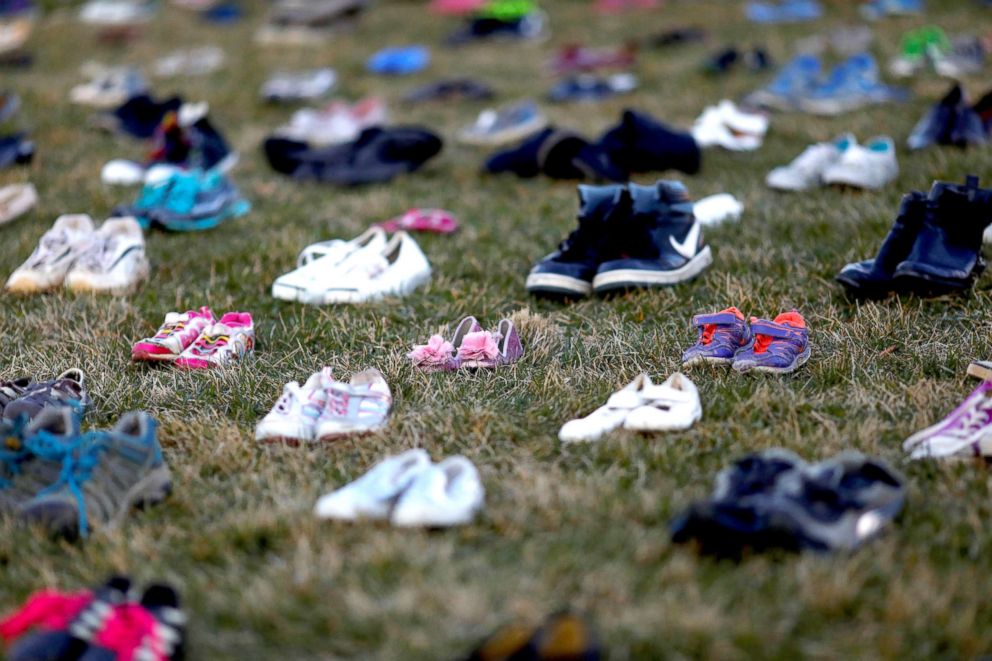
 PHOTO: Over 7000 shoes sit on the lawn in front of the U.S. Capitol in Washington, D.C.,March 13, 2018. Members of AVAAZ spent the morning placing them as a symbol of the number of lives lost since the shooting at Sandy Hook elementary in Newtown, Ct.

Welcome

Reading of the Names of Those Lost at Marjory Stoneman Douglas High School in Parkland, Florida, on February 14, 2018.

Alyssa Alhadeff, 14

Scott Beigel, 35

Martin Duque Anguiano, 14

Nicholas Dworet, 17

Aaron Feis, 37

Jaime Guttenburg, 14

Chris Hixon, 49

Luke Hoyer, 15

Cara Loughran, 14

Gina Montalto, 14

Joaquin Oliver, 17

Alaina Petty, 14

Meadow Pollack, 18

Helena Ramsay, 17

Alex Schachter, 14

Carmen Schentrup, 16

Peter Wang, 15


Silence


Hymn:  God, We Have Heard It    (“Ah, Holy Jesus”)

God, we have heard it, sounding in the silence:
News of the children lost to this world’s violence.
Children of promise! Then without a warning,
Loved ones are mourning.


Jesus, you came to bear our human sorrow;
You came to give us hope for each tomorrow.
You are our life, Lord God’s own love revealing.
We need your healing!


Heal us from giving weapons any glory;
Help us, O Prince of Peace, to hear your story;
Help us resist the evil all around here;
May love abound here!


By your own Spirit, give your church a clear voice;
In this world’s violence, help us make a new choice.
Help us to witness to the joy your peace brings,
Until your world sings!

Tune: Johann Crüger (or Crueger), 1640 (“Ah, Holy Jesus”)  (MIDI)
Text: Copyright © 1999 by Carolyn Winfrey Gillette. All rights reserved.
Email: bcgillette@comcast.net  Permission is granted for free use of this hymn in worship.  http://www.carolynshymns.com/

Prayers

            (We’ll end each group of prayers with “God in your mercy, Hear our prayer.”)

            …for students walking out today…

…for the 7,000 students killed since the Sandy Hook school massacre…

…for administrators and teachers…

…for our legislators at the local, state, and national levels…

…for the soul of our nation…

…for ourselves…our anger, our fear, our determination, our hope…

…for peace…

Hearing the Words of Stoneman Douglas High School…

No kid should be afraid to go to school, no kid should be afraid to walk outside, and no kid should have to worry about being shot. Now that’s why I’m marching.”

— Alfonso Calderón, Junior

“The ‘children’ you pissed off will not forget this in the voting booth. Don’t doubt the power of the younger generation, because we are a force to be reckoned with.”

—Aly Sheehy, Senior

“Maybe the adults have gotten used to saying ‘it is what it is,’ but if us students have learned anything, it’s that if you don’t study, you will fail. And in this case if you actively do nothing, people continually end up dead, so it’s time to start doing something. We are going to be the kids you read about in textbooks. Not because we’re going to be another statistic about mass shooting in America, but because…we are going to be the last mass shooting.”

— Emma González, Senior

“High schools shouldn’t be hashtags every other day”

—Jaclyn Corin, Junior

“More prayer, Jesus, god, and compassion won’t bring back the victims that sadly lost their lives. It won’t bring back the sense of security that my fellow peers and I lost. The only way to get that back is through gun control starting now.”

—Jose Iglesias, Senior

“The children will become leaders as the leaders have become children.”

—Madison Leal, Junior

“We march for Parkland, Newtown, Chicago, St. Louis, Columbine, and every other town in America affected by gun violence.”

—Nikhita Nookala, Senior

“On March 24th, #IWillMarch so no child ever has to worry about texting their parents a final “I love you.’”

—Alex Wind, Junior

“Our trauma isn’t going away, but neither are we. We will fight everyday because we have to, because change is the only thing that makes any of this bearable.”

—Leonor Munoz, Senior

“The fact that some of the students at Stoneman Douglas high school … are showing more maturity and political action than many of our elected officials is a testament to how disgusting and broken our political system is right now in America. But we’re trying to fix that.”

—David Hogg, Senior

“Our nation’s leaders are baffled and surprised that a bunch of 17 year olds are planning a nationwide movement but haven’t even blinked that we’ll also be able to purchase weapons of war in the same year.”

—Adam Alhanti, Junior

“The faces you see all over the media are not the only members of this movement. If you are willing to help to make a change, you are also a member. Simple as that.”

—Morgan Williams, Junior

“We may be young but our voices are louder than you can imagine.”

—Sarah Chadwick, Junior

“I blame the government for what happened and the people that are sending prayers and condolences but aren’t doing anything. It’s just heartbreaking to know that the people that are representing you are failing you.”

—Lina Crisostomo, Junior

“This isn’t red versus blue. This is life or death. And we refuse to ever allow any other student or human being to endure what we endured.”

—Liz Stout, Senior


A Vow to Listen

The young people have spoken.  We will listen.

They have challenged us to take action.  We will act.

They are the hope of our future.  We will follow where they lead.

But mostly, we will listen.  We will listen.  We will listen.


Benediction

Christ has no body now but ours.  No hands, no feet on earth but ours.  Ours are the eyes through which Christ looks compassion on this world. Ours are the feet with which Christ walks to do good.  Ours are the hands through which Christ blesses all the world.  Ours are the hands, ours are the feet, ours are the eyes, we are Christ’s body. Christ has no body now on earth but ours.  (Adapted from St. Teresa of Avila)

******************************************************************************

Join us…

–Saturday, March 24th, March for Our Lives, 11:00 a.m. Pack Square


Posted in Uncategorized | Leave a comment

Sermon: “Midwives to Light” (Lent 4 – B); John 3:14-21 (3/11/18)

Did a shiver run up your spine just now when you heard this passage?  Those of us who were raised as evangelicals likely associate this text with trying to get people “saved.”  “Soul-winning” they called it in Baptist churches I attended growing up.  Shiver break!  (Shiver)  Perhaps if we spend some time with it, we’ll find deeper truth in these verses.

The context of the passage is a mini-lecture Jesus gives to Nicodemus.  Nicodemus was a religious leader who had some questions about things Jesus was teaching.  Not wanting others to know he had questions, Nicodemus came to Jesus “by night.”  (The original “Nick at Night.”)

For the beautifully literate writer of John’s Gospel, that Nicodemus comes—and leaves—in darkness serves as a metaphor.  He doesn’t “get” Jesus when he arrives…and though he asks his questions and hears Jesus’ answers, he still doesn’t “get” Jesus when he leaves.  Nicodemus arrives in darkness and leaves in darkness.  He does not believe.

What is it he doesn’t believe?  Belief is the main focus of John’s Gospel.  Every scene in the book asks the question:  Do you believe?  But do you believe what?  At the end of the book, the writer says it clearly: “These (signs) have been recorded to help you believe that Jesus is the Messiah, the Only Begotten, so that by believing you may have life in Jesus’ name.”  (20:31)

Believing, then, is believing that Jesus is the Messiah, the one in whom God dwells.  It’s believing that God now resides not only in the Temple, but also in the person of Jesus.  Believing means following in the way of Jesus because that is the best means we have of realizing God’s fierce hopes for the world.

(21st century note:  Believing in the way of Jesus in no way discounts the ways of other religions.  Believing in the way of Jesus means simply that this story, this language, this filter through which we view the world is the way we have chosen to follow.  As followers of Jesus, we journey alongside our neighbors who follow other ways–the ways of Judaism, Islam, Buddhism, Hinduism, Baha’i… All of us seeking a common goal—to repair the world.)

So, according to the Gospel writer, “everyone who believes in the Chosen One has eternal life.  Yes, God so loved the world”–God so wanted to act the world into wellbeing– “that God gave the Only Begotten One, that whoever believes may not die, but have eternal life.”

Do we need another shiver break?  🙂  A big part of the evangelical message is “get saved” while you’re alive so you don’t go to hell when you die.  Some parts of the New Testament might be interpreted that way…but none of those parts are in the Gospel of John.  The writer of John doesn’t so much see salvation in terms of what happens after we die as something that happens in and affects the here-and-now.  If we believe Jesus is the best picture we have of God’s fierce hopes for the world, eternal life–any life–already has begun.

Another word in this passage that sends a shiver up the spine is “judgment.”  (Shiver)  For the longest time, I didn’t like the word judgment.  It always sounded so…judgy, you know?  It also evoked images of hellfire and brimstone and all that.

But if John’s writer isn’t working with the idea of eternal damnation—of a place of torment after we die—then to what might judgment refer in the Gospel of John?  What role does “judgment” play in the here-and-now?

From John’s perspective, judgment in the here-and-now isn’t about sending people to hell–or giving them hell… Judgment in the here and now is about distinguishing between what is of God and what is not…what acts the world into wellbeing and what subverts the world’s wellbeing…what brings God joy and what makes God weep…

The image the Gospel writer uses to illustrate this point about judgment is that of darkness and light.  At the beginning of the book, the writer calls Jesus “the light that has come into the world.”  That imagery continues here–whatever is in the light is whatever evidences belief in Jesus, that is, whatever reflects God’s fierce hopes for the world.  Whatever remains in darkness militates against God’s hopes for the world.  Indeed, people who do wrong hate the light and avoid it, for fear their actions will be exposed; but people who live by the truth come out into the light, so that it may be plainly seen that what they do is done in God.

So, as followers of Jesus, we have one task, one goal, one reason for being—to do whatever we can to bring light into the world.  As followers of Jesus—the light of the world—we are midwives to light, doing whatever we can to help bring light into the world.

Image result for picture of light

We’ve all heard birth stories.  The brief time I taught school—a young thing, fresh out of college—I was the tiniest bit alarmed at how many lunchtime conversations focused on telling stories of births.  Not always the best lunchtime conversation.

If you’ve heard those stories, you know that some labors are short, while others are very, very long.  Some babies get born before the midwife has time to arrive.  Others require attentive and skillful presence for hours.

In our efforts to assist the birth of light into the world, the same is true.  In some places, light comes quickly, without our assistance.  In others, though, if new light is to enter the world, we have to wait patiently, attend carefully, and do what we can in every moment to facilitate light’s birth.  Sometimes what’s required is nothing more than wiping the mother’s sweaty brow with a cloth.  Other times, though, more is required to guide her skillfully through the difficult and painful parts of the birthing process.

The February 14th shooting at Margery Stoneman Douglas High School in Florida, was a wake-up call.  I’ve been heartened by the large number of folks in this congregation who are eager to take action in reducing gun violence.  In a way, we have been attending the birth of light.  It’s clear this birth won’t be a quick one.  This labor will require our thoughtful, skillful attendance for a very long time.  At each moment, we’ll have to discern what our best action might be, what action of ours will facilitate the birth of light into the world.

The past two weeks, we’ve had a couple of brainstorming sessions about what we might do in response to gun violence.  The conversations have been wide-ranging.  We’ve quickly come to realize that the tentacles of gun violence run deep and wide in our country’s culture.  It’s not just changing gun laws, though that’s a part of it.  It’s not just increasing the number of security and mental health professionals in schools, though that’s a part of it.  It’s not just praying for the transformation of hearts and minds on this issue, though that’s a part of it.

We’ve come to realize that serving as midwives to light in this moment also requires speaking to issues of violence, in general…and confronting the idolatry of firearms in our country.  Have you seen the pictures of people getting married with their guns?  Of worship services where people are holding their firearms, wearing crowns of ammunition?  If that doesn’t say idolatry, I don’t know what does.

Arriving at this birth, no doubt, would fill even the most experienced midwife with dread.  How in the world can we assist in the birth of light in this moment?  How can we ensure that both mother and child survive…and—if we can dare to hope it—thrive?

How can we facilitate the birth of life in this moment?  We’ll do it by taking it step by step…just like you did with birthing the light of marriage equality.  Every day, you sent folks to the courthouse.  Every day.  Every day.  Every moment, you attended to what was going on in that moment and responded with actions that facilitated the birth of light.  The labor was long and arduous and, I’m sure, at times it felt hopeless…but now…how many of you are married?

I’ve compiled a list of some of the ideas and initiatives we’ve imagined in our conversations the last two weeks.  We’ll have another conversation today.  We’re pleased to welcome Allyn Maxfield-Steele, Co-Executive Director of the Highlander Center.  He’ll talk with us about how Highlander offers support to the leadership and justice initiatives of young people through Highlander’s Seeds of Fire program.  Today’s conversation will be the last for a while.  Talking is helpful.  But a midwife who comes and only talks about birthing a baby isn’t much use to mother or baby, is she?  So, after today, we’ll turn more to doing things.

If you see things on the list you’d like to become the point person for, please let me know.  If there are actions we need to add to the list, let me know that, too.  If you’d like to join the email list, send me an email.  If you’d like to join the Organizing for Gun Safety Facebook group, I’m afraid you’ll have to friend me.

The summer I discovered Highlander, I also discovered the powerful work of Pete Seeger.  Pete believed, really believed, that the world would change for the better if we could just learn to sing together.  I invite us now to sing a 19th century union song Pete put to music.  May it become our theme song as we serve as midwives to light.

Step by step the longest march. Can be won can be won.

Many stones can form an arch. Singly none singly none.

And by union what we will. Can be accomplished still.

Drops of water turn a mill. Singly none singly none.


In the name of our God, who creates us, redeems us, sustains us, and hopes for our wholeness.  Amen.


Kimberleigh Buchanan  ©2018


Posted in Uncategorized | Leave a comment

Sermon: “Zeal for God’s House” (John 2:13-22) Lent 3 [3/4/18]

I’m about to break the number one rule of starting a new pastorate–I’m going to tell you what I miss about my old pastorate.  Actually, I’m going to show you.


No automatic alt text available.

When I arrived at Pilgrimage in 2001, I went despite the building.  It’s a simple building, constructed of concrete block, one level.  At the time, the floor of the sanctuary was covered with utilitarian carpet the color of blah; for seating we had metal folding chairs.

Unlike the rest of the room, the stained wood ceiling was striking.  It soared up from one side of the building to the other.  From the ceiling’s highest point descended a wall of windows–four sets of three windows each.  An energy saving feature, the windows were designed to allow in sunlight to warm the space with passive heat in winter.

Great plan, bad execution.  The light was so bright, people couldn’t see.  Every Sunday was a road to Damascus experience.  Of necessity, the windows stayed covered all the time.

When we decided to renovate in 2008, I got a call from the church member who was overseeing the project.  “How about stained glass windows?” he asked.  In one of my less-inspired moments of pastoral leadership, I assured Ric that we were NOT a stained glass church.  He asked me to think about it.

Five minutes later I remembered Merridy, a woman who attended our church. Want to guess Merridy’s profession?  Stained glass artist.  I sent her info to Ric, who immediately reached out.  Later, Merridy told me, “The first time I came into this space and looked up at those covered windows I thought, ‘What a waste.’”  After Merridy got through, the windows were whatever the opposite of “waste” is.  They’d gone from a nuisance to something that could create the kind of beauty you see on today’s bulletin.

Image may contain: table and indoor

Truth be told, I’m still grieving the loss of the colors.  The windows themselves are beautiful…but the colors they cast!  As the sun creeps across the sky, the colors cast by the windows creep across the room.  It’s like the artwork in the room changes every second of the day.  The room is alive now; it breathes.  My first task when coming to work each day was to see what the light and colors were doing.

Image may contain: one or more people

So, why am I telling you this story about the stained glass windows in another church I served?  I tell the story because that experience taught me the importance of having a beautiful space in which to worship.  The alterations to the sanctuary changed how we worshiped together.  Before, we worshiped despite the space.  Afterward, we worshiped WITH the space.  Those windows taught me that beauty invites us into God’s presence as few things can.

The beauty of this room also invites us into God’s presence…the openness of it, the dark-stained wood, the stained glass windows.  Something inside you shifts when you enter this space, doesn’t it?  It invites reverence, maybe even awe.  Take a moment to take in the space.

Why does beauty affect us so deeply?  John O’Donohue described beauty in this way.  He said, “The human soul is hungry for beauty; we seek it everywhere – in landscape, music, art, clothes, furniture, gardening, companionship, love, religion, and in ourselves. No one would desire not to be beautiful. When we experience the beautiful, there is a sense of homecoming.”

Beauty as homecoming…a rightness, a sense that things are as they should be, that we are connected to everything around us, that we are home.

So.  Jesus in the Temple…cracking a whip, over-turning the tables of the moneychangers, running out the animals being sold for the sacrifices necessary for religious rituals.  I get the sense most of us here like this Jesus…like, really like this Jesus.  Getting angry about religion selling its soul?  Sticking it to the Temple authorities?  Standing with those who are being exploited?  Oh, yeah.  I’m guessing we like this Jesus a lot.

But Jesus’ invitation here is about much more than simply living our faith out loud and speaking truth to power.  For Jews at that time, the Temple was the actual dwelling place of God; for them, the Temple was God’s literal home.  If you wanted to encounter God, you had to go to the Temple.  So, when Jesus claimed that his body was now God’s Temple, he was giving notice that God had relocated.  God was no longer only to be found in the Temple and the old way of being it represented.  Now, the best place to find God was in Jesus.  Thus, Jesus’ zeal for God’s house became zeal for the new thing God was doing in Jesus.  Where the Temple once had been God’s home, now God’s home was wherever Jesus went.

After a couple of millennia of following Jesus, this seems like old hat to us…but to the religious authorities at the time?  This notion that God now had a new home?  That the beauty of the religion they followed had shifted to a place outside their purview, outside their control?  That was dangerous….dangerous enough that those religious authorities eventually colluded with the Roman government to kill Jesus.  (We often speak of Jesus’ anger in this scene.  But the more dangerous anger would seem to be that of the religious authorities, the people in power.  In our own society we’ve seen the devastation that ensues when the powerful become angry…and, even more so, when their anger becomes law.)

What new thing might God be wanting to do here at FCUCC?  What once beautiful  systems or traditions no longer give life or could be reawakened by refocusing on the new thing Jesus hopes to do in our midst?  Where is the beauty of our faith located now?

In recent weeks, we’ve talked about the steady rhythm of breathing in God’s love and breathing out God’s love, the yin and yang of gathering for worship and acting the world into wellbeing…in the pretty red doors, back out the pretty red doors, in the doors, out the doors…How crucial it is to have a space in which to breathe in God’s love and renewal, so that we can leave this place to breathe out God’s love and renewal as we seek to heal the world.

And how beauty renews us!  Beauty nourishes our souls…  It also jumpstarts our imaginations, our creativity.  Beauty invites us to see things in new ways.  Can you imagine trying to change the world without experiences of beauty?

On Friday, I attended “On the Row,” a staged reading of pieces written by inmates on death row in Arkansas.  The pieces described different aspects of the men’s lives—how they felt about themselves, about what they’d done.  What it was like to be isolated 23 hours a day.

For his part, one man described his cell.  Bed, polished steel mirror.  Cream-colored walls.  When he said “cream-colored walls,” it hit me—there’s no artwork in those cells.  Bare concrete walls.  Twenty three hours a day.

The sister of a man executed by the state of Arkansas had some artwork created by her brother there Friday night.  He was a gifted artist.  And I was glad to hear that, if family pays for art supplies and has them sent to the prison, inmates are allowed to create art.  But the simple act of choosing artwork that inspires you and putting it up on the wall—that doesn’t happen.

The over-riding theme of “On the Row,” is the power of redemption…the possibility of people who’ve done hard, even horrific things to be transformed.  When I heard the words “cream-colored walls,” I wondered—How does depriving people of beauty facilitate their redemption?  Or, to put it another way—Does depriving people of beauty actually militate against redemption?

Gary Dorsey is a member of the last church I served.  Ten years ago or so, Gary, his wife, Jan, and daughter Ella moved to Atlanta.  Gary had taken a job as a religion writer at the Atlanta Journal Constitution.  Some of you minister types might have read Gary’s book, Congregation.  It’s a great snapshot of congregational life.  Jan was hired as an editor at the same paper.

Six weeks after arriving in Atlanta, Gary had a massive stroke in his brain stem.  Most strokes of the type Gary had are fatal.  Folks who survive either lose significant physical control—becoming “locked in”—or they lose cognitive function.  Gary lost cognitive function.

In the early days of Gary’s recovery, I invited Jan to share with the congregation some of her experiences of the recovery process.  As often happens with traumatic brain injuries, the words Gary spoke didn’t always make immediate sense.  Once you thought about it, though, it became clear that the words he said were connected to deeper truths.

Once, when Jan asked Gary how he was feeling about things, Gary told her:  “You are my cathedral.”  “You are my cathedral.”  You are the one who keeps me connected to the holy.  You are the one who keeps me connected to beauty.  You are my home.

Maybe Gary had it right.  Maybe we’re all cathedrals.  Maybe Jesus’ point that day in the Temple was that, through him, we are the ones who keep each other connected to the holy, we are the ones who keep each other connected to beauty.  Maybe we are home for each other.

Perhaps the best way, the only way, to redeem the world, is to enter each other’s presence—all others’ presence—with the reverence with which we enter this space.  If we did that, if we lived consciously as if we are cathedrals for others—and they cathedrals for us—If we entered every encounter with every person as if we were on holy ground, what might happen to this world?  What might happen to this church?  Might we find a new way forward?  Might we create something beautiful?  Might we find that, at last, we are home?


In the name of our God, who creates us, redeems us, sustains us, and hopes for our wholeness.  Amen.


Kimberleigh Buchanan  ©  2018


Posted in Uncategorized | Leave a comment

Sermon: “Who Is Following Whom?” (Lent 2) Gen. 17:1-7, 15-16 [2/25/18]

Today is my fourth Sunday in the pulpit.  Does that make me a long-term pastor? Nah.  I’ve just finished saying hello and have only begun the process of getting to know FCUCC.

Getting to know a community can be… confusing.  Here’s why:  every person has her or his own unique experience of the community.  There are some experiences everyone in the community has in common; stories people tell about those events are consistent.  But the vast majority of things that happen in a community, people experience individually.  Sometimes you end up with very different–even conflicting–stories of the same event.

A documentary, Stories We Tell, describes this dynamic.  An event happened in the movie maker’s family–a parent had an affair.  Years later, she invites each person in the family to tell his or her story.  Everyone’s story—especially about the affair—is different… sometimes the stories directly contradict each other.  You begin to see how each person constructs a narrative that helps him or her to make sense of the family, and of his or her place in it.

The same thing happens in communities.  We tell ourselves stories to help us make sense of who we are as a community, of what we are called to do, and of our individual place in the community.  One of my jobs as pastor is to help us all get on the same page-ish with the story we’re telling about who we are, why we’re here, and the work to which we feel called.

There’s one story, in particular, I’m wondering about today.  It’s a story I sometimes hear from folks both inside and outside FCUCC.  Are you ready?  “FCUCC is an aging congregation.”  Have you heard that story before?  Have you told that story before?  If so, how does that story help us make sense of who we are as a community of Jesus followers?  How does that particular narrative help us as individuals understand our place within the community?

What does it even mean to call a congregation “aging?”  Are we talking about chronological age?  If so, we might well be an “aging” congregation.  Do you know the average age of people in the United States?  In 2016, it was 37.9 years.  Would you say the average age of FCUCC members is higher or lower than 37.9 years?  Thanks to Mr. Finley Stuart Snider, the average age has skewed down a tad this week…but I think it’s safe to say that the average age of FCUCC members exceeds– perhaps signficantly–the average age of people in the United States.

But is chronological age the only thing that’s meant when a congregation is described as “aging?”  Among my colleagues, when we talk about “aging congregations,” it’s often a euphemism for “dying congregations”…that is, congregations who cling so hard to the way things used to be, they can’t change or adapt to what the church is becoming.  And so, they die.  It happens all the time.

If that’s what people mean when they refer to FCUCC as an “aging congregation,” I’m not going to say they’re wrong…but I will say that my experience of FCUCC thus far has led me to construct a different narrative.

Here’s some of what I’ve seen that’s helping me construct my narrative of FCUCC as an alive congregation.  We’ve had roses on the communion table–the symbol in our community of births–two Sundays in a row.  Betty Dillashaw works consistently with the children and has asked when they next can ring in worship.  Last Sunday, there were at least six teenagers here for worship…and that didn’t include some regulars who were away last week.  Also last Sunday, in response to the children’s suggestion a couple of weeks ago that wearing hats and/or party hats might help us share God’s love with other people–many of you listened.  You wore hats, up to and including hats with blinking lights.

Are we a chronologically older congregation?  Absolutely.  Are we a dying congregation?  Absolutely not.  Based on what I’ve seen the past four weeks, we are a congregation that takes delight in all people, but perhaps especially in younger people.  We also are a congregation that not only is NOT afraid of change, but that seeks every day to effect change.  What is acting the world into wellbeing if not a commitment to changing the world?

Abram and Sarai.  Were they an aging couple?  You bet.  He was 99; she was 90.  Were they a dying couple?  Absolutely not.  When God said go, they went.  They didn’t get everything right—and in fact, got some things horrifically wrong…particularly with Hagar, Ishmael, and Isaac.  The writer of Genesis, though, takes great pains to remind us that even these deeply-flawed nonagenarians were able to bear and keep alive God’s fierce hopes for the world.

So.  How will we keep alive God’s hopes for the world, we who don’t always get things right, but who seek with all of who we are to go when God says go?  (Pause)-

How will we keep God’s hopes for the world alive in the wake of yet another—what disgusting words those are, “yet another”—how will we keep God’s hopes for the world alive in the wake of yet another school shooting?

While what happened on Valentine’s Day at Margery Stoneman Douglas High School in Parkland, Florida, was “yet another” school shooting, the response this time has been different.  Teenagers are rising up.  To quote shooting survivor Emma Gonzalez, teenagers are “calling BS”—on adults, on legislators, on a country that lacks the moral courage or political will to stop the COPMLETELY UNNECESSARY slaughter of innocents.

Protesters gathered outside of the Wescott building

On Friday’s News Hour, David Brooks mentioned a conversation he’d had this week with college students.  When trying to define their generation, a couple of students said, “You know, we’re the school shooting generation.”  Do you hear that?  We’re the school shooting generation.

What have we done?

At UCC General Synod in 2015, I met Leah Gunning Francis.  Her book, Ferguson and Faith:  Sparking Leadership and Awakening Community, had just come out.  This was just 11 months after Michael Brown’s death in Ferguson, Missouri, and the protests that ensued.

Leah teaches at the UCC’s Eden Seminary in St. Louis and had been asked to interview faith leaders in the protest movement in Ferguson, to hear their stories and to see what might be gleaned from them for faith leaders moving forward.

When I asked Leah what her biggest take-away from the project was, she shared with me what many of the older faith leaders share with her.

In the first days of protest, the usual characters showed up to offer their support and leadership.  Many of these folks either had been involved in the Civil Rights movement or were using the same methods used by those in the Civil Rights movement.

It quickly became clear, though, that the old methods no longer worked.  The “old guard” soon realized they no longer knew best when it came to addressing racism—especially that experienced by African American young men—in 2014.  As the realization dawned, the older members of the movement stopped talking and started listening to the young people.  They soon shifted into the role of mediation.  They served as a literal buffer between law enforcement and protestors.  They put their bodies on the line so that the young people could say and do the things that needed to be said and done in that moment and time.

I believe we’re now in a similar time….a time when those of us with some age on us simply don’t have as clear an understanding of what’s going on as do our children, card-carrying members of “the school shooting generation.”

…which means it’s time for us to stop talking and listen.  At last week’s prayer service in the wake of the Parkland shooting, we had a time of commitment, when we were invited to name things we would DO in the wake of the shooting.  One person said, “I’m going to spend more time talking with my grandkids.”  At first, I didn’t get it…but then I realized that’s exactly the kind of commitment we all need to be making right now.  We need to LISTEN to our children.  We need to hear their pain, their rage, and their ideas.

Without the mediators in Ferguson, it’s likely the protests would have devolved into violence much more quickly and, perhaps, with more devastating results.  And I don’t think anyone would dare to say that a whole lot has been resolved in Ferguson.  The struggle against systemic racism continues.  I do think, though, a key gift of what happened in Ferguson—a gift that we can keep alive—is the realization that, while sometimes the older generation leads the young, sometimes the only way forward is for the older generation to follow the young.

So, what will be our role in the wake of “yet another” school shooting?  That’s something we’re going to have to figure out together—all of us together…old AND young.  I invite us to begin the conversation downstairs after our time of fellowship.  If you are ready to effect some change on gun violence, if you are ready to listen to the “school shooting generation,” if you are fed up with complacency among legislators and voters on this issue, if you are determined to keep God’s hopes for the world alive, I invite you to join me for some frank conversation and active plan-making.

If God chose to start the promise with two deeply- flawed nonagenarians, surely we here at FCUCC can keep it going.  Don’t you think?

In the name of our God, who creates us, redeems us, sustains us, and hopes for our wholeness.  Amen.

Kimberleigh Buchanan  ©2018

Posted in Uncategorized | Leave a comment

Sermon: “The Wild Beasts of Lent” (Lent 1); Genesis 9:8-17; Mark 1:9-15 [2/18/18]

            Our first day in Asheville, we had a pleasant chat with our next door neighbor.  She welcomed us, the dogs welcomed us … by christening our yard through the chain-link fence–it’s what dogs do, right?

Image result for pictures of dogs

As we headed back inside, our neighbor said, “The last people who lived in your house brought the garbage out all through the week.  So…we have bears, a mama and three cubs.  You can hear them at night going up and down the street, foraging all the garbage cans that have food in them.  Just so you know, we put our food garbage out the morning the garbage truck comes.  Because of the bears.  Welcome to the neighborhood!”

Of course, the only word that stuck in our minds was:  “BEARS?!”  Being less than a minute from the Parkway…APPARENTLY, you’re going to have bears.  And bears– especially mamas with three cubs–are going to forage for food.  It’s what bears do, right?

Lent always begins with some version of Jesus’ 40 days in the wilderness.  Every third year, we also get today’s text from Genesis–the covenant-making between God and Noah and the rest of creation after the flood.  That covenant says, in part, ‘I hereby establish my covenant with you and with your descendants after you, and with every living creature that is with you–birds, cattle, and Earth’s wildlife–everything that came out of the ark, everything that lives on Earth.”  By these words, God commits to remaining in relationship with all creation.

So, here’s an interesting link between this covenant scene in Genesis and the story about Jesus’ sojourn in the wilderness:  they both involve wild beasts.  In Genesis, it’s all the beasts on the ark, all creation.  In Mark’s account of Jesus’ 40 days in the wilderness, it says that “Immediately, the Spirit drove Jesus out into the wilderness, and he remained there for forty days, and was tempted by Satan.  He was with the wild beasts, and the angels looked after him.”

Mark is the only Gospel writer who mentions the wild beasts.  Matthew and Luke’s accounts go straight into the three big temptations presented by the Tempter…but they don’t mention the wild beasts at all.  And yet Mark, by far the least wordy of all the Gospel writers, takes the time to mention them.  I wonder why?

Maybe the Gospel writer’s neighbor had just told him or her about a mother bear and 3 cubs foraging the neighborhood for food.  Could be…could be….Or….

I’ve been thinking about the way our neighbor’s dogs welcomed us.  Christening things is just what dogs do, isn’t it?  Foraging for food is just what bears do.  Any creature–especially a wild one—just does what it was created to do.  It doesn’t think about it.  It doesn’t wonder how others will feel about what it does.  It simply– un-self-consciously–does what it does.

Maybe that’s why Mark gives a cameo appearance to the “wild beasts” in this account of Jesus’ time in the wilderness.  Coming on the heels as it does of Jesus’ baptism, that might make sense.  In Jesus’ baptism, as we heard, immediately after emerging from the baptismal waters, Jesus hears these words:  “You are my child, my beloved.  With you I am well-pleased.”  Baptism is grounded in this idea that we are deeply loved by God, not for anything we’ve done, but simply for who we are.  Period.

Image result for picture jesus in the wilderness

Human beings…I guess we’re okay.  We’re kind of funny sometimes; we’ve been known to make each other laugh.  Occasionally, we do some amazingly kind and compassionate things.

At the same time, though, human beings are the only creatures in all creation who have the capacity to choose to be who we are not.

Have you ever done that?  Chosen to be someone you’re not?  It’s a painful way to live, isn’t it?  To stifle some vital part of who you are?  Maybe my neighbor could have taught her dogs to carefully craft a sweet welcome note to Allen and me, signing it with a paw print.  But that’s not what dogs do, is it?  No, dogs christen things.

As we enter this season of Lent, then, perhaps the wild beasts in today’s Scripture passages can remind us that being who we are created to be is the first task of Lent.  If we are to do the work we’re called by God to do, we must begin by being who God created us to be… freely, un-self-consciously, unapologetically.

Being your pastor the last two and a half weeks has been a real kick.  You all care about this church!  You also care about the world outside this church.  Announce a press conference to offer support to immigrants, especially Dreamers (who still need our active support, by the way)?  You’re there!  Actively engaging in creation justice?  Check!  Serving the poor and food insecure through Pritchard Park breakfasts, Room in the Inn, providing food to elementary school students, Laundry Love?  Check, check, check, and check.  We’re there for all of that.

Because I hear and see just how active we are as a community of Jesus’ followers, because the minute an initiative is announced, many of you respond immediately with, “I’m there!” other conversations I’ve had have come as a bit of a surprise.  “I’ve been trying to find my calling.”  “I think I’m finally starting to live into my calling.”  “I’m trying to figure out where I plug in at FCUCC and what I need to be doing to act the world into wellbeing.”

These comments have surprised me a little, AND they have filled me with tremendous hope.  Wow!  You get it!  Calling isn’t just something young people work to discern, then spend the rest of their lives living out.  Calling requires a lifetime of discernment.  At any given moment, as circumstances change, our calling also can change.  The task of prayer–and of seasons of reflection, like Lent–is to take time, to become still, to open ourselves to our deepest longings, to become reacquainted with who we are created by God to be.

Based on what I’ve experienced thus far in two and a half weeks as your pastor, I’m pretty sure we’re going to spend a lot of time outside those pretty red doors doing what we can to act the world into wellbeing.  That’s terrific.  I encourage us, though, during this season of Lent, to do a little reflecting, a little praying, a little breathing in.  In this way, I suspect we’ll get some clarity about who we are so that, when it comes time to hit the streets, we’ll know without a doubt who we are and can engage in that work with all the resources we have.

As we begin this reflective Lenten journey, we might learn a thing or two from weasels.  Weasels are wild.  As wild creatures, weasels do what nature has designed them to do–they hunt prey.  Here’s how they do it.  Disclaimer–this will be momentarily icky, but stay with me.  The point will be well-made.  I promise.  Here’s how nature has designed weasels to kill their prey–they bite them (rabbits, mice, birds) on the neck and don’t let go until they’ve dragged the carcass back to their nest.

Image result for pictures of weasels

In an essay titled, “Living Like Weasels,” Annie Dillard tells of a man “who shot an eagle out of the sky.  The man examined the eagle and found the dry skull of a weasel fixed by the jaws to his throat.  The supposition is that the eagle had pounced on the weasel and the weasel swiveled and bit as instinct taught him, tooth to neck, and nearly won.”  There’s no telling how long that skull had been dangling from the eagle’s throat.

Dillard finds in the weasel’s single-minded focus inspiration for her own life.  “We can live any way we want,” she writes.  “People take vows of poverty, chastity, and obedience–even of silence–by choice.  The thing is to stalk your calling in a certain skilled and supple way, to locate the most tender and live spot and plug into that pulse.

“I think it would be well, and proper, and obedient, and pure,” she says, “to grasp your one necessity and not let it go, to dangle from it limp wherever it takes you.  Then even death, where you’re going no matter how you live, cannot you part.”  (Dillard, Annie.  “Living Like Weasels,” Teaching a Stone to Talk:  Expeditions and Encounters, 65-70.)

Stalk our calling…now there’s an image.  What in your life have you dug your teeth into completely, single-mindedly?  How will you—you, with all your gifts and quirks and passion and energy—how will you act the world into wellbeing?  What unique gift do you have to offer in the work of healing the world?

As we unwrap this Lenten gift of reflection, this time of breathing in, this time of stalking our calling, hear again the words of Mary Oliver–  Wild Geese.


You do not have to be good.

You do not have to walk on your knees

For a hundred miles through the desert repenting.

You only have to let the soft animal of your body

Love what it loves.

Tell me about despair, yours, and I will tell you mine.

Meanwhile the world goes on.

Meanwhile the sun and the clear pebbles of the rain

Are moving across the landscapes,

Over the prairies and the deep trees,

The mountains and the rivers.

Meanwhile the wild geese, high in the clean blue air,

Are heading home again.

Whoever you are, no matter how lonely,

The world offers itself to your imagination,

Calls to you like the wild geese, harsh and exciting–

Over and over, announcing your place

In the family of things.


“Let the soft animal of your body love what it loves…and learn your place in the family of things.”

In the name of our God, who creates us, redeems us, sustains us, and hopes for our wholeness.  Amen.

Kimberleigh Buchanan  ©2018


Posted in Uncategorized | Leave a comment

Sermon: Down from the Mountain? (Transfiguration) [Mark 9:2-9]

It’s not quite the same as Peter, James, and John’s experience with Jesus at the Transfiguration, but we have been having a bit of a mountaintop experience here at FCUCC the past couple of weeks.  In our excitement, not knowing what to say, we, like Peter, might have blurted out some odd things.  (Note to self, “Come and get your stuff,” is probably not the most respectful way to invite people to the communion table. J)  Though not the same kind of mountaintop experience, there might yet be something for us to learn from the Transfiguration.

The story begins with Jesus taking Peter, James, and John up a mountain.  While they’re there, two figures appear with Jesus—Moses and Elijah.  All three seem to glow.  The point of the story—which we know after 2,000 years of reflecting on it—is that Jesus is continuing the work of the law and the prophets.  Basically, God says, I spoke through Moses, I spoke through Elijah, now I’m speaking through Jesus.  Listen to him!

Image result for transfiguration of jesus pictures

Not having the benefit of 2,000 years of reflection, Peter babbles.  “Let’s build three dwellings!” They don’t. Instead, they come back down the mountain…where a crowd is waiting.

A father has brought his ailing child to Jesus’ disciples and asked for healing.  The disciples can’t do it.  A debate ensues.  When Jesus shows up, they want his opinion.  Do you want to hear what Jesus says to the eager crowd?

Here goes.   “What an unbelieving lot you are!  How long must I remain with you?  How long can I endure you?”  Maybe Jesus needed to stay on retreat another day or two.  Jesus eventually heals the child, but man!  Doesn’t he seem a bit grumpy to you?

This last bit isn’t included in today’s reading.  Without the scene down below, though, I’m not sure we get a complete picture of what happens up above.  If mountaintop experiences are disconnected from what goes on down from the mountain, what’s the point?

Last summer, in a video interview with the search committee, someone asked: “What do you know about Asheville?”  At the time, I didn’t know much.  Allen and I had vacationed here once.  It was in the mountains.  That was about it.

As we talked, I learned that tourist Asheville and everyday Asheville can be quite different.  The Asheville people experience on vacation doesn’t necessarily square with the experience of people who live here all the time.

The question intrigued me enough that I drove to Asheville the next day to see things for myself.  Here’s what I wrote the search committee after that trip.

After our conversation Monday night, I decided to drive to Asheville and see FCUCC in its context.  Driving, then walking around gave me some ideas about how to answer the “How will the church survive?” question.

            Monday night, I answered in “be the church” terms—institutional church might be in transition right now, but the message of the Gospel has not changed—God’s love extends to every person and to all creation.  The key task of Jesus’ followers is to act the world into wellbeing in his name.  How individual churches act the world into wellbeing in Jesus’ name depends on their context.  That’s why I took the field trip—to see FCUCC in its context and begin to imagine how it might move into the future in healthy and sustainable ways.

            I love the downtown area.  I’m also intrigued by the buildings surrounding FCUCC.  Health and Human Services, Buncombe County court buildings, Juvenile Justice, the YMCA.  What does FCUCC’s location in the midst of those buildings mean in terms of its mission?  Most buildings, except First Baptist and FCUCC, seem new.  A sign of gentrification? 

I saw other signs of gentrification.  A vibrant downtown, small shops and restaurants.  I also saw some guys, who I assume are without permanent housing, hanging out in Thomas Wolfe Park.  The widening gap between haves and have-nots became a little clearer.  It makes sense that with all the new construction, lower-income populations are being pushed out of the city.

So, how might a church be church in that context?  After being in the city for less than an hour, I’m not sure of the specifics, but here’s the line that came to me yesterday on my walk—become indispensable to the Asheville community.  Become an even better neighbor… you’re already a good neighbor. J  You’ve got a great start with the way you invite community groups in to share space with you.  I am eager to hear more about how the congregation interfaces with those groups.  Room in the Inn also is a vital ministry.  The church I currently serve has become more vibrant since starting to host families without permanent housing.  It has deepened significantly our understanding of hospitality as a spiritual practice.

In what other ways might FCUCC become a place for the larger Asheville community to gather?  Might the church become a regular venue for music events?  Or maybe author events?  Social justice issues are important.  Vital.  I suspect, though, that social justice initiatives will get more traction and buy-in from the wider community if they see, not “that church” doing things, but “my friends, Kelly, Jim, and Phillip” doing those things.  Does that make sense?

Building on your initiatives in the community—feeding the homeless breakfast, giving gifts to high school students—will be another way to strengthen relationships in the community. 

Hear me well.  Actively engaging in social justice is crucial.  Part of my desire to seek another church is to be in a place where I feel more freedom to preach directly to injustices in our country and around the world.  I am suggesting that building relationships with those whose minds we seek to change paves the way for actual change to happen much more quickly.

Another thing I’m looking for in moving to another church, is a place smaller than the 18-county metro Atlanta area.  Metro Atlanta is simply too big to have any real sense of community.  While tourism might disrupt it some, my sense is that Asheville is small enough to have that strong sense of community. 

A couple of weeks ago, an image of church-life came to me:  the church as lung.  The image came from reading the first four chapters of the book of Acts.  The book begins with the disciples gathered to see Jesus off.  After Jesus leaves the scene for good, the disciples disperse.  At Pentecost, they come back togethe, then gather into community (Acts 2).  Ch. 3 describes a foray by Peter and John into the wider community.  As they enter the Temple, a man lame from birth asks for alms.  Peter heals the man…which annoys the religious authorities.  So, Peter preaches to them.  After that, Peter and John return to the community (the end of ch.4).

Reading all 4 chapters together, I began to see a pattern—together in community (koinonia)-out into the wider community-koinonia community-wider community.  It began to feel like breathing.  Breathing in God’s love and renewal within the koinonia community—breathing out God’s love in healing and preaching and calling the powers that be to account.

Just as a body requires both inspiration and expiration to live, so does the body of Christ need to breathe in God’s love in worship, and breathe out God’s love in service, including justice work.  A body can’t only breathe in and survive; neither can it only breathe out and survive.  The healthiest bodies breathe in and breathe out in a regular rhythm.  Come to think of it, without that regular pattern of inhaling and exhaling, a body dies, doesn’t it?

So…how might FCUCC stay alive?  It can stay alive by continuing to breathe in God’s love-breathe out God’s love-breathe in God’s love-breathe out God’s love.  If Spirit leads us to continue our journey together, I look forward to exploring that question further.

In order to remain vibrant, in order to continue acting the world into wellbeing in Jesus’ name with passion and effectiveness, it’s important to nurture the connection between what happens on the mountaintops and what happens down below, what happens here in worship and what happens outside those pretty red doors.  Mountaintop experiences without any connection to the real lives of real people is narcissism.  By the same token, working to improve the real lives of real people without experiences of the holy is a sure path to burn out.

Having lived in relatively flat places all my life, I’ve had a limited understanding of mountaintop experiences.  Mountaintop experiences have always been what happens when you go far away in search of awe-inspiring experiences.  Coming down from the mountain always means re-entering the realm of the mundane.  What happens on mountaintops seems beautiful and rare.  What happens down the mountain seems blah.

Having lived in Asheville for nearly two whole weeks now, I’m realizing the distance between mountaintop and down below is much shorter than I thought–both literally AND figuratively.  Here, we see mountaintops all the time.  In less than a minute from our house, I can be on the Parkway.  Some of us in this room live on the mountaintops.  There are others who live in the mountains, but for whom life is anything but a mountaintop experience.

So maybe our location here in Asheville gives us a unique way to understand the Transfiguration…and what happens afterward.  Mountaintop and real-life experiences are much more integrated than we know.  We breathe in God’s love, we breathe out God’s love.  We come to this place to be acted into wellbeing; we leave this place to act the world into wellbeing.

If we give ourselves over to this rhythm of breathing in God’s love, breathing out God’s love, allowing ourselves to be acted into wellbeing, and leaving this place to act the world into wellbeing, if we hold in our centers the connection between mountaintops and life down below, I suspect, perhaps sooner than we think, we, too, will be transfigured.

In the name of our God, who creates us, redeems us, sustains us, and hopes for our wholeness.  Amen.

Kimberleigh Buchanan  © 2017

Posted in Uncategorized | Leave a comment

Sermon: “I Have Come to Preach the Gospel” (First sermon at FCUCC Asheville) [I Cor. 9:16-23] 2/4/18

Hi, everybody.  I’m here!  Now what?  I’m reminded of that great scene from the movie The Graduate.  Not that scene.  The final scene of the movie.  Ben and Elaine have been working to disengage themselves from their parents’ expectations, and, for Elaine, from her soon-to-be-husband.  As Elaine and her groom are taking their vows at the church, Ben rushes into the balcony and begins shouting, “Elaine!  Elaine!  Elaine!  Elaine!”  A clamor begins from the groom, from Elaine’s parents….but all she can hear is Ben’s voice.  “Elaine!  Elaine!”

Then, a flurry of activity that borders on the madcap ensues—Ben elbows Elaine’s father and heads butts the groom, then he grabs a cross from the table in the narthex, and runs it through the door handles from the outside the church.  Having rescued Elaine, Ben grabs her hand and they run to catch the city bus that just happens to be passing by at that moment.  They race down the aisle of the bus and fall onto the back bench…exhilarated.

Then, after a brief moment, the couple grows still.  Sitting about a foot apart, each stares straight ahead.  If they’d done pop-ups in the movies in 1967, the bubble above each head would have read, “Now what?”

Oh, we have been in a flurry of activity the last several months.  Does November feel like years ago to anyone else?  We’ve been working so hard to get together!  You’ve said, “Kim!  Kim!  Kim!  Kim!”  I’ve said, “FCUCC!”  (If I try to say that four times in a row, I’m going to get in trouble.)  We’ve run and hopped the bus for our new journey together.  Everything has been leading up to THIS moment!

Now what?

When I read today’s assigned reading from one of Paul’s letters to the Corinthians, the “what” got clarified for me.

No one’s more surprised than me that the first Scripture text I’m preaching is from Paul.  I’m reminded of the title of Karen Armstrong’s book, Paul:  The Apostle We Love to Hate.  That title sums up my relationship with Paul for most of my life.  I confess, though, that the longer I pastor, the more I “get” Paul…especially his words to the church at Corinth.

The people in the church at Corinth had a gift for getting on each other’s nerves.  One person didn’t like what another person ate.  Some people were eating such large quantities that other folks didn’t get anything at communion.  They had implemented a hierarchy of gifts that prioritized the holiness of some—like speaking in tongues—over others.

As you read I Corinthians, you get the sense that Paul is pulling his hair out—or pulling at where his hair used to be.  He begins in the first chapter naming deep divisions in the church.  “Someone says, I belong to Paul, or I belong to Cephas, or I belong to Apollos, or …”  “No!” he says.  “We all belong to Christ.  Period!”

Before I became a pastor, I thought Paul to be a very grumpy person.  The longer I pastor, though, the more I feel Paul’s exasperation.  “Come on, church!” I’ve wanted to say on a few occasions.  “We all belong to Christ!” As a community of Jesus’ followers, if we let anything—including dissension in the community—get in the way of our communal calling to follow Jesus by sharing God’s love in the world, to act the world into wellbeing in Jesus’ name, then we’re missing the point.

Among the grumblings at the church at Corinth were complaints about Paul himself…  Isn’t this a terrific passage for a pastor’s first Sunday?  God has a wicked sense of humor!  The verses from today’s Epistle lesson are part of Paul’s reminder to the Corinthians of the point of his serving among them…  Hear these words of Paul to the church at Corinth.

16If I proclaim the gospel, this gives me no ground for boasting, for an obligation is laid on me, and woe betide me if I do not proclaim the gospel! 17For if I do this of my own will, I have a reward; but if not of my own will, I am entrusted with a commission. 18What then is my reward? Just this: that in my proclamation I may make the gospel free of charge, so as not to make full use of my rights in the gospel.  This might be a good time to let you know that I am not a complete biblical literalist.  J

19 For though I am free with respect to all, I have made myself a slave to all, so that I might win more of them.  Okay.  Did you bring your to-do lists?  In Friday’s newsletter, I invited everyone to create their own personal to do list for me…things you’ve been waiting for a settled minister to do.  If you created a list, go ahead and pull it out.  We’ll come back to it shortly.

 20To the Jews I became as a Jew, in order to win Jews. To those under the law I became as one under the law (though I myself am not under the law) so that I might win those under the law. 21To those outside the law I became as one outside the law (though I am not free from God’s law but am under Christ’s law) so that I might win those outside the law. 22To the weak I became weak, so that I might win the weak. I have become all things to all people, so that I might by any means save some. 23I do it all for the sake of the gospel, so that I may share in its blessings.

In my previous life, we’d conclude readings of Scripture with a line taken from Professor Jack Ashbrook at Rochester Seminary:  “If you respond to these words, then for you, they have become the word of the living God.”  Then the congregation responds, “Thanks be to God!”

So…does this mean that in order for this passage to become the word of the living God for us, I have to become all things to all people?  If you have a list, raise it high in the air.  How many items are on your list?  (Responses)  What do you think?  Based on the number of items on your lists, do you think I’m going to be able to be all things to all people?  Even if I wanted to be all things to all people, I wouldn’t succeed.  It’s not physically possible.  Every single one of us has a different expectation of what a pastor’s job entails.  Even those of you who have been pastors will have different ideas about what a pastor’s work entails.

What does that mean?  It means I’m going to disappoint you sometimes.  I’m going to frustrate you sometimes.  I might even make you angry sometimes.  I suspect the reverse will be true as well.  You’ll disappoint, frustrate, and anger me sometimes, too.  Here’s what I want you to know.  When we ruffle each other’s feathers, it’s not the end of the world.  If we ruffle each other’s feathers, it’s a sign that we’re all taking this church thing seriously…that we’re all deeply committed to each other, and that we’re all committed to working things through together.

When people join the Church for all Sinners and Saints in Denver, Colorado, Pastor Nadia Bolz-Weber says she tells them that, “This community will disappoint them. It’s a matter of when, not if. We will let them down or I’ll say something stupid and hurt their feelings. I then invite them on this side of their inevitable disappointment to decide if they’ll stick around after it happens.  If they choose to leave when we don’t meet their expectations, they won’t get to see how the grace of God can come in and fill the holes left by our community’s failure, and that’s just too beautiful and too real to miss.”  (Pastrix: The Cranky, Beautiful Faith of a Sinner & Saint)

I doubt Paul actually was all things to all people.  His rhetoric occasionally dips into the hyperbolic.  I suspect this is one of those cases.

I do hear, though—and feel—his passion for preaching the gospel.  That’s the whole point of what we’re doing here, isn’t it?  We’re here to share the Gospel, to proclaim the good news that God’s love is for everyone.  Christian ethicist, Beverly Harrison, offered a terrific description of love.  She described love as “the power to act each other into well-being.”  So, when we preach the Gospel, that’s what we’re doing—we’re loving the world, we’re acting it into wellbeing.

Of the two graphics included on the bulletin, the first—of course!—is the most important.  The words are attributed to St. Francis:  “Preach the Gospel at all times; if necessary, use words.”

Image result for preach the gospel at all times and when necessary use words picture

I included the quote on the back to be a bit playful.  As one who is called to preach the Gospel with words, I get Rev. Sproul’s point.


Image result for preach the gospel at all times and rebuke when necessary use words picture

Francis’ point, of course, is much more to Paul and Jesus’ point.  We all are called to preach the Gospel, using any means at our disposal to act the world into wellbeing in Jesus’ name.  As it happens, the means at my disposal to act the world into wellbeing is the role of pastor, the words of a preacher.  I have come here to Asheville to preach the Gospel in the traditional sense of that word.  But all of us are called to share God’s love in the world.  So, how will you share it?  What role will you play in this community as we seek together to act the world into wellbeing?  That list in your pocket…How might you accomplish those tasks?  Who might you invite to help you accomplish them?

So…now what?  Now, I have come to preach the Gospel…with words.  I will try to meet you where you are.  Unfortunately, I can’t work for free and it’s not possible for me to be all things to all people.  But all of us together, answering the call to act the world into wellbeing in Jesus’ name, working together actively to share God’s love in the world…If we all work together, each of us using our individual gifts and skills, all of us imagining together the world of which God dreams and doing what we can to create that world…if we do these things—and keep doing them—Y’all!  This church will be transformed!  Asheville will be transformed!  And the world will become just a little more whole…which is the whole point, right?

First Congregational UCC:  I have come to preach the Gospel!  Won’t you join me?

Image result for first congregational asheville picture

In the name of our God, who creates us, redeems us, sustains us, and hopes for our wholeness.  Amen.

Kimberleigh Buchanan  ©2018

Posted in Uncategorized | Leave a comment