Op Ed: Horror and Guilt Lead to Hope: Visiting the National Memorial for Peace and Justice (Asheville Citizen Times, 8/5/18)


I didn’t expect to feel hope.

In May, a church member requested prayer for racial healing in Buncombe County.  That request led to a pilgrimage to the newly opened National Memorial for Peace and Justice in Montgomery.

The Memorial commemorates more than 4300 lynchings documented from 1865 – 1950.  The idea for the Memorial began with attorney Bryan Stevenson and the organization he helped found, the Equal Justice Initiative.  EJI’s primary mission is to work to free the unjustly incarcerated.

The epidemic of mass incarcerations of African Americans in our country has led Stevenson to this conclusion:  In the United States, slavery did not end; it evolved.  From slavery, to prisoner-leasing programs during Reconstruction, to Jim Crow, to the current staggering incarceration rates, systemic racism–the denigration of a whole race of people based on the darkness of their skin–in our country persists.

How might we heal that racism?  How might we create a truly just society?  A first step, Stevenson suggests, is squarely facing one horrific practice in our nation’s history–lynching.

The Memorial consists of large, metal pillars suspended from the structure’s ceiling.  The likeness to hanging bodies is clear.  Each pillar represents a county in which lynchings occurred.  The names of victims and dates of their deaths are recorded on each pillar.  On Buncombe County’s pillar are three names: John Humphreys (7/15/1888), Hezekiah Rankin (9/24/1891), and Bob Bracket (8/11/1897).

Descended from slaveholders, I joined our 39-member interfaith pilgrimage with trepidation.  When I learned of my family’s slaveholding past, the feelings of guilt nearly incapacitated me.  How could people with my DNA think they could own other human beings?  How could I ever atone for their cruelty?  How could I, a white Southerner descended from slaveowners, do anything in the cause for racial justice?

I entered the memorial feeling the weight of these questions.  In the first moments inside the structure, the horror of all the memorial represents hit full force.  So many pillars, so many names, so much cruelty, so much death.  Executions occurred for the tiniest of crimes—knocking on someone’s front door, looking another person in the eye, writing a note to a white person.  A plexiglass box at the center of the Memorial contains dirt collected from sites of lynchings across the South.  Whose DNA might be mingled with those grains of soil?  The dirt somehow makes the history real.  Above this very dirt, your mind’s eye imagines a lynched body hanging.

national memorial

(Photo by Rachael Bliss)

As I emerged from the Memorial, I found the pillars for counties where I had lived and where each of my parents had grown up.  I found the pillar for Oglethorpe County, Georgia, where my family’s plantation was located.

Seeing each pillar, reading the names, learning the stories of the deaths of some of those individuals connected me with the past in a profound way.  Perhaps most helpful was seeing “my” pillars placed alongside so many others.  The vast array visually demonstrated that my ancestors weren’t the only racists in the country.  Looking at row upon row of pillars, I realized that all of us—my slave-holding ancestors as well as all of us today—all of us are still caught in the insidious web of racism.

I left the Memorial harboring hope that it is within our power—together—to begin unraveling that tangled web.

At the center of the Memorial—at its lowest point—is a wall dedicated to thousands of lynching victims whose deaths were not documented.  A sheet of water cascades down the wall.  As I sat amidst the horror and my guilt I wondered—did the water represent tears for those who were lost?  Or did it represent the words of the prophet Amos, that “justice might roll down like water, righteousness like an ever-flowing stream”?  Did that water represent tears or justice?

I realize now it represented both.  Justice only comes after we have acknowledged—and felt—the suffering of those treated unjustly.  Now that I have faced the horror and wept tears of grief and guilt, I feel ready to work for racial justice.  Now, I feel ready to begin answering my congregant’s prayer for racial healing in Buncombe County.  Now, having faced the horror, I feel hope.


Posted in Uncategorized | Leave a comment

Sermon: “The Welcome Table” (7/29/18) John 6:1-15

Thousands had gathered to hear the traveling teacher.  News of his kindness, his talk of hopefulness, and his acts of healing had spread throughout the region.  When they heard the teacher and his disciples had landed on the beach in their area, the people made a pilgrimage to the sea to meet them.

The teacher did not disappoint.  So mesmerized were they by his teaching, the group lost track of time.  Then someone’s stomach growled.  Jesus looked out at the thousands gathered and saw how hungry they were–not just for food, but also for hope, peace, dignity, healing.

Responding to all the people’s hungers, Jesus seized the teachable moment.  He asked the disciples where they were going to get food to feed everyone.  The disciples thought it was a joke.  Where would they possibly get enough money to feed thousands of people?

As the other disciples scratched their heads and counted their coins, Andrew looked around the crowd.  He spotted a young child with a small lunch.  “Here’s a young child with a small lunch,” he said.

You know how the story ends…Jesus instructs the disciples to organize the people.  He takes the small lunch, blesses it, then has the disciples distribute the food to the thousands gathered.  Afterward, they collect twelve baskets of leftovers.

October 16, 1912.  A farm outside of Cumming, Georgia, in Forsyth County, just north of metro Atlanta.  Another gathering of thousands…a crowd hungry, but not for healing.  After a breath-takingly swift trial, the two young black men convicted–one of them just 16 years old–were to be hanged in what some historians would describe as a “legal lynching.”  A wealthy farmer happily donated his property for the execution.  A scaffold was constructed.  The date and time were set.  The hungry people came.  The young men were killed.  The crowd cheered.

But the crowd’s hunger was not sated.  They wanted more.  They wanted no African Americans at all in their county.  And so, through law and intimidation, all 1,098 African Americans were driven out of Forsyth County.

Lest you think these past events remained in the past, a couple of contemporary stories.

Part of Allen’s family is from Forsyth County.  Cumming is 20 miles from where Allen grew up.  In the spring of 1979, as he was preparing to graduate from the University of Georgia, Allen interviewed for a teaching job at Forsyth County High School.  In the interview, the principal proudly told Allen he didn’t have to worry about teaching any black students.  Needless to say, Allen didn’t take the job.

Seven years later, racial violence broke out across the country after four black men were beaten by a mob of whites in the Howard Beach section of Queens, New York.  One of the men, Michael Griffith, died when he tried to escape across a busy highway after being beaten with a baseball bat.  “In response to the killing, Rev. Al Sharpton led 1200 demonstrators through Howard Beach on December 27, 1986, as furious local whites screamed racial slurs and demanded that black protesters get out of their neighborhood.”  (Blood at the Root: A Racial Cleansing in America, by Patrick Phillips.)

A recent transplant to Cumming, Georgia, from San Francisco, Chuck Blackburn planned a similar march for his town on January 17th, the newly established Martin Luther King, Jr. Day.  The march would end at Mr. Blackburn’s business, a martial arts studio.

After several death threats, Mr. Blackburn backed out of the march.  Another person, Dean Carter, took up the cause.  On January 17th, a bus filled with marchers, including civil rights icon, Hosea Williams, arrived and began marching.  Knowing a counter-protest had been planned, 80 local and state law enforcement officers had been called in.

Those 80 officers were no match for the 2500 angry counter-protesters who showed up.  The counter protest turned violent.  When it became clear that gun violence was likely, the deputies convinced Mr. Williams and the rest of the marchers to get back on the bus.  They drove to the end of the march and got out, but the damage had been done.  The march had failed.

After the march, Hosea Williams, a veteran of numerous civil rights marches that turned violent, including Selma in 1965, said, “I have never seen such hatred.  I have been in the civil rights movement for 30 years, and I’m telling you we’ve got a South Africa in the backyard of Atlanta…There were youngsters 10 and 12 years old screaming their lungs out, ‘Kill the …”

A second march the following week was successful.  350 law enforcement officers were called in along with 2,000 from the National Guard.  Successful though it was, the attempt the week before showed just how deep our nation’s racial wounds go.

But, hey.  That was 30 years ago, right?  Things are better now, right?  Oh, wait a minute.  Ferguson 2014.  Charleston 2015.  Charlottesville last year.  Many observers today say that current manifestations of racism aren’t new, people just have permission now to express their racism out in the open.  I suspect those observers are right.

Do you ever feel hopeless about working for racial justice?  Do you ever wonder, What’s the point?  Can anything we do as individuals or as a congregation really have any substantive impact on what Jim Wallis calls our country’s “original sin” of racism?  Are the wounds not too deep?  Is the hatred not too intricately woven into the very fabric of our nation?

As we gathered in the parking lot Wednesday morning, Jacque and I chatted.  We talked about what we were feeling as we embarked on our pilgrimage to Montgomery to visit the Legacy Museum and the National Memorial for Peace and Justice.  I told Jacque I was excited and scared.  In that beautifully direct way she has, Jacque asked me, “Why are you scared?”

As a white Southerner, descended from slave owners, I was afraid…I guess I was afraid of feeling shame.  My ancestors “owned” other human beings.  No doubt they lost a lot after the Civil War.  Might they have taken out their frustrations on their former slaves?  Might their once-legitimized racism have led them to commit racial violence after the war?  On the way to Montgomery, I wondered if people with my DNA might have perpetrated—or celebrated—any of the lynchings we’d see recorded at the Memorial.

I’m not going to lie.  Visiting the Memorial is tough.  So many pillars, so many names, so much cruelty, so much death…and for the tiniest of crimes—knocking on someone’s front door, looking another person in the eye, writing a note to a white person…or simply knowing someone who did one of those things.  Walking through the Memorial, among and beneath all the pillars, reading stories of people who had been lynched… It’s not overstating it to call the experience horrifying.

(Photo by Rachel Bliss)

But as I emerged from the Memorial structure to walk through duplicates of the pillars arrayed outside, the horror began to lift.  Outside, I searched for and found the pillars for counties where I or my family members had lived—Alachua and Madison Counties in Florida.  Lee County, Alabama.  Dekalb County, Georgia.  I found the pillar for Oglethorpe County, Georgia, where my family’s plantation was located.  I found the pillar for Buncombe County.

buncombeco.pillar

Seeing each pillar, reading the names, and learning the stories of the deaths of some of the people connected me with the past in a profound way.  Perhaps most helpful was seeing “my” pillars placed alongside so many others.  The vast array visually demonstrated that my ancestors weren’t the only racists in the country, which I think is where I’d gotten stuck.  Looking at row upon row of pillars, I realized that all of us—my slave-holding ancestors as well as all of us today—all of us still are caught in the insidious web of racism.

I left the Memorial harboring hope that it is within our power—together—to begin unraveling that tangled web.  But how do we do it?  How do we dismantle racism?

Have you ever wondered how thousands of people got fed with a child’s small lunch that day on the shore of the Sea of Galilee?  Or maybe, chalking it up to yet another fantastical, unbelievable Bible story, you’ve simply written the story off as fantasy.

Perhaps the most believable and, I would say, most hopeful interpretation of the story is that the child’s offer to share a small lunch inspired others to share food they, too, had brought with them.  In this interpretation, the real miracle isn’t food appearing out of thin air like on Star Trek.  The real miracle is a shift in people’s thinking from holding tightly to what was theirs to sharing what they had with others.  Everyone ate, not because of a magic trick, but because people decided to share.

In the work of justice, I wonder if someone is simply waiting for one of us to share our lunch, so they’ll know it’s okay to share theirs.  What if our giving freely of what we have here at FCUCC—a profound understanding of the radical inclusiveness of God’s love, an unshakeable conviction that racism is antithetical to Christian faith, a fierce hope that if we just keep working and sharing and working and sharing, the world as God hopes it to be not only is achievable, but is achievable in our lifetimes—what if all that’s needed to dismantle racism here in Buncombe County is simply for us here at First Congregational to offer what we have to give to the cause of racial justice?

Church, Buncombe County is hungry for racial justice!  What say we offer what we have to the cause so that everyone in Buncombe County—everyone in Buncombe County—has and knows they have a seat at the Welcome Table!

In the name of our God, who creates us, redeems us, sustains us, and hopes for our wholeness.  Amen.

Kimberleigh Buchanan  ©2018

Posted in Uncategorized | 1 Comment

Sermon: The Limits of Hospitality; (Mark 6:1-13) [7/8//18]

Week before last, I attended songwriting camp.  As she drove to camp, my good friend Kate penned a song that was inspired by her one-year-old grandchild.

I like to play a special game // Peek-a-boo baby is its name

Around the world it’s all the same // We play it all together

Chorus:

Peek-a-boo, where’s my mommy?  //  Peek-a-boo, where’s my daddy?

Peek-a-boo, where’s our baby?  //  Here we are together!


I am safe in mommy’s arms // She feeds me and keeps me warm

With her I’m safe from any harm // And here we are together.  Chorus


Daddy likes to toss me high // He makes me feel that I can fly

I am his and he is mine // And here we are together   Chorus


When strangers want to hold me tight // I squirm and put up quite a fight

But mommy’s here so it’s all right // And here we are together.   Chorus


But now our home is far away // It wasn’t safe for us to stay

We need a place where I can play // And we can stay together.  Chorus


Now more strangers come for me // My mom and dad I cannot see

And I’m as scared as scared can be // ‘Cause we are not together.

Final Chorus:  

Peek-a-boo, where’s my mommy? //  Peek-a-boo, where’s my daddy?

Peek-a-boo, where’s our baby?

(Kathryn Canan:  https://eclectictutor.wordpress.com/songwriting/peek-a-boo/


The policy of separating families at the border has been roundly condemned…and rightly so.  I was glad to see so many of you participated in last weekend’s march.  I understand that immigration issues are complex.  But traumatizing children for political purposes is cruel.

In addition to being cruel, family separations at the border also demonstrate the stark difference between having power to choose what happens to you and not having that power, between being privileged and being marginalized.  Choosing to play a “special game” of Peek-a-Boo with Mommy or Daddy is very different from becoming a pawn in someone else’s game.

Reading today’s Gospel lesson through the lens of what’s happening on our southern border, I’m struck by the privilege assumed in the passage.  Jesus goes home to preach.  The close-minded-ness of folks in his hometown makes it difficult for Jesus to accomplish much there.  So what does he do?  He simply moves on.  He has the power to make that choice.

Then Jesus sends his disciples out two by two and tells them to take nothing for their journey.  He invites them to choose poverty—choosing poverty is a privilege.  Having it thrust upon you is very different.  Then when Jesus warns the disciples they might not be welcomed every place they go, he tells them to “Shake the dust off their feet as a testimony against them” and move on to the next place.

Which is all well and good…but what if there is no other place to go?  As we heard from Angelica’s story a couple of weeks ago, many of the people at our border seeking asylum have no other choice.  For them, staying home means certain death.  Many people at the border literally have nothing left to lose.  All of Angelica’s family, except her 3 year old granddaughter Sophie, were murdered by Mexican cartels.  If Angelica and Sophie stayed in Mexico, they too would be killed.  Their only hope was to seek asylum in the U.S.  Had Angelica and Sophie been turned back at the border–which fortunately, they were not–they would not have had the luxury of “shaking the dust off their feet” and moving on.

I’m talking here about the people caught in social and legal systems that keep them chained to the underside of society, people whose attempts at taking care of their families and creating meaningful lives—what we all try to do—are stymied at every turn.  I’m talking about people who have few choices in life, people who are not afforded the privilege of “shaking the dust off their feet” and moving on to better circumstances.

People, perhaps, like Mattie and Acey, the married couple who worked for my grandparents on their farm for decades.  Mattie helped Granny around the house and with the chickens.  Acey helped Pa Joe with the rest of the farming, tobacco and hogs, mostly.

Everybody loved Mattie and Acey.  They were quiet people, and kind.  When Acey died a couple years before Pa Joe, Pa Joe was heart-broken.

As a child, going to the farm was a treat.  One summer, I remember walking with my cousins Beth and Randy down the road to Mattie and Acey’s.  In the small patch of dirt in front of their house, the three of us dug with our spoons, creating an intricate system of canals.

Our feat of brilliant engineering complete, we decided to “go calling” on Mattie and Acey.  We hauled our 5 and 6 year old selves up the weathered steps onto the porch that leaned a little, and knocked on the door.

The face Mattie greeted us with wasn’t the quiet-kind face she always met us with at Granny and Pa Joe’s.  One arm clenched around her middle, she looked something I’d never seen Mattie look before.  Mattie looked annoyed.

We asked to come in.  Mattie and Acey stepped aside so we could enter…but even at that young age, I could tell that letting us into their home cost them something.  Something dear.

The house was small–one room.  It was dark.  As children, we got the part about knocking on the door, but not so much about what to do after that–especially when your hosts didn’t seem thrilled you were there.

As we looked around Mattie and Acey’s house, I sensed that we had—unwittingly—offended these people we loved.  I learned that day the importance of entering someone else’s space only after being invited into it.  I began to understand that there are limits to hospitality.

It wasn’t until a few years ago that I began to understand the visit to Mattie and Acey’s house in terms of white privilege.  I’ve no doubt there was genuine affection between Granny and Pa Joe and Mattie and Acey, but I see now that the relationship between them had its roots in relationships established during slavery.  Quiet.  Humble.  Kind.  Doing everything that’s asked of them.  Paid, but not well.  Given a one-room shack on the property in which to live.

The shack wasn’t much, but now I realize that it was THEIRS.  That shack was Mattie and Acey’s home.  It was the one place on the farm they truly could be themselves, the one place they didn’t have to play a role assigned to them because of the color of their skin.

And a bunch of white children barged in without a thought.

That day at Mattie and Acey’s is painful to remember.  I know.  We were just kids.  We were only acting out the roles that had been assigned to us.  I wish now, though, that I had never asked myself into, that is, violated, the sanctity of their home.

As I reflect on what working for racial justice means for me as a white person chock full of privilege, and for us as a congregation with a majority of white people who also are chock full of privilege…I’m not going to lie.  Those reflections get uncomfortable.  Because, while we are well-intentioned and want desperately to DO SOMETHING about racial injustice, as people steeped in privilege, a lot of our work for racial justice involves acknowledging our privilege and listening to the stories of those directly affected by racial injustice.  It’s easy for us to see many of the ways people of color are disadvantaged economically and socially because of the color of their skin.  It’s much more difficult to come to grips with the fact that a lot of our successes in life come, not only from our own hard work, but also because of the color of our skin.

Related image

As we prepare for our pilgrimage to Montgomery, I don’t know about you, but I’m apprehensive.  I agree with Bryan Stevenson, Director of the Equal Justice Initiative, that the only way to heal our country from its racism is to face up to slavery, lynching, and all the other racist practices that have evolved from them.  But as a white Southerner, what that means for me is acknowledging that people with my DNA likely contributed to the deaths of some of the names we’ll see on those markers at the memorial.  That’s a lot to take in and to take on.

The thing about systemic racism is that it traps all of us.  It traps black and brown people AND it traps white people.  Systemic racism prevents all of us from seeing—and treating—each other as fully human.  Systemic racism diminishes all of us.

So, how do we participate in this pilgrimage with authenticity?  How do we learn from it without becoming mired in guilt or overwhelmed by exposure to so much cruelty?

Though today’s Gospel story presumes a lot of privilege, it also suggests a method for participating in our pilgrimage.  When Jesus sent the disciples out, how did he send them?  He sent them two by two.  He sent them together.  And what happened?  The disciples cast out demons and accomplished a lot of healing.

As we undertake our own pilgrimage in the next month—those of us making the literal trip as well as those making it vicariously—I suspect that if we embark on this journey together, we too will learn more and grow deeper in our understanding of racism and of our own participation in it.  And who knows?  Perhaps we will return from Montgomery also having cast out a few demons and—just maybe—having brought a little healing to ourselves, to our country, and to the world.

In the name of our God, who creates us, redeems us, sustains us, and hopes for our wholeness.  Amen.

Kimberleigh Buchanan  ©2018

Posted in Uncategorized | Leave a comment

Sermon: “Calming Each Other’s Storms” (Mk. 4:35-41) [6/24/18]

Image result for picture glyn storm

(Glyn Norman)

Have you ever gone through a rough time?  What got you through it?  I was struck by something Greg Clemons said during prayer time a couple weeks ago.  Greg told us about his struggle with depression and anxiety.  He told us what is most helpful when he gets to that place is someone just to be there, to sit with him until he gets to the other side of it.  Greg’s words were a helpful reminder of just how healing someone’s presence can be.

In his book Let Your Life Speak, Parker Palmer shares his own experience with clinical depression.  During his darkest days, the thing that helped most, he said, was the daily visit of his friend, Bill.  Every afternoon, Palmer writes, “Bill stopped by my home, sat me down in a chair, knelt in front of me, removed my shoes and socks, and for half an hour simply massaged my feet.  He found the one place in my body where I could still experience feeling—and feel somewhat reconnected with the human race.”  (p.63)  All Bill did was show up; he was fully present to Parker when Parker had absolutely nothing to give.

Presence…This week the News Hour has been reporting from the border between the US and Mexico.  The focus of one story was Angelica and her 3 year old granddaughter, Sofie.  Angelica’s husband, son, daughter-in-law, and three of her grandchildren have been murdered by Mexican cartels.  Getting out of Mexico, she says, is a matter of life or death.

Ruben Garcia is an advocate escort.  He’s been accompanying and housing asylum seekers for 40 years.  Ruben accompanied Angelica and Sofie through the grueling process this past Wednesday.  Finally, after several hours, they crossed the Paso del Norte Bridge between Juarez and El Paso, and made it across the border.  Now Angelica is waiting to be processed as an asylum seeker.  Ruben said, “I have a suspicion that if we had not been with them, they would have been turned back.”  But Ruben WAS with them.  Ruben, like Parker Palmer’s footrubbing friend, understands the power of presence.

Presence.  Of all the things we can give to others, perhaps the greatest gift is the gift of ourselves.  At MAD camp a couple weeks ago, campers learned the meaning of the word Namaste—“the divine in me acknowledges the divine in you.”  Every single person has that of the divine within them.  When a news show this week claimed that children at the border “aren’t our children,” they were dead wrong.  Each of us bears the divine image…and if each of us bears the divine image, then we all belong to each other, right?

Today’s Gospel story is familiar.  After being hounded by crowds for a long while, Jesus and the disciples take a boat out onto the Sea of Galilee.  Exhausted from the crowds, Jesus curls up on a cushion in the stern of the boat and falls asleep.  During his nap, a storm blows in.  The disciples are terrified.  They wake Jesus up and say “Don’t you care that we’re about to drown?”  Jesus gets up, rebukes the wind, and says to the sea, “Quiet!  Be calm!”  Immediately, everything becomes perfectly still.  That’s when the disciples get really frightened:  “Who is this,” they ask, “whom even the wind and sea obey?”

I’ve heard a lot of sermons on this text–maybe you have, too–that focus on what Jesus says to the twelve:  “Why were you so frightened?  Do you have no faith?”  Going straight to the object lesson, I can see the merit in that….but if you go straight to the lesson, you gloss over the thing that makes the lesson possible:  Jesus calmed the storm.  Maybe the disciples did have something to learn that day, but they weren’t going to learn it while they were terrified.  If any lesson was going to take, the disciples were going to have to feel safe.  So Jesus, good teacher that he was, did what he had to do to make that learning possible—he calmed the storm.

There are lots of terrified people today who are living in actual life-threatening circumstances.  Angelica and her granddaughter, Sofie.  Twenty-three hundred children already separated from their parents and sent to foster families across the country.  Not to mention people who are living in poverty, who aren’t sure where their next meal is coming from or if the leaky roof they currently have over their head is going to stay over their head.  And, as Greg reminded us a couple weeks ago, people whose minds and spirits have been broken by depression, bipolar disorder, schizophrenia, and other mental illnesses.

Around a lot of people in our world, vicious storms are raging.  There’s a lot about storms we can’t control.  We can’t stop a hurricane or a tsunami or a dust storm.  But we can hunker down together in the midst of the storm.  We can provide nourishment and prayer and presence.  We can look into the eyes of our terrified companions and see that of God in them.  We can extend compassion to them.

What I’m trying to say is that, as followers of Jesus, it’s part of our calling to calm each other’s storms.  Mary Ann and Mary K are doing that every Thursday this summer when they feed children who might otherwise go hungry during the summer without school lunches.  If you’ve signed up for Room in the Inn, you’re preparing to calm the storms of 12 women, who without our help, could well be spending the night in a shelter on or the streets.  And…the marches.  Yesterday’s Poor People’s marches.  And next Saturday’s marches for immigrant families.  In all these and countless other ways, we are calming other’s storms…with our presence, we are bringing just a little bit of healing, a little bit of wholeness, a little bit of love to people who are just trying to survive the storms of their lives.

It was 1969.  Both Dr. King and Robert Kennedy had been murdered, racial tensions were high, the Viet Nam showed no signs of ending… In 1969, hope was in short supply.

In the midst of these troubling times, Paul Simon sought to write a song of solace.  The opening lines of the song came easily:  ‘When you’re weary/Feeling small/When tears are in your eyes/I will dry them all.’ One person writes that Simon especially liked how the melody to the second couplet echoed one of his favorite Bach chorales.  After that promising start, though, there was only the sound of silence.  “I was stuck for a while,” Simon admits.

“What ultimately inspired him to finish his “humble little gospel song” was an album by the southern black gospel group the Swan Silvertones: “Every time I came home, I put that record on, so it was in my mind. I started to go to gospel chord changes, and took the melody further. Then there was one song where the lead singer was scatting, and he shouted out: ‘I’ll be your bridge over deep water/If you trust in my name.’ I guess I stole it.”

Learning this history of the song—of the time it was written, of how it’s reminiscent of both Bach and black gospel music, I began to see that the song itself is a bridge—it bridges styles and cultures.  In these days of murder, racial injustice, and unending war, the words of the song are as apt as ever.

As we sing the song, I invite you think about how you might calm storms for others.  What gifts, skills, and passion do you have that could be used to act someone else into wellbeing?  To whom might your simple presence give life?  Whom might you escort over a bridge to safety, a bridge to life?  (Sing, “Bridge Over Troubled Water”)

In the name of our God, who creates us, redeems us, sustains us, and hopes for our wholeness.  Amen.

Kimberleigh Buchanan  © 2018

Posted in Uncategorized | Leave a comment

Sermon: “Cracking Faith Open” (Mark 4:26-32) [6/17/18]

Want to hear about the scariest thing that’s happened to me since coming to FCUCC?   Karen Nice-Webb—who is so aptly named—gave me a plant.  Despite the fact that I am descended from farmers, I did not get the plant gene.  More like the plant-killing gene.

So, when Karen gave me this lovely plant, terror flooded my being.  Just as I was trying to impress you all, this kind person delivered what was sure to become the vehicle of my first spectacular failure.  At that moment, I determined that it was going to take me twice as long as usual to kill this plant.  Karen has been so gracious….assuring me that when—I mean, if—this plant dies, she’ll provide another.  (I hope she’s on the frequent flower plan.)

So, here it is.  Through Lent, I did okay.  I forgot to water it a couple of times…but when I saw its leaves drawing in and drying out, I gave it a quick spritz and it perked right up.

Then I was gone a couple weeks after Easter to tend to Mom.  I forgot to ask someone to water the plant.  When I got back, so much work had piled up, I forgot I even had a plant.

By the time I saw it a couple of weeks ago, remembering with alarm that I had a plant, it didn’t look too great.  Some of the leaves had dried up, turned black, and were resting on the parched dirt.  I pulled them out and tossed them.  In truth, I wasn’t sure there was anything left to save.  But the thought of having to ask Karen for another plant…flooded my being with terror.

So, I determined to try to bring this plant back to life.  I watered it.  I put it in the sun.  And a couple days later, a new leaf emerged!  I’m not sure about the long-term prognosis, but it is doing better.

Most of Jesus’ preaching and teaching happened in the Judean countryside, in and among folks who tended the land.  So, when he tried to help folks imagine a whole new way of understanding of God’s realm, he often used agricultural metaphors.  //  Just my luck.

“The reign of God is like this,” Jesus said. “A sower scatters seed on the ground, then goes to bed at night and gets up day after day. Through it all the seed sprouts and grows without the sower knowing how it happens. The soil produces a crop by itself—first the blade, then the ear, and finally the ripe wheat in the ear. When the crop is ready, the sower wields the sickle, for the time is ripe for harvest.”

Image result for picture flower growth

Even for the agriculturally-challenged, like me, the message here seems clear–building God’s kindom, acting the world into wellbeing in Jesus’ name, doesn’t happen overnight.  It happens one tiny action at a time, myriad tiny steps taken by myriad people over long periods of time.  If we tend to the small things with steady attention, eventually, in its own time, the new thing will emerge, and before you know it, the crop will be ready for harvesting.  Eventually, Jesus is saying, if we keep at it, the world of which God dreams will be born.

Sounds good. Yay, Jesus! But the needs of the world are overwhelming, aren’t they?  Our theme this summer is radical hospitality.  A quick look at the news shows just how important it is for people of faith to reclaim this vital spiritual practice.  Children ripped from their parents’ arms at our country’s southern border…as a matter of governmental policy.  Same- gender-loving families continuing to experience exclusion and disenfranchisement, despite the Supreme Court’s decision on marriage equality in 2015.  A pastor friend of mine with two young children recently posted on Facebook about how scary it still is in many settings to mention her wife.  And the world remains a dangerous place for trans and gender-non-conforming folks.

Racial justice…Jim Wallis calls racism our country’s “original sin.”  I suspect he’s right.  From the beginning, our nation’s first immigrants, had Native Americans in their sights–disease, alcohol, indebtedness…reading about the treatment of Native Americans throughout our history is deeply disturbing…

…as is reading about our country’s history of building an entire economy on the backs of people we had enslaved, not to mention interning Japanese Americans during World War II, or the current incarceration crisis, or the current immigration crisis.

Getting woke is a primary spiritual practice for people of faith…or it should be.  But staying woke is hard, perhaps especially for white folk.  For white folk, waking up to the sin of racism means, first of all, dealing with our own white privilege.  It’s not easy, is it?

Here’s the thing about privilege.  The privilege of any kind of privilege–white, male, hetero, able-bodied–the privilege of privilege is the luxury of navigating the world without having to think about race or gender or gender identity or sexual orientation or physical ability.  The really hard part about getting woke from our privilege is suddenly having to think about all those things…and coming to grips with the fact that much of our flourishing depends on the diminished lives of others.  Confronting privilege is such.  Hard.  Work.

So…for those of us who want to get and stay woke, those of us who want to act the world into wellbeing in God’s name, those of us who want to work for all kinds of justice–economic, environmental, gender, racial…For those of us who are eager to work as hard as we know how to create the world of which God dreams, but who occasionally get overwhelmed by just how much needs to be done…What do we do?  How do we go about establishing God’s realm here on Earth when the justice to-do list seems so long?

We do it, to quote Pete Seeger, step by step.  There’s an African proverb that enjoins us to plant trees in whose shade we’ll never sit.  Why do something if we won’t see–or enjoy–the results?  We do it because we care about people far into the future whom we do not know.  We do it because a part of our jobs as human beings is to make the world a better place for those who come after us.  Tending well to small acts of justice now, planting trees in whose shade we’ll never sit, is the best means we have of extending hospitality to future generations.

But it gets discouraging sometimes, doesn’t it?  When gender issues re-emerged into our national consciousness after the presidential election, I had one church member—a woman in her 60s—who stayed enraged for many months.  She’s raising her two granddaughters, one in high school, the other in college.  She said, “I’ve already done all this work for women’s rights!  I did it for my girls!  Why do I have to do all this work again?”

Justice work, this work of creating the world of which God dreams, often feels like two steps forward, three steps back.  Which is probably why Jesus told the story about the sower.

“A sower scatters seed on the ground, then goes to bed at night and gets up day after day. Through it all the seed sprouts and grows without the sower knowing how it happens. The soil produces a crop by itself—first the blade, then the ear, and finally the ripe wheat in the ear. When the crop is ready, the sower wields the sickle, for the time is ripe for harvest.”

Our job as Jesus’ disciples, our work of creating the world of which God dreams isn’t about pulling fully-formed flowers—or shade trees—out of some magical hat.  Our job as Jesus’ followers is to scatter seeds of justice, to tend them day by day, and see what happens.  If we do that, eventually, some day, somehow, the harvest will come.

One harvest we’re awaiting here at First, is the harvest of racial justice.  We are blessed in this congregation to have many people who’ve been working for racial justice for more than 50 years.  In this week’s newsletter, Horace Hunt shared with us his experience of hearing Dr. King’s “I Have a Dream” Speech in 1963.  I encourage you to ask some of our elders to tell their stories about working for racial justice in the Civil Rights era.

As a community—in large part because of the crucial work done for racial justice by the elders in our midst—we aren’t starting our racial justice work from scratch.  A lot of groundwork already has been laid.  Roots have taken hold; leaves are bursting forth.  The harvest will come… but we must tend to our work day by day.

There’s another harvest we’re waiting for here at first—the harvest of a vibrant children’s ministry.  With children’s ministries, I’d say we’re closer to seedling phase than to full-fledged flower phase.  Seeing all the children who aren’t here…that, too, might be discouraging.  If you are discouraged, let me cheer you up by telling you about this past Friday night.

A couple of months ago, Betty Dillashaw came to me with the idea of a music camp.  I said let’s do it!  Last Friday was the first of three MAD (Music Art Drama) Camps this summer.  Fourteen children came.  Fourteen!  The sounds of children in Friendship Hall, sharing pizza and artwork, running up the stairs to the choir room for music, and—I’m not sure what Loraine had done to them—but 9 children lying on the floor here in the sanctuary for drama….This place was alive Friday night!  It seemed so natural for these halls to ring with the laughter and excitement of those children.

Don’t get me wrong.  We’re still a way off from having a fully-formed children’s ministry…but we took a healthy step on Friday.  And why?  Because Betty Dillashaw scattered a little seed.  She tended it day by day…then invited the rest of us to tend it with her until—boom!  Fourteen bright green shoots appeared.

What might happen if we continue tending our ministry with children…day by day?  What might happen if, nurtured by the stories of our elders, we continue tending to the important work of racial justice?  If we plant our trees today, who might one day rest beneath their shade?

Step by step the longest march // Can be won can be won // Many stones can form an arch //

Singly none singly none // And by union what we will // Can be accomplished still // Drops of water turn a mill //Singly none singly none

In the name of our God, who creates us, redeems us, sustains us, and hopes for our wholeness.  Amen.


Kimberleigh Buchanan  ©2018

Posted in Uncategorized | Leave a comment

Sermon: “Family’s What You Make It” (Mark 3:20-35) [6/10/18]

Family.  Who’s in your family?  What makes them family?  How has family formed you? How does the family you are creating differ from the family in which you grew up?

Family.  Do you look forward to family gatherings?  Will there be a gathering next week for Father’s Day?  Will there not be?  Will there be a gathering to which you aren’t invited?

Family.  All of us have feelings about family.  I suspect all of us have a variety of feelings about family.  Families are complex, multi-layered.  Families both nurture and wound us.  We both nurture family members and wound them.

Family is hard.  And beautiful.  And joyful.  And crazy-making.  And exasperating.  And at the heart of what it means to be human.  Families–for good AND for ill–make us who we are.

Anybody’s stomach in knots yet?  🙂  If you’ve ever struggled with family issues, you might at some time or other have taken comfort in today’s Gospel lesson.

Jesus, weary from a relentless schedule of teaching and healing, goes home to rest.  But even at home, in the tiny scrap of Sabbath he scratches out for himself, the crowds find him.  So many people gather, in fact, that Jesus and the disciples aren’t even able to eat a meal.

Hearing he’s back in town, Jesus’ blood family heads over to where he is to “take charge of him.”  Why?  “Because they thought he’d lost his mind.”  He’d been traveling throughout the region, saying things that didn’t sync with the rabbis’ teaching.  He spoke to demons.  He cast out demons.  He ate with people with whom the certifiably sane would never dine.  Acting in such a departure from the norm…he must be crazy, right?

What happens with those who are deemed “mentally ill?”  Best case scenario, those people’s families come and take them home.  Thinking him to be mentally ill, that’s what Jesus’ family does.  They come to fetch their loved one home.

When Jesus’ family arrives, they find him embroiled in a debate with religious scholars.  When the scholars say Jesus is possessed by a demon, Jesus questions their logic. How can a demon-possessed person cast out demons?  (That’d be like a government official pardoning himself, right?  Crazy!)  Jesus goes on to suggest that in confusing God’s goodness–which Jesus himself embodies–with the demonic, they are the ones who have committed blasphemy.

At its heart, the debate between the religious authorities and Jesus focuses on good and evil.  What is good?  What is evil?  Sometimes it’s hard to tell the difference, isn’t it?

It’s intriguing that Mark frames this debate about good and evil in the context of family.  On the surface, Jesus’ question “Who is my family?” sounds like a dismissal of blood families. But I suspect that, rather than disowning his own family, he’s inviting his hearers into a more expansive understanding of family.  Want to act the world into wellbeing?  Become part of Jesus’ true family, that collection of people who choose to live God’s love in the world.

What has your family taught you about good and evil?  I suspect all of us know people who have experienced what can only be described as evil in their family of origin– rejection, abuse, neglect.  I hope all of us at some point have experienced acceptance and love from our families, either our families of origin or the families we have created.

Families.  We all have them.  Even when we have to disengage from them…still, those families are part of us.  Even if we give ourselves completely to the new kind of family Jesus invites us to create, we’ll never totally be rid of our family of origin.  It’s just not possible.

So, what of this new family Jesus proposes?  We just lived it out a few minutes ago when we baptized Finley.  When I made the transition from Baptist life to the UCC, the one thing I had to think through was infant baptism.  Baptists practice believer’s baptism, which occurs when a person makes a conscious decision to follow Jesus.  Babies are dedicated; they aren’t baptized.

Wondering if I could really do this UCC thing, I consulted the baptism liturgy we just used.  The congregational assent gave me pause.  Do you, who witness and celebrate this sacrament, promise your love, support, and care to the one about to be baptized, as he lives and grows in Christ?  You mean somebody else’s baptism creates a to-do list for me?  Promising love, support, AND care for the one being baptized?  AND helping parents nurture their children into Christian faith until they can claim the faith for their own?  It sounded like a lot of work.

It also made beautiful sense.  After all, Christianity is a communal faith.  It makes sense that one of our tasks as a community is nurturing the children in our midst into the faith we practice.  If we hope for the church to live on after we’re gone, we’re going to have to nurture the next generation into faith, right?  When I got that figured out, it clicked.  UCC!  UCC!  UCC!

Family.  There’s been a lot of talk of family in the news this week.  First, there was the Supreme Court’s Masterpiece decision…that wasn’t.  Maybe it’s true that the way the case was presented necessitated such a narrow ruling, and certainly curtailing one person’s rights to gain another’s isn’t a place we want to go, but…come on!  When are we, as a justice-loving country, going to make decisions that benefit ALL American families?  And when are Christians going to start acting like Jesus?

The other current news cycle that’s focused on family is the policy of separating children from their parents when they enter the country without documentation.  The New York Times this week reported the experiences of one of those children.

When he landed in Michigan in late May, all the weary little boy carried was a trash bag stuffed with dirty clothes from his dayslong trek across Mexico, and two small pieces of paper — one a stick-figure drawing of his family from Honduras, the other a sketch of his father, who had been arrested and led away after they arrived at the United States border in El Paso.

An American government escort handed over the 5-year-old child, identified on his travel documents as José, to the American woman whose family was entrusted with caring for him. He refused to take her hand. He did not cry. He was silent on the ride “home.”

The first few nights, he cried himself to sleep. Then it turned into “just moaning and moaning,” said Janice, his foster mother. He recently slept through the night for the first time, though he still insists on tucking the family pictures under his pillow.

Since his arrival in Michigan, family members said, a day has not gone by when the boy has failed to ask in Spanish, “When will I see my papa?” “I am watching history happen before my eyes,” said Janice. “It’s horrendous.”

In the last couple of weeks, the one thing that animates Jose is discussing his “photos,” as he calls the family drawings.  He points to the figures of his parents, brother, and younger sister.  “Mi familia,” he says.  He stares at the picture of his father.  

It was “just me and him” on the trip from Honduras, he told Janice one night as he lay in bed shuffling the pictures, taking turns looking at one and then the other. “He holds onto the two pictures for dear life,” Janice said, through tears. “It’s heart-wrenching.”  (New York Times, Jun 8, 2018)

I can’t speak for Jose, but I wonder what he is learning of evil through the lens of family?

Family.  How might we love, support, and care for our flesh-and-blood families?  How might we love, support, and care for the families in this church community?  How might we love, support, and care for families like Jose’s and the families of so many other at-risk children in the world?

In the face of so much anguish in the world, how might we act and be so that others will know that we are part of Jesus’ family?  Sing:  And they’ll know we are Christians by our love, by our love, Yes, they’ll know we are Christians by our love.

In the name of our God, who creates us, redeems us, sustains us, and hopes for our wholeness.  Amen.

Kimberleigh Buchanan  © 2018


Posted in Uncategorized | Leave a comment

Sermon: “Table Hospitality” (6/3/18) [Mark 2:23-28]

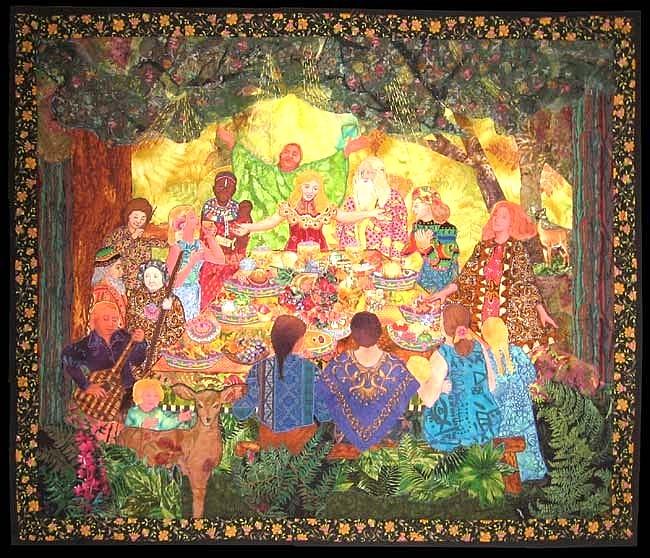
Image result for artwork welcome to the table   All are Welcome at Our Table, by Carol Bridges


“One Sabbath day,” the narrative begins.  Those three words would have set up specific expectations in the minds of this story’s first hearers.  Taking seriously the command to “Remember the Sabbath and keep it holy,” religious authorities devised a complex set of rules governing what could or could not be done on Sabbath.  If it was work, it was forbidden.  In contemporary understandings of Jewish law, especially among the Orthodox, driving or cooking or even turning on a light are considered work.  For a time, Allen and I lived in an Orthodox Jewish neighborhood in Atlanta.  Every Saturday, we felt the connection to these ancient Sabbath laws as we watched families in traditional garb walking to Shabbat services.

In today’s reading, Jesus challenges strict Sabbath rules.  One Sabbath, Jesus and the disciples are walking by a field. They’re hungry. Jesus plucks some grains of wheat and feeds his friends.  In the next scene—the same Sabbath—Jesus heals a man’s withered hand.  Plucking grain and healing people were considered work and, thus, were infractions of Sabbath law.

As you might imagine, the keepers of the law—the Pharisees—weren’t pleased.  After all, enforcing religious laws was their job.  Enforcing the rules gave them power.

Jesus’ point is not that religious rules aren’t important.  Rather he seeks to remind us that written laws aren’t the end of spiritual living….they merely are a means to seeking a spiritual life.  “The Sabbath was made for people, not people for the Sabbath,” Jesus said.  The guidelines are there to help us experience true Sabbath, not to make sure we toe the religious line.

In Sunday School, we shared stories of hospitality.  As we heard, hospitality is a key practice in many cultures.  The roots of hospitality extend back to the times when, without the kindness of strangers, travelers literally could die.  Hospitality saved people’s lives.  In our own culture, when we hear the word “hospitality” we often think of a hotel, or maybe Biltmore.  It’s become more a service to be provided than a means of saving lives.

As people of Christian faith, I wonder what might be gained from reclaiming the notion of hospitality as a means of saving lives?  Let’s check back in August and see where we are.

In the meantime, we’re going to explore the most tangible welcoming practice in our community of faith–table hospitality.

Our deacons do a lot each month to prepare the table…in fact, I don’t even know all they do.  Somehow, bread, juice, wine, and gluten-free wafers magically appear.  If all I can manage on a given Sunday is to invite you to “come and get your stuff”…It’s probably best I’m not involved in these other preparations, right?  That’d be more than I could handle.

And yet…the preparation itself is an act of worship, it’s an act we often miss…until today.  As the deacons prepare our table today, I’ll read from our book for the summer, Radical Hospitality:  Benedict’s Way of Love.  Chapter 5: “Preparing a Table.”  Let our worship begin.

We all have memories of tables prepared for us and those we have readied for others.  Some of the memories are from childhood.  Others are memories of good friends, of falling in love, or of deeply connecting with another human being.  Meals are powerful symbols in our memory.  But someone has to make a meal happen. 

Setting a table and making ready for a meal involves preliminary consideration for others.  To do it right you have to think through your guest’s preferences and history; you need to know of allergies or chronic illnesses.  If you invite more than one guest, you must consider which of them would enjoy sitting together and how they might relate.  Preparing for another pulls us out of ourselves—that is one of the good gifts of hospitality.

The image of preparing a table is a good overall image for hospitality.  In genuine hospitality we work to make our entire existence a welcoming table, a place prepared for others to be at ease, to receive from us comfort and strength.  Hospitality teaches me to work at becoming someone who is easy to be with, as either guest or host.

Hospitality becomes a way of life as we become more open.  It will not happen unless you intend it to happen.  When we speak of ‘preparing a table,’ we refer to the intention and the work of making space for another human being.

Preparing a table has sacramental meaning.  Every meal, like every encounter with a human being, has the potential to reveal God.  The table represents the unknown yearning of every human heart for communion with the ‘something more.’

Food is basic to human existence, but it is more than it seems to be; it represents the More, capital M.  In the Christian tradition, bread and wine are sacramental.  In every family meal, every dinner between friends, a sacramental mystery is present.  There is magic in these connections that does something to us way down deep.  The lesson is that we must take seriously our receiving of others.  Whether we are cooking a meal, mowing the grass, scouring the sinks, or painting a wall, we are preparing for the Sacred to come to us.

The monastery feeds dozens of teenagers almost every weekend during the school year.  Brother Antony is the one who sets the tables.  Besides being a monk, Antony is an artist.  If you watch him setting tables in the retreat house you will probably guess he is an artist, even if you have never seen his studio.  He prepares the tables for the teens with a sense of reverence that is obvious and humbling.  He is setting places for pizza and soda, but he does so with the same care he uses when he prepares the table for Eucharist.

Antony understands that in preparing a table, he is not just setting a place to eat.  He is making room for one of God’s children.  He is creating a space for a human being, and human beings are sacred.  This means you do it right, you pay attention, you get out of yourself and whatever else might be occupying your mind.

Many young adults who go to the monastery will remember their weekend for all their life.  Many of them return to the monks to baptize their children and solemnize their marriages.  They visit for Easter and Christmas.  They show up when the bottom has fallen out of their lives.  Somehow, a whole lot of them understand that the monks care about them. Father Dan says it’s because the monks take care in the little things…. Like Brother Antony setting the table as if he were creating a work of art. (109-112)

The table set for the teens is one example of hospitality.  But we set other kinds of tables every day.  We all eat and drink with others.  When we ask someone to our table, as those teens are invited to the monks’ table, we include them, we make them part of ‘us.’ (114)

In Latin, the word companion literally means to ‘break bread’ together.  No wonder the Eucharist has such power.  It taps into our earliest experiences of food, experiences we associate with warmth and touching.  Food is powerful.  It says, ‘You belong here.’  It comforts.  (115) Preparing a place says ‘welcome’ and ‘you are accepted and honored.’  Few can resist such a welcome. 

Preparing for others is holy work; welcoming others connects us with the divine in powerful ways.  As we prepare for others, though, a surprising thing happens.  As we do the work of preparation, we find that we also are being prepared by the divine presence.  The work of preparation opens us up.  We begin consciously to turn our will toward receiving others.

Set an extra place at your table tonight and receive God who comes among us.  Light a candle and take a deep breath and receive the presence of the One who is always with you.  Remember this:  There is a place prepared for you.  It is a place where you can rest.  It is a place where you are renewed and changed.

The work you do that prepares a home or a building or a yard to welcome others is very important work.  It is holy work.  But it is not the most important work of preparation.  The most important work is preparing yourself to receive others.  Only you know what you need to do to make that happen.  Is there someone to forgive?  Is there someone to release?  Is there a fear to abandon?  Is there an attitude to adjust?

We all have weapons to lie down and battles to call off before we can open up our hearts.  It is a stance of surrender that we are talking about.  Ultimately, hospitality is not about the table you set, or the driveway you plow.  Hospitality is about preparing the holiest of holies.  It is about the heart you make ready.  Yours.  (126-128)

Here’s the thing about hospitality—it’s often difficult to find the place where receiving hospitality ends and extending it begins.  As we prepare, we are prepared.  If we haven’t been welcomed, it’s difficult to welcome others.

When we read this book several years ago at my last church, one of the people who read it said, “This is too hard.”  The part of hospitality that’s hardest, I think, is this radical openness to others.  Being open to others makes us vulnerable.  In order to be truly open to each other, we have to give up a little of our power.  That congregant was right—it’s hard.  It’s very hard.

But if we can do it…if we can open ourselves to each other, if we can prepare ourselves with intention to receive each other, if we welcome each other to the table, chances are good that we’ll discover in our welcoming of each other, that God has shown up and welcomes us too.

In the name of our God, who creates us, redeems us, sustains us, and hopes for our wholeness.  Amen.

Posted in Uncategorized | Leave a comment

Sermon: “Radical Hospitality: God’s Heart” [John 3:1-17] (Trinity Sunday, 5/27/18)

Poor Nicodemus.  A leader in his faith community, Nicodemus comes at night to speak with Jesus.  Jesus has just arrived in Jerusalem for the Passover.  His first act in the holy city is to visit the Temple … and throw a hissy fit.  He overturns the tables of the moneychangers and yells:  “Take these things out of here!  Stop making my Father’s house a marketplace!”

It’s not long after this scene that Nicodemus comes to visit Jesus.  It’s no mystery why he comes at night.  After the scene in the Temple, it wouldn’t be wise for a religious leader to be seen fraternizing with the angry-crazy guy.

If Jesus’ behavior in the Temple was confusing, the things he says to Nicodemus are downright opaque.  Be born again?  Of water and Spirit?  How can this be?  Indeed.  The lectionary folks probably chose this story for Trinity Sunday because Jesus, God, and the Spirit all show up.  All three “persons” of the Trinity are accounted for…or, as my theology prof said, “All three hypostatic forms of being…”  But maybe the strongest connection between the story of Nicodemus and the doctrine of the Trinity is his question:  How can this be?

Have you ever asked that question when contemplating the Trinity?  How can this be?  How is your relationship with the Trinity these days?  Do you understand it?  No?  Good news!  All is about to be revealed!   (Trinity pics)

Ann had just had eye surgery.  The recovery process required her to lie face down for two weeks.  Ann’s husband fashioned a bed for her, with a hole cut out for her face.  The bed was surprisingly comfortable…but staring at the floor for hours on end was excruciatingly boring.

So, Ann had her husband place her Rublev Holy Trinity icon on the floor so she’d have something to look at….which might sound just as boring as staring at the carpet.  But spending time with an icon is different than simply looking at a poster.  Coming from the Orthodox tradition, icons are invitations to prayer.  Every step of their creation is itself an act of prayer—from the preparation of the wood on which they’re written to the materials, objects, and colors used.  Icons aren’t meant to be glimpsed and quickly understood.  They’re meant to be sat with, entered into, and taken into the pray-er’s deepest self.

Related image

On this Trinity Sunday, the invitation is to enter into the Rublev icon.  It was created by a monk named Andrei Rublev in the early 1400s to honor St. Sergei, one-time abbot of Holy Trinity Monastery near Moscow.  Like many iconographers before him, Rublev set his depiction of the Trinity in the context of the story of Abraham and Sarah hosting three visitors.  It seems odd that Christian iconographers would use an Old Testament story to illustrate the Trinity.  Let’s listen to Genesis 18 and see if we can figure out why they did.

Yhwh appeared to Abraham by the oak grove of Mamre, while Abraham sat at the entrance to his tent in the heat of the day.  Looking up, Abraham saw three travelers standing nearby.  When he saw them, Abraham ran from the entrance of the tent to greet them; and bowing to the ground, said, “If I have found favor in your eyes, please do not pass by our tent.  Let some water be brought, that you may bathe your feet, and then rest yourselves beneath this tree.  As you have come to your faithful one, let me bring you a little food, that you may refresh yourselves.  Afterward, you may go on your way.” “Very well,” they replied, “do as you have said.”  

Abraham hurried into the tent to Sarah and said, “Quick— take a bushel of fine flour and knead it into loaves of bread.”  Abraham then ran to the herd, selected a choice and tender calf, and sent a worker hurrying to prepare it. Then Abraham took cheese and milk and the calf which had been prepared, and placed it before the travelers; and he waited on them under the tree while they ate.

After the visitors have eaten and rested, they promise the elderly couple that, in a year’s time, Sarah will bear Abraham a son.

In the icon, we see a couple of references to the Genesis story.  There are three visitors, who first are identified as “YHWH.”  We see the tree, which could be a reference to the oaks of Mamre where Abraham was camped.  There’s the building, which could be Abraham’s house, though in the story he and Sarah live in a tent.  The three sit at a table which recalls the hospitality Abraham extends to the visitors.  In the original, that blob in the middle of the chalice is the head of the calf mentioned in the story.

Generally, rooting around in the Old Testament looking for Jesus isn’t the most responsible form of biblical exegesis.  Even so, I’m intrigued by our faithful forebears connecting this story to the Trinity, not so much for the three-in-one God thing, but because  Genesis 18 fundamentally is a story of hospitality.  When the three visitors appear, Abraham bows to them, he washes their feet and offers them food and a place to rest.  He whips up some milk and curds then has the fatted calf killed and served to the visitors.  It’s only after all the rituals of hospitality have been completed that God gets down to business promising a son for the elderly couple…which suggests just how important these rituals—and hospitality—are.

Look again at the icon.  The guests are seated at a table.  There is a cup; there is food.  In the way the 3 figures lean toward one another, the connection among them is clear.  All these pieces of the icon—along with the allusions to the Abraham story—clearly portray hospitality.

There is one more thing about it that fairly shouts hospitality.  Can you discern what it is?  (Responses)  The gap.  That gap invites us to pull up a chair and join the three figures at the table.  Rublev’s icon isn’t just a picture of the Trinity; it’s an invitation to participate in the Trinity.  Despite all those great pictures we saw earlier, none of them invited us to participate with, live in the Trinity…except maybe the one of the 3 men in the pub.  Almost to a one, those diagrams and depictions invited us only to look at the Trinity from the outside, to observe it, analyze it, come up with a mathematical equation for it.  Except for the men in the pub, none of the depictions really invited us into the Trinity.  Rublev’s 15th century icon does exactly that.

So…How can these things be?  Let’s say we accept the Trinity’s invitation to pull up a chair—Then what?  How does one go about participating in, with, and out of the Trinity?  Ann Persson, the woman who prayed the Rublev icon as she recovered from eye surgery, calls Rublev’s depiction of the Trinity a “circle of love.”  The icon invites us to join that circle of love….not just for our own edification, but so that we can work with God in the world.  Persson writes:  “Just as Rublev’s icon leaves a space for us to enter the circle, so the Trinity makes space for us to join in.  The dance is in full swing but a hand is extended, as it were, so that we, the people of God can join in and live life out of relationship with the Trinity.  This life is to be expressed in the world in which we live, in our attitudes and actions, our thoughts and words.  God is at work and calls us to join in that work.”  (K848)

As we begin reflecting on radical hospitality, the Trinity is a good place to start.  If we see the Trinity not so much as “three hypostatic forms of being,” but more as what lies between and among them—aka, their interrelatedness… If we trade in the image of the Brick Testament Trinity, with its three block figures blankly staring out, for one of a joyous dance to which we’re invited, we begin to see that at the heart of God’s heart isn’t judgment and exclusion, but rather hospitality, inclusion, and joy.

So, what might it be like to join the Trinity’s dance?  What does it mean for us—as individuals and as a community—to live in and with the Trinity?  Another quote from Ann Persson:  If we lived in, with, and out of the Trinity, “we would see a genuine honoring of each other, the people of God in whom the same Spirits dwells.  We would serve one another without feeling threatened.  This attitude would release us to be the people God created us to be, both individually and as a community of believers.  We would recognize the differing gifts that lie in one another and find contexts in which they could be expressed.  Instead of hierarchy, we would create a fellowship built on relationships emanating from God’s own love” (K963).

We’ve only scratched the surface of praying this icon.  In truth, we haven’t prayed it at all.  I’ve just been talking about it.  So….we’re going to take a couple of minutes of silence.  In the silence, I invite you to pray this icon.  Allow yourself to experience the hospitality that’s being extended.  Allow yourself to accept God’s invitation into God’s own heart.  Let us pray.   (2-3 minutes of silence).


In the name of our God, who creates us, redeems us, sustains us, and hopes for our wholeness.  Amen.

Kimberleigh Buchanan  © 2018 [2015]


Posted in Uncategorized | Leave a comment

Sermon: “Ad/Ministry” (Ascension) Acts 1:15-26 [5/13/18]

Next Sunday’s Scripture story is about Pentecost…and what a story it is!  The crowd!  Rushing wind!  A riot of languages.  And fire!  Lots of fire!  Filled with God’s Spirit, Peter preaches.  He quotes the prophet Joel, who quotes God:

I will pour out my Spirit on all humankind.  Your daughters and sons will prophesy, your young people will see visions, and your elders will dream dreams. 

That first Pentecost was so powerful, 3,000 people joined the church.  Man.  I hope that doesn’t happen next week.  We don’t have the parking!

Pentecost!  Birthday of the church, we call it.  Pentecost is where it all began!  Right?

Well…let’s think about it.  You’ve been following Jesus for a year or two.  Fifty-three days ago at the Passover celebration in Jerusalem, he was executed by the Romans….which devastated you and the rest of Jesus’ followers.  Now what were you going to do?

Then, three days later, Jesus appeared!  He hung around for 40 days, reassuring you and the rest of his followers, reminding you of everything he’d taught.  Then, just as you were getting used to his being around again, Jesus vanished.  Again.  Right into heaven.  This time, he stayed.

Image result for ascension artwork

So, how do you get from Jesus leaving the scene again—Ascension Day, we call it.  We celebrated it this past Thursday.  How do we get from Ascension to the day of Pentecost?  What happened in those 10 days?  Did the Spirit just chill for a week and a half, then jump out of a box and yell “Surprise!”?  Or did something happen to create space for Spirit’s arrival?

I’m completely open to the possibility that God’s Spirit can show up whenever and wherever she wants.  She can create her own soundtrack and special effects.  She can go as big as she wants whenever she wants.  God’s Spirit is God’s Spirit.  She can’t be pinned down.

I do suspect, though, that we become aware of God’s Spirit when we cultivate spaces for its arrival.  And—it just seems to work out this way—the more we prepare ourselves to welcome God’s Spirit, the more we actually experience God’s Spirit.

So, how do we do that?  How do we prepare ourselves to welcome God’s Spirit?  Let’s see what Jesus’ followers did after he left the scene for good.

Just before he departs, Jesus tells his followers to return to Jerusalem where they will receive the Holy Spirit.  So, that’s what they do.  They go back to Jerusalem…

…and hold a business meeting.  Judas, you’ll recall, overcome with shame at having betrayed Jesus, had taken his own life.  Peter reminds everyone of Judas…and of the need to fill his position on the Board, I mean, with the 12 apostles.

They nominate two people, then pray, “‘God, you know the hearts of people.  Show us which of these two you have chosen for this apostolic ministry.’  Then they draw lots and Matthias” becomes one of the 12.  The next thing Luke reports is the day of Pentecost.

So, the book of Acts begins with Jesus dramatically flying off to heaven.  Then a few verses later, in even more dramatic fashion, Pentecost happens—with its mighty wind, raucous linguistics, fire, and 3,000 converts.  And sandwiched between these two fantastic events is….a business meeting.  The Nominating Committee proposes two names to fill the vacancy created by Judas’ death, the group prays, draws lots, then welcomes Matthias to the group of 12.

Seems like a mundane thing to include in such an energized, powerful narrative.  Jesus disappears–again!  The Holy Spirit swoops in and 3,000 people join the church!  And in between–the Board quietly fills a vacancy.

Is the inclusion of this tiny administrative detail superfluous?  Should the editor of Acts have made one more trip through the text with her blue pencil?  Or is the placement of this quiet administrative task intentional?

A couple of years ago, the Council of my last church created a set of norms.  The first norm begins:  We will remember that our work is a part of our spiritual leadership of our congregation.  A little thrill still goes through me every time I hear that line.  It’s a reminder that ministry and administration aren’t mutually exclusive categories.  Effective ministry happens when we attend well to administrative details.

I learned this lesson well at the church I attended during seminary.  That congregation gathered Wednesday nights for a community meal and Bible study.  To make sure there was enough food, they asked that people make reservations.  I eagerly signed up.

When I got to the door to pay for supper that first Wednesday, my name wasn’t on the list.  Having an overactive superego, I couldn’t bring myself to go in and eat anyway.  My name wasn’t on the list, I wasn’t going to eat.  I didn’t want to take someone else’s food.

The next week, I called again to sign up.  When I arrived with my $5 bill in hand, the cashier again couldn’t find my name on the list.  I gave the church one more try.  You guessed it—again, my name wasn’t on the list.  I’m sure I would have been welcome to eat anyway…but being forgotten by my church three times in a row?  I never signed up for another dinner.

Now, administrative slip-ups happen from time to time.  They’re inevitable.  Sometimes things just fall through cracks.  My experience at my seminary church, though, taught me just how closely linked administration and ministry are.  Indeed, both words come from the same roots in Latin and Greek.  In Latin, the word is ministerium; in Greek, it’s diakonia.  Both words translate as “service.”

It’s easy to live as if administration and ministry are separate categories, to see ministry as fun, touchy-feely, and holy and administration as dull, but necessary.

But the story between Jesus’ ascension and the day of Pentecost, this report of the 11’s quiet meeting to replace Judas, suggests that ministry and administration are two sides of the same coin.  One informs the other; each needs the other.  Ministry without administration isn’t effective.  Deacons couldn’t do the ministry they do so well without being organized.

By the same token, administrative processes that are imbued with prayer create spaces for people to meet God.  This past Thursday evening, your Board met, not for a meeting, but to pray and dream and share and tune in to where we imagine God might be leading our congregation.  We’ll have our regular meeting to do the business of the church next week…but it was energizing to step out of all the decision-making to remind ourselves why decisions being made by the Board are important.  Everything the Board does, everything any of us does in an administrative vein, every list created, every process outlined, every note taken, every decision made—every single administrative task we attend to is an opportunity to create space for all of us to meet God.  Every detail we see to creates space for God’s Spirit to rush in.

So, from our own vantage point between Ascension and Pentecost, how might we create space for God’s Spirit to rush in?  I don’t know that we have any vacancies that need to be filled, but are there other details needing attention?  Is there someone who needs to be called?  Is there some task that needs to be completed?  Is there something that needs to be let go?  Might we need to search for 3,000 more parking spaces?

As we anticipate celebrating the coming of God’s Spirit next week, how will we create space for God’s Spirit to rush in?  How will we prepare for the re-birth of this church?

In the name of our God, who creates us, redeems us, sustains us, and hopes for our wholeness.  Amen.

Kimberleigh Buchanan  ©2018

Posted in Uncategorized | Leave a comment

Sermon: “It’s All about Love” (I John 4:7-21) [4/29/18]

I’m going to go out on a limb here and say that in this passage John is trying to say something about love. J  Love’s what we’re known for, right?  As the song says, “They’ll know we are Christians by our love.”  Ideally, anyway.

There are many ways to talk about living love as people of faith.  We can parse it.  We can analyze it.  We can testify to it.  We can confess when we don’t do it.  We can sing it.

Having just returned from a Women Touched by Grace retreat, today I choose to testify to divine love as I have experienced it, not just in the last week, but for the last decade.  And since singer-songwriter Carrie Newcomer was our retreat leader, there might be a song, too. J

Women Touched by Grace is a program for Protestant clergywomen dreamed up by a spunky nun named Sr. Mary Luke Jones at Our Lady of Grace Monastery in Beech Grove, Indiana.  Seventeen years ago, the Lilly Endowment–which is headquartered in Indianapolis–ran a grant program focused on sustaining pastoral excellence.  On a lark, Sr. Luke met with a couple of women pastors.  Over an intense week they designed Women Touched by Grace.

Initially, 30 women pastors were invited to participate in 6 ten-day retreats at Our Lady of Grace.  Each retreat focused on a different topic, from Benedictine spirituality, to systems theory, to spiritual practices.  The program would end with a trip to Rome.

Happily, Lilly liked the proposal and WTBG was born with a $500,000 grant.  The response of those first 30 women was so positive, Lilly invited WTBG to apply for a sustaining grant for a second group.  The sustaining grant of $250,000 supported a program of 5 retreats for 20 clergywomen.  No trip to Rome.  Because of the persistent nagging of a friend of mine who was in group I, I applied for group II and was accepted.  As our group finished our program in 2010, the response again was so positive, we applied for a third grant.  Lilly gave another $250,000 for WTBG III with an additional $50,000 to pay someone to help us set up a foundation so that WTBG could become self-sustaining.  Last week was the first time women from all three groups gathered at the same time.

Two years ago, Lilly started another grant program called Thriving in Ministry.  WTBG wrote another grant and this time received $1 million.  They’re currently taking applications for WTBG IV.  After WTBG IV, there will be a WTBG V.

Because each WTBG group requires only $250,000, and because all the grant monies must be spent in 5 years, two other programs have been designed.  One is called a Multitude of Mentors, the other Grace-filled Turnings.  The first is designed to mentor mentors of young clergywomen.  The second is a series of four retreats designed to help clergywomen with times of transition.  Last week’s event also was paid for by this new grant.

That’s the what of Women Touched by Grace.  Here’s the So what? of it.  Women Touched by Grace changed my life…and it did so by means of profound love.  I want to share a little of this experience with you not only to help you understand me a little more and to illustrate today’s epistle lesson, but also to help you understand where I’m coming from as your pastor.

In the last ten years since starting the WTBG program, I’ve incorporated everything I can into my work as pastor.  From WTBG–and the Rule of Benedict–I have learned what it means to be part of a spiritual community.  From this program I have learned what truly radical hospitality is and how important prayer and other spiritual practices are to living the life of faith.  From this program I have learned that the love one experiences in community is meant to be shared outside the community, especially with those who are living on the margins.  From this program I have learned that laughter is an integral part of Christian faith.

WTBG I - III, April 2018


Carrie.WTBG

Image may contain: 16 people, including Janet Hoover, Susan Barnes, Janell Monk Bethke, Laurie Lynn Newman, Deana J. Reed, Yolande Herron-Palmore, Patricia Barrett, Karen Brau, Nancy Young and 3 others, people smiling, people standing and outdoor

Sr. Eugenia.2

It’s impossible to explain everything about Women Touched by Grace and Benedictine spirituality in a 20 minute sermon.  Today, I simply want to introduce you to them.  We’ll have the opportunity this summer to immerse ourselves in the radical hospitality lived by the Benedictines.  If you want to get a jump on those conversations, you might like to start reading the book Radical Hospitality: Benedict’s Way of Love.  I read this book with a small group in my last church, folks who said they wanted to live their faith in a more profound way.  After reading the book, one person said, “This is too hard.”  Living faith with authenticity isn’t easy.  Living the love of radical hospitality is especially difficult.  We’ll explore all that this summer.

Here’s what I want to say today.  The world needs us to be living our faith, just as it needs people of other faiths to be living their faith.  The world needs followers of Jesus to live our belief in the love of neighbor.  The world needs followers of Jesus to act into wellbeing immigrants and refugees and women and children and the hungry and the oppressed and the abused and the fearful and the hopeless and people of all races, sexualities, belief systems, nationalities, and ethnicities… the world needs us to be and live as true followers of Jesus… which is to say, the world needs, desperately needs Christians to live the love of Christ, to act others into wellbeing in Jesus’ name every chance we get…

As we gathered for our banquet Thursday night, I looked around the room at 60 clergywomen talking, laughing, hugging….I saw the woman who’s just been diagnosed with a virulent form of cancer, the woman who lost her teenage daughter to suicide 8 years ago, the picture of Mary Jacobs from my group who died of breast cancer six years ago…I saw the women who have helped me through difficult times in my life…and I saw a conga line of women pastors and nuns dancing to the music of the Karaoke singer they’d hired.  I also saw hope and health and joy and life and love…I saw a miracle.  All it took was one nun’s quirky idea, nurtured by community, and now 70—soon to be 90—clergywomen’s lives, and through them, over 100 congregations, have been changed.

We are one of those congregations.  It was my WTBG colleagues ultimately who convinced me to seek another call…and who rejoiced to see how happy I am in this new one.  We owe them a lot.  As we seek to act the world into wellbeing in Jesus’ name, as we seek to extend to our neighbor God’s radical hospitality, as we seek to follow Jesus in the way of love, we too will be changed.  As will the world.

When I got the WTBG acceptance letter in August 2007, I didn’t know what to do with it.  Allen, on the other hand, was bouncing off the walls.  “Let’s go out and celebrate!” he said.  On the way back from supper, I asked Allen why he was so excited.  He said, “Because those people are going to love you for the rest of your life.”  He was right.  And that love has made all the difference to me both personally and professionally.

That is what we have the opportunity to do here at FCUCC…to love so well that everyone in the wider community knows that when people come here, we are going to love them “for the rest of their lives.”  Isn’t that what John is saying in today’s Epistle Lesson?  “Beloved, let us love one another because love is of God.”

During the retreat, Carrie led us in writing a song about our experiences as Women Touched by Grace.  The process of writing the song was just that—a process.  The goal wasn’t a finished product; it was to help us name our experiences in WTBG.  Pouring all those experiences into a song, Carrie said, would help us experience them not just in our heads, but also in our hearts.  Singing is one of the few human activities that engages all of who we are—mind, body, emotion.  I’ve said before that Pete Seeger believed—really believed—that the world would change if we could just sing together.  Our process this past week bore that out.

You’ve got the words.  I’ll sing it the way we wrote it first….then you can join me in  singing it for our community.  May we always live grace.  May we always live love.  [Sing, “I Am.  We Are.”]


I Am, We Are 

The words poured out,                                                We are wise.

The world pushed back,                                              We are strong.

But I just kept on singing.                                           We refuse to go along.

I claimed my voice,                                                     We are the future.

I sang my song,                                                           We are the past.

The truth, it kept on ringing.                                      We are a blessing meant to last.  Chorus


Chorus:                                                                        Alternate Chorus:

I am.  We are                                                              I am.  We are

Sisters of spirit.                                                           People of spirit.

I am.  We are                                                              I am.  We are

Women touched by grace,                                         People touched by grace,

Living grace…                                                              Living grace…..


You heard me,

I heard you,

A refuge for my soul.

We are loved,

We are welcomed

In a place where we are known.  Chorus


(Written by Women Touched by Grace, Groups I – III, April 25, 2018, with Carrie Newcomer.  Our Lady of Grace Monastery, Beech Grove, Indiana.)

Posted in Uncategorized | Leave a comment